2900
Prediction of histopathologic grades of bladder cancer with radiomics based on MRI: comparison with traditional MRI1Shaanxi Provincial People's Hospital, xi'an, China
Synopsis
Keywords: Pelvis, Body
Motivation: Setting up a noninvasive and accurate method to predict tumor grade preoperatively is urgently needed. However, the comparison between the potential of the bpMRI-based radiomics model and that of traditional MRI model in estimating the grade of BCa have not yet been investigated.
Goal(s): The purpose of this study was to construct a radiomics model based on bp-MRI for the preoperative prediction of BCa grade and compare it with traditional MRI model.
Approach: A logistic regression classifier was used to develop the radiomics signatures.
Results: Radiomics model was outperformed the traditional MRI model in distinguishing high-grade and low-grade bladder cancer.
Impact: The bp-MRI radiomics model was useful in distinguishing high-grade and low-grade bladder cancer. Radiomics model was outperformed the traditional MRI model.
Introduction
The grading of bladder cancer(BCa) mainly depends on the findings at cystoscopic biopsy and transurethral cystectomy. However, the tumor is heterogeneous, and the cystoscopic biopsy results are not always representative of the entire tumor and may require a repeated biopsy. However, this approach is invasive and expensive. In addition, it is reported that 20-80% of the lesions were misdiagnosed due to the variations in performing cystoscopic biopsy. Thus, setting up a noninvasive and accurate method to predict tumor grade preoperatively is urgently needed.Traditional MRI, which included T2WI, DCE, DWI sequences, plays an important role in diagnosing and predicting the grade of BCa, especially for mADC mapping. However, the mADC value overlaps between low-grade and high-grade tumors; it is the only predictive index, and a single mADC value is not strong evidence and produces insufficient information to predict differentiation capabilities.
The radiomics method, which is an advanced image-processing technique that extracts multiple quantitative features from images and is more objective and repeatable than traditional MRI, has been widely used in the diagnosis and preoperative grading of tumors of various systems in the body.
However, to our knowledge, the comparison between the potential of the bpMRI-based radiomics model and that of traditional MRI model in estimating the grade of BCa have not yet been investigated.Therefore, the purpose of this study is twofold. First, we aimed to construct a radiomics model based on bp-MRI (ADC and T2WI) for the preoperative prediction of BCa grade. The second objective was to compare it with traditional MRI model.
Materials and methods
This retrospective study included 255 consecutive patients with pathologically confirmed 113 low-grade and 142 high-grade BCa who underwent preoperative MRI, including T2-weighted imaging (T2WI) and apparent diffusion coefficient (ADC). The traditional MRI nomogram model was developed using univariate and multivariate logistic regression by the mean apparent diffusion coefficient (mADC), vesical imaging reporting and data system (VI-RADS) scoring, tumor size and number of tumors. Volumes of interest were manually drawn on T2WI and ADC maps by two radiologists. Using ANOVA, correlation and LASSO methods to select features. Then, a logistic regression (LR) classifier was used to develop the radiomics signatures in the training set and assessed in the validation set. Receiver operating characteristic (ROC) analysis was used to compare the diagnostic abilities of the radiomics and traditional MRI models by the DeLong test. Finally, decision curve analysis (DCA) was performed by estimating the clinical usefulness of the two models in both the training and validation sets.Results
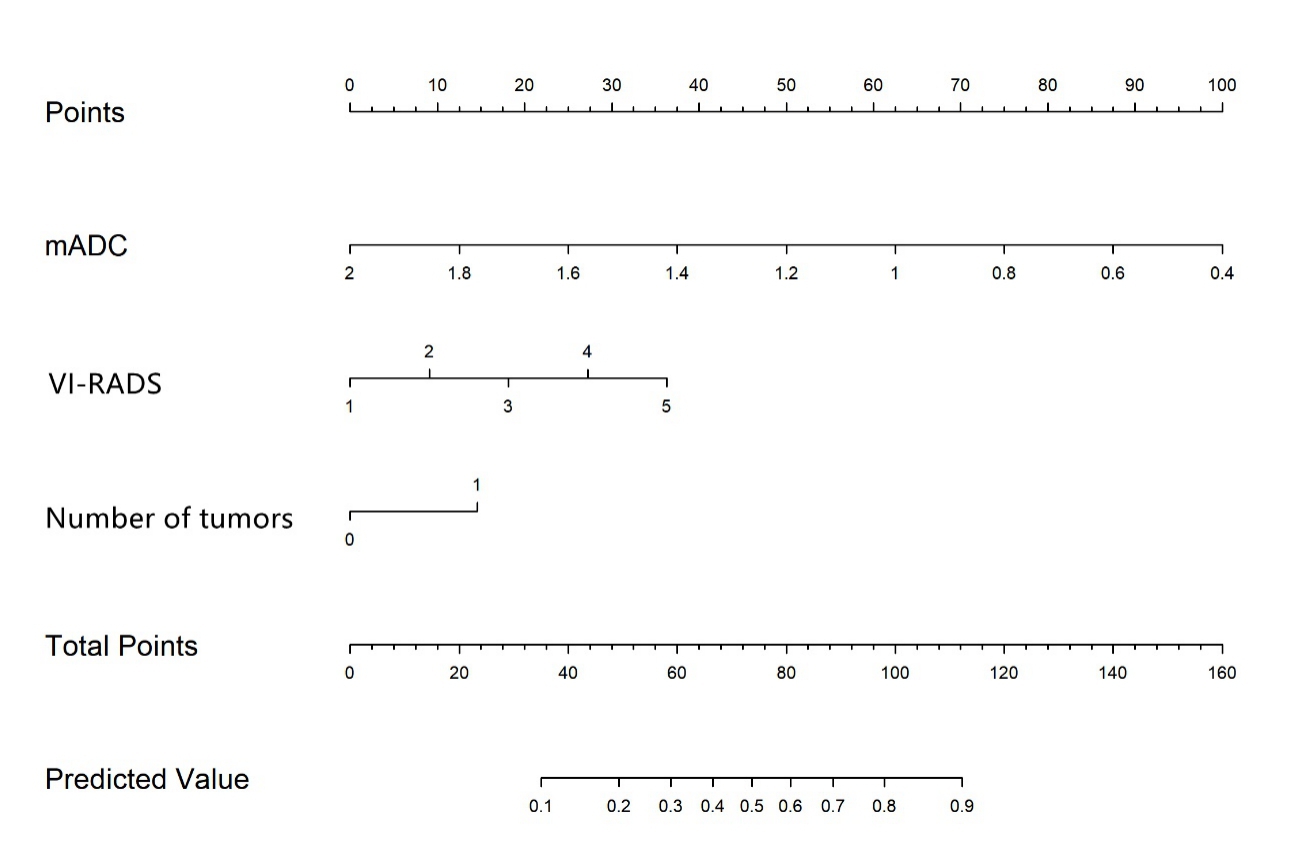
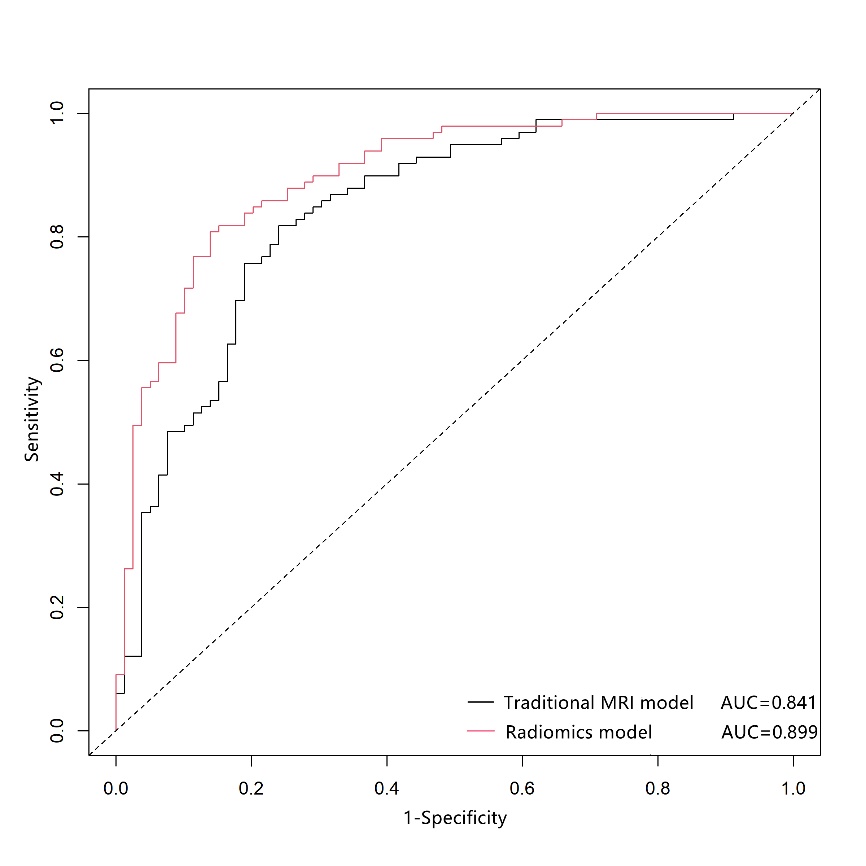
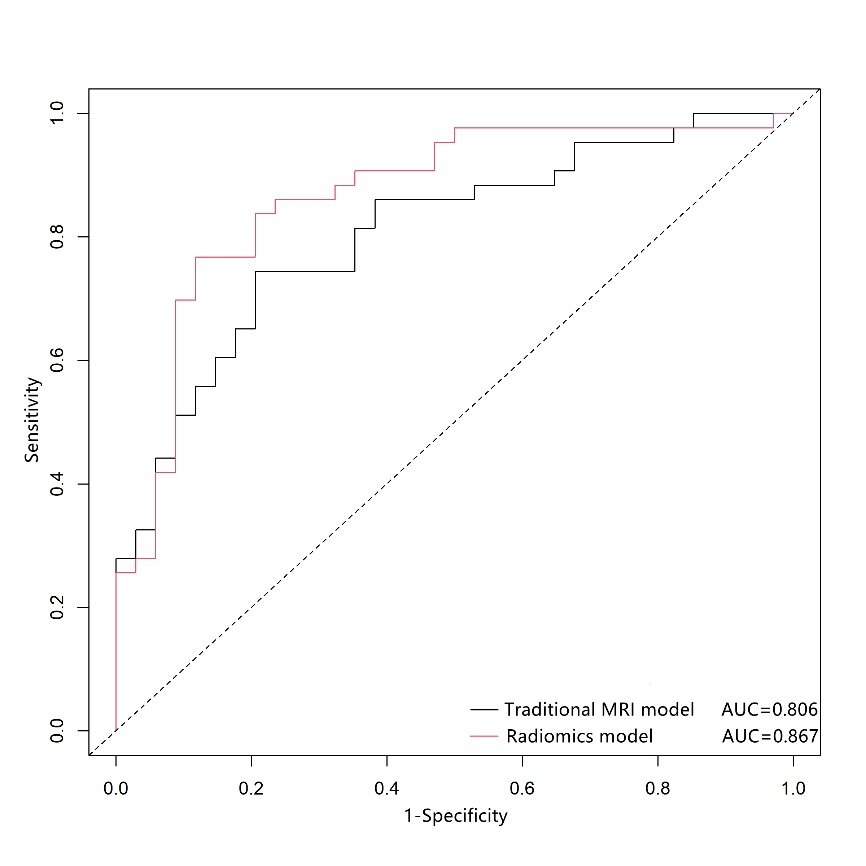
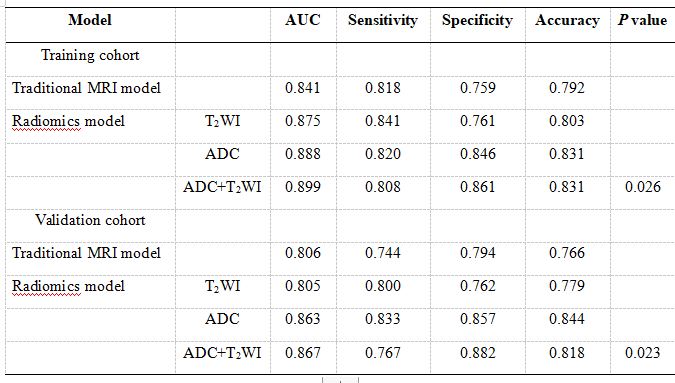
The nomogram integrating traditional MRI model independent risk factors was constructed to predict the pathological grade of Bca (figure 1). The areas under the ROC curves (AUCs) of the traditional MRI model were 0.841 in the training cohort and 0.806 in the validation cohort(figure 2,3). The AUCs of the three groups of radiomics model [ADC, T2WI, bp-MRI (ADC and T2WI)]-based logistic regression analysis algorithms were 0.888, 0.875 and 0.899 in the training cohort and 0.863, 0.805 and 0.867 in the validation cohort, respectively(table 1). The combined radiomics model achieved higher AUCs than the traditional MRI model and was compared using the DeLong test (P = 0.026 and 0.023 in the training and validation cohorts, respectively). DCA indicated that the radiomics model had higher net benefits than the traditional MRI model.Discussion
Our main finding was that the bp-MRI-based radiomics signature can provide incremental value over traditional MRI model for the preoperative noninvasive assessment of BCa tumor grades in both the training and validation cohorts. For the three radiomic models, the predictive performance of the ADC combined with T2WI model in the validation set was better than that of the single-sequence model. This conclusion shows that the radiomics model based on bp-MRI improved the diagnostic power in BCa grading compared with the traditional model and achieved good net clinical benefit.In our study, a traditional MRI nomogram model was developed based on one quantitative feature (mADC value) and two objective factors (VI-RADS score and number of tumors). However, the radiomics model permits high-throughput extraction of multiple quantitative features to evaluate the degree of intratumor heterogeneity and subjective explanation of radiological images. This may explain why the AUC of radiomics was higher than that of traditional MRI model.
Conclusions
The bp-MRI radiomics model may be helpful for distinguishing high-grade and low-grade BCa and outperformed the traditional MRI model. Multicenter validation is needed to acquire high-level evidence for its clinical application.Acknowledgements
We are grateful to all the participants for their cooperation and patience.References
1. Kluth LA, Black PC, Bochner BH, et al. Prognostic and Prediction Tools in Bladder Cancer: A Comprehensive Review of the Literature. Eur Urol 2015;68:238-53.
2. Powles T, Bellmunt J, Comperat E, et al. Bladder cancer: ESMO Clinical Practice Guideline for diagnosis, treatment and follow-up. Ann Oncol 2022;33:244-58.
3. Panebianco V, Narumi Y, Altun E, et al. Multiparametric Magnetic Resonance Imaging for Bladder Cancer: Development of VI-RADS (Vesical Imaging-Reporting And Data System). Eur Urol 2018;74:294-306.
4. Zhang X, Xu X, Tian Q, et al. Radiomics assessment of bladder cancer grade using texture features from diffusion-weighted imaging. J Magn Reson Imaging 2017;46:1281-8.
5.Wang H, Hu D, Yao H, et al. Radiomics analysis of multiparametric MRI for the preoperative evaluation of pathological grade in bladder cancer tumors. Eur Radiol 2019;29:6182-90.
Figures