2870
Correcting the unwanted diffusion-weighting in STEAM-DWI Sequence for Time-Dependent Diffusional Kurtosis Imaging1Department of Biomedical Engineering, College of Biomedical Engineering & Instrument Science, Zhejiang University, Hangzhou, China, 2MR Collaboration, Siemens Healthcare China, Shanghai, China
Synopsis
Keywords: DWI/DTI/DKI, Brain
Motivation: Time-dependent diffusion kurtosis imaging (tDKI) enables the noninvasive mapping of transmembrane water exchange by measuring diffusion signals at varying diffusion-times. To access long diffusion-times, the diffusion-weighted STEAM sequence is typically used, in which the unwanted diffusion weighting produced by the crushers and slice selection gradients.
Goal(s): We first showed that this unwanted weighting, particularly on the b0 image led to an underestimation of kurtosis.
Approach: We proposed a strategy to resolve this problem by removing the crusher gradient while adding a smaller and fixed b value to the b0 acquisition.
Results: Proposed strategy showed reasonable tDKI measurements in phantom and human brain experiments.
Impact: This study presented an important issue of unwanted diffusion-weighting in STEAM-DWI, which led to inaccurate estimation of tDKI-based transmembrane water exchange. We proposed a strategy that removed the crusher and dynamically adjusting the diffusion gradient to achieve the desired b-value.
Introduction
Time-dependent diffusional kurtosis imaging (tDKI)[1, 2] allows us to measure transcytolemmal water exchange, a process indicative of several critical cellular properties [2, 3]. The requirement of long diffusion times (td) in tDKI gives a preference for the use of DW-STEAM over DW-SE [4]. In the existing DW-STEAM acquisition, a crusher gradient (Gcrusher) must be included to eliminate the stimulated echoes, which is indispensable for the non-diffusion-weighted (b0) image [5]. We showed in this study that Gcrusher and also the slice-selection gradient (Gslice) introduced an unwanted td-dependent diffusion weighting in addition to the diffusion-encoding gradients and led to bias in tDKI estimations. An b-value correcton strategy was proposed to fix this problem.Methods
Theory: As illustrated in Figure 1, Gslice alongside the Gcrusher in the DW-SE (part A) is symmetric around the refocusing pulse, and thus avoiding additional diffusion effects. However, DW-STEAM separates these gradients into part B and C, and water diffusion sensitized by part B takes place throughout the restoration process. Therefore, even for the b0 acquisition without Gdiffusion, a non-zero diffusion weighting exists. The schematics in Figure 2 demonstrated that ignoring the diffusion-weighting of b0 leads to an underestimation of diffusivity and kurtosis. Moreover, as td increases, the unwanted diffusion-weighting becomes more prominent, leading to a bias in tDKI measurement.Here we proposed a strategy with two modifications of the DW-STEAM sequence to address this problem: 1) removing the crusher gradient while adding a small b-value (e.g., 50 s/mm2) in the b0 acquisition to suppress the stimulated echoes; and 2) dynamically adjusting the Gdiffusion that counteracts with Gslice to achieve the desired b-value.
Data acquisition: MRI scans were performed on a 3T Siemens Prisma scanner with a 64-channel head coil. All experiments used tds from 32 to 300 ms. dMRI of the water phantom was acquired b-values = 200 s/mm2 in six directions. In vivo human brain data were collected with 6 directions at b-values = 50 s/mm2 (pseudo-b0) and 20 directions at b-values = 1000 and 2000 s/mm2. The other parameters included: FOV = 220 × 220 mm2, voxel size = 1.7 × 1.7 × 4 mm3, TR/ TE = 3700/65 ms, GRAPPA acceleration factor = 2, partial Fourier factor = 6/8.
Data analysis: The DW data was denoised and de-Gibbsed. The kurtosis and diffusivity was fitted using the RobustDKIFitting toolkit [5]. The water exchange time ($$$\tau _{ex}$$$) was calculated from $$$K(t)=K_0\frac{2\tau _{ex}}{t} \left [ 1-\frac{\tau _{ex}}{t}\left ( 1-e^{-\frac{t}{\tau _{ex}}} \right ) \right ]$$$ [7].
Results
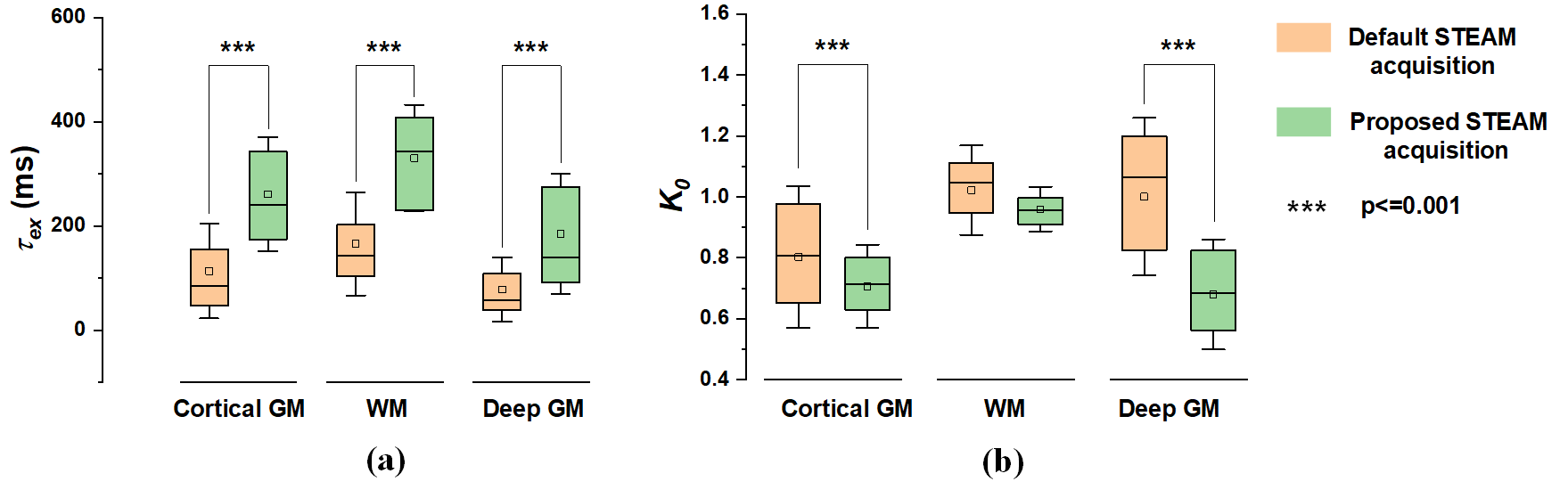
Experiments in the water phantom showed that in default DW-STEAM sequence the diffusion weighting in b0 image acquisition increased rapidly with td, and reached ~100 s/mm2 at td=300ms (Figure. 3a). As shown in Figure. 3b, ignoring the diffusion weighting in b0 in the calculation led to an underestimation of diffusivity, resulting in inaccurate time-dependence.Figure 4 showed that td-dependent diffusivity and kurtosis change obtained using the proposed strategy was much less that that using the default DW-STEAM acquisition, in both the gray and white matter structures. As a result, $$$\tau _{ex}$$$ estimated by the proposed method was significantly higher than the original method in all ROIs, and significantly lower estimation of K0 was found in the cortical and deep GM regions (Figure 5).
Discussion and Conclusion
In this study, we illustrated that the unwanted b-values in DW-STEAM sequence leads to inaccurate td-dependence measurement and significant underestimation of transmembrane water exchange in the tDKI model. Our proposed method removes this underestimation and yields more reasonable fitting results. The method has limitations in that it requires additional acquisition of the pseudo-b0 images.Acknowledgements
This work is supported by the National Natural Science Foundation of China (81971606, 82122032), and Science and Technology Department of Zhejiang Province (2022C03057, 202006140).References
Figures
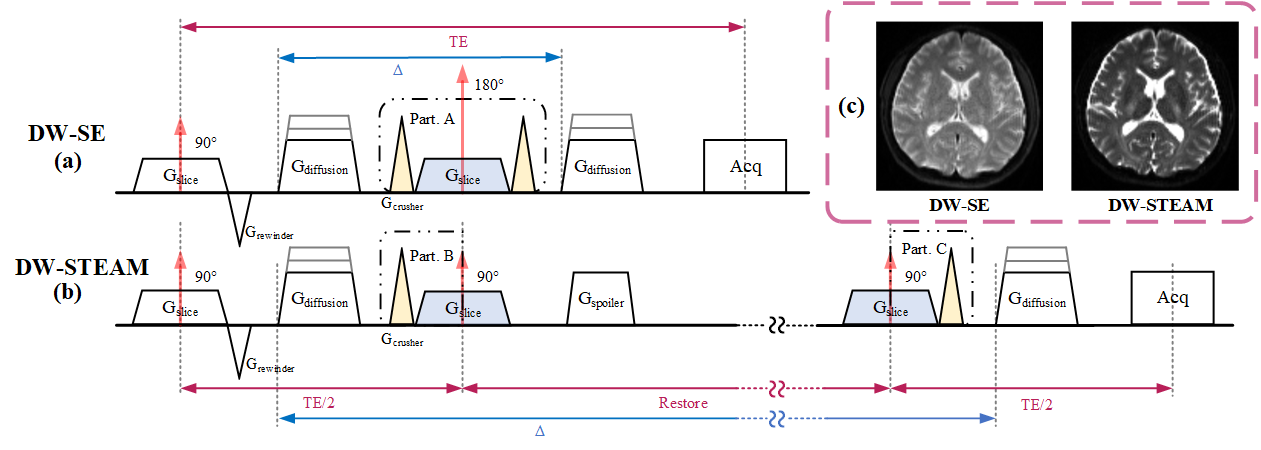
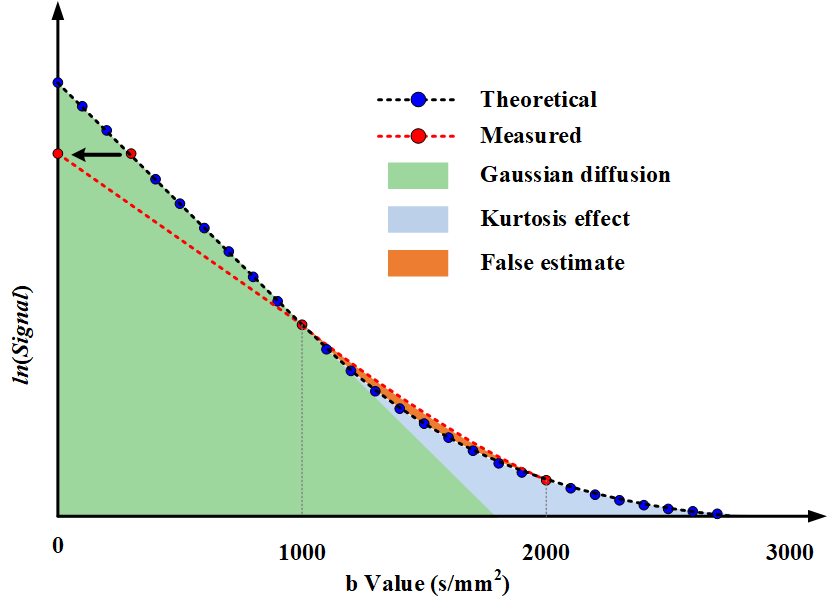
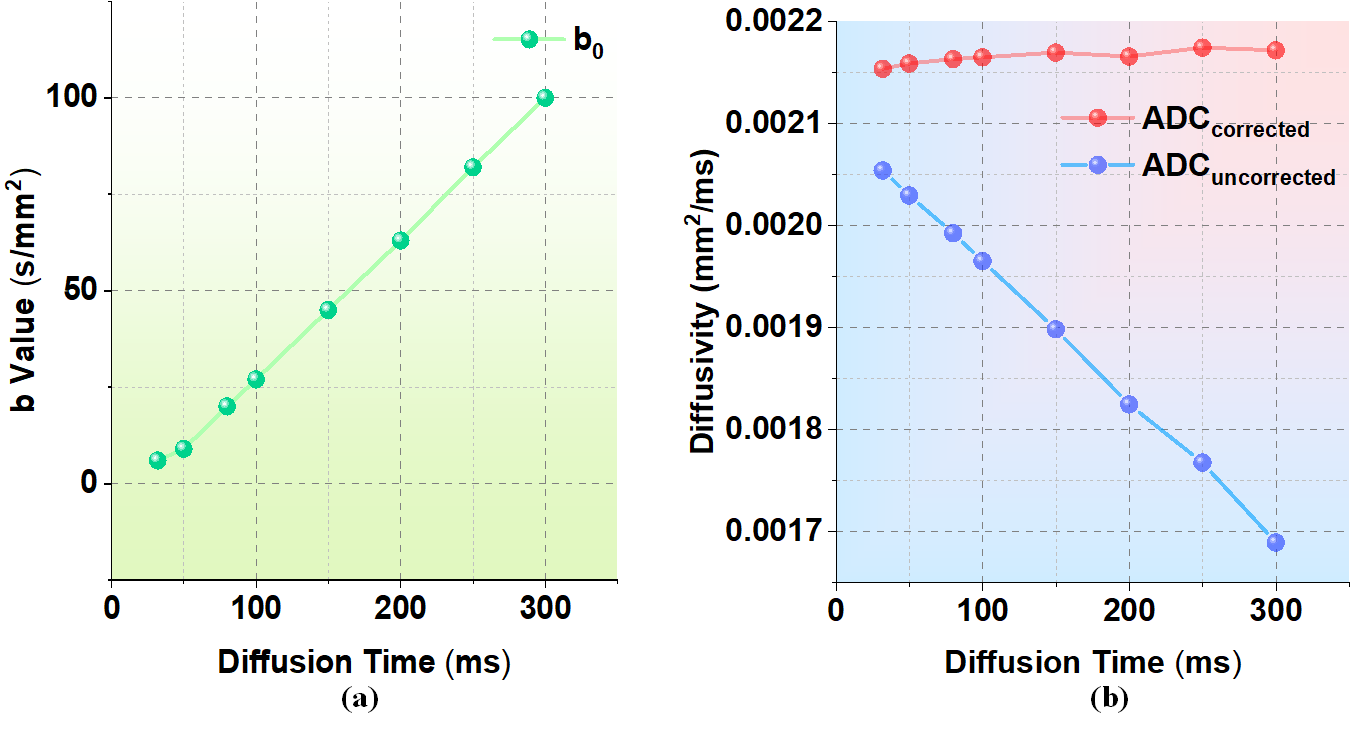
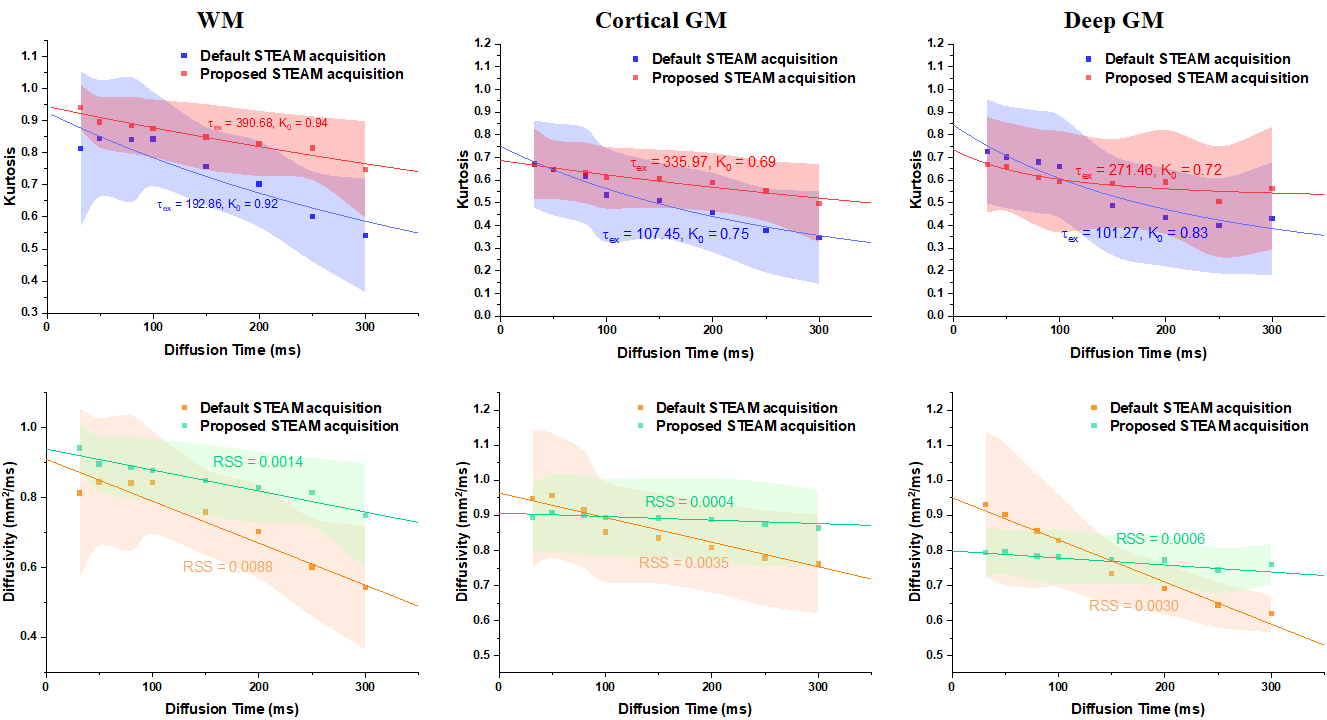
Figure 4. Kurtosis and diffusivity fitted using the default DW-STEAM acquisition or using the proposed acquisition strategy, respectively. Mean and standard deviation in the WM, cortical GM, and deep GM were plotted. The td-dependent kurtosis curve is fitted by the Kärger model [8], and diffusivity curve is fitted by the linear fit.