2854
Concomitant field effects in MR Elastography1School of Biomedical Engineering and Imaging Sciences, King's College London, London, United Kingdom, 2Siemens Healthineers AG, London, United Kingdom
Synopsis
Keywords: Low-Field MRI, Low-Field MRI, Elastography
Motivation: To our knowledge, concomitant field effects in MRE have not been investigated yet, which might become of importance when translating MRE to low field MR systems.
Goal(s): Propose a framework to investigate concomitant field effects on MRE, in particular Hadamard-encoded 3D MRE at 0.55T.
Approach: A 6x6 encoding scheme is proposed to study the effects of concomitant fields on 3D MRE at 0.55T in phantom experiments.
Results: Phantom experiments demonstrated that the effects of concomitant fields on 3D Hadamard-encoded MRE at 0.55T are negligible.
Impact: A framework to assess concomitant field effects in MRE, in particular Hadamard-encoded 3D MRE at 0.55T in phantom experiments.
Introduction
Translating hepatic 3D MRE to wide-bore low-field MR systems(B0≤1.0T) can serve as a means of accommodating liver patients with high BMI. Furthermore, the longer T2*relaxation times at low-field may be beneficial to mitigate iron overload(1, 2). Another aspect is that low-field MR system bring down the financial entry point of MR which might allow a wider spread of MRE(3).However, low-field MR systems come with a penalty in SNR and phase-to-noise ratio(PNR). A Hadamard-motion-encoding scheme may be used to increase PNR(4), where unique combinations of MEGs are applied on all the gradient axes simultaneously; simultaneous gradients lead however to concomitant fields which are inversely proportional to the static magnetic field B0(5).
The goal is to design an experiment that measures the effect of concomitant fields on Hadamard-encoded 3D MRE at 0.55T.
Methods
When applying a magnetic gradient field, there is a concomitant magnetic field Bc resulting from Maxwell’s equations and given to the lowest order by the following equation(5):$$B_c(x,y,z,t)=\frac{1}{2B_0}\left(G_x^2z^2+G_y^2z^2+G_z^2\frac{x^2+y^2}{4}-G_xG_zxz-G_yG_zyz\right)$$
Where B0 is the static field, and Gx,Gy,Gz are the applied gradients at time point t, and x,y,z are the spatial coordinates.
Let us consider a bipolar MEG G with lobes(G2=-G1), with a total duration T, applied on x,y,z and without overlap with any imaging gradient in the MRE sequence. Following the terminology in(5), the phase accrual $$$\phi_c$$$ due to Bc by a spin isochromat is:
$$\varphi_c=\frac{\gamma T}{2B_0}(\overbrace{G_x^2z^2+G_y^2z^2+G_z^2\frac{x^2+y^2}{4}}^{\text{"self-squared"terms}}\underbrace{-G_xG_zxz-G_yG_zyz}_{\text{"cross"terms}})$$
The following 4x4 Hadamard matrix(H) is typically used in MRE measurement:
$$H=\left[\begin{array}{llll}-1&+1&-1&+1\\+1&-1&-1&+1\\-1&-1&+1&+1\\+1&+1&+1&+1\end{array}\right]$$
The first 3 terms in the previous Eq, the “self-squared”-terms, are constant throughout the different measurements of Hadamard-encoding and are therefore encoded in the same term that encodes constant phase errors such as magnetic field inhomogeneity. However, the last 2 terms, the “cross”-terms, change signs between the different measurements of Hadamard-encoding depending on the polarity of the applied motion encoding gradients. As a result, the “cross”-terms cannot be resolved using a conventional 4x4 Hadamard-encoding matrix. We present a 6x6 encoding matrix M that resolves the “cross”-terms by accounting for the different possible sign combinations of the "cross"-terms:
$$M=\left[\begin{array}{llllll}-1&+1&-1&+1&+1&-1\\+1&-1&-1&+1&+1&+1\\-1&-1&+1&+1&-1&+1\\+1&+1&+1&+1&-1&-1\\+1&-1&+1&+1&+1&-1\\-1&+1&+1&+1&+1&+1\end{array}\right]\\$$
$$\left[\begin{array}{l}m_1\\m_2\\m_3\\m_4\\m_5\\m_6\end{array}\right]=M\left[\begin{array}{l}\varphi_{U_z}\\\varphi_{U_x}\\\varphi_{U_y}\\\varphi_{err}\\\varphi_{xz}\\\varphi_{yz}\end{array}\right]$$
Where mk(k=1,2,..,6) is the k-th MRE phase measurement, $$$\phi_{U_x}$$$,$$$\phi_{U_y}$$$,$$$\phi_{U_z}$$$ are the phase accruals due to the 3D displacement field. $$$\phi_{err}$$$ is the phase accrual due to constant phase errors and the “self-squared”-terms. $$$\phi_{xz}$$$and$$$\phi_{yz}$$$ are the phase accrual due to the first and second “cross”-terms respectively.
The proposed encoding matrix M is incorporated into a 3D Ristretto MRE sequence(6) extending the sequence from 4to6 measurements. The MEGs are applied without any overlap with the imaging gradients.
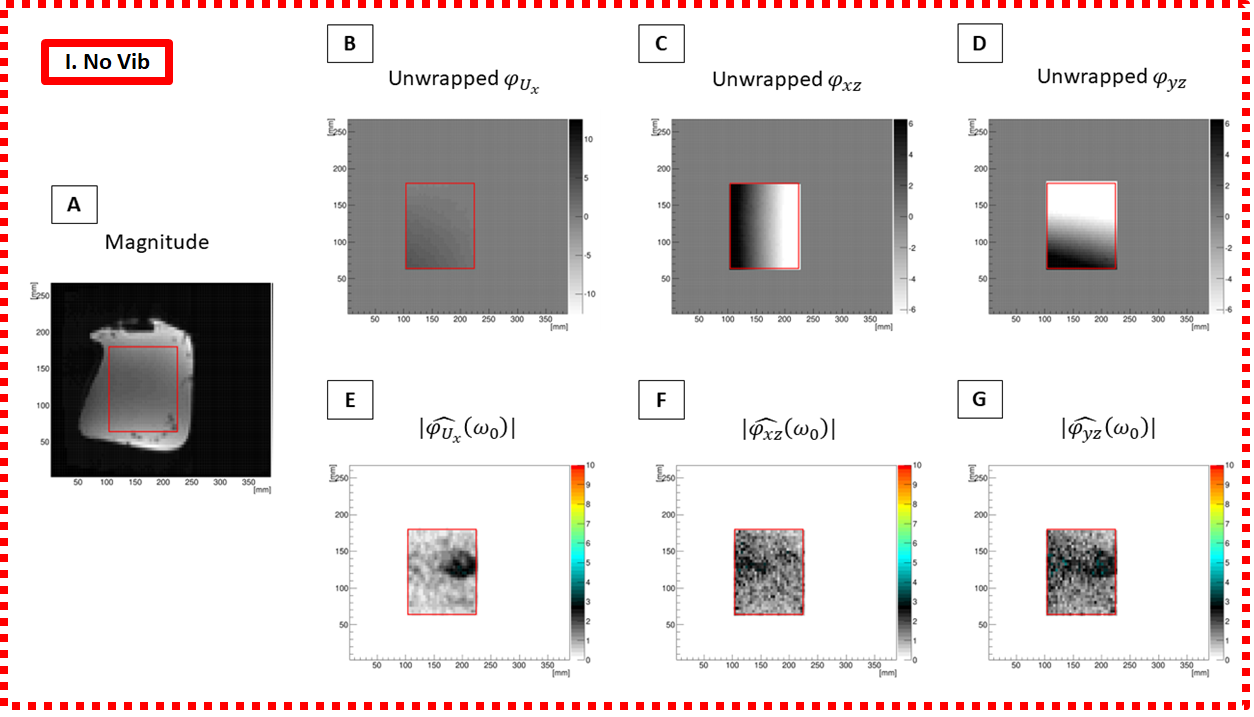
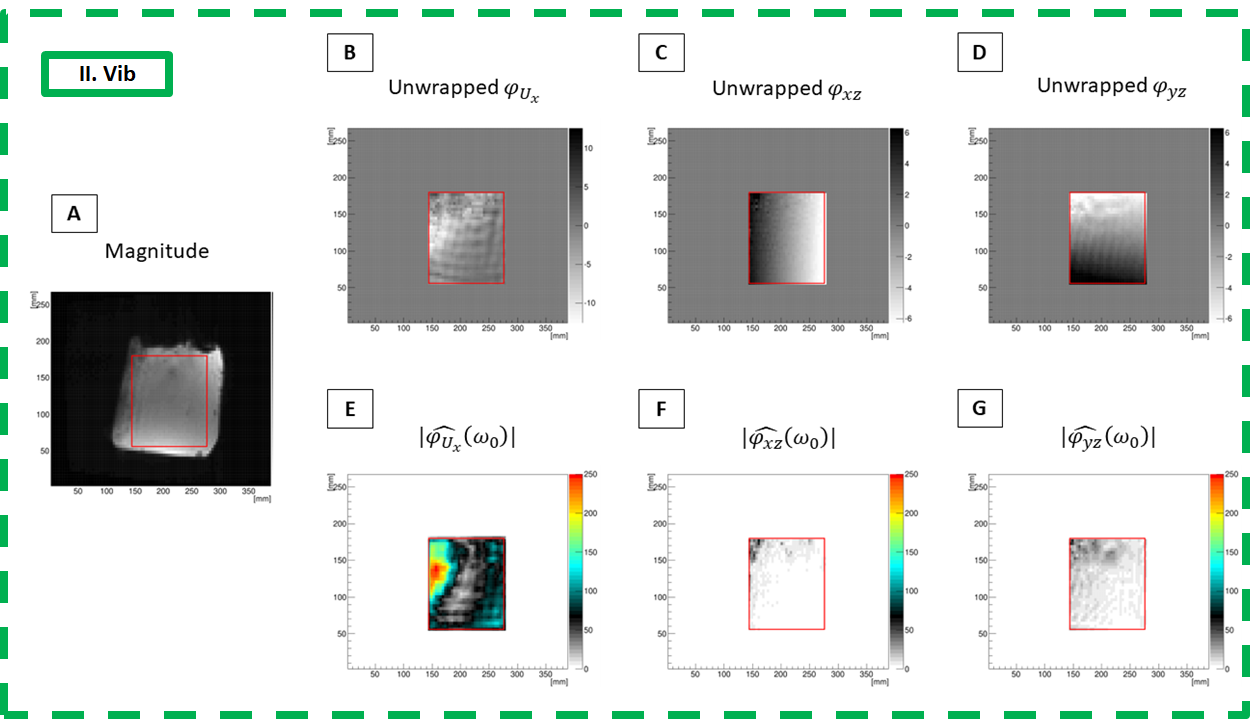
The extended 3D MRE sequence is implemented on a 0.55T system(MAGNETOM Free.Max, Siemens Healthineers AG, Erlangen, Germany). Two phantom experiments were performed: (I)without vibration to verify that M is solving for the “cross”-terms. Note that the first “cross”-term($$$G_xG_zxz$$$)varies with x and z, and the second “cross”-term($$$G_yG_zyz$$$)varies with y and z. (II)with 60Hz vibration(7) to verify that the phase accrual due to Bc is constant with respect to the acquired wave-phase-offsets and can be filtered-out using temporal Fourier Transform. The phantom used is an ultrasound-gel phantom shifted to right of the iso-centre to increase the apparent effect of the concomitant fields.
The imaging parameters of the extended 3D MRE sequence were as follows: 8slices,4mm isotropic resolution,a 96X64 acquisition matrix,flip-angle=25°,in-plane GRAPPA acceleration factor of 2 resulting in a FOV of 386X256X32mm3,TR=18.24ms,TE=12.90ms,receiver bandwidth=180Hz/px. The motion encoding gradients followed the proposed 6x6 encoding matrix. The total acquisition time was 126seconds preformed in six measurements of 21seconds each.
Results
The results of the phantom experiment without vibration are shown in Figure1. There is no spatial variation in $$$\phi_{U_x}$$$(Figure1.B). However, we observe a spatial variation in x (left-right) in $$$\phi_{xz}$$$(Figure1.C) and in y (posterior-anterior) in $$$\phi_{yz}$$$(Figure1.D). The spatial variation observed in Figures1.C-D suggests that the proposed encoding matrix M is solving for the “cross”-terms. The amplitude of the displacement field in the three terms is very low(0.9±0.2um,1.4±0.2um,and1.6±0.2um respectively)(Figures1.E-G).The results with vibration are in Figure2. $$$\phi_{U_x}$$$(Figure2.B) varies with the vibration, however, $$$\phi_{xz}$$$(Figure2.C) and $$$\phi_{yz}$$$(Figure2.D) only vary spatially in x and y respectively. In addition, the amplitude of the displacement field encoded in $$$\phi_{U_x}$$$(81±11um) is approximately an order of magnitude higher than the amplitudes encoded in $$$\phi_{xz}$$$(5±2um) and $$$\phi_{yz}$$$(10±2um)(Figures2.E-G).
Discussion and conclusions
In our study, we characterised the effects of concomitant fields on Hadamard-encoded 3D MRE at 0.55T using a 6x6 encoding matrix and verified in phantom experiments that the displacements encoded due to concomitant field terms are negligible. The phase errors due to concomitant fields in MRE can be considered constant across wave-offsets and therefore will mainly contribute to the DC-component of the temporal Fourier Transform.Acknowledgements
No acknowledgement found.References
1. Wagner M, Besa C, Bou Ayache J, et al. Magnetic Resonance Elastography of the Liver: Qualitative and Quantitative Comparison of Gradient Echo and Spin Echo Echoplanar Imaging Sequences. Investigative Radiology. 2016;51(9):575-581. doi:10.1097/rli.0000000000000269
2. Yin M, Glaser KJ, Talwalkar JA, Chen J, Manduca A, Ehman RL. Hepatic MR Elastography: Clinical Performance in a Series of 1377 Consecutive Examinations. Radiology. Jan 2016;278(1):114-24. doi:10.1148/radiol.2015142141
3. Sarracanie M, Salameh N. Low-Field MRI: How Low Can We Go? A Fresh View on an Old Debate. Review. Frontiers in Physics. 2020-June-12 2020;8doi:10.3389/fphy.2020.00172
4. Guenthner C, Runge JH, Sinkus R, Kozerke S. Analysis and improvement of motion encoding in magnetic resonance elastography. NMR Biomed. May 2018;31(5):e3908. doi:10.1002/nbm.3908
5. Bernstein MA, Zhou XJ, Polzin JA, et al. Concomitant gradient terms in phase contrast MR: Analysis and correction. Magnetic Resonance in Medicine. 1998;39(2):300-308.
6. Guenthner C, Sethi S, Troelstra M, Dokumaci AS, Sinkus R, Kozerke S. Ristretto MRE: A generalized multi-shot GRE-MRE sequence. NMR Biomed. May 2019;32(5):e4049. doi:10.1002/nbm.4049
7. Runge JH, Hoelzl SH, Sudakova J, et al. A novel magnetic resonance elastography transducer concept based on a rotational eccentric mass: preliminary experiences with the gravitational transducer. Phys Med Biol. Feb 6 2019;64(4):045007. doi:10.1088/1361-6560/aaf9f8
Figures