2853
SNAC-DL: Self-Supervised Network for Adaptive Convolutional Dictionary Learning of MRI Denoising1Bernard and Irene Schwartz Center for Biomedical Imaging, Department of Radiology, New York University Grossman School of Medicine, New York, NY, United States, 2Department of Electrical and Computer Engineering, NYU Tandon School of Engineering, Brooklyn, NY, United States, 3Center for Advanced Imaging Innovation and Research (CAI2R), Department of Radiology, New York University Grossman School of Medicine, New York, NY, United States, 4Siemens Medical Solutions, New York, NY, United States
Synopsis
Keywords: Low-Field MRI, Low-Field MRI
Motivation: Low-Field MR (LF-MRI) offers greater accessibility and reduced sensitivity to susceptibility artifacts, but it suffers from low SNR. As a result, novel denoising techniques hold great promise to improve image quality and promote broader clinical applications of LF-MRI.
Goal(s): This work introduces a novel MRI denoising technique that is based on self-supervised deep learning without requiring high SNR references.
Approach: Our technique, called SNAC-DL, employs a Self-supervised Network for Adaptive Convolutional Dictionary Learning using a complex-valued coil-to-coil ($\mathbb{C}$C2C) training strategy.
Results: SNAC-DL has been tested for lung MRI denoising at 0.55T to demonstrate efficient denoising while preserving the underlying image structure.
Impact: The proposed denoising technique holds significant potential to improve image quality for LF-MRI. This is expected to facilitate the broad adoption of LF-MRI to improve cost-effectiveness and enable new clinical applications that are traditionally challenging at high field strengths.
Introduction
Low-field MRI (LF-MRI), specifically at 0.55T or below, has emerged as an exciting area of research and has also seen increasing clinical adoption in recent years [1]. While reduced cost increased accessibility are often highlighted as advantages of low-field MRI, its benefits extend beyond financial considerations. LF-MRI presents unique opportunities for MR applications that are traditionally challenging at high field, such as lung MRI. However, LF-MRI suffers from a major limitation of low SNR. Traditionally, the SNR can be improved by averaging multiple acquisitions, but this increases scan time and reduces accessibility of the scanner. In this study, we propose a novel MRI denoising technique that employs a Self-supervised Network for Adaptive Convolutional Dictionary Learning (referred to as SNAC-DL) using a complex-valued Coil2Coil ($$$\mathbb{C}$$$C2C) training strategy. The performance of SNAC-DL has been tested for lung MRI denoising at 0.55T to demonstrate efficient denoising while preserving the underlying image structure.Methods
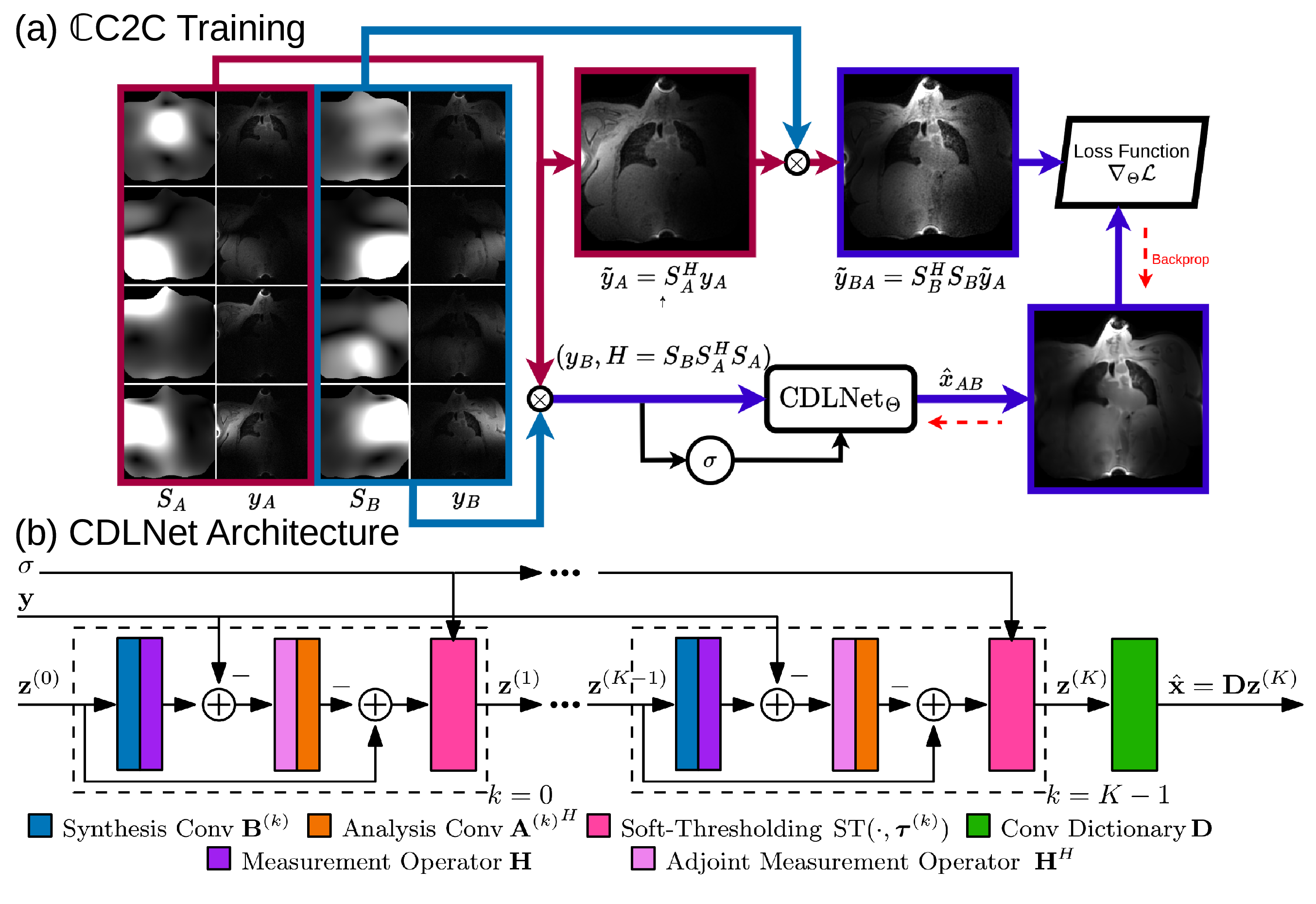
Figure 1a shows the proposed complex-valued Coil2Coil training scheme ($\mathbb{C}$C2C) employed in SNAC-DL. It extends a magnitude-based Coil2Coil training strategy described in [4], which is based on the Noise2Noise (N2N) denoising approach, to estimate an expected MSE loss when given pairs of noisy images as training data. N2N assumes that 1) noise is zero mean; 2) noise in each image is uncorrelated; and 3) each image contains the same (noise-free) signal. Assumption 1 is satisfied for raw MRI data. Assumption 2 may be enforced by performing coil-whitening preprocessing [6]. Assumption 3 can be satisfied by taking a single multicoil sample and dividing its coils into two sets: A (target coils) and B (input coils). Using the corresponding sensitivity operators of each set of coils ($$$S_A$$$, $$$S_B$$$), the respective coil-combined images from each set ($$$\tilde{y}_A = S_A^Hy_A$$$, $$$\tilde{y}_B=S_B^Hy_B$$$) represent noisy versions of the same ground-truth image ($$$x$$$) when compensated for brightness variations. We treat $$$\tilde{y}_BA = S_B^HS_B\tilde{y}_A$$$ as a noisy target image and $$$\tilde{y}_{AB}=S_A^HS_A\tilde{y}_B$$$ as a noisy input image to train a convolutional dictionary learning network (CDLNet) in a N2N-style training scheme.CDLNet is a noise-adaptive and physics-aware convolutional neural network [3]. Figure 1b shows the CDLNet architecture. The measurement operator $$$H$$$ and its adjoint are used in each layer to encourage measurement consistency. The learned thresholds of each layer are parameterized to increase with an increasing input noise-level, $$$\tau = \tau_0 + \hat{\sigma}\tau_1$$$.
SNAC-DL was trained using a total of 77 3D lung MRI datasets previously acquired at 0.55T using a spiral sequence with ultrashort echo times (spiral-UTE). Each dataset has 140 slices with a voxel size of or 2x2x2mm3. 42 datasets were acquired during a single breath hold (~18 seconds), and 35 datasets were acquired during free breathing (~3.5 minutes). The free-breathing protocol employed a respiratory-gated acquisition with more averages to improve SNR. The noise covariance matrix of each volume was estimated by the standard method of median absolute deviation (MAD) of wavelet detail coefficients. Sensitivity maps for each slice were estimated using the ESPIRiT algorithm [5]. The data and sensitivity maps were whitened according to [6]. 3 breath-hold datasets and 3 free-breathing datasets (6 in total) were used for evaluation.
Results
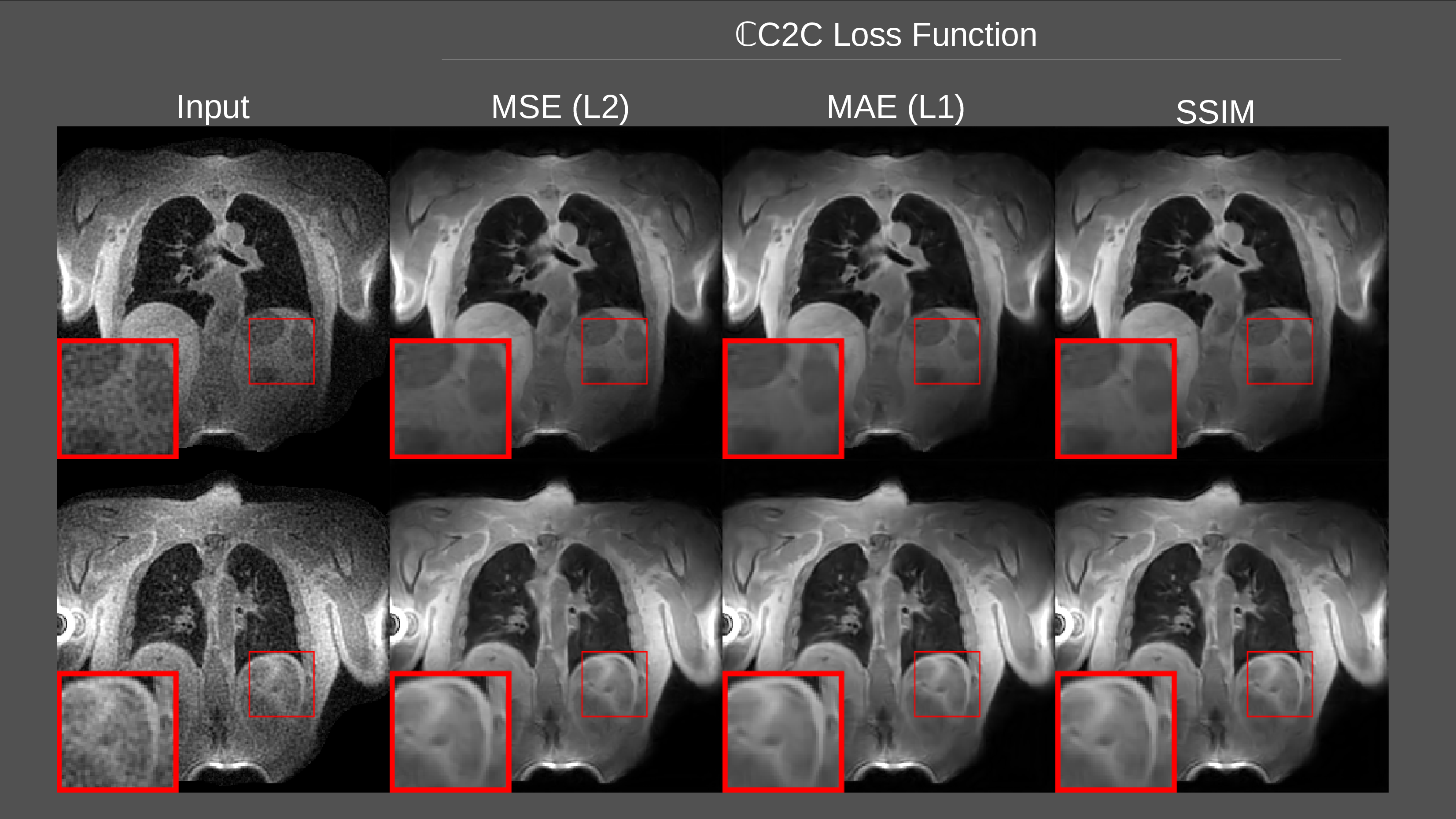
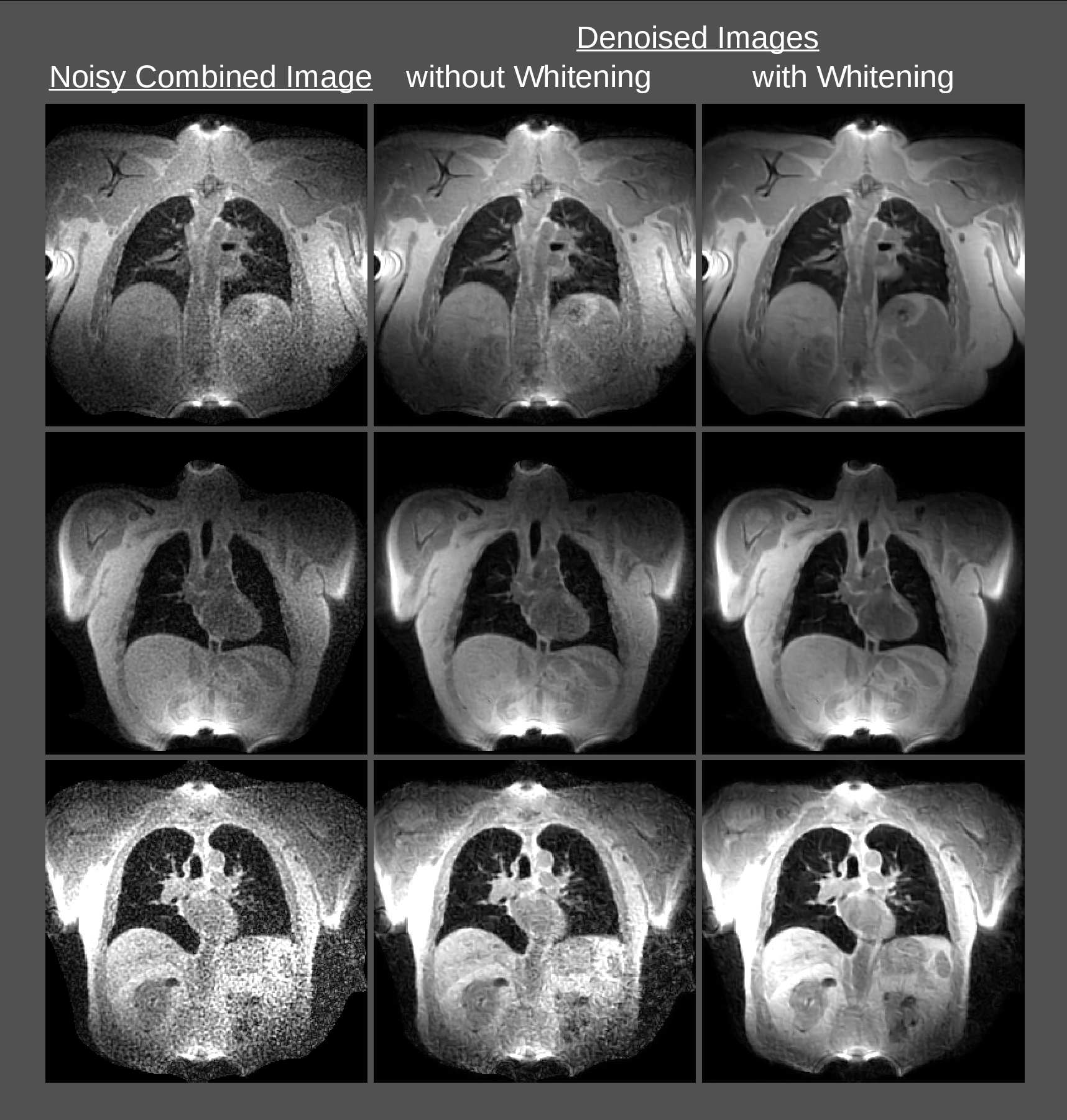
Figure 2 compares SNAC-DL denoising using different loss functions in the $$$\mathbb{C}$$$C2C training scheme. All the $$$\mathbb{C}$$$C2C loss functions yielded effective denoising while preserving the underlying image structure (e.g., minimal structural information appears in the residual maps). The mean-absolute-error based $$$\mathbb{C}$$$C2C loss qualitatively appears to preserve edges most favorably.Figure 3 compares SNAC-DL denoising with and without the coil whitening preprocessing. Whitening is qualitatively seen to improve the denoising quality.
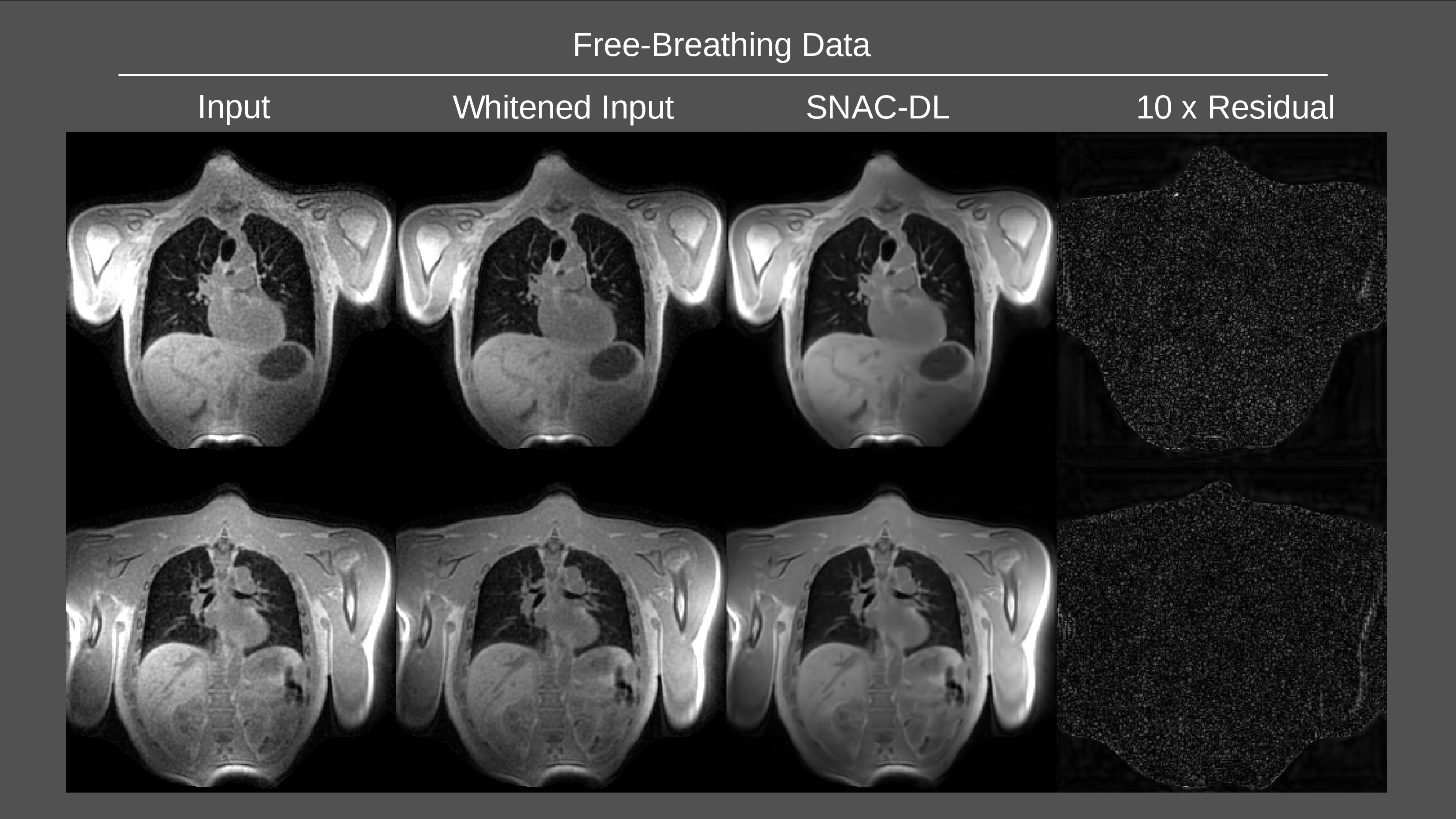
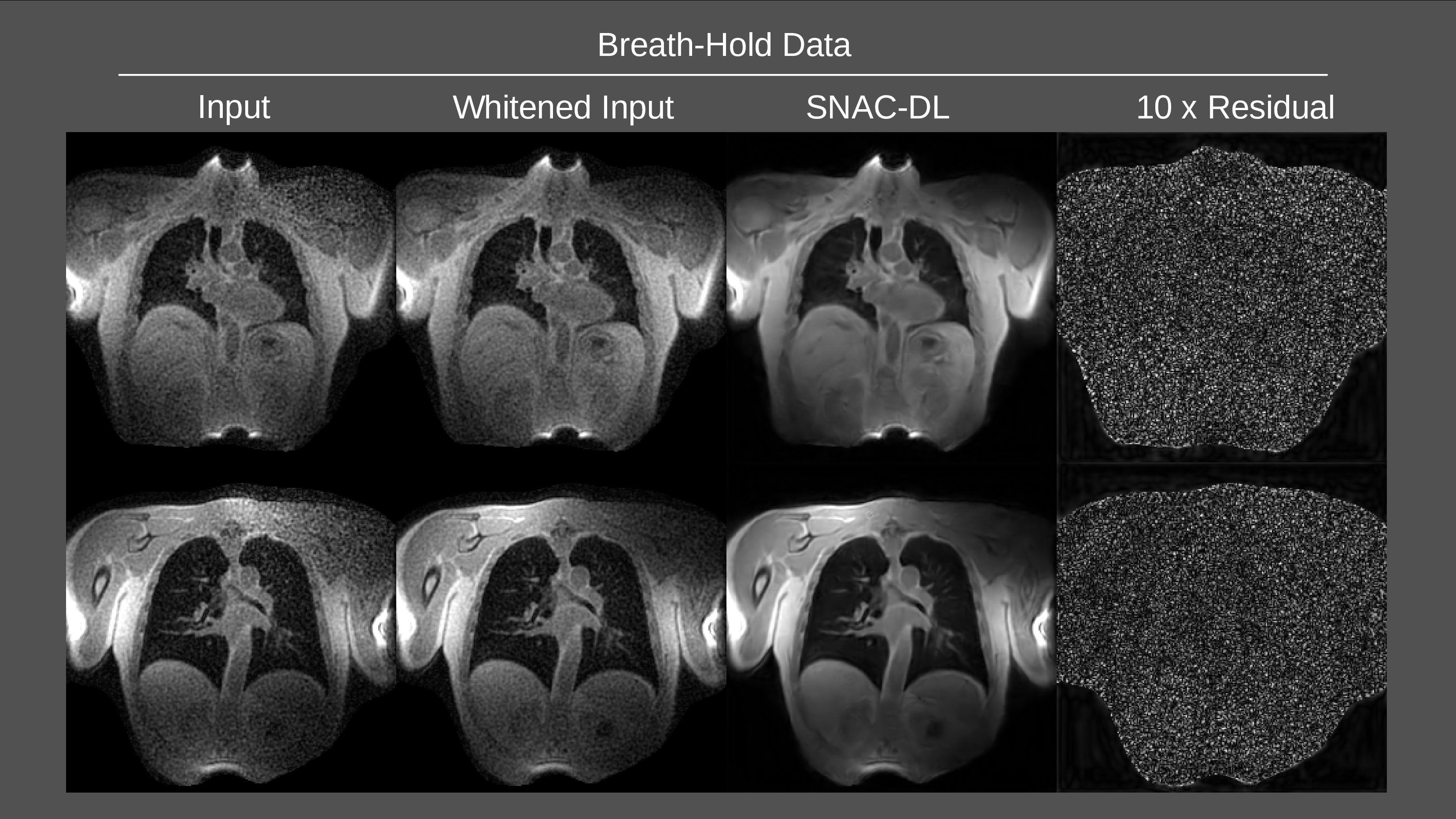
Figures 4 and 5 demonstrate the performance of SNAC-DL denoising in free-breathing and breath-hold lung images with different noise levels. Coil-whitening preprocessing is used before passing through the denoiser, which has the effect of creating a spatially uniform noise-level in the coil-combined input. The SNAC-DL results maintain detail in their denoising and a near structureless residual image.
Conclusion
This study introduces a novel self-supervised deep-learning denoising method (SNAC-DL) that aims to offset SNR losses associated with LF-MRI. SNAC-DL employs a complex-valued Coil2Coil loss and an operator/noise adaptive CDLNet. Our results demonstrate effective and efficient denoising of lung MR images acquired at 0.55T. For inference, SNAC-DL is performed using only coil-combined complex images without sensitivity maps. This suggests that a pre-trained SNAC-DL model is coil agnostic and may be applied to a wide range of LFMR images. This technique is expected to facilitate the broad adoption of LF-MRI to improve cost-effectiveness and enable new clinical applications that are traditionally challenging at high field strengths.Acknowledgements
This work was supported by the NIH (R01EB031083, R01EB030549 and P41EB017183) and was performed under the rubric of the Center for Advanced Imaging Innovation and Research (CAI2R), an NIBIB National Center for Biomedical Imaging and Bioengineering.References
1. Campbell-Washburn AE, Ramasawmy R, Restivo MC, Bhattacharya I, Basar B, Herzka DA, Hansen MS, Rogers T, Bandettini WP, McGuirt DR, Mancini C, Grodzki D, Schneider R, Majeed W, Bhat H, Xue H, Moss J, Malayeri AA, Jones EC, Koretsky AP, Kellman P, Chen MY, Lederman RJ, Balaban RS. Opportunities in Interventional and Diagnostic Imaging by Using High-Performance Low-Field-Strength MRI. Radiology. 2019 Nov;293(2):384-393. doi: 10.1148/radiol.2019190452. Epub 2019 Oct 1. PMID: 31573398; PMCID: PMC6823617.
2. Lehtinen, J., Munkberg, J., Hasselgren, J., Laine, S., Karras, T., Aittala, M., and Aila, T.. (2018). Noise2Noise: Learning Image Restoration without Clean Data. Proceedings of the 35th International Conference on Machine Learning, in Proceedings of Machine Learning Research
3. Janjušević N, Khalilian-Gourtani A, and Wang Y, "CDLNet: Noise-Adaptive Convolutional Dictionary Learning Network for Blind Denoising and Demosaicing," in IEEE Open Journal of Signal Processing, vol. 3, pp. 196-211, 2022, doi: 10.1109/OJSP.2022.3172842.
4. Park J, Park D, Shin HG, Choi EJ, An, H, Kim M, Shin D, Chun SY, and Lee J, ”Coil2Coil: Self-supervised MR image denoising using phased-array coil images.” arXiv (2022).
5. Uecker M, Lai P, Murphy MJ, Virtue P, Elad M, Pauly JM, Vasanawala SS, Lustig M. ESPIRiT--an eigenvalue approach to autocalibrating parallel MRI: where SENSE meets GRAPPA. Magn Reson Med. 2014 Mar;71(3):990-1001. doi: 10.1002/mrm.24751. PMID: 23649942; PMCID: PMC4142121.
6. Wu M, Fang L, Ray CE Jr, Kumar A, Yang S. Adaptively Optimized Combination (AOC) of Phased-Array MR Spectroscopy Data in the Presence of Correlated Noise: Compared with Noise-Decorrelated or Whitened Methods. Magn Reson Med. 2017 Sep;78(3):848-859. doi: 10.1002/mrm.26504. Epub 2016 Nov 21. PMID: 27873353; PMCID: PMC7200078.
Figures