2844
An evaluation method for encoding capability of rSEM with non-linear gradients and its application to angle selection1Department of Medical Engineering, Chiba University, Chiba, Japan, 2Engineering Product Development Department, Singapore University of Technology and Design, Singapore University of Technology and Design, Singapore, Singapore, 3Department of Surgery, National University of Singapore, Singapore, Singapore, 4Center for Frontier Medical Engineering, Singapore, Singapore
Synopsis
Keywords: Low-Field MRI, Low-Field MRI, Spatial encoding field, Evaluation method
Motivation: For non-linear encoding technology for portable MRI, the evaluation of encoding capability is by checking the image quality, which is time-consuming and hard to integrate into an optimization process.
Goal(s): Here, we aim to propose a fast evaluation method for the encoding capability of rotational spatial encoding magnetic field (rSEM).
Approach: The filling factor of local k-spaces is proposed to evaluate the encoding capability of an rSEM with non-linear gradients.
Results: The proposed evaluation of encoding capability is fast and agrees with the resultant image quality. It was used for angle selections to accelerate imaging, showing improved image quality experimentally.
Impact: A rapid evaluation method for the encoding capability of rSEMs with non-linear gradients is validated using simulation and experimental data. It allows fast evaluations of SEMs without checking the image quality in a design process, which accelerate the optimization.
Introduction
Dedicated MRI using permanent magnet arrays (PMAs) reduced power consumption with small footprint, which shows portability. Such a system using the magnetic field from the PMA only as spatial encoding magnetic fields (SEMs) without gradient coils has further simplified hardware1,2. The downside of such a system is the non-linear gradients which leads to location-dependent k-space, local k-space, and image quality4,5. For the designs of PMAs with non-linear gradients, the encoding capability of the SEM is checked through the quality of the simulated images and used to guide the design, which is time-consuming2,3. Here, a fast evaluation of the encoding capability of rotational SEM (rSEM) is proposed. It is done by the calculation of the filling factor of local k-spaces.Methods
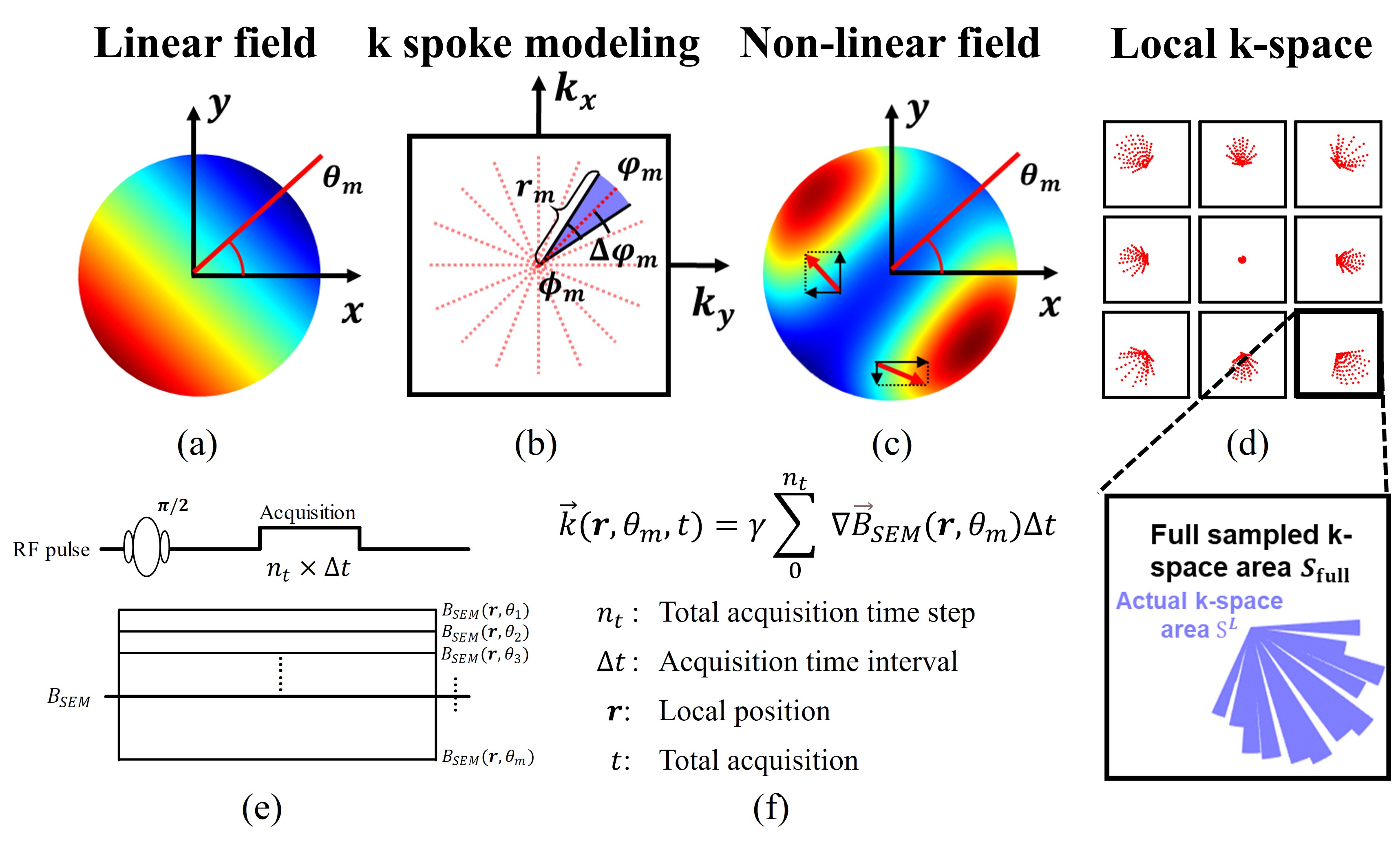
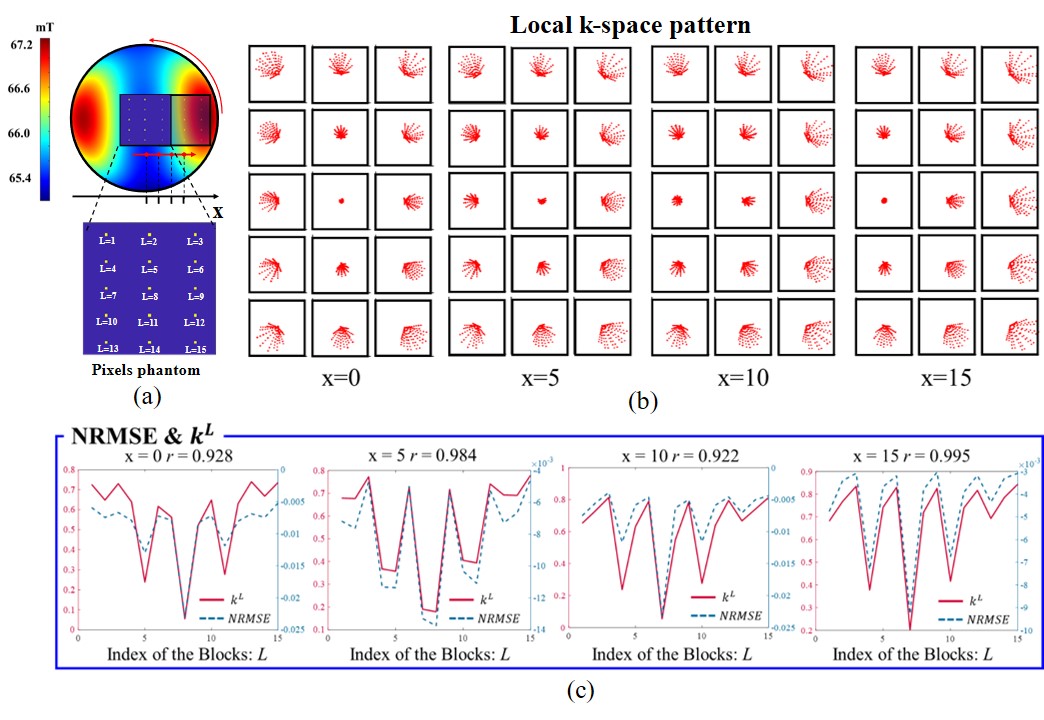
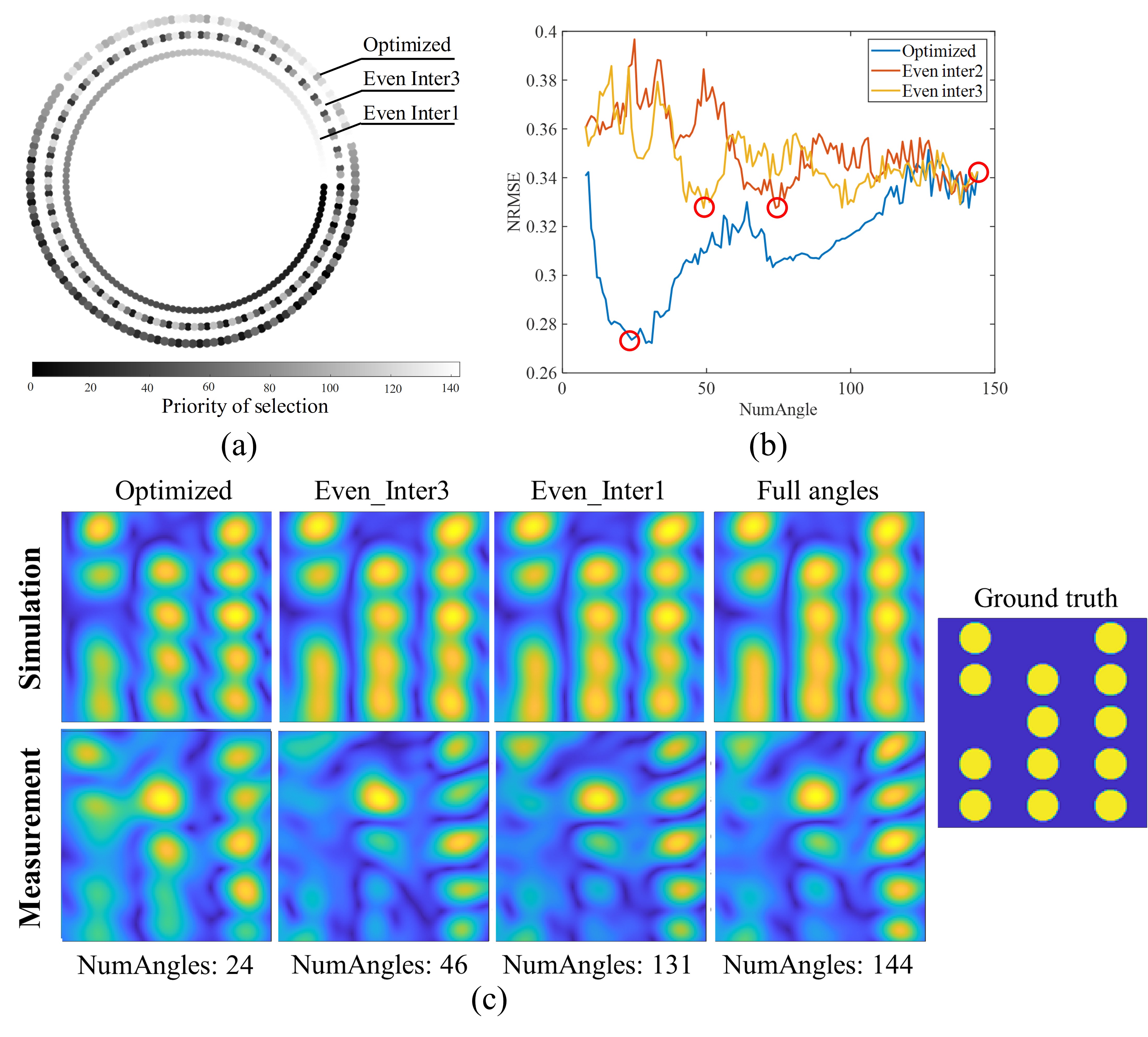
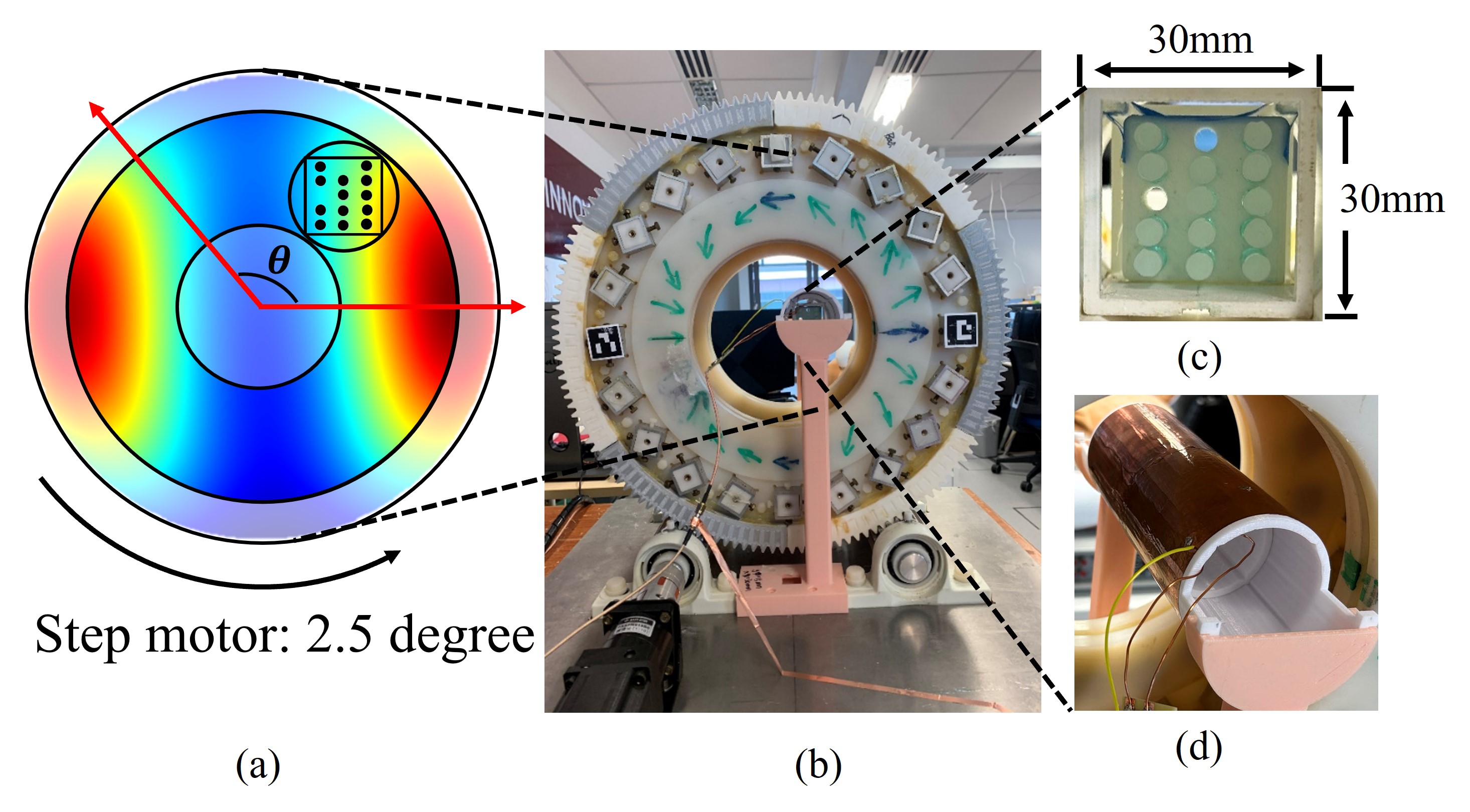
K-space/local k-space is the spatial gradient of the accumulate phase at a location $$$\boldsymbol{r}$$$ (definition shown in Fig 1). Fig 1(b) shows the k-space for a linear rSEM (Fig 1(a)) with one pulse sequence (Fig 1(e)) which consists of spokes tilted with an angle $$$\varphi_m$$$, the same as the rotational angle of the field $$$\theta_m$$$ varies. Based on the Nyquist criterion, the filling factor of k-spaces/local k-spaces, $$$k^L$$$, can be correlated to the encoding capability. To calculate $$$k^L$$$, the effective area for one spoke $$$(A_m^s)$$$ is modelled as a sector (center angle of $$$\phi_m$$$ and radius of $$$r_m$$$ shown in Fig.1(a)), where the $$$\phi_m$$$ and $$$r_m$$$ are determined by the $$$\Delta k $$$ in the azimuthal direction and $$$k_{FoV}$$$ in the radial direction respectively. For the non-linear case, due to the varying spoke lengths and $$$\Delta \varphi_m$$$, stiuations when $$$r_m>1/\Delta w$$$ and/or $$$\Delta \varphi_m<\phi_m$$$ can happen where signals do not contribute significant increase in information, thus the extra area beyond the full sampled circle and the overlapped parts are truncated $$$(\Delta A)$$$. The actual k-space area $$$S_L$$$ is calculated as $$$S^L = \sum_{1}^{n_s} A_m^s - \Delta A$$$ and $$$k_L = S^L/S_{\rm full}$$$ where $$$S_{\rm full}$$$ is the area of a ful k-space. Experiments were designed to examine the correlation between $$$k^L$$$ and the encoding capability of an SEM. A phantom (30mmx30mm) with one pixel at the center point of each 5 x 3 block was used for the examination of local resolution. The resolution was set at 100x100. A rotational SEM with a quadrupolar pattern measured from a Halbach array was used. The center of phantom was set at x = 0, 5, 10, 15 mm and the SEM was rotated 144 angles. Fig 2(b) shows the corresponding local k-space patterns. Images were constructed using an iterative algorithm. The NMRSE of the reconstructed images were calculated.The proposed method is further applied to angle selection. Greedy algorithm was used. The high encoding efficiency of optimized rotation angle pattern is validated both in simulation and measurement. Experiment setup of rSEM portable MRI scanner is shown in Fig 5. Even rotation angle pattern with 2 times and 3 times rotation angle accuracy is set as reference. The rotation angle pattern is shown in Fig 4(a)
Results and Discussions
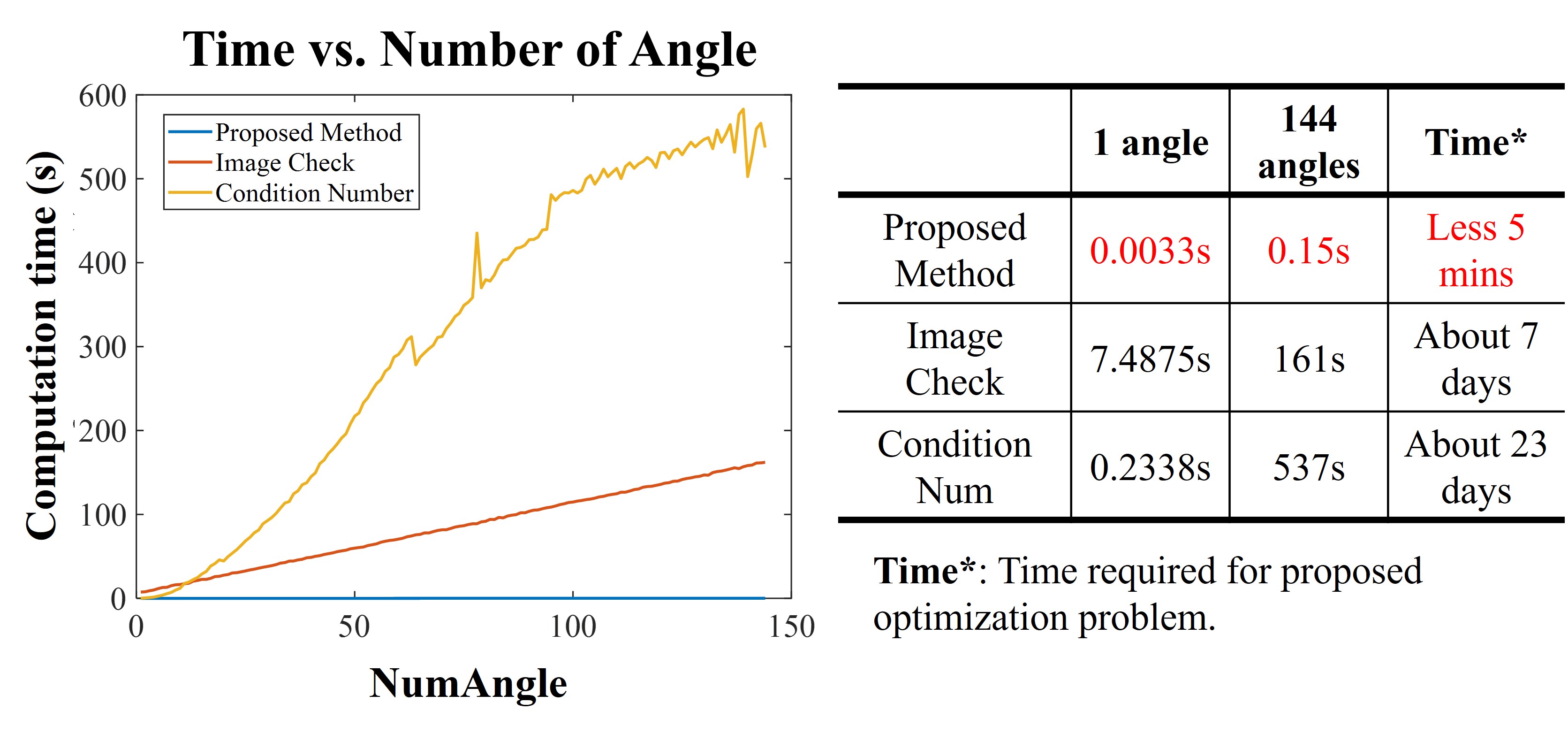
In Fig 2(b), a strong correlation between the NRMSE and $$$k^L$$$ at each block can be observed. The correlation coefficient exceeds 90%. The calculation time of using the proposed method is compared to the other two methods for the evaluation of encoding capability, image quality checking and condition number checking. As shown in Fig 3, the proposed method is much faster than the other two.Fig 4(a) shows the optimized angle selection and the two reference cases. Fig 4(b) shows the change of NRMSE as the number of angles increases for different angle selections. Using $$$k^L$$$ as an indicator of image quality, the most significant angles can be quickly identified, which corresponds to the dip at N = 24 of the blue curves in Fig 4(b). With the selected angles, images were reconstructed and shown in Fig 4(c), using both simulated and experimental data. As shown, the angle selection using $$$k^L$$$ as indicator of encoding capability shows the best image quality with the least number of angles (i.e., the least scan time).
Conclusion
In this study, we proposed a fast evaluation technique based on local k-space for encoding capability of SEM with non-linear gradients, which is suitable for different kinds of optimization processes. It was successfully applied to angle selection to show its effectiveness.Acknowledgements
No acknowledgement found.References
- Liang T-O, Koh YH, Qiu T, Li E, Yu W, Huang SY. High-performance permanent magnet array design by a fast genetic algorithm (GA)-based optimization for low-field portable MRI. J Magn Reson. 2022;345:107309
- Cooley CZ, Stockmann JP, Armstrong BD, Sarracanie M, Lev MH, Rosen MS, Wald LL. Two-dimensional imaging in a lightweight portable MRI scanner without gradient coils. Magn Reson Med. 2015;73(2):872-883.
- Fessler JA. Optimization methods for magnetic resonance image reconstruction: Key models and optimization algorithms. IEEE Signal Process Mag. 2020;37(1):33-40.
- Gallichan D, Cocosco CA, Dewdney A, Schultz G, Welz A, Hennig J, Zaitsev M. Simultaneously driven linear and nonlinear spatial encoding fields in MRI. Magn Reson Med. 2011;65(3):702-714.
- Gong J, Huang SY, Ren ZH, Yu W. Effects of encoding fields of permanent magnet arrays on image quality in low-field portable MRI systems. IEEE Access. 2019;7:80310-80327.
- Rajendran M, Yang J, Tingou L, Yu W, Chen X, Huang S. Frequency Selective Surface (FSS) Radiofrequency Shield of Solenoid Coil for Low-Field Portable MRI. Published online 2023. TechRxiv.
Figures