2843
On the Extension of MARIE Coil Simulation to Low Frequencies and Arbitrarily Fine Meshes1Bernard and Irene Schwartz Center for Biomedical Imaging, Department of Radiology, New York University Grossman School of Medicine, New York, NY, United States, 2Center for Advanced Imaging Innovation and Research (CAI2R), Department of Radiology, New York University Grossman School of Medicine, New York, NY, United States, 3Vilcek Institute of Graduate Biomedical Sciences, New York University Grossman School of Medicine, New York, NY, United States
Synopsis
Keywords: Low-Field MRI, Simulations
Motivation: Accurate and precise simulation of low field MR, as well as simulation of high field MR with arbitrary granularity.
Goal(s): To assess and address the limitations in the Magnetic Resonance Integral Equation (MARIE) suite that prevent successful low field simulation.
Approach: We achieved these goals using a number of numerical analysis techniques, such as Taylor series approximations and Kahan summation.
Results: We successfully identified and addressed the limitations of MARIE, which we attributed to catastrophic loss of numerical precision. In doing so, we enabled low frequency and fine mesh simulation.
Impact: Low field and detailed simulation of coils would enable many applications, such as coil optimization, synthetic generation of MR data for machine learning algorithms, computational pulse sequence optimization, accurate safety assessments in simulation, among many other applications.
Introduction
The standard of assessment for precision and accuracy of simulation tools is typically performed on elements whose characteristic lengths are on the order of $$$\frac{\lambda}{8}$$$, where $$$\lambda$$$ denotes vacuum wavelength. When designing an accurate RF coil simulation tool suitable for ultra-low to ultra-high field MRI simulations, this practice is problematic: for example, at a field strength of 3T, $$$\lambda$$$ is approximately 2.3 meters, meaning that accuracy is guaranteed only when the characteristic length of the discretization is on the order of 30cm. Because wavelength is inversely proportional to the frequency, the performance of these simulation tools further degrades at low field and fails completely at ultra-low fields. In this work, we detail the processes by which we assessed the precision of the open-source Magnetic Resonance Integral Equation suite MARIE1, and how we drastically improved its performance in cases where precision was lost catastrophically.Theory & Background
We focus our attention on the Surface Integral Equation (SIE) component of the MARIE suite2. We quickly summarize the SIE formulation: The underlying system of equations is the standard Electric Field Integral Equation formulation (EFIE) discretized using the Galerkin method and Rao-Wilton-Glisson (RWG) basis functions3. The condition number of a such a system for a typical coil array is on the order of 105 because the eigenvalues cluster about $$$0$$$. Consequently, the conditioning of this system limits the maximum accuracy (11 digits for double precision), and amplifies any errors that may be present in the system of equations itself. This system of equations is given by$$\mathbf{Z}_{cc}\mathbf{J}_c=\mathbf{F}\mathbf{V}_{\rm{in}}\text{,}$$ where $$$\mathbf{Z}_{cc}$$$ is the discretized system of equations, $$$\mathbf{J}_c$$$ is the set of RWG coil currents, $$$\mathbf{F}$$$ is an interpolation matrix, and $$$\mathbf{V}_{\rm in}$$$ is the input voltage.
Assembling the system involves calculating a large number of singular and non-singular integrals. These integrals are of the form $$\iint_{S_i}\iint_{S_j}f_m\!\left(\mathbf{r}\right)\cdot f_n\!\left(\mathbf{r}^\prime\right)G\!\left(\mathbf{r}-\mathbf{r}^\prime\right){\rm d}S^\prime{\rm d}S$$ where $$$f_m$$$ and $$$f_n$$$ denote the testing and basis functions of the discretization, respectively. The function $$$G\!\left(\mathbf{r}-\mathbf{r}^\prime\right)$$$ is the Dyadic Green’s function. In MARIE, the singular integrals are computed using the Direct Evaluation Method and can be subdivided into three cases2: Self-Term (ST), Edge Adjacent (EA), and Vertex Adjacent (VA). The non-singular (NS) integrals are computed with standard Gauss-Legendre quadrature schemes.
Methods & Results
We assessed the precision of the assembly of the SIE method by manually varying the order of the 1D Gauss-Legendre quadrature, and then calculating the Frobenius norm of the difference of $$$\mathbf{Z}_{cc}$$$, normalized by the norm of the highest tested order. We made the following observations:- ST, EA, and VA terms had a precision of 10-6 for the fixed orders in the original MARIE.
- NS terms had a precision of 10-6 for the fixed order.
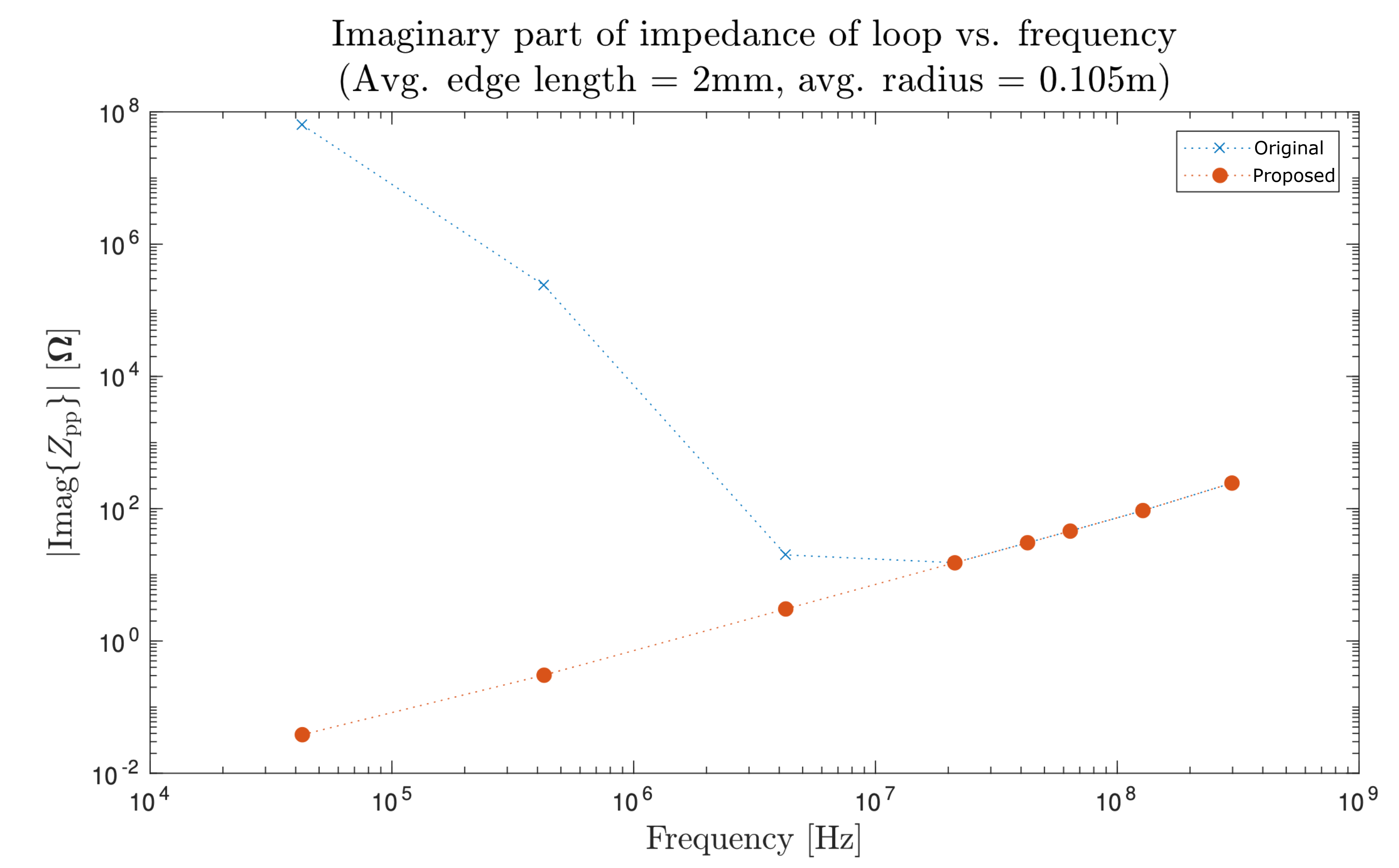
- The maximum attainable precision of singular terms was 10-10 due to the catastrophic loss of numerical precision.
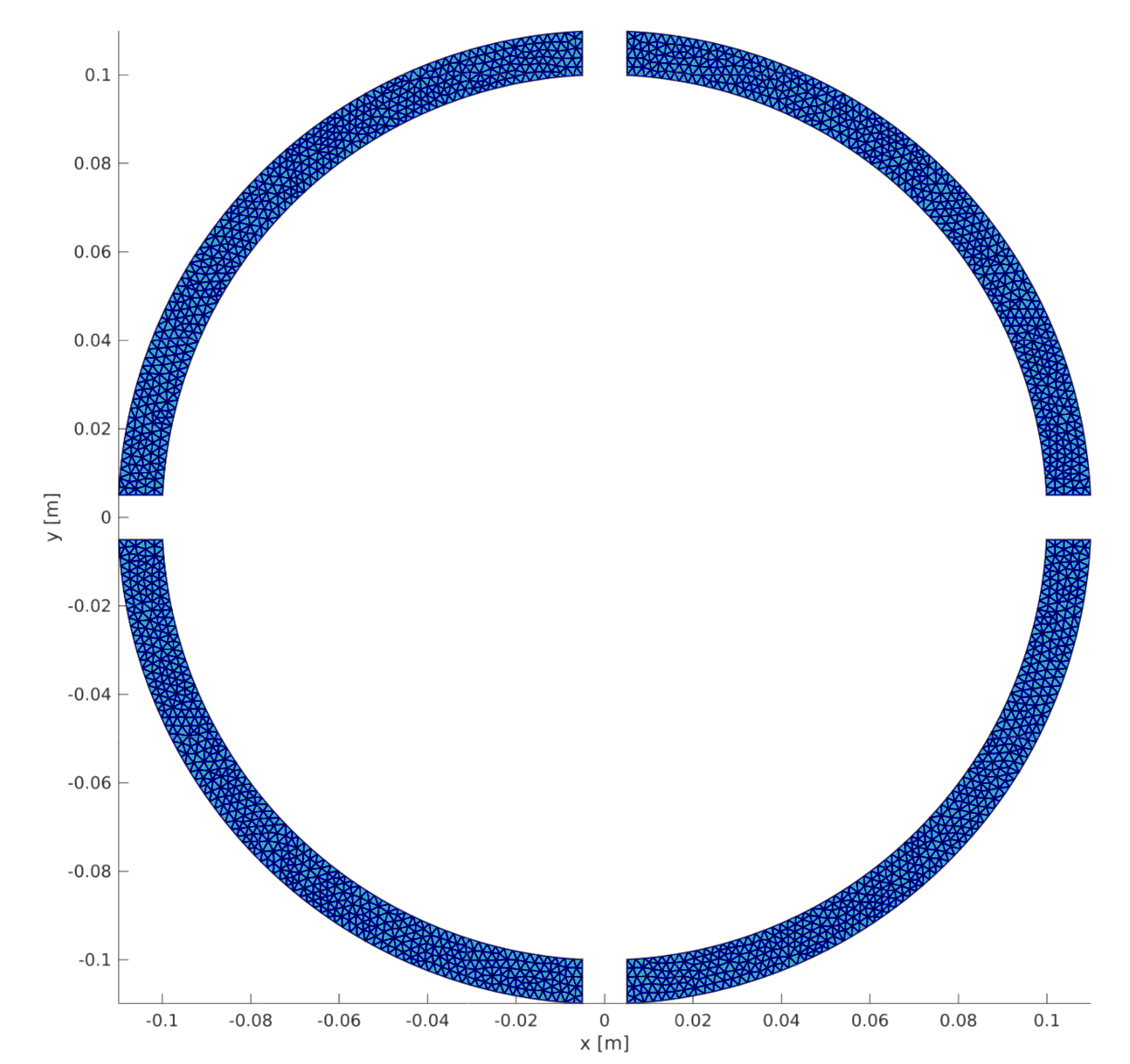
- At 1.5T and for a loop with 8cm diameter (scaled down from Fig. 1), the error in the coil currents is on the order of 5%.
Conclusion & Future Work
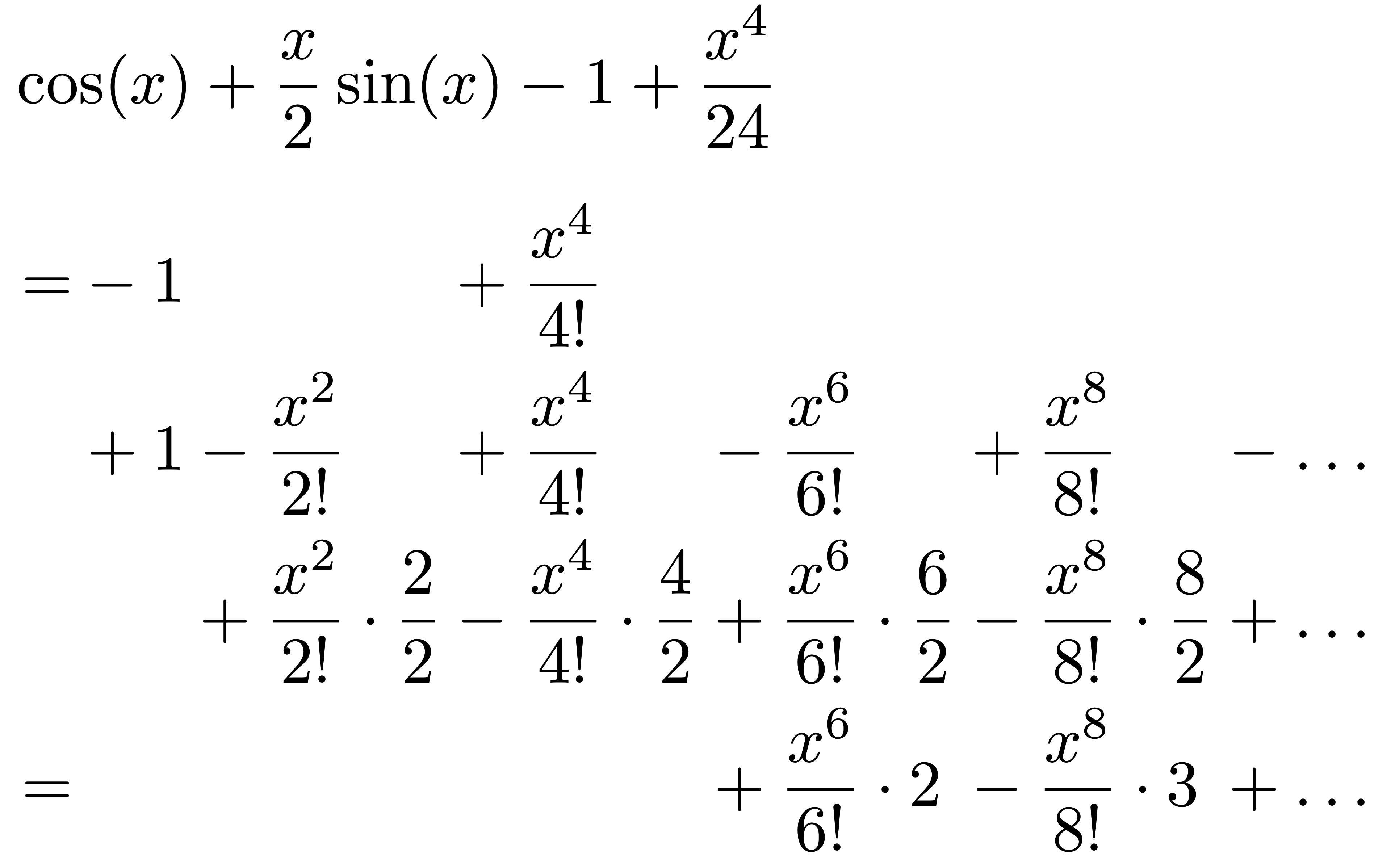
We successfully identified and addressed catastrophic loss of numerical precision issues and high quadrature errors in MARIE using Taylor series expansions and higher quadrature orders. We believe that this increase in accuracy is essential to better replicate experiments in simulation, especially at low field strengths. Such a high degree of precision and hence accuracy would enable applications like synthetic data generation for machine learning algorithms, patient safety assessments, and iterative methods used to approximate ultimate performance bounds6. The achieved high precision will be key for iterative inverse problems, such as coil optimization7 or electrical property mapping8 because a systematic error such as the one detected for MARIE could significantly bias the overall simulation’s accuracy.Acknowledgements
This work was supported in part by NIH R01 EB024536 and was performed under the rubric of the Center for Advanced Imaging Innovation and Research (CAI2R, www.cai2r.net), an NIBIB National Center for Biomedical Imaging and Bioengineering (NIH P41 EB017183).References
- Villena JF, Polimeridis AG, Eryaman Y, Adalsteinsson E, Wald LL, White JK, Daniel L. Fast electromagnetic analysis of MRI transmit RF coils based on accelerated integral equation methods. IEEE Transactions on Biomedical Engineering. 2016 Jan 22;63(11):2250-61.
- Polimeridis AG, Tamayo JM, Rius JM, Mosig JR. Fast and accurate computation of hypersingular integrals in Galerkin surface integral equation formulations via the direct evaluation method. IEEE transactions on antennas and propagation. 2011 Apr 19;59(6):2329-40.
- Rao S, Wilton D, Glisson A. Electromagnetic scattering by surfaces of arbitrary shape. IEEE Transactions on antennas and propagation. 1982 May;30(3):409-18.
- Burrus CS, Fox JW, Sitton GA, Treitel S. Horner’s method for evaluating and deflating polynomials. DSP Software Notes, Rice University, Nov. 2003 Nov 26;26.
- Kahan, W. Further remarks on reducing truncation errors. Communications of the ACM, 8 (1): 40, doi:10.1145/363707.363723, Jan. 1965.
- Georgakis IP, Polimeridis AG, Lattanzi R. A formalism to investigate the optimal transmit efficiency in radiofrequency shimming. NMR in Biomedicine. 2020 Nov;33(11):e4383.
- Serralles JEC, Adalsteinsson E, Wald LL, Daniel L. Parametric coil optimization via global optimization. InProc. ISMRM 2021 (p. 1399).
- Serrallés JEC, Giannakopoulos II, Zhang B, Ianniello C, Cloos MA, Polimeridis AG, White JK, Sodickson DK, Daniel L, Lattanzi R. Noninvasive estimation of electrical properties from magnetic resonance measurements via global Maxwell tomography and match regularization. IEEE Transactions on Biomedical Engineering. 2019 Mar 25;67(1):3-15.
Figures