2839
Effect of the RF shield-to-coil distance on coil efficiency for a 46 mT Halbach-based point-of-care MRI system1Leiden University Medical Center, Leiden, Netherlands, 2Radiology, Leiden University Medical Center, Leiden, Netherlands
Synopsis
Keywords: Low-Field MRI, Simulations
Motivation: Inner-Shield in Halbach-array magnet effect RF coil transmit efficiency and signal-to-noise ratio(SNR). With this, finding a good trade of between magnet diameter and SNR is important.
Goal(s): Find the proper magnet diameter with respect to the RF coil transmit efficiency.
Approach: Simulations of the transmit efficiency of three RF coils used for neuroimaging on a 46 mT Halbach-array point-of-care MRI system have been performed in terms of analyzing the coil to RF shield distance located inside the magnet.
Results: Results show that a distance of 1 cm results in a 50% lower transmit/receive efficiency than a 3 cm gap.
Impact: This means that slightly larger magnets may have higher signal-to-noise even though the B0 field is lower.
Introduction
The number of low field point-of-care (POC) MRI systems for neuroimaging has grown significantly in recent years. Most of these are targeted to neuroimaging, and comprise lightweight, cryogen-free systems with minimal fringe fields and no electrical power requirements.1-9 The major challenges are the low signal-to-noise ratio (SNR) and high B0 inhomogeneity. System design involves trade-offs between magnet strength and homogeneity, weight, gradient performance and RF coil sensitivity. Given the limited space, RF transmit coils are usually designed to fit tightly around the head. To avoid mutual coupling between gradient and RF coils, a thin cylindrical copper shield is fitted inside the magnet bore and grounded to the shielding around the magnet8. Mirror currents induced in this shield reduce the transmit/receive efficiency, reducing the image SNR with respect to an unshielded coil. Increasing the coil to shield distance implies a larger diameter magnet and gradient coils, which reduce the field strength and gradient efficiency, respectively10.In order to determine the dependence of RF coil efficiency on coil-to-shield distance, we performed detailed electromagnetic (EM) simulation setups on three commonly-used RF setups, using a dome-helix and ellipse solenoid RF coil geometries with either cylindrical or elliptical RF shields. These coils were assumed to operate in transmit/receive mode, and therefore the transmit magnetic field efficiency (B1+ per W input power) and receive efficiency, which is proportional to the SNR, are essentially identical.
Material and methods
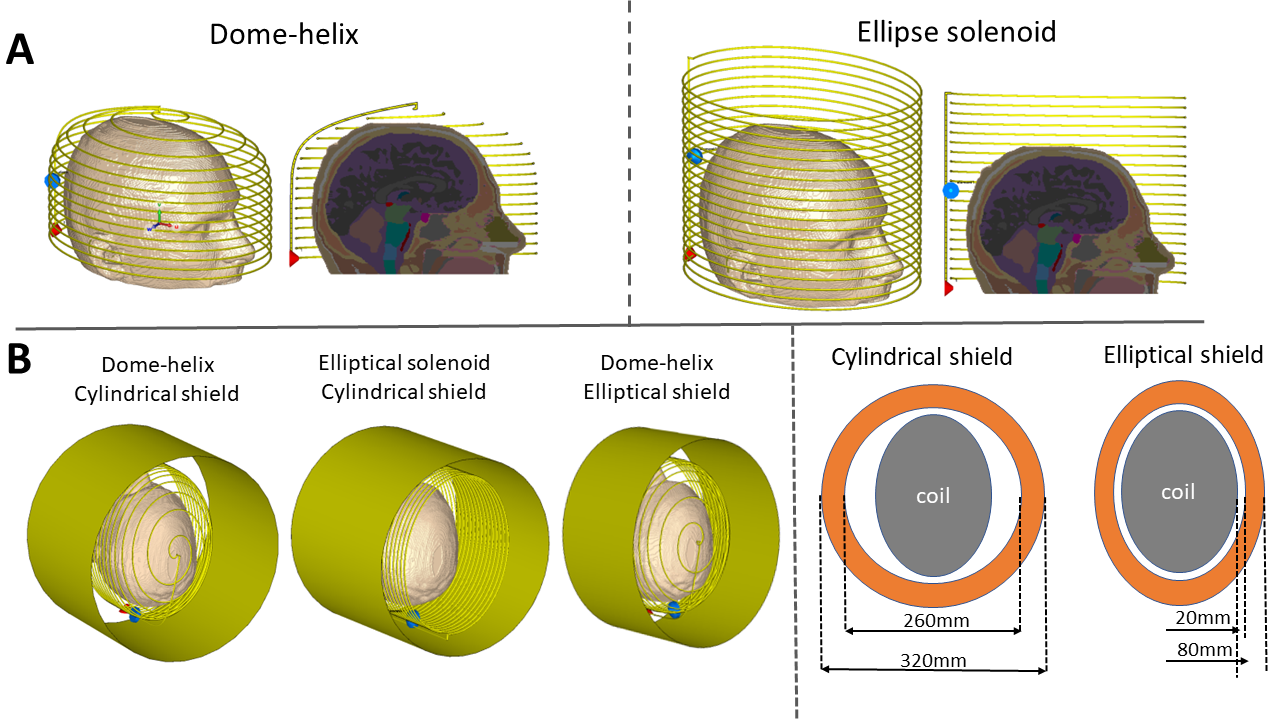
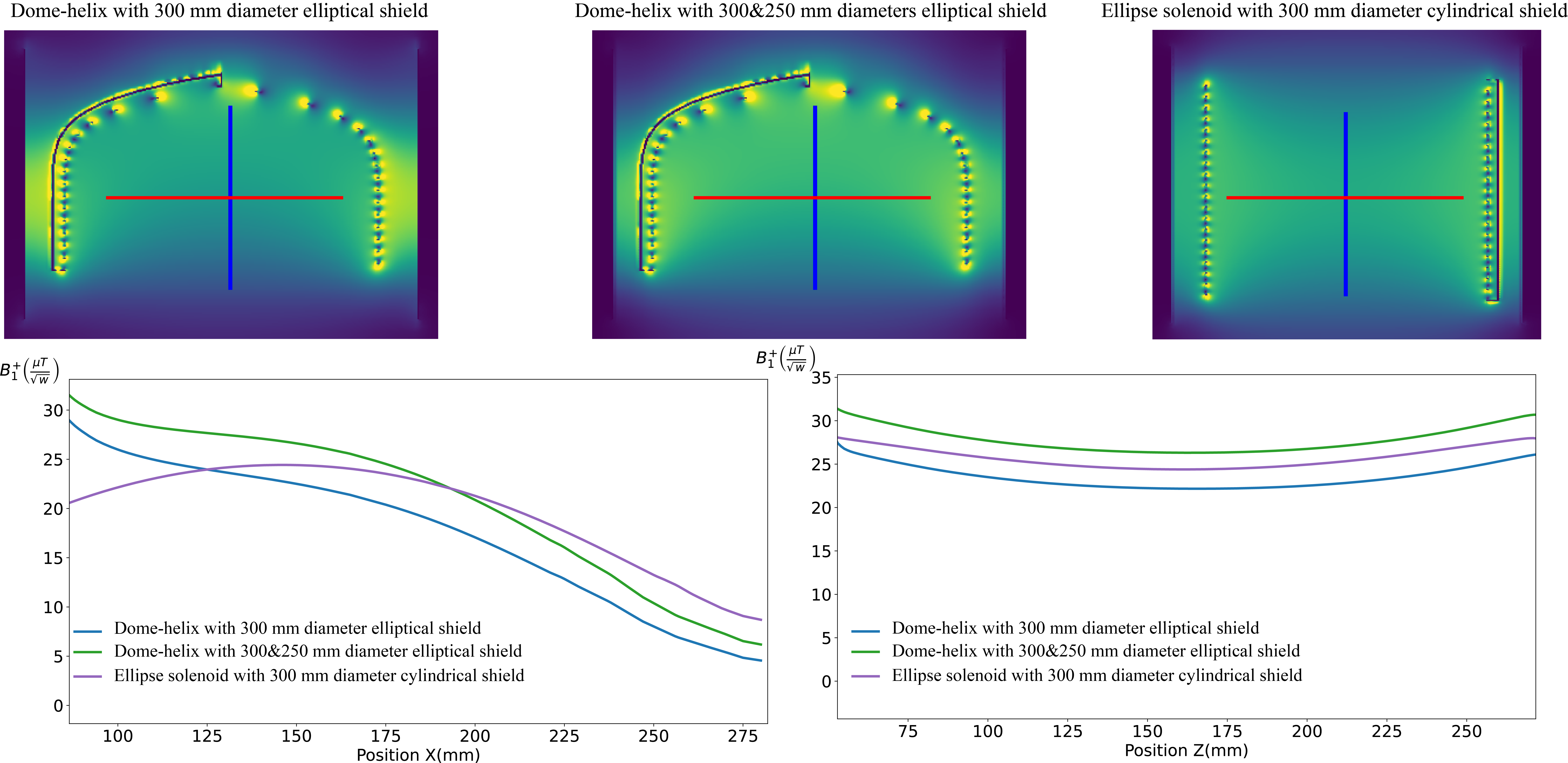
Electromagnetic simulations: these were performed in CST Microwave Studio (CST GmbH, Darmstadt, Germany ). A dome-helix and ellipse solenoid coil, consisting of 15 and 20 turns of copper wire of 1.5 mm diameter, respectively, with one capacitive segmentation halfway along the wire length were simulated. The coils had dimensions of 180 mm width, 240 mm height, and 10 mm gap between wire turns. Figure 1A shows the setups for the EM simulations for the coil. The RF shield was simulated as a continuous copper structure with a length of 350 mm and thickness of 0.07 mm. The coils were loaded with the Duke head model (It is Foundation) with the appropriate permittivity and conductivity values for different tissues at 2 MHz. Figure 1B shows the three different simulation setups considered: dome-helix coil inside a cylindrical shield with various diameters changing from 260 mm to 320 mm in steps of 5 mm step, an ellipse solenoid coil with the same shield geometry and range in diameters, and a dome-helix coil inside an elliptical shield with a symmetric gap between the coil and shield ranging from 20 mm to 80 mm with a 5 mm step size. In each case the RF coils were impedance matched to 2 MHz using variable capacitors in an L-network. The B1+ efficiency (\(\frac{\mu T}{\sqrt{w}}\)) was calculated for each setup.Results
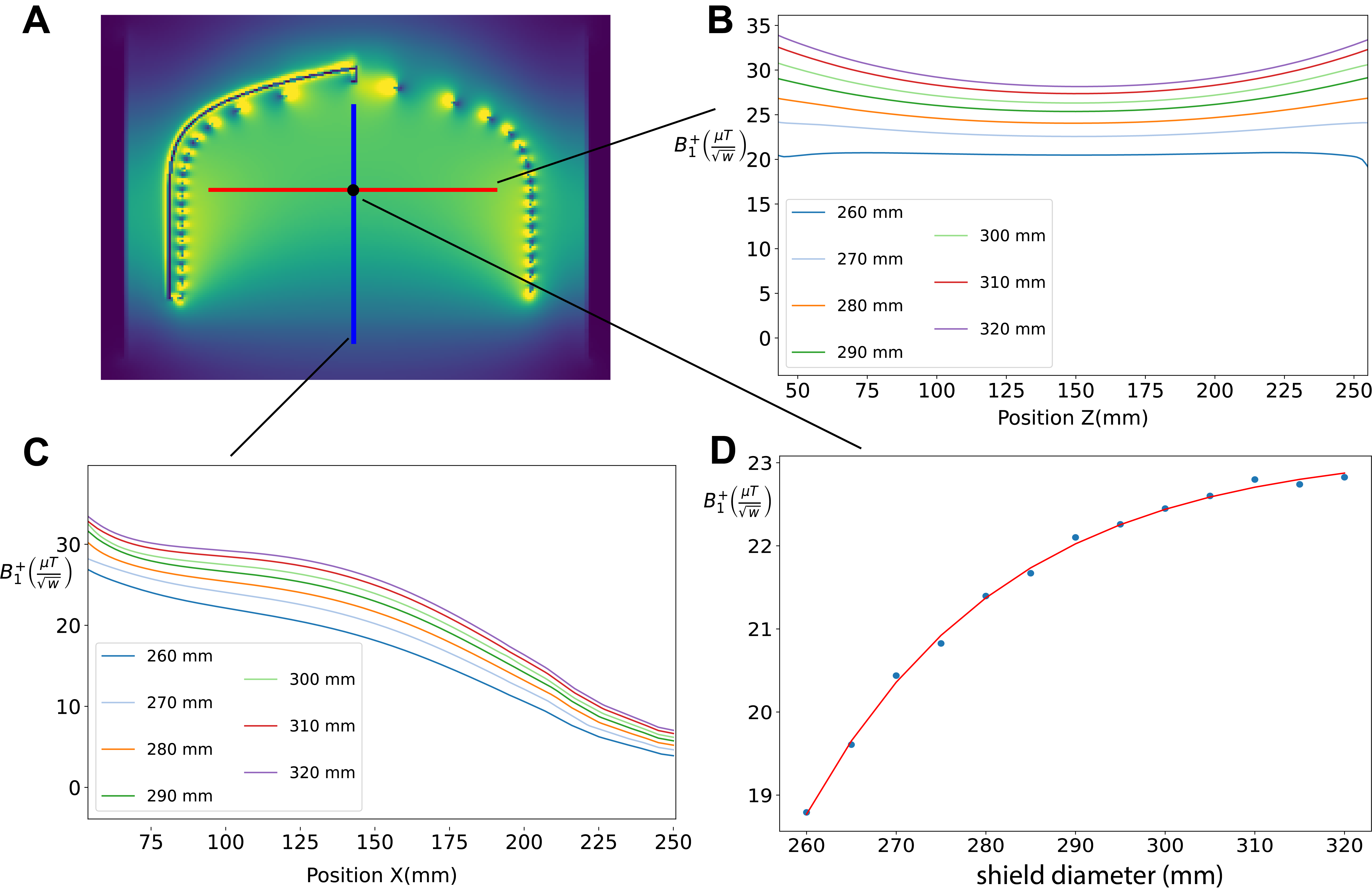
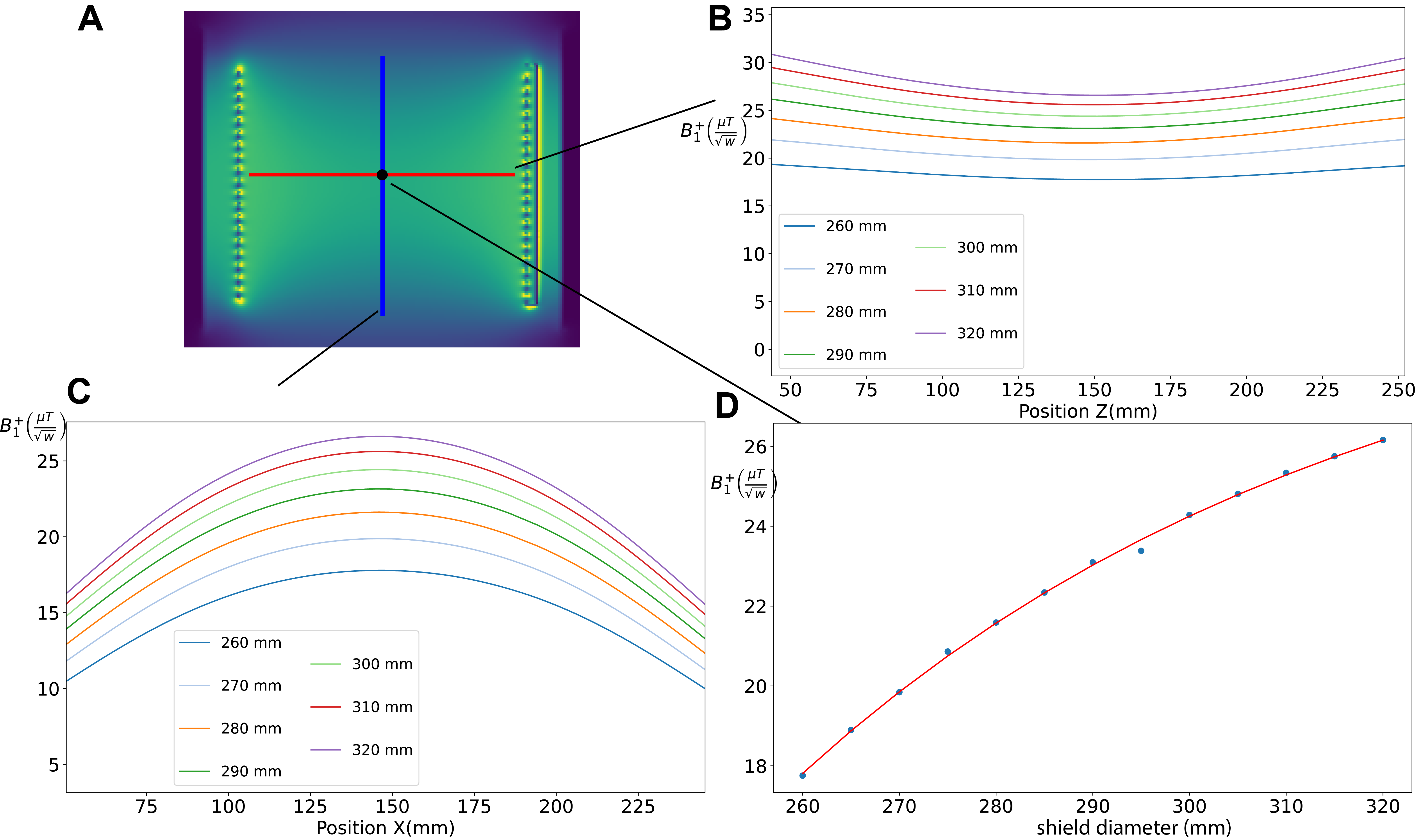
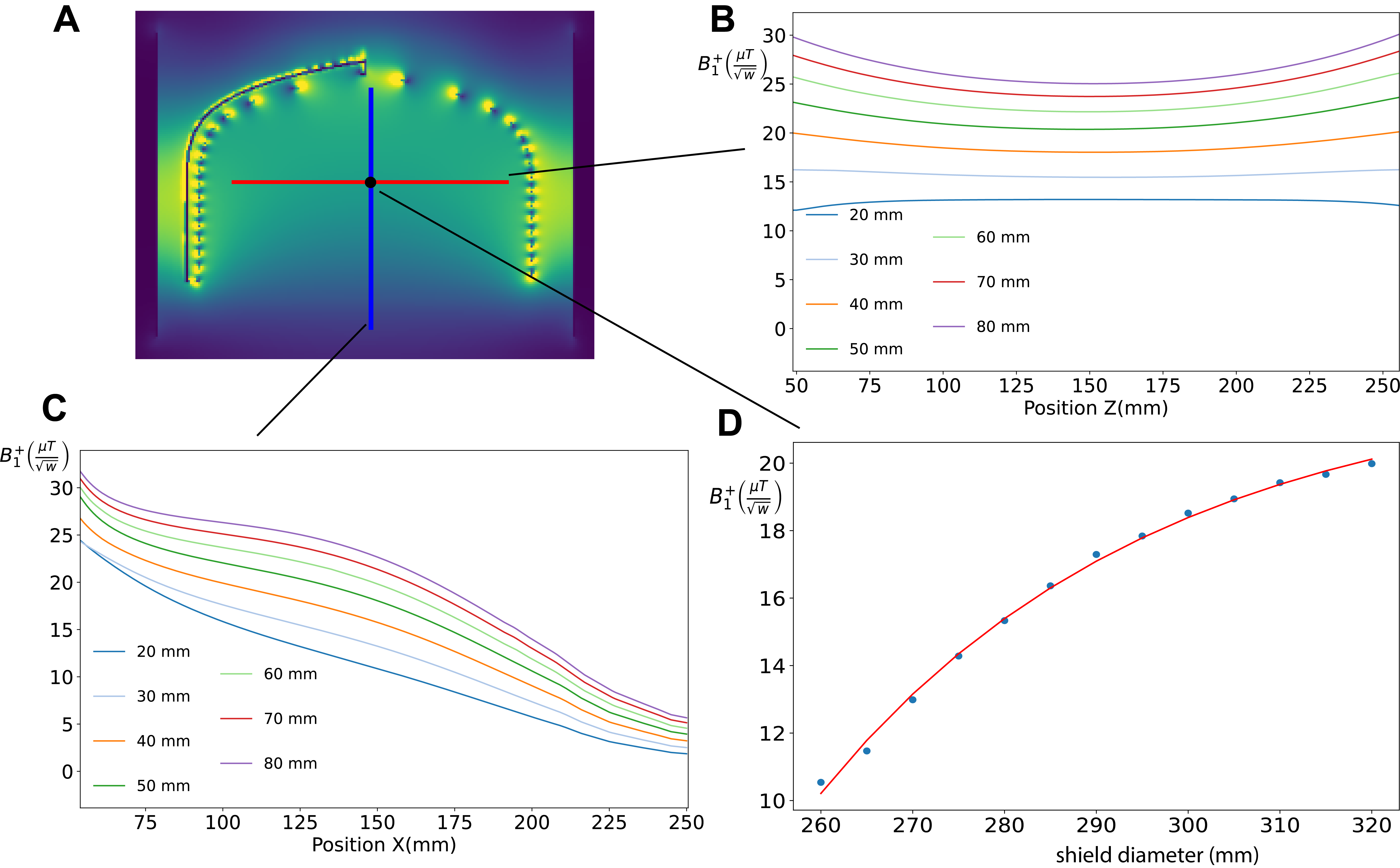
Figures 2-4 show the simulated B1+ efficiency (\(\frac{\mu T}{\sqrt{w}}\)) for the three different shielding setups. The results show that the relationship between efficiency and diameter can be well approximated by a simple exponential curve. For the dome-helix with cylindrical shield the transmission efficiency drops from ~30 to ~20 \(\mu\mathrm{T}\) for a 320 and 260 mm diameter shield, respectively, corresponding to an ~50% reduction in SNR. The same coil with an elliptical shield shows significantly poorer performance with transmission efficiency drops from ~27 to ~13 \(\mu\mathrm{T}\). Results for the ellipse solenoid with cylindrical shield are similar to the dome-helix with transmission efficiency dropping from ~28 to ~17 \(\mu\mathrm{T}\), but with a less pronounced drop-off in sensitivity in the head-feet direction due to the longer length. These results are summarized in Figure 5.Discussion
This work presents an overview of the transmit efficiencies for RF coils used for POC MRI neuroimaging. Simulations of RF coil characteristics and B1+ transmit efficiencies indicate that there is a strong dependence on coil-shield separations and a difference of only a few mm can result in significant reduction in SNR.Acknowledgements
This work was funded by Horizon 2020 ERC Advanced Grant (670629).References
1. Sarracanie M, Salameh N (2020) Low-Field MRI: How Low Can We Go? A Fresh View on an Old Debate. Front Phys-Lausanne 8.
2. Wald LL, McDaniel PC, Witzel T, Stockmann JP, Cooley CZ (2019) Low-cost and portable MRI. J Magn Reson Imaging doi:10.1002/jmri.26942.
3. Beekman R, Crawford A, Mazurek MH, Prabhat AM, Chavva IR, Parasuram N, Kim N, Kim JA, Petersen N, de Havenon A, Khosla A, Honiden S, Miller PE, Wira C, Daley J, Payabvash S, Greer DM, Gilmore EJ, Kimberly WT, Sheth KN (2022) Bedside monitoring of hypoxic ischemic brain injury using low-field, portable brain magnetic resonance imaging after cardiac arrest. Resuscitation 176:150-158.
4. Mazurek MH, Cahn BA, Yuen MM, Prabhat AM, Chavva IR, Shah JT, Crawford AL, Welch EB, Rothberg J, Sacolick L, Poole M, Wira C, Matouk CC, Ward A, Timario N, Leasure A, Beekman R, Peng TJ, Witsch J, Antonios JP, Falcone GJ, Gobeske KT, Petersen N, Schindler J, Sansing L, Gilmore EJ, Hwang DY, Kim JA, Malhotra A, Sze G, Rosen MS, Kimberly WT, Sheth KN (2021) Portable, bedside, low-field magnetic resonance imaging for evaluation of intracerebral hemorrhage. Nat Commun 12 (1).
5. Mazurek MH, Yuen MM, Cahn BA, Rosen MS, Gobeske KT, Gilmore EJ, Hwang D, Kaddouh F, Kim JA, Falcone G, Petersen N, Siner J, Spudich S, Sze G, Kimberly WT, Sheth KN (2021) Low-Field, Portable Magnetic Resonance Imaging at the Bedside to Assess Brain Injury in Patients with Severe COVID-19. Neurology 96 (15).
6. Sheth KN, Mazurek MH, Yuen MM, Cahn BA, Shah JT, Ward A, Kim JA, Gilmore EJ, Falcone GJ, Petersen N, Gobeske KT, Kaddouh F, Hwang DY, Schindler J, Sansing L, Matouk C, Rothberg J, Sze G, Siner J, Rosen MS, Spudich S, Kimberly WT (2021) Assessment of Brain Injury Using Portable, Low-Field Magnetic Resonance Imaging at the Bedside of Critically Ill Patients. Jama Neurol 78 (1):41-47.
7. Cooley CZ, McDaniel PC, Stockmann JP, Srinivas SA, Cauley SF, Sliwiak M, Sappo CR, Vaughn CF, Guerin B, Rosen MS, Lev MH, Wald LL (2021) A portable scanner for magnetic resonance imaging of the brain. Nat Biomed Eng 5 (3):229-239.
8. de Vos B, Parsa J, Abdulrazaq Z, Teeuwisse WM, Van Speybroeck CDE, de Gans DH, Remis RF, O'Reilly T, Webb AG (2021) Design, Characterisation and Performance of an Improved Portable and Sustainable Low-Field MRI System. Front Phys-Lausanne 9.
9. O'Reilly T, Teeuwisse WM, de Gans D, Koolstra K, Webb AG (2021) In vivo 3D brain and extremity MRI at 50 mT using a permanent magnet Halbach array. Magn Reson Med 85 (1):495-505.
10. Turek K, Liszkowski P, (2014) Magnetic field homogeneity perturbations in finite Halbach dipole magnets. JMR 238: 52-62.
Figures