2829
A comparison of coil loading and SNR for elliptical solenoidal coil vs. a tight fitting dome helmet coil for low field neuroimaging1Leiden University Medical Center, Leiden, Netherlands
Synopsis
Keywords: Low-Field MRI, Low-Field MRI
Motivation: The narrow bandwidth of RF coils for low field MRI means that coils often require re-tuning between subjects due to different loading conditions.
Goal(s): We compare the performance and loading effects of an elliptical solenoid and a dome helmet coil to see which coil is more sensitive to loading
Approach: The SNR and transmit efficiency of the two coil types are compared in when lightly loaded (phantom) and normally loaded (in-vivo) settings
Results: The elliptical solenoid coil has a substantially smaller frequency shift when loaded (~1kHz vs ~13kHz) and has superior SNR in-vivo compared to a tight -fitting dome helmet coil.
Impact: We compare the performance of tight-fitting dome helmet coil to an elliptical solenoid coil and find that due to reduced loading the performance of the elliptical coil is superior in-vivo while having better frequency stability with differing loads.
Introduction
Losses in RF coils are typically much less at low field than at high field due to lower sample loading and conductor losses[1]: this is seen in the loaded Q factor of coils which can be well in excess of 100. Practically this means that the bandwidth of the coils can be very narrow, < 10kHz [2], meaning that the coil will often need to be re-tuned between subjects as slight differences in loading of the coil may cause significant frequency shifts with respect to the bandwidth.In this work we compare the performance of a tight fitting helmet coil with an elliptical cylindrical coil of similar dimensions.We show that the helmet coil, which has wires close to the sample over the entire head, has an increased load sensitivity and that when loaded with a human head the cylindrical coil actually has superior performance despite having worse performance when loading is negligible.
Method
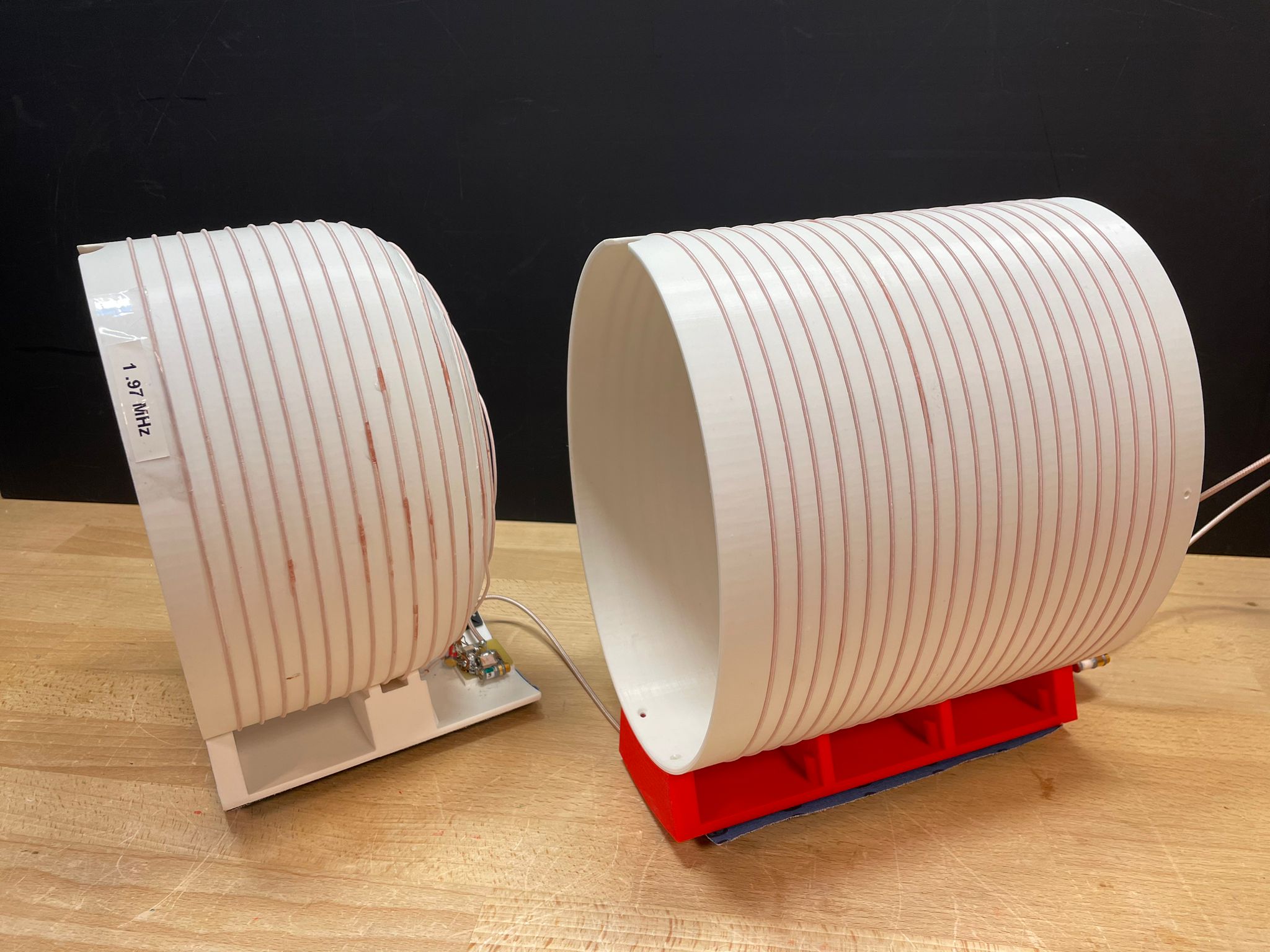
A 15 turn 240mm high, 180mm wide, 150mm long spiral solenoid coil based on similar designs[3] in literature was designed and printed on a 3D printed former. A 20 turn 240mm high, 180mm wide, 200mm long elliptical solenoid coil was designed for comparison. The helmet coil was segmented in 2 locations and the elliptical coil in 3 locations such that the wire length of each segment for each coil was similar. Both coils were wound using 1500 strands of 0.03mm wire Litz wire (Elektrisola, Germany) and tuned with capacitors from the same series (ATC 800E).MRI experiments were performed on a self-built Halbach based MRI scanner based on a system described previously[4]. The MRI scanner has an RF shield placed located inside of the bore (302mm diameter, 500mm length) consisting of two unconnected solid sheets of 30µm thick copper connected to RF ground. Flip angle calibration was performed by measuring FID signal strength over a range of pulse amplitudes and fitting a sinusoidal function to the data. A 150 µs hard pulse was used for all experiments. Images were acquired using a TSE sequence with the same scan parameters for both phantom and in-vivo images (resolution: 1.5x1.5x5mm3, TE/TR: 16ms/600ms, ETL:7, BW:25kHz) except the FOV which was 240x180x200mm3 for in-vivo scans and 240x180x100mm3 for the phantom. Images were corrected for Q-factor related shading by normalising the images to the measured noise distribution[2]. Noise levels were evaluated by acquiring 1000 scans while no RF was transmitted.
S parameters were measured on a Copper Mountain Technologies S5048 Vector network analzyer with the RF coil placed inside the bore. The loaded S11 parameter at the resonance frequency was lower than -20dB for all experiments. All Q-factor measurements were done with the coil impedance matched to 50Ω.
Results
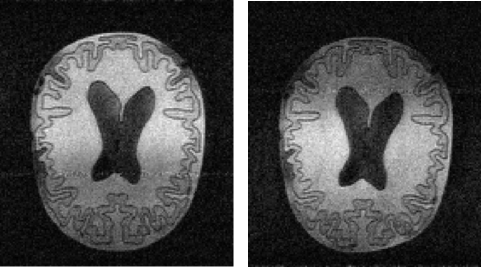
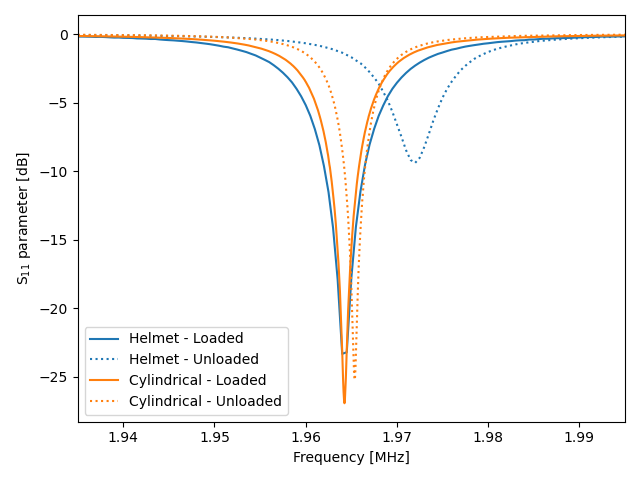
The Q-factor of the unloaded helmet coil was 308, dropping to 157 when loaded with a human head, the resonance frequency decreased 12.9 kHz when loaded. The Q-factor of the cylindrical coil was also 308 and dropped to 212 when loaded with the same subject, the coil frequency decreased by only 1.1 kHz when loaded.The B1+ efficiency of the helmet coil was 33.0 µT/√W for the 10mm thick phantom (lightly loading) compared to 29.1 µT/√W for the cylindrical coil. Signal-to-noise ratio in the phantom images were 21.1 and 19.8 for the helmet coil and cylindrical coil respectively. Noise level measurements for the helmet coil showed higher levels than the cylindrical coil (2.91µV vs 2.76µV).
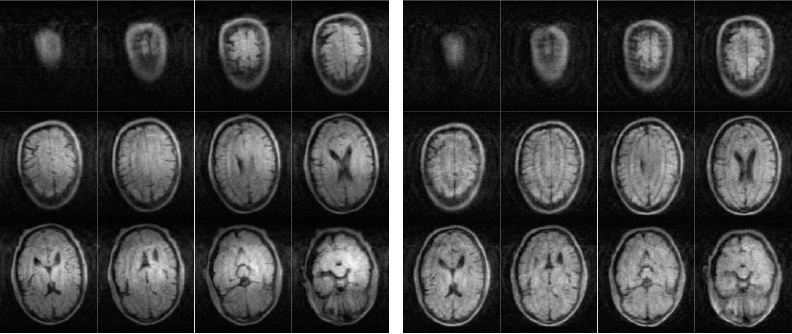
For in-vivo experiments the B1+ efficiency of the helmet and cylindrical coil were 25.8 µT/√W and 26.4 µT/√W, respectively. Signal-to-noise ratios for the in-vivo images were 12.4 for the helmet coil and 14.9 for the cylindrical coil. Noise levels were again higher for the helmet coil, 2.93µV against 2.70µV for the cylindrical coil.
Discussion
In this work we show that the load sensitivity of a cylindrical solenoidal coil is substantially less than for a helmet coil of equal height and width. The significant reduction in frequency shift when loading the coil in the cylindrical coil reduces the need for retuning the coil between subjects. While the cylindrical coil is less efficient than the helmet coil in lightly loaded cases, the reduced load sensitivity means that for in-vivo applications the coil efficiency is essentially equivalent. The SNR in the cylindrical coil is higher than expected compared to the helmet when looking at B1+ efficiency and consider the principle of reciprocity due to lower noise levels (approximately 12%) in the cylindrical coil, despite both coils being matched to 50Ω and suggests that the cylindrical coil is less sensitive to external interference.Acknowledgements
This work was funded by a Horizon 2020 ERC Advanced Grant (670629) and the European Partnership on Metrology, co-financed by the European Union’s Horizon Europe Research and Innovation Program (22HLT02 A4IM).
References
1. Gilbert K m., Scholl T j., Chronik B a. RF coil loading measurements between 1 and 50 MHz to guide field-cycled MRI system design. Concepts in Magnetic Resonance Part B: Magnetic Resonance Engineering. 2008;33B(3):177-191. doi:10.1002/cmr.b.20118
2. Webb A, O’Reilly T. Tackling SNR at low-field: a review of hardware approaches for point-of-care systems. Magn Reson Mater Phy. 2023;36(3):375-393. doi:10.1007/s10334-023-01100-3
3. Shen S, Xu Z, Koonjoo N, Rosen MS. Optimization of a Close-Fitting Volume RF Coil for Brain Imaging at 6.5 mT Using Linear Programming. IEEE Transactions on Biomedical Engineering. 2021;68(4):1106-1114. doi:10.1109/TBME.2020.3002077
4. O’Reilly T, Teeuwisse WM, Webb AG. Three-dimensional MRI in a homogenous 27 cm diameter bore Halbach array magnet. J Magn Reson. 2019;307:106578. doi:10.1016/j.jmr.2019.106578
Figures