2827
An elliptic-bore low-field portable Halbach magnet with full-length gradient support1Institute for Molecular Imaging and Instrumentation (CSIC-UPV), Valencia, Spain
Synopsis
Keywords: Low-Field MRI, Low-Field MRI, Magnets (B0), New Devices
Motivation: To build a truly portable MRI scanner for neurological and MSK applications, optimized for field homogeneity and FoV size compared to standard Halbach configurations.
Goal(s): To explore elliptic-bore magnets to improve the field homogeneity and remove constraints to the extent of the gradient coils typical of Halbach magnets.
Approach: We have optimized a tightly-packed distribution of magnetic Nd2Fe14B cubes with differential evolution algorithm, and a second array of shimming magnets with interior point and differential evolution methods.
Results: We have built a 10 & 14 cm radii elliptic magnet with 87.4 mT@5700 ppm in a 10 cm radius FoV.
Impact: Elliptic-bore Halbach magnets enhance the ergonomicity and field distribution of low-costportable MRI scanners, while allowing for full-length gradient support to increase the FoV. Thisgeometry can be potentially adapted for a prospective low-cost whole-body technology.
Introduction
Halbach mandhalas1, i.e. collections of small magnetic pieces in a Halbach configuration, have proved a great tool to produce low-field (<100 mT) MRI magnets2 with high portability3, low weight and cost. However, they are usually conceived with cylindrical bores, which naturally produce an elongated field pattern. Also, the bore size is dictated by the rings at the extremes to constrain inhomogeneities, reducing the space available for gradients to the inner part of the magnet. This limits severely the available imaging FoV length due to magnetic gradient nonlinearities. Here, we demonstrate a Halbach magnet with an elliptical bore4,5 with outer diameters 65 & 72 cm and a length of 44.5 cm, enabling neurological and MSK applications while retaining full-length support for gradient coils.Methods
Our target specifications are: that feet with a 46/47 European size (non-flexed) and human heads(99 percentile) fit in the bore; that the magnet fits through standard doors (70 cm maximum breadth), and that gradient coils span the full length. These constraints lead to minimum bore diameters of 20 & 28 cm, and a full length of ~44 cm. The constraint for gradients determines the magnet apertures.We study configurations with cubic Nd2Fe14B magnets, arranged in piles of rings following a Halbach dipole configuration and tightly packed along the angular, radial and longitudinal directions. We consider multiple cube sizes (in each case the magnet only has a given cube size),and material tolerances. Configurations are optimized by adjusting the radii of rings which, due to tight-packing, is equivalent to adjusting the number of cubes in each ring. As opposed to the procedure in 2,3, here we force the three outermost rings at each mouth to fit the gradient assembly,so only inner rings are optimized.We limit the number of layers in each ring to two for low weight. Since commonly used genetical gorithms are slow, we use differential evolution6, which is faster and converges better. The cost function used is the total B0 inhomogeneity in a spherical 10 cm radius FoV. Once B0 is measured, for the shimming unit we use a 1-layer elliptic cylinder inside the bore, with smaller cubes. Distributing the shimming magnets is a MINLP optimization: at each cylinder position, a magnet is placed either in Halbach configuration, anti-Halbach (opposite direction), or is not placed, to which we assign the values (1,-1, 0). We also study the possibility of only having(1,0). We first use interior point method (cost function is RMS deviation) to find configurations where each variable is continuous and constrained between +1 and -1 (or between 1 and 0). With this “seed” configuration, we further optimize with differential evolution imposing in the cost function (inhomogeneity) that variables are taken as integer. This allows fast optimization without requiring exact integer character of variables.All optimizations have been programmed in Julia 7 using the BlackBoxOptim.jl8 library, which includes differential evolution, and Ipopt.jl9 for interior point. Magnets have been idealized as dipoles and we have neglected coercitivity.Results
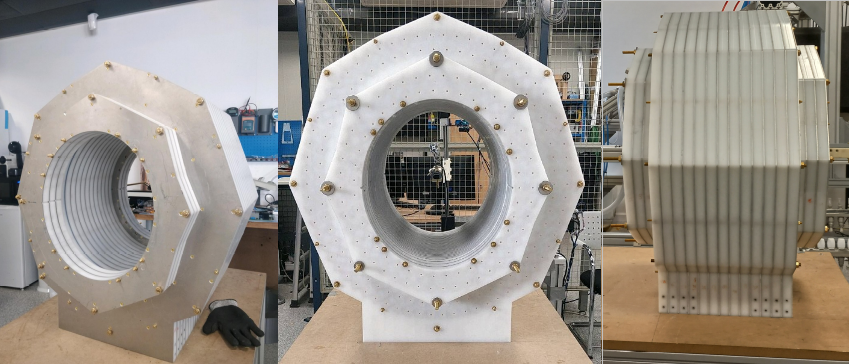
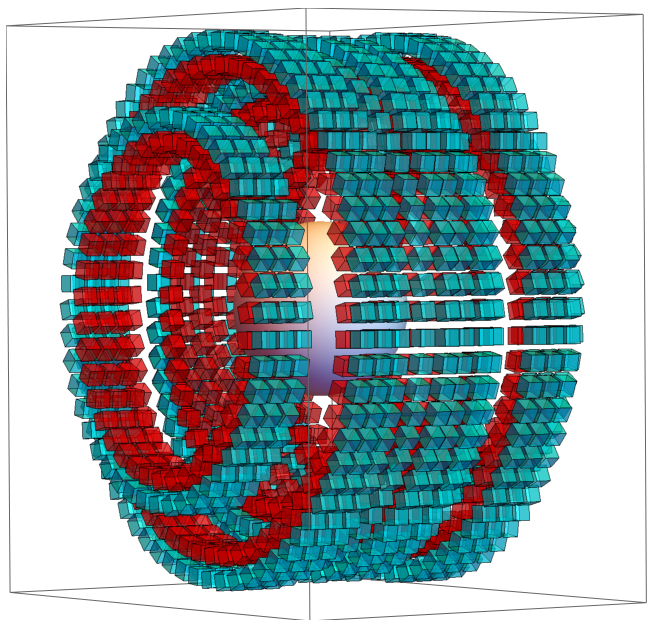
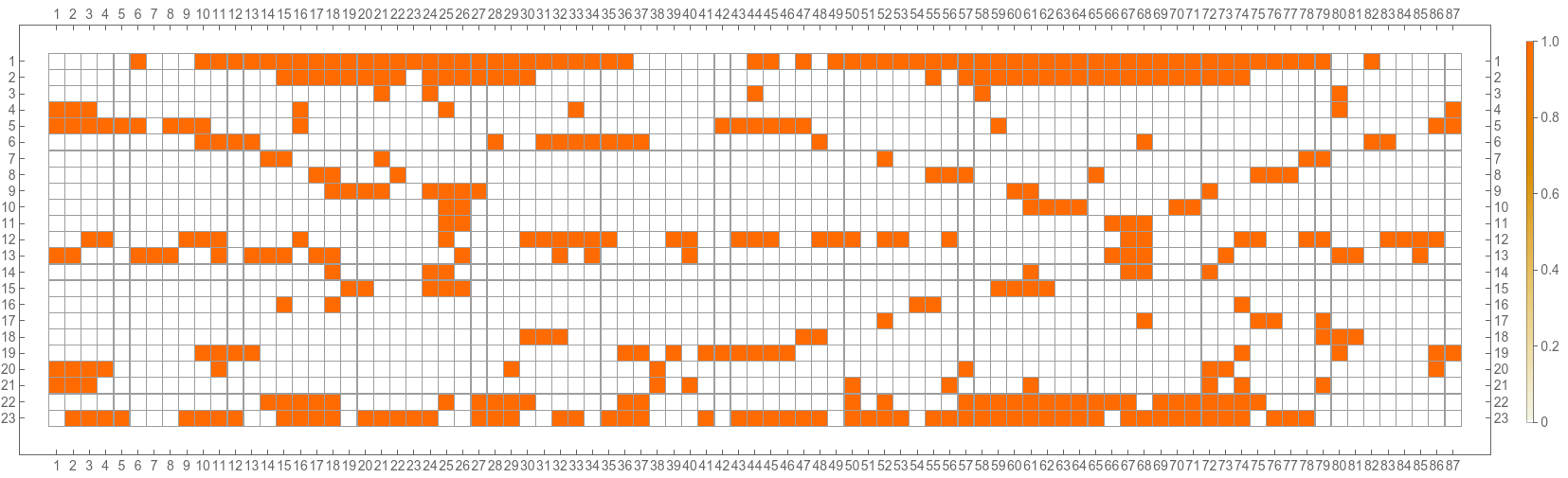
We found a promising configuration for the main magnet, with cube size of 19 mm, 19 rings with 2 layers each, with a predicted field of 90.8 mT @ 3745 ppm (Figs. 1, 2). The outer layer has +7 cubes with respect to the inner layer, indicating reasonable radial-packing. Optimization by differential evolution was fastest and led to the same solution in a high percentage of the runs. A total of 30,000 iterations, single-thread CPU, takes less than an hour in an AMD Ryzen 7 3700X processor. This configuration was simulated in COMSOL Multiphysics, predicting 89.3 mT @ 3900 ppm, indicating coercitivty effects are small. We built the magnet, and measured the field with a THM1176 probe, leading to 85 mT @ 11300 ppm. The best two shimming configurations used 7 mm cubes in 23 single-layer rings (87 cubes per ring), leading to 85 mT with 2500 ppm (1,-1,0), and 4100 ppm (1,0) (Fig.3) . We built both shimmings and measured 83 mT @ 6900 ppm (1,-1,0), and 87 mT @ 5100 ppm. Deviations from the simulated values stem from coercitivity effects, mechanical tolerances and/or lower remanence than specified, which we measure to be around 10%.Conclusions
We have built a Halbach magnet with an elliptic bore amenable to heads and large extremities with full-length gradient support, with 87mT @ 5100 ppm magnetic field, and which fits through doors and weighs 216 kg, by differential evolution. This paves the way for other small length-to-ratio ergonomic and portable MRI magnets.Acknowledgements
Project funded by: the EU (EIC Transition, 101136407), Spanish MICINN (PID2022-142719OB-C22), the Valencian Government (CIPROM/2021/003) and the Valencian Innovation Agency (INNVA1/2022/4).References
[1] H. Soltner, P. Blümler, Dipolar Halbach Magnet Stacks Made from Identically Shaped Permanent Magnets for Magnetic Resonance, Concepts in Magnetic Resonance Part A, 2010; Vol. 36A(4) 211–222.[2] T. O’Reilly, W. M. Teeuwisse, D. de Gans, K. Koolstra, A. G. Webb, In vivo 3D brain and extremity MRI at 50 mT using a permanent magnet Halbach array, Magnetic Resonance in Medicine 2021; 85(1), 495-505.
[3] T. Guallart-Naval et al., Portable magnetic resonance imaging of patients indoors, outdoors and at home, Scientific Reports 2022; 12, 13147.
[4] S. M. Lund , K. Halbach, Iron-free permanent magnet systems for charged particle beam optics, Fusion Engineering and Design 1996; 32-33, 401 415.
[5] S. Tewari, A. Webb, The permanent magnet hypothesis: an intuitive approach to designing non- circular magnet arrays with high field homogeneity, Scientific Reports 2023; 13, 2774.
[6] R. Storn, K. Price, Differential Evolution – A Simple and Efficient Heuristic for Global Optimization over Continuous Spaces, Journal of Global Optimization 1997; 11, 341–359.
[7] J. Bezanson, A. Edelman, S. Karpinski, V. B. Shah, Julia: A fresh approach to numerical computing, SIAM Review 2017; 59(1), 65-98.
[8] R. Feldt, BlackBoxOptim.jl, Github Repository.
[9] (Ipopt.jl is a wrapper of Ipopt -Part of the COIN-OR Initiative-). A. Wächter and L. T. Biegler, On the Implementation of a Primal-Dual Interior Point Filter Line Search Algorithm for Large- Scale Nonlinear Programming, Mathematical Programming 2006; 106(1), 25-57.
Figures