2821
Quantitative Susceptibility Mapping by Controllable Diffusion Models1University of Queensland, Brisbane, Australia, 2Central South University, Changsha, China
Synopsis
Keywords: Machine Learning/Artificial Intelligence, Quantitative Susceptibility mapping
Motivation: Current deep learning Quantitative Susceptibility Mapping (QSM) methods often rely on rigorous supervised training with paired data of the input and susceptibility maps and are only capable of specific one-to-one reconstructions.
Goal(s): In this study, we introduce the Diffusion Model QSM (DM-QSM), a controllable generative model capable of synthesizing high-quality susceptibility maps without the need for supervised training.
Approach: The DM-QSM method can produce controllable susceptibility maps with different measurements as the guidance.
Results: DM-QSM is versatile and suitable for many-to-one task including QSM super resolution and dipole inversion for both simulated and in-vivo tests.
Impact: This manuscript investigates the application of 3D generative models on QSM. It demonstrates robustness against acqusition artifacts for in-vivo test, and shows the potential beyond current tasks and is able to solve inverse problems like single-step QSM reconstruction.
Introduction
Existing deep learning methods [1, 2] proposed to address QSM problems by training one-to-one mappings between the susceptibility map and other modalities of measurements in a supervised manner, but they are limited to specific reconstruction problems, e.g., QSM dipole inversion, single-step reconstruction or super resolution, and fail to give reliable predictions if the test scenario differs from the training procedure. In this work, the capability of the score-based diffusion model for QSM was investigated, and an unsupervised approach named Diffusion Model QSM (DM-QSM) was demonstrated. The proposed method can successfully generate high-quality susceptibility maps under the guidance of different modalities, making it a versatile and well-suited approach for many-to-one mapping tasks.Methods
Diffusion processes and controllable generationsScore-based generative model [3] learns the underlying data distribution by matching the gradient of its log density, i.e., score. As showcased in Fig. 1(a), it employs a forward process as given by Eq. (1), which iteratively introduces noise as a stochastic different equation (SDE):\begin{equation}dx_t = f(t)x_t \, dt + g(t) \, dw_t \tag{1}\end{equation}Conversely, the reverse process aims to recover the data from noise corruption from the forward process. This can be formulated as a reverse SDE:\begin{equation}dx_t = \left[ f(t)x_t - g(t)^2 \nabla_{x_t} \log p_t(x_t) \right] dt + g(t) \, dw_t \tag{2}\end{equation}where the time-dependent score is fitted by a parameterized neural network as a denoising score-matching function at each step t:\begin{equation}L = E_{t \sim [0,1]} \left\| \nabla_{x_t} \log p_t(x_t) - \epsilon_{\theta}(x_t, t) \right\|^2 \tag{3}\end{equation}To perform a controllable generation under the guidance of different measurements, the diffusion posterior sampling (DPS) [4] is imposed after each iterative free generation $$$x'_{t-1}$$$:\begin{equation}x_{t-1} = x'_{t-1} - \xi \nabla_{x_t} \left\| y - A(\hat{x}_0) \right\|^2 \tag{4}\end{equation}where the step size ξ is a hyper-parameter balancing the guidance contributions. $$$A$$$ is the forward system matrix. $$$\hat{x}_0$$$ is the inverse of the forward process of $$$x_t$$$, and can be formulated as follows in the case of Variation Preserving (VP) SDE:\begin{equation}x'_{t-1} = \alpha_t \hat{x}_0 + \beta_t z \tag{5}\end{equation}$$$α_t$$$ and $$$β_t$$$ are dependent from $$$f(t)$$$ and $$$g(t)$$$ in Eq. (2).
Training dataset
We used QSM from the multi-orientation COSMOS [6] dataset from [7] and the training set of [8] for the generative model training. All 3D susceptibility maps were cropped into 483 patches with a step of 30 voxels for each dimension. Patches with more than 80% number of background voxels were removed.
Controllable full-size 3D susceptibility generation
At time T, patches of random noise with a size of 483 are initially generated. The number of patches is determined beforehand to ensure that the 3D assembly of all patches matches the shape of the measurement. To mitigate boundary effects during the generation process, as illustrated in Fig. 1(b), the patches are repeatedly assembled and disassembled at each step, with a dimension-wise overlap of S. An overlap mask, as depicted in Fig. 1(c), is calculated based on the number of repetitions, which divides the overlapping noise $$$ε_{t-1}$$$ after each denoising, similar to the approach presented in [9]. The step size ξ for posterior sampling is set to 0.5 and 2 for DipInv and SR tasks respectively. Considering the sampling time, the overlap S is set to 8.
Results
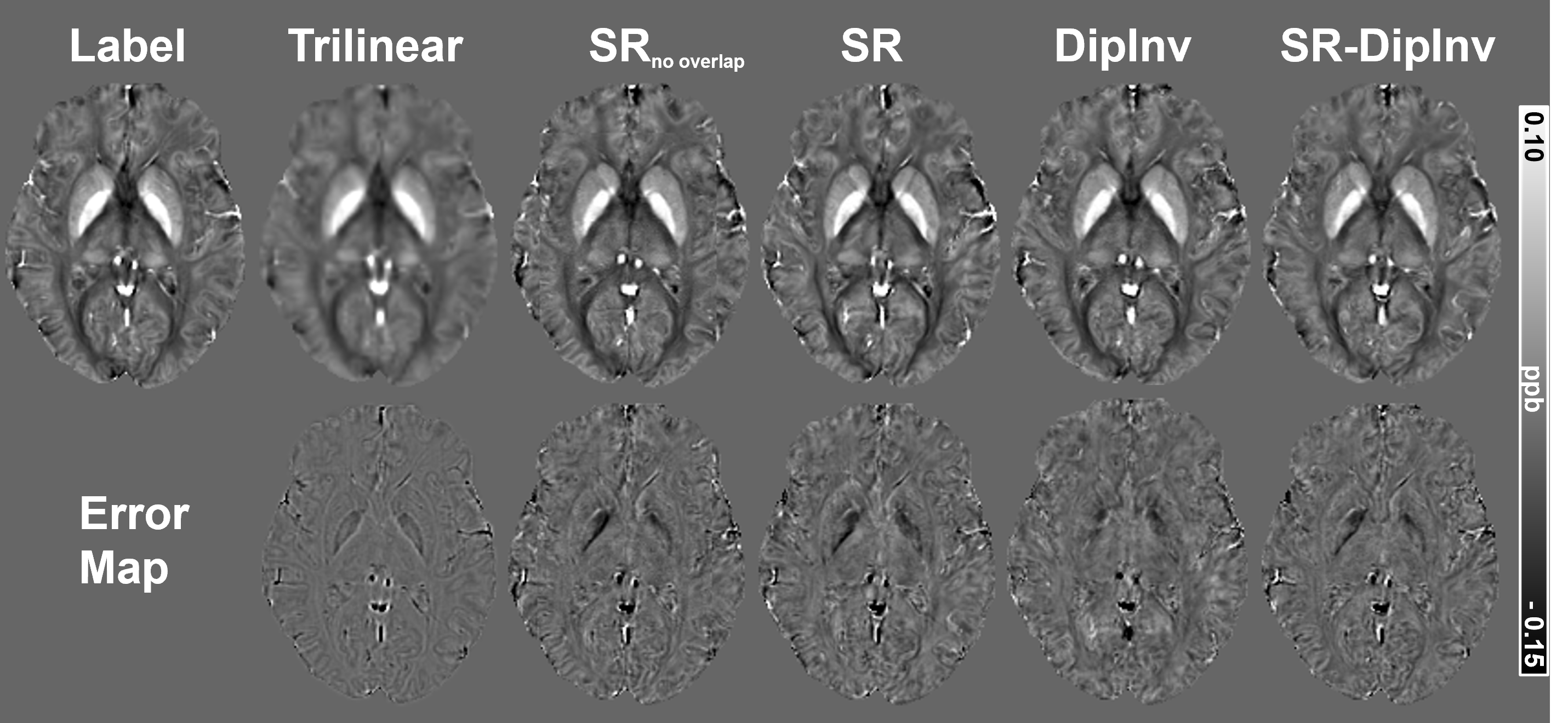
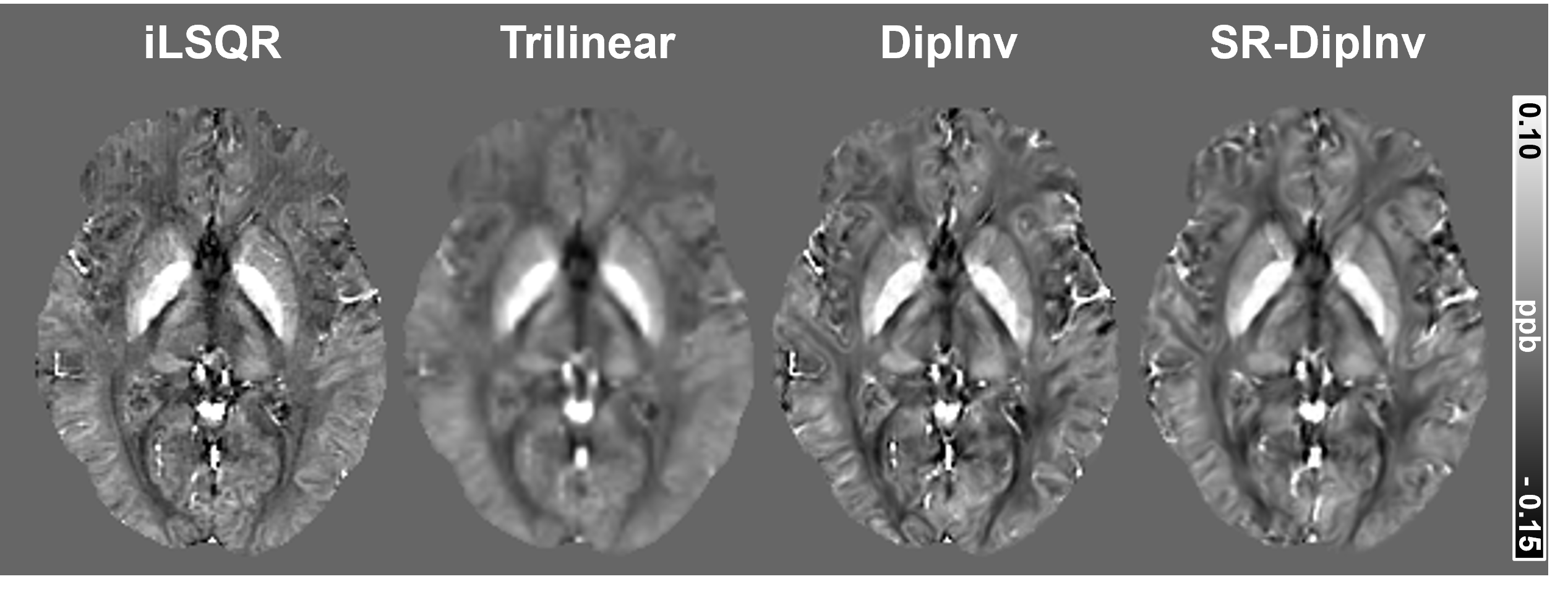
DM-QSM is evaluated using three susceptibility mapping tasks: QSM dipole inversion (DipInv), super resolution (SR), and their combination (SR-DipInv). The tasks utilize local field, low-resolution QSM, and low-resolution local field measurements, respectively. To standardize these tasks, DipInv and SR-DipInv formats are transformed to be SR tasks of TKD and LR-TKD initial estimations of a 0.1 truncation threshold. In the simulation test, DM-QSM was assessed on a 1mm³ COSMOS human brain, guided by a down-sampled 2mm³ label and simulated local fields at 1mm³ and 2mm³ resolutions. The ablation study for the overlapped generation was made by comparing the results of SR, where SR without overlapping suffered from boundary effect. Results showed DM-QSM’s enhanced generalizability across different inverse problems. For in-vivo testing on a 1mm³ human brain, DM-QSM maintained its generalizability and robustness. DipInv and SR-DipInv tasks, referenced to iLSQR results, showed DM-QSM achieved higher SNR and interestingly eliminated iLSQR’s parallel imaging artifacts, preserving anatomical details.Discussion and Conclusion
In contrast to conventional supervised learning methods designed for specific QSM reconstruction tasks, in this abstract, our approach introduces a generative model capable of producing susceptibility maps in a controlled manner under varying measurement conditions. This innovation enables the creation of a unified model with the potential to handle one-to-many tasks. In future research, we aim to explore the model's capabilities further, particularly in the context of single-step QSM and QSM reconstruction in multi-modal settings.Acknowledgements
Hongfu Sun acknowledges support from the Australian Research Council (DE210101297, DP230101628).References
[1] J. Yoon et al., "Quantitative susceptibility mapping using deep neural network: QSMnet," Neuroimage, vol. 179, pp. 199-206, Oct 1 2018, doi: 10.1016/j.neuroimage.2018.06.030.[2] Y. Gao et al., "Instant tissue field and magnetic susceptibility mapping from MRI raw phase using Laplacian enhanced deep neural networks," Neuroimage, vol. 259, p. 119410, Oct 1 2022, doi: 10.1016/j.neuroimage.2022.119410.
[3] Y. Song, J. Sohl-Dickstein, D. P. Kingma, A. Kumar, S. Ermon, and B. Poole, "Score-based generative modeling through stochastic differential equations," arXiv preprint arXiv:2011.13456, 2020.
[4] H. Chung, J. Kim, M. T. Mccann, M. L. Klasky, and J. C. Ye, "Diffusion posterior sampling for general noisy inverse problems," arXiv preprint arXiv:2209.14687, 2022.
[5] T. Liu, P. Spincemaille, L. De Rochefort, B. Kressler, and Y. Wang, "Calculation of susceptibility through multiple orientation sampling (COSMOS): a method for conditioning the inverse problem from measured magnetic field map to susceptibility source image in MRI," Magnetic Resonance in Medicine: An Official Journal of the International Society for Magnetic Resonance in Medicine, vol. 61, no. 1, pp. 196-204, 2009.
[6] Y. Shi, R. Feng, Z. Li, J. Zhuang, Y. Zhang, and H. Wei, "Towards in vivo ground truth susceptibility for single-orientation deep learning QSM: A multi-orientation gradient-echo MRI dataset," NeuroImage, vol. 261, p. 119522, 2022.
[7] K. W. Lai, M. Aggarwal, P. van Zijl, X. Li, and J. Sulam, "Learned Proximal Networks for Quantitative Susceptibility Mapping," Med Image Comput Comput Assist Interv, vol. 12262, pp. 125-135, Oct 2020, doi: 10.1007/978-3-030-59713-9_13.
[8] O. Özdenizci and R. Legenstein, "Restoring vision in adverse weather conditions with patch-based denoising diffusion models," IEEE Transactions on Pattern Analysis and Machine Intelligence, 2023.
[9] P. Dhariwal and A. Nichol, "Diffusion models beat gans on image synthesis," Advances in neural information processing systems, vol. 34, pp. 8780-8794, 2021.
[10] C. Saharia et al., "Photorealistic text-to-image diffusion models with deep language understanding," Advances in Neural Information Processing Systems, vol. 35, pp. 36479-36494, 2022.
[11] K. Shmueli, J. A. de Zwart, P. van Gelderen, T. Q. Li, S. J. Dodd, and J. H. Duyn, "Magnetic susceptibility mapping of brain tissue in vivo using MRI phase data," Magnetic Resonance in Medicine: An Official Journal of the International Society for Magnetic Resonance in Medicine, vol. 62, no. 6, pp. 1510-1522, 2009.
[12] J. Song, C. Meng, and S. Ermon, "Denoising diffusion implicit models," arXiv preprint arXiv:2010.02502, 2020.
[13] W. Li et al., "A method for estimating and removing streaking artifacts in quantitative susceptibility mapping," Neuroimage, vol. 108, pp. 111-22, Mar 2015, doi: 10.1016/j.neuroimage.2014.12.043.
Figures
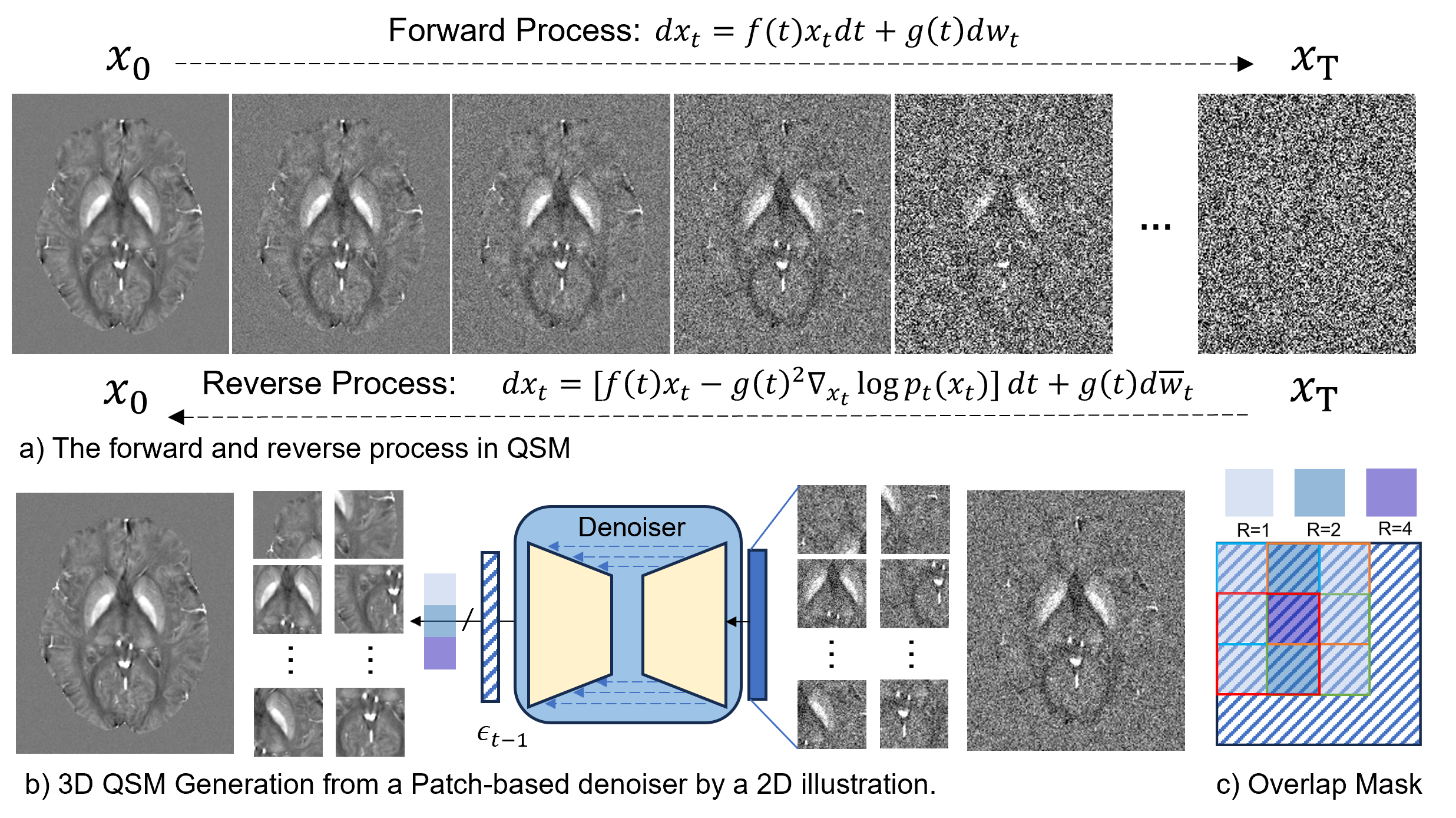
Figure. 1. a) The forward and reverse process for score-based QSM generative model. $$$x_0$$$ is gradually corrupted with noise $$$dx_t$$$ during the forward process during each time step t. The reverse process predicts the added noise and recovers the original QSM image. b) A step illustration of 3D QSM Generation from a Patch-based denoiser by a 2D illustration. c) The overlap mask for patch-based 3D image generation. Colours of the grids stand for different overlap times of R.