2817
One-Heartbeat Cine MRI with Implicit Neural Representations Reconstruction1Millennium Nucleus For Applied Control And Inverse Problems, Santiago, Chile, 2Department of Mathematics, Pontificia Universidad Católica de Chile, Santiago, Chile, 3Department of Mathematical Engineering, Universidad de Chile, Santiago, Chile, 4Institute for Biological and Medical Engineering, Pontificia Universidad Católica de Chile, Santiago, Chile, 5School of Engineering, Pontificia Universidad Católica de Chile, Santiago, Chile
Synopsis
Keywords: Machine Learning/Artificial Intelligence, Machine Learning/Artificial Intelligence, Reconstruction, cardiac cine imaging
Motivation: Cardiac cine MRI is the gold standard for cardiac functional assessment but requires acquiring several slices under multiple breath-holds, leading to limited number of cardiac phases, patient fatigue and misregistration between slices.
Goal(s): To develop a novel undersampled reconstruction based on Implicit Neural Representations (INR) to enable continuous cardiac cine MRI in a single heartbeat.
Approach: INRs allow implicitly regularized reconstruction of radial cardiac cine MRI without ECG gating. The proposed method is compared to a fully sampled acquisition and iterative SENSE in a healthy subject.
Results: The proposed approach shows comparable results to the fully sampled images but offering higher temporal resolution.
Impact: The proposed method allows implicitly regularized single heartbeat reconstruction of radial cardiac cine MRI without ECG gating, offerings potential improvements in cardiac cine acquisition efficiency and patient comfort.
INTRODUCTION
Cardiac cine MRI is the gold standard for cardiac functional assessment1. To reduce artifacts from respiratory motion, cardiac cine imaging is acquired under breath-holding (~15s), thus limiting its spatial and temporal resolution. Fully sampled images for each cardiac phase are desired, but its acquisition takes more than one heartbeat, so typically cardiac motion is assumed to be periodic, and retrospective ECG gating is applied to group/bin the segments of the k-space, acquired over several heartbeats, into a given number of cardiac phases2,3.In the last years deep-learning-based reconstructions4, such as unrolled neural networks, have been proposed to accelerate cardiac cine imaging, but usually require large databases for training, which are not always available. In the last few years there has been an increasing interest in self-supervised methods that do not require big databases, such as Deep Image Prior5,6 and Implicit Neural Representations (INR). INR in particular has shown promising results, allowing good-quality reconstructions with acceleration of up to 26x7–9.
In this work, INRs are used as implicit regularization in a golden-angle radial cardiac cine MRI reconstruction to enable single-heartbeat cine imaging. This approach (NF-cMRI) uses a spatio-temporal encoding that leverages the continuous nature of INRs to reconstruct the data without the need of ECG gating, thus enabling reconstruction of one cardiac phase per radial spoke. The proposed NF-cMRI method is evaluated in a healthy subject in comparison to the fully sampled acquisition and iterative SENSE (itSENSE) reconstruction.
METHODS
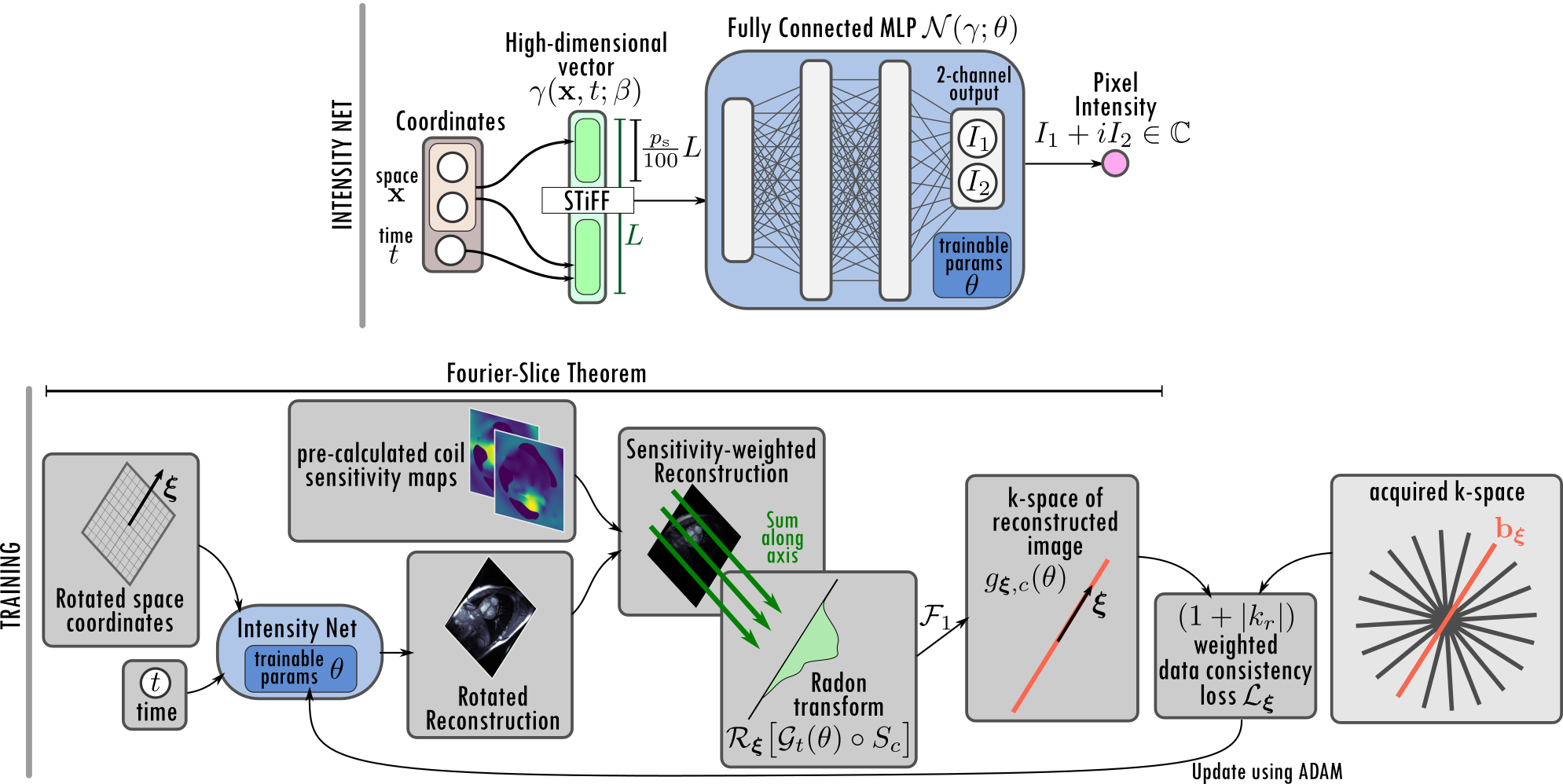
An INR10 is a fully connected multilayer perceptron (MLP) whose weights represent an image; every pixel is seen as an intensity value associated with a coordinate. An INR takes the coordinate as input and aims to predict the pixel intensity value. Evaluating a whole grid of coordinates creates a full image, whose k-space can be compared against the measured data to calculate a loss function. This loss allows updating the network weights using a gradient-descent-based technique.The well-known problem of spectral bias of INRs can be solved using Fourier Features11, a preprocessing step applied to the coordinates before passing them through the MLP. We use STiFF9, a spatiotemporal encoding for nearly-periodic dynamic images that mixes spatial Fourier Features with periodic time.
The proposed NF-cMRI approach relies on an INR called Intensity Net (Figure 1) that takes spatio-temporal coordinates and passes them through STiFF and a fully connected MLP to generate complex-valued intensities.
As a self-supervised method, the proposed NF-cMRI can be trained using undersampled data from a single subject, without a fully sampled reference image. This also means that reconstructing a different image needs retraining the network from scratch. A previously proposed9 simplified approach for training with radial data was used, leveraging the Radon Transform and the continuous nature of Intensity Net to remove the necessity of the NUFFT and allow a non-gated processing of the spokes.
EXPERIMENTS
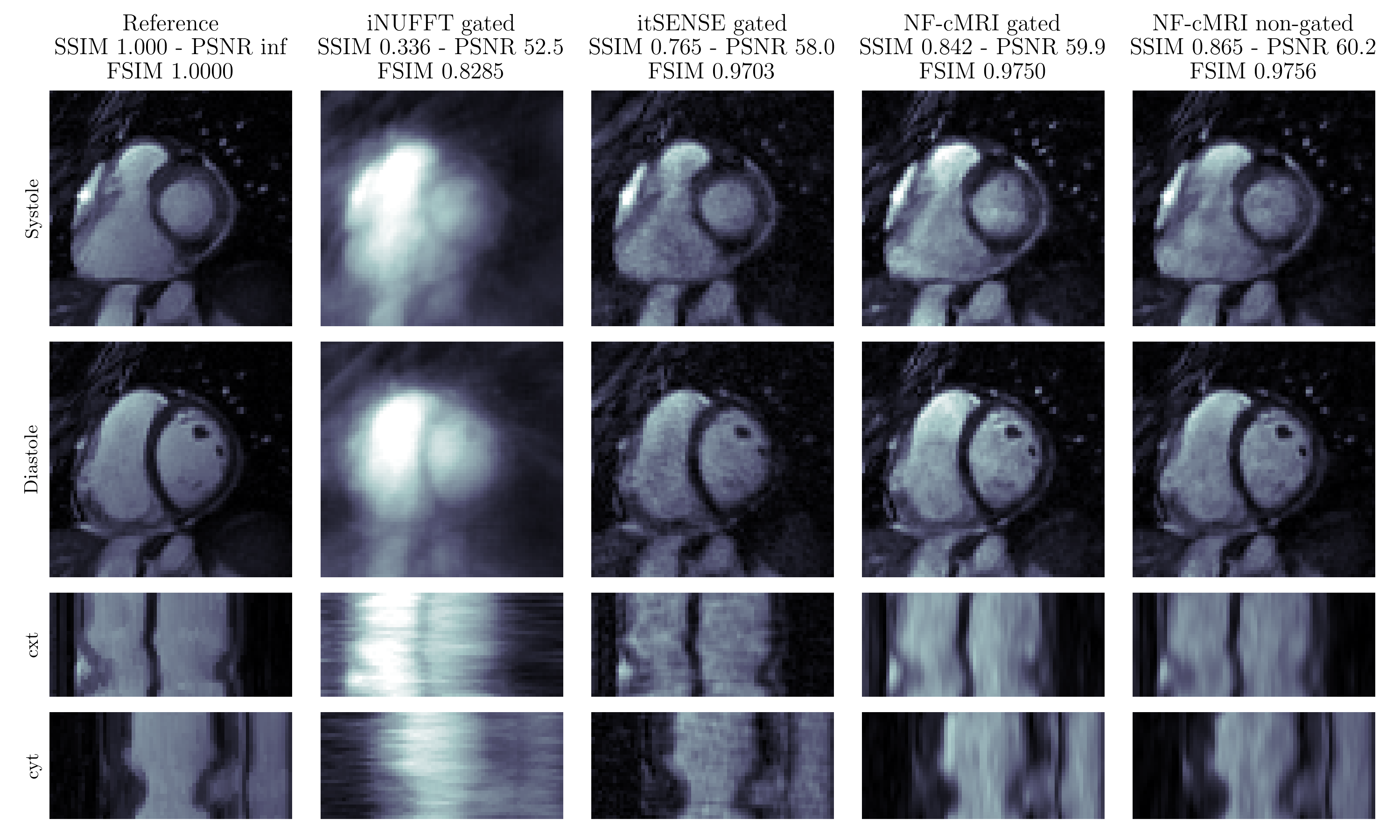
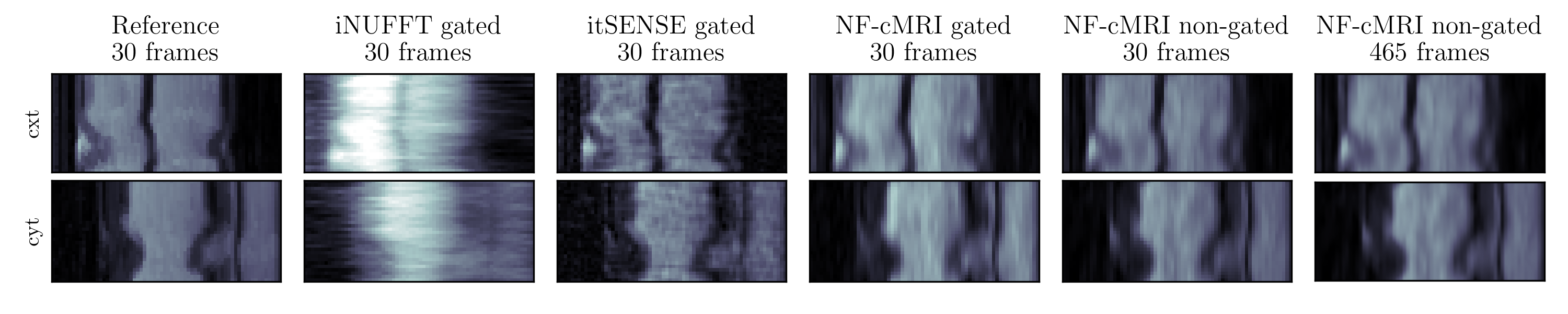
The proposed approach was evaluated on a healthy subject. Data was acquired at 1.5 T (Ingenia, Philips, Best, The Netherlands) with a 28-channel cardiac coil, acquiring 8960 radial spokes in a nominal scan time of ~20s. Imaging parameters were: field of view (FOV) = 256 x 256 mm2 ; 8 mm slice thickness; resolution = 2 x 2 mm2; TE/TR = 1.16/2.3 ms; b-SSFP readout; radial tiny golden angle of ~23.6°41-43; flip angle 60°.A reference fully sampled image was reconstructed from the 20 heartbeats binned into 30 cardiac phases, using itSENSE12 reconstruction, implemented in BART13. A single heartbeat from this acquisition was selected and the following reconstructions were performed: iNUFFT, itSENSE, and NF-cMRI on the gated data (30 cardiac phases); and NF-cMRI on the non-gated data (465 cardiac phases). These reconstructions were compared against the reference using structural similarity index (SSIM)14, feature similarity Index (FSIM)15, and peak signal-to-noise ratio (PSNR) metrics.
Hyperparameters for STiFF were $$$\sigma=7.5,p_{\text{s}}=80,L=1\,000$$$. MLP had $$$[512,512,512]$$$ ReLU-activated layers, optimized with ADAM16 (learning rate $$$7.5$$$) in ~30 min.
RESULTS
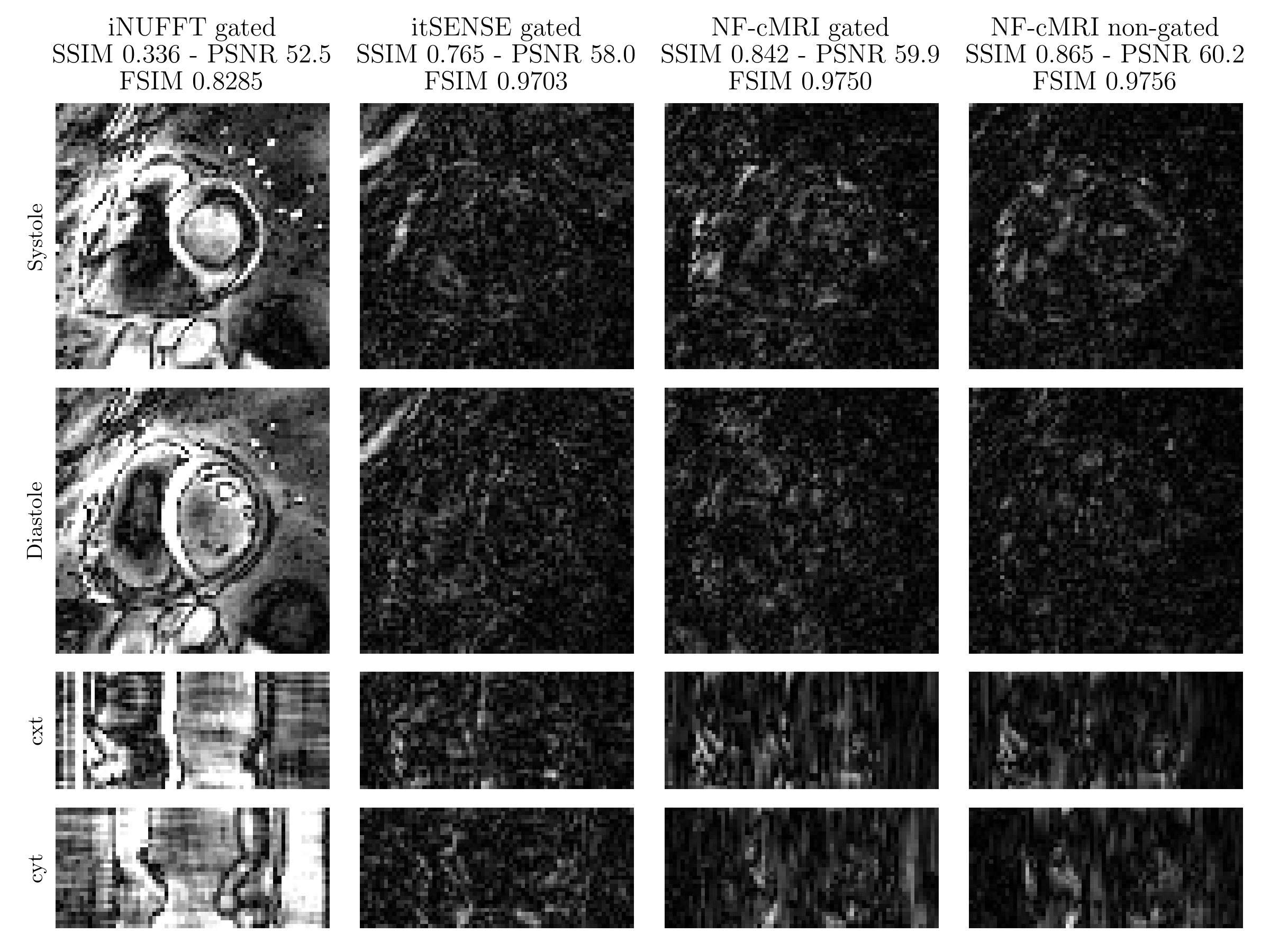
Reconstruction results for the proposed NF-cMRI singe-heartbeat cine imaging are shown in Figure 2 in comparison to NUFFT and itSENSE. The proposed approach shows comparable results to the fully sampled images for both gated and non-gated reconstructions, with some remaining spatial-temporal intensity variations. This is also observed in the difference images with respect to the fully sampled images, shown in Figure 3. Non-gated NF-cMRI offers increased temporal resolution with respect to gated approaches (Figure 4).CONCLUSION
We have presented an approach for single-heartbeat non-gated cine MRI using self-supervised Implicit Neural Representations reconstruction. This algorithm can be trained from the data itself, without a large training database. Further evaluation in a larger cohort of healthy subjects is warranted.Acknowledgements
This work was supported by the following grants: (1) Millennium Nucleus for Applied Control and Inverse Problems ACIP NCN19_161, (2) Millennium Institute for Intelligent Healthcare Engineering (iHEALTH) ICN2021_004References
1. Mojibian H, Pouraliakbar H. Chapter 8 - Cardiac Magnetic Resonance Imaging. In: Maleki M, Alizadehasl A, Haghjoo M, eds. Practical Cardiology. Elsevier; 2018:159-166. doi:10.1016/B978-0-323-51149-0.00008-0
2. Cruz G, Küstner T, Botnar RM, Prieto C. Cardiac imaging. In: Advances in Magnetic Resonance Technology and Applications. Vol 6. Elsevier; 2022:383-417. doi:10.1016/B978-0-12-824460-9.00034-0
3. Cruz G, Hammernik K, Kuestner T, et al. Single-heartbeat cardiac cine imaging via jointly regularized nonrigid motion-corrected reconstruction. NMR Biomed. 2023;36(9):e4942. doi:10.1002/nbm.4942
4. Hammernik K, Küstner T, Yaman B, et al. Physics-Driven Deep Learning for Computational Magnetic Resonance Imaging. Published online October 13, 2022. Accessed November 3, 2022. http://arxiv.org/abs/2203.12215
5. Ulyanov D, Vedaldi A, Lempitsky V. Deep Image Prior. Int J Comput Vis. 2020;128(7):1867-1888. doi:10.1007/s11263-020-01303-4
6. Yoo J, Jin KH, Gupta H, Yerly J, Stuber M, Unser M. Time-Dependent Deep Image Prior for Dynamic MRI. IEEE Trans Med Imaging. 2021;40(12):3337-3348. doi:10.1109/TMI.2021.3084288
7. Feng J, Feng R, Wu Q, Zhang Z, Zhang Y, Wei H. Spatiotemporal implicit neural representation for unsupervised dynamic MRI reconstruction. Published online January 13, 2023. doi:10.48550/arXiv.2301.00127
8. Huang W, Li HB, Pan J, Cruz G, Rueckert D, Hammernik K. Neural Implicit k-Space for Binning-Free Non-Cartesian Cardiac MR Imaging. In: Frangi A, de Bruijne M, Wassermann D, Navab N, eds. Information Processing in Medical Imaging. Lecture Notes in Computer Science. Springer Nature Switzerland; 2023:548-560. doi:10.1007/978-3-031-34048-2_42
9. Catalán T, Courdurier M, Osses A, Botnar R, Sahli-Costabal F, Prieto C. Unsupervised reconstruction of accelerated cardiac cine MRI using Neural Fields. Published online July 24, 2023. doi:10.48550/arXiv.2307.14363
10. Xie Y, Takikawa T, Saito S, et al. Neural Fields in Visual Computing and Beyond. Comput Graph Forum. 2022;41(2):641-676. doi:10.1111/cgf.14505
11. Tancik M, Srinivasan P, Mildenhall B, et al. Fourier Features Let Networks Learn High Frequency Functions in Low Dimensional Domains. In: Advances in Neural Information Processing Systems. Vol 33. Curran Associates, Inc.; 2020:7537-7547. Accessed November 9, 2022. https://proceedings.neurips.cc/paper/2020/hash/55053683268957697aa39fba6f231c68-Abstract.html
12. Feng L, Grimm R, Block KT, et al. Golden-angle radial sparse parallel MRI: combination of compressed sensing, parallel imaging, and golden-angle radial sampling for fast and flexible dynamic volumetric MRI. Magn Reson Med. 2014;72(3):707-717. doi:10.1002/mrm.24980
13. Blumenthal M, Holme C, Roeloffs V, et al. mrirecon/bart: version 0.8.00. Published online September 24, 2022. doi:10.5281/ZENODO.7110562
14. Wang Z, Bovik AC, Sheikh HR, Simoncelli EP. Image quality assessment: from error visibility to structural similarity. IEEE Trans Image Process. 2004;13(4):600-612. doi:10.1109/TIP.2003.819861
15. Lin Zhang, Lei Zhang, Xuanqin Mou, Zhang D. FSIM: A Feature Similarity Index for Image Quality Assessment. IEEE Trans Image Process. 2011;20(8):2378-2386. doi:10.1109/TIP.2011.2109730
16. Kingma DP, Ba J. Adam: A Method for Stochastic Optimization. CoRR. Published online December 22, 2014. Accessed June 29, 2023. https://www.semanticscholar.org/paper/Adam%3A-A-Method-for-Stochastic-Optimization-Kingma-Ba/a6cb366736791bcccc5c8639de5a8f9636bf87e8
Figures