2813
Self-supervised variational manifold learning: application to dynamic MRI of airway collapse in obstructive sleep apnea.1Roy J. Carver Department of Biomedical Engineering, The University of Iowa, iowa city, IA, United States, 2Department of Neurology, The University of Iowa, iowa city, IA, United States, 3Department of Otolaryngology, The University of Iowa, iowa city, IA, United States, 4Department of Electrical and Computer Engineering, The University of Iowa, iowa city, IA, United States, 5Department of Radiology, University of Iowa, iowa city, IA, United States
Synopsis
Keywords: Machine Learning/Artificial Intelligence, Machine Learning/Artificial Intelligence
Motivation: Recent manifold-based models use unsupervised generative Variational smoothness regularization on manifold framework for improved recovery. This unsupervised method lacks a well-defined automated early stopping criterion and rely on subjective qualitative assessment only.
Goal(s): We aim to adapt a physics-guided early stopping criterion to V-SToRM framework leveraging non-cartesian multi-slice acquisition.
Approach: We developed a self-supervised variational manifold recovery method where we modified the original variational manifold scheme to integrate an early stopping criterion.
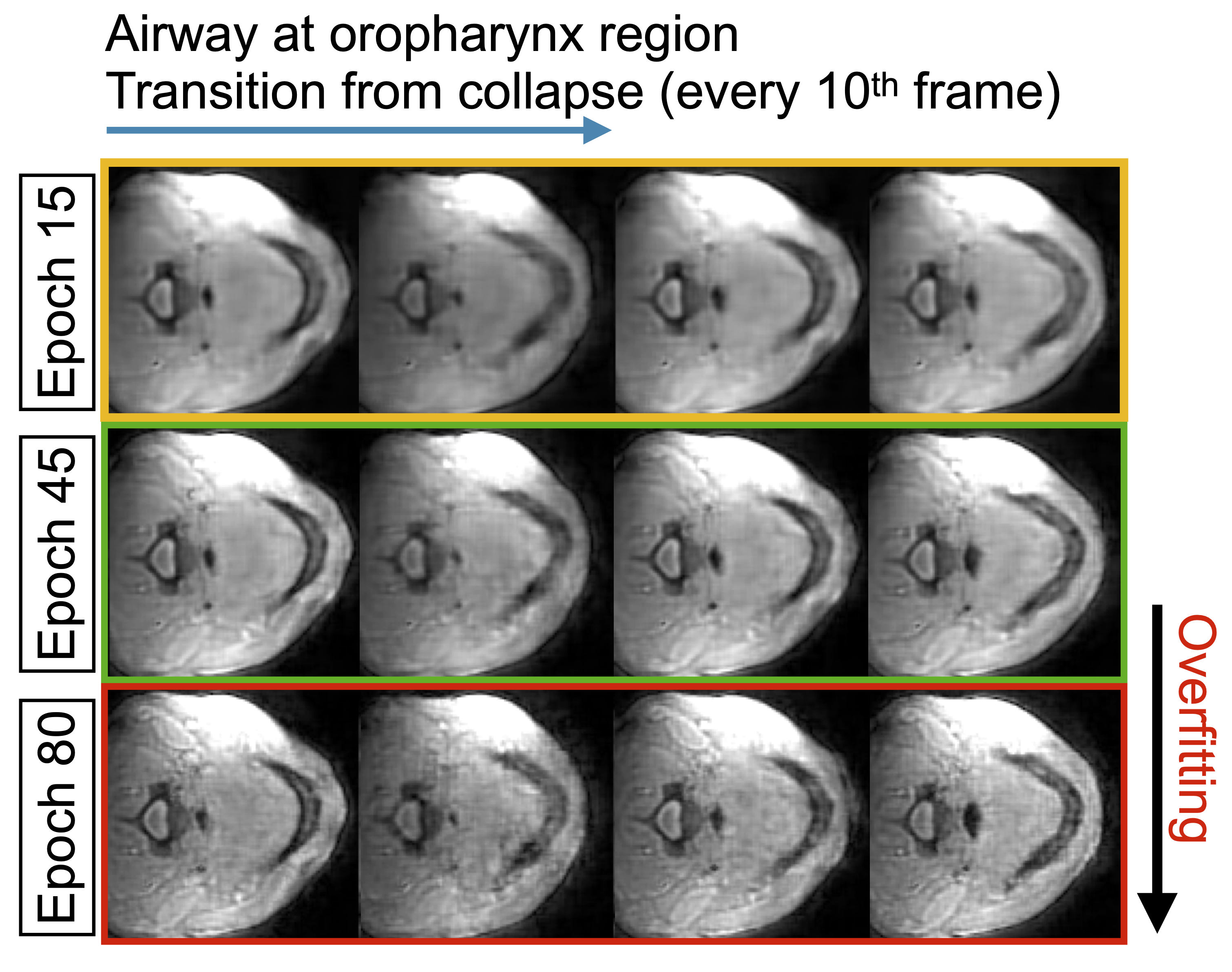
Results: With early-stopping criterion enforced, we observe a faithful reconstruction of spatiotemporal dynamics at epoch 45 and images without blocky/noise amplification artifacts at different temporal phases with suppressed temporal blurring artifacts.
Impact: While preserving the integrity of the ongoing joint learning of latent variables and generator weights, the adoption of early-stopping strategy in this context streamlines the computational complexity and consequently, rendering faithful and reproducible faster reconstructions.
PURPOSE
Manifold learning-based reconstruction constraints are emerging as powerful models to accelerate MRI, and have shown utility in several applications (e.g., free-breathing cardiac MRI1, dynamic speech imaging2, free-breathing lung imaging3, and dynamic sleep MRI4). Earlier models employed analysis manifold-based priors (e.g., smoothness regularization on manifold (STORM), kernel PCA5), but more recent models use generator based Variational STORM (V-STORM) framework for improved recovery. The V-STORM model utilizes an unsupervised approach to jointly learn CNN-based generator weights and 1D temporal latent vectors subject to data-consistency from undersampled data6. The advantage here is that this approach does not require any labelled dataset, distinguishing it from supervised algorithms. However, the unsupervised V-SToRM method lack a well-defined automated early stopping criterion and rely on subjective qualitative assessment only. Recently, Yaman et al. introduced a physics-guided early stopping criterion for deep unrolled algorithms, proposing disjoint splitting of acquired undersampled k-space data for training and validation7. Our objective is to adapt this physics-guided early stopping criterion to non-cartesian multi-slice dynamic imaging to the V-SToRM framework, and demonstrate its utility in characterizing dynamic upper airway collapse in obstructive sleep apnea.METHODS
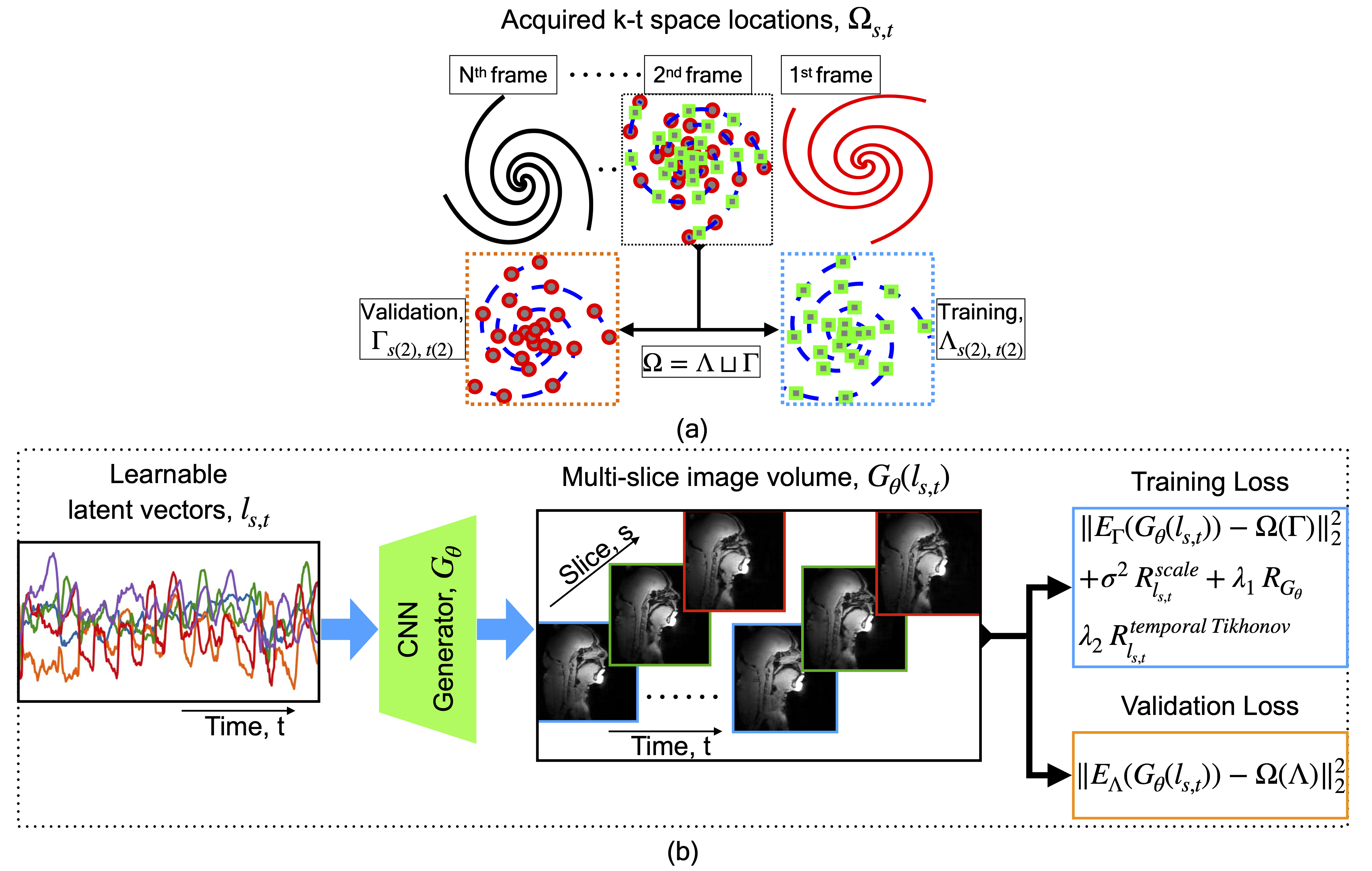
We conducted experiments on a GE 3 Tesla Premier scanner, imaging two obstructive sleep apnea (OSA) patients with a custom 16 channel airway coil8. A 2D gradient echo based variable density spiral sequence was implemented with 330 readout points, readout duration of ~1.3 ms, spatial resolution of 1.34mm2, and a field of view of 20cm2; requiring 72 interleaves for full sampling. Spiral arms were interleaved at golden angle ratio. The sequence was prescribed axially, with a slice thickness of 6 mm, TR ~6 ms, and a flip angle of 5 degrees. The sequence acquired 23 slices in the top-down direction in the axial orientation, with slice interleaving capturing raw data for all 23 slices before progressing to the next spiral arm. The sequence was run continuously for approximately 16minutes, when the subjects were asleep (as confirmed by simultaneously recorded respiratory effort and 02 saturation signals). For reconstruction, we resorted the raw data to two arms/frame (i.e., a time resolution of ~276 ms/frame). We developed a self-supervised variational manifold recovery method where we modified the original variational manifold scheme6 to integrate an early stopping criterion. We partitioned the multi-slice k-t space data into two disjoint sets: a training set and a validation set (also see Fig. 1(a)). The disjoint splitting was performed along each spiral arm independently in randomized fashion. The training set was used for calculating the data term required to update the generator weights and latent vectors while, the validation set monitored k-space data-consistency following each iteration of joint refinement, leading to automated early stopping to resist overfitting.RESULTS
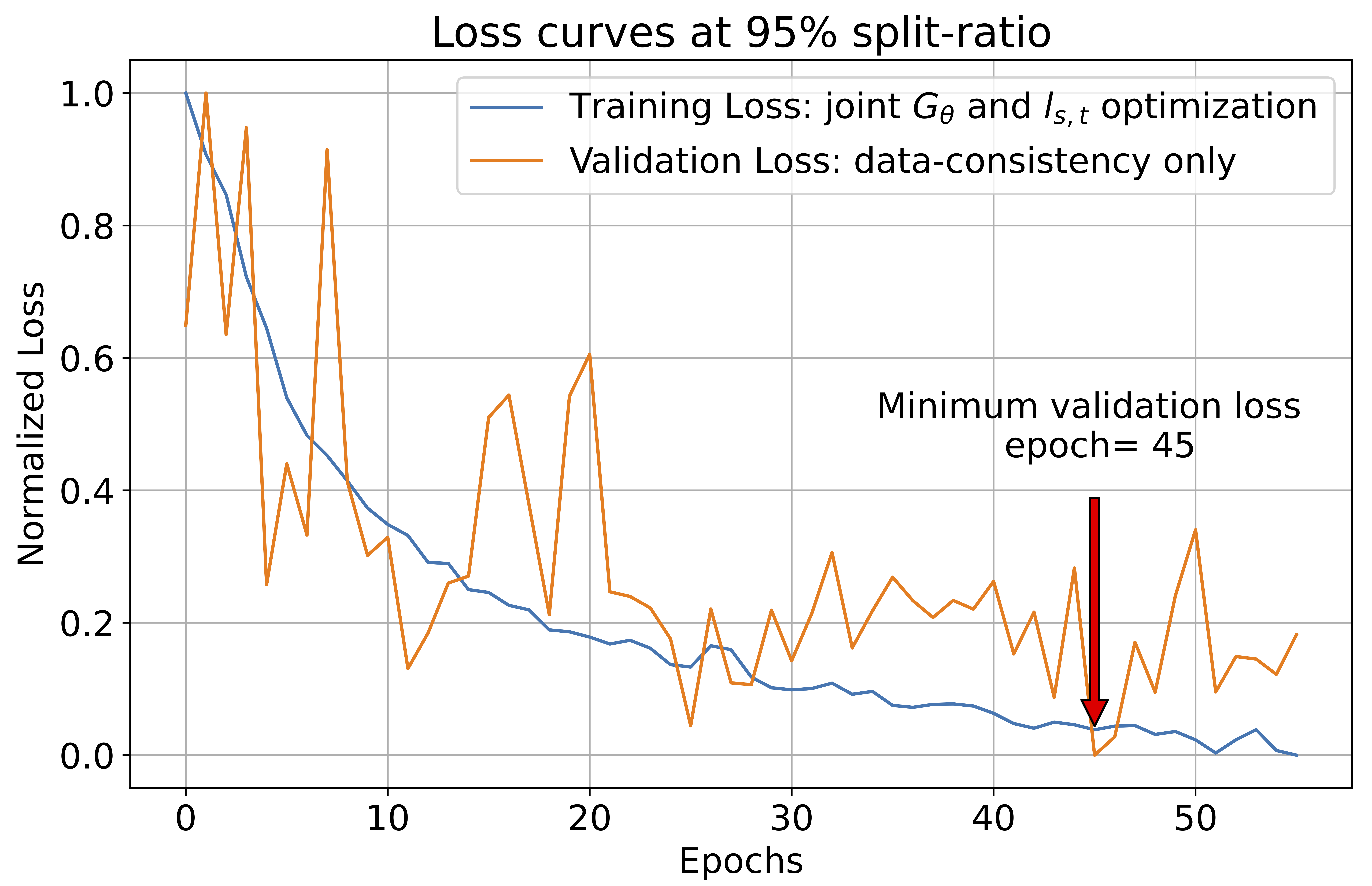
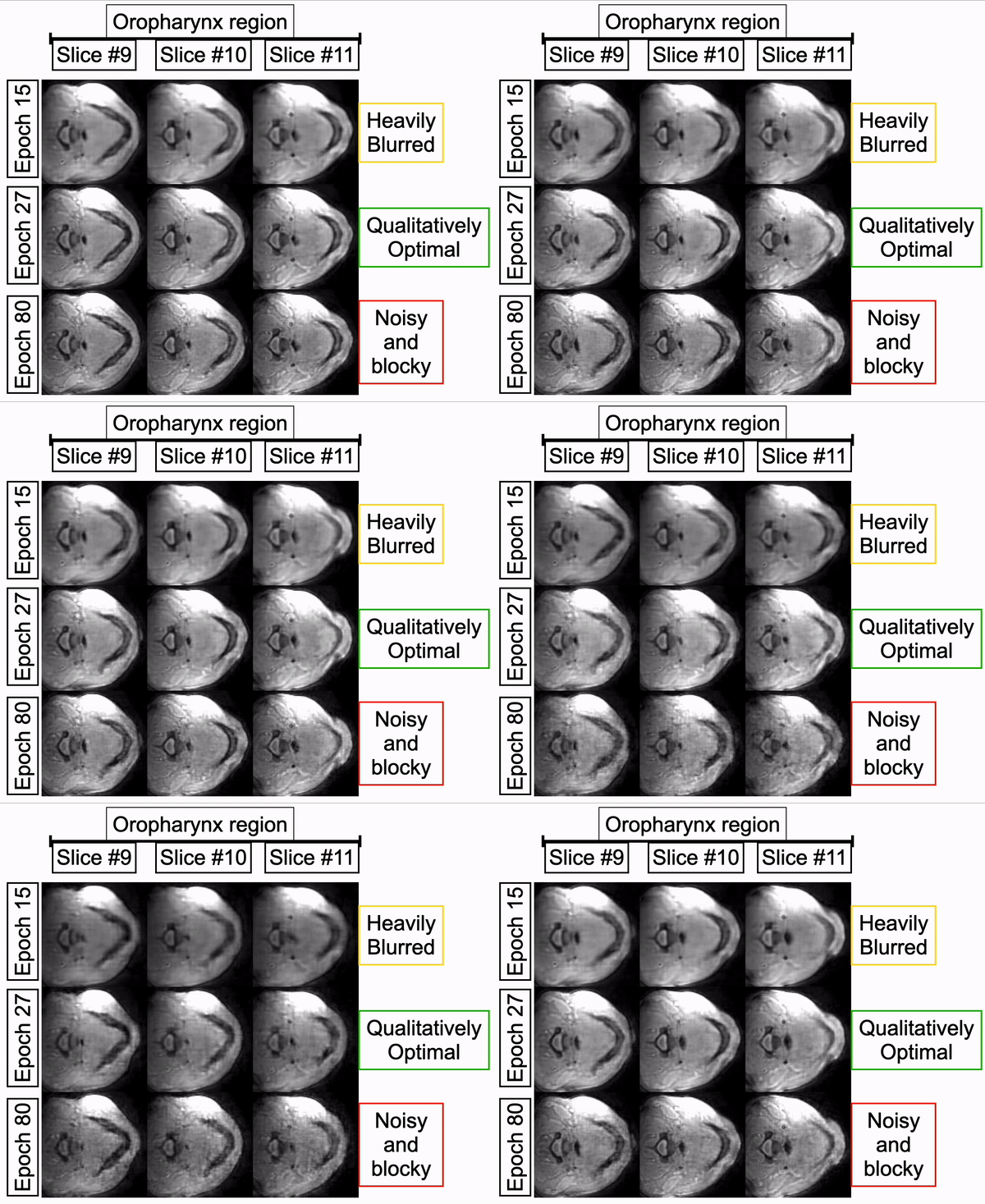
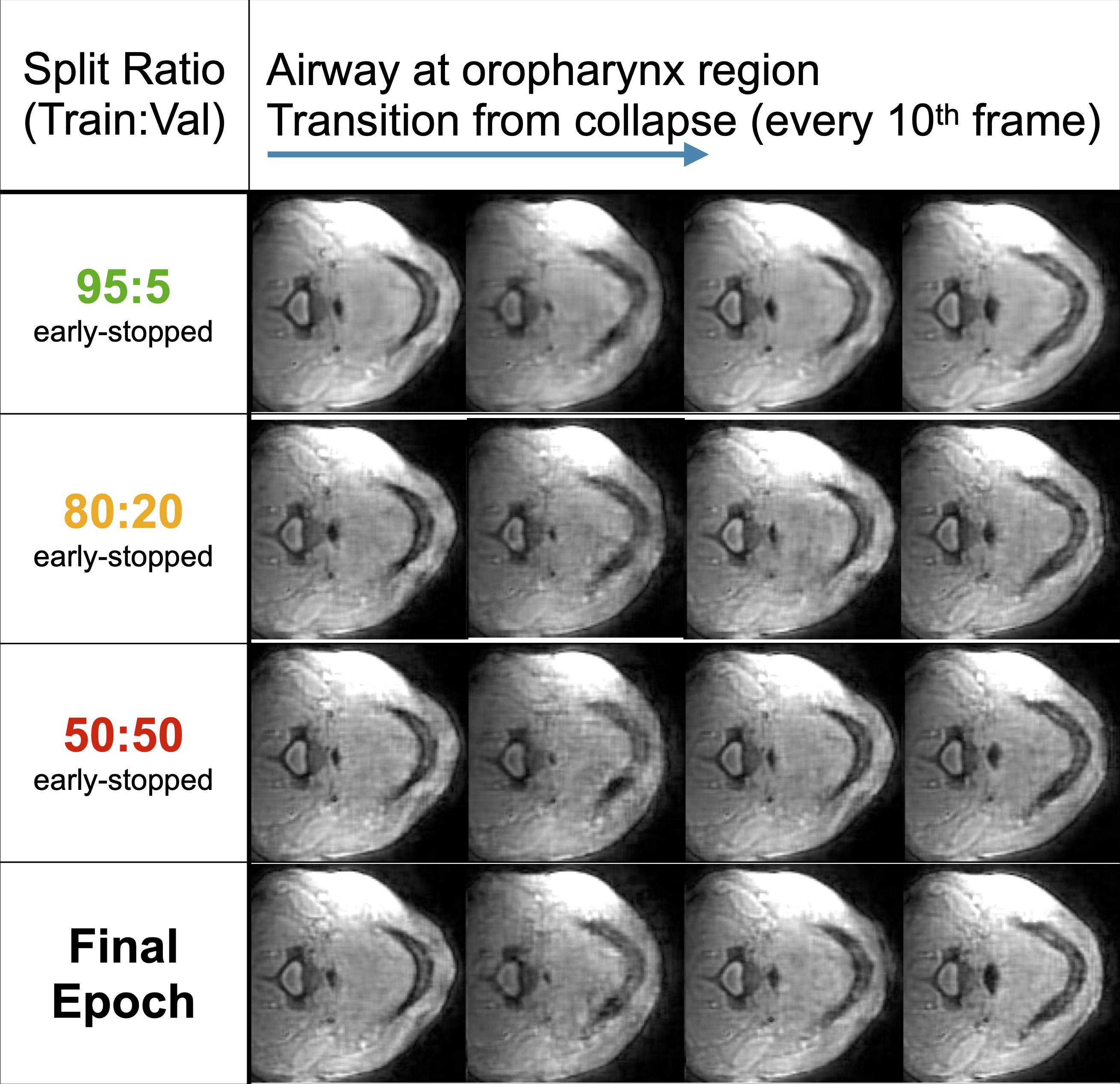
Fig. 2 displays the normalized training and validation losses at every iteration of joint learning until the minimum validation loss remains unchanged for ten consecutive iterations. Optimal generator weights and latent vectors were chosen at the epoch corresponding to the minimum validation loss. Fig. 3 shows the progression from heavy blurring at epoch 15 due to underfitting, to noise amplification at the air-tissue boundaries and blocky artifacts within soft tissue areas at epoch 80 due to overfitting. However, with early-stopping criterion enforced, we observe a faithful reconstruction of spatiotemporal dynamics at epoch 45 and images without blocky/noise amplification artifacts at different temporal phases with suppressed temporal blurring artifacts. Additionally, Fig. 3 presents a fast-forwarded animation (speed up factor of 3-fold) of sleep apnea dynamic imaging reconstruction of continuous three slices at Oropharynx region of the airway at epochs 15, 45, and 80. 95% split-ratio is considered in this reconstruction. In Fig. 4, we assess image reconstruction quality with different training and validation dataset split ratios, observing that an increased validation dataset size introduces overfitting as the data distribution between training and validation sets aligns.CONCLUSION
We demonstrated a self-supervised variational joint manifold learning approach for capturing upper airway dynamics in OSA patients. Our preliminary findings show that an early stopping criterion holds the potential for enabling self-validation within the V-SToRM and averting overfitting. Future work will include expanding this approach to more dynamic MRI applications beyond sleep imaging.Acknowledgements
This work was conducted on an MRI instrument funded by NIH-S10 instrumentation grant: 1S10OD025025-01.References
1. Poddar, Sunrita, and Mathews Jacob. "Dynamic MRI using smoothness regularization on manifolds (SToRM)." IEEE transactions on medical imaging 35.4 (2015): 1106-1115.
2. Rusho, Rushdi Zahid, et al. "Accelerated Pseudo 3D Dynamic Speech MR Imaging at 3T Using Unsupervised Deep Variational Manifold Learning." International Conference on Medical Image Computing and Computer-Assisted Intervention. Cham: Springer Nature Switzerland, 2022.
3. Zou, Qing, et al. "Dynamic imaging using motion-compensated smoothness regularization on manifolds (MoCo-SToRM)." Physics in medicine & biology 67.14 (2022): 144001.
4. Alam, Wahidul, et al. "Accelerated imaging of airway collapse in obstructive sleep apnea with variable density spirals and variational manifold learning." ISMRM. January 2023.
5. Arif, Omar, et al. "Accelerated dynamic MRI using kernel-based low rank constraint." Journal of medical systems 43 (2019): 1-11.
6. Zou, Qing, et al. "Variational manifold learning from incomplete data: application to multislice dynamic MRI." IEEE transactions on medical imaging 41.12 (2022): 3552-3561.
7. Yaman, Burhaneddin, Seyed Amir Hossein Hosseini, and Mehmet Akçakaya. "Zero-shot self-supervised learning for MRI reconstruction." arXiv preprint arXiv:2102.07737 (2021).
8. Alam, Wahidul, et al. "A flexible 16‐channel custom coil array for accelerated imaging of upper and infraglottic airway at 3 T." Magnetic resonance in medicine 89.5 (2023): 2117-2130.
Figures