2799
Image reconstruction performance using mixed real and synthetic MR phase training data1Radiology and Biomedical Imaging, University of California, San Francisco, San Francisco, CA, United States, 2Electrical Engineering and Computer Science, University of California, Berkeley, Berkeley, CA, United States
Synopsis
Keywords: Machine Learning/Artificial Intelligence, Image Reconstruction
Motivation: Prospectively developing MRI datasets with raw-kspace for MRI reconstruction is difficult, expensive and time-consuming. Generating synthetic k-space with synthetic phase as training data has been shown to work comparably for training MRI reconstruction models but its hard to access paired synthetic data.
Goal(s): How does training data consisting of mixed real and synthetic k-space (including synthetic phase) affect image reconstruction performance.
Approach: Five variational networks were trained with varying amounts of mixed real and synthetic training data. Image quality metrics were used to evaluate the quality of reconstructed images.
Results: Adding small amounts of real training data helps increase reconstruction performance.
Impact: The results suggest that small addition of real training data in addition to using mostly synthetic training data can help reconstruction performance. This could be useful clinically where synthetic data can augment models trained with small amounts of real data.
Introduction
Despite the proliferation of deep learning for accelerated acquisition and enhanced image reconstruction, aggregation of large and diverse MRI datasets continues to pose a barrier for effective clinical translation of these technologies. One major challenge is in retaining the MRI phase (required for image reconstruction) in clinical scanning, as only magnitude images are typically saved and used for clinical assessment and diagnosis.While several academic medical centers have begun the long concerted effort to upgrade clinical database systems and overcome regulatory and standardization issues, current databases have limitations such as lack of diversity in anatomy and pathology, lack of diversity of acquisition types, and contained preprocessed magnitude-only data which can lead to biased results1 all of which limit the generalization potential and clinical viability of advanced reconstruction models2. Our prior work3 addressed synthetic phase generation using a one-to-one image translation model4 framework to generate synthetic phase images from input magnitude images. However in many cases, it is not practical to have access to a full dataset to create a synthetic phase image for every corresponding magnitude image. A more practical scenario would be using a subset of real data and synthetic data to train image reconstruction. In this work we train a Variational Network5 with different mixtures of real and synthetic data and compare the performance to ground truth reconstructions. Our results suggest that only a small amount of real training data is necessary to increase the performance when complimented with synthetic training data.Methods
DatasetWe used 16-coil (22691 training, 6541 test) from the fastMRI dataset6 consisting of raw k-space with corresponding T1 T2, and FLAIR contrast brain images acquired at 1.5T and 3T with a fast spin echo (FSE) pulse sequence with an echo train length (ETL) of 4. Synthetic phase images for each corresponding raw k-space sampled were generated using our previously reported method. Corresponding magnitude images were combined with synthetic phase images and with ESPIRiT7 synthetic multicoil k-space was generated
Evaluation
To evaluate the effect of mixing real and synthetic training data, five Variational Networks were trained with the following data makeup: 1. ground truth reconstructions 2. 100% real data, 75% real data 25% synthetic, 50% real data, 50% synthetic data, 25% real data, 75% synthetic data, and 100% real data. Equispaced undersampling masks (at R= 4 acceleration factors) with a center fraction of 0.04 were applied to k-space.
Each trained image reconstruction model was then run on the same ground-truth test set (235 images) and the quality of reconstructed magnitude images was evaluated using standard quantitative image reconstruction metrics: PSNR, SSIM, NMSE.
Results and Discussion
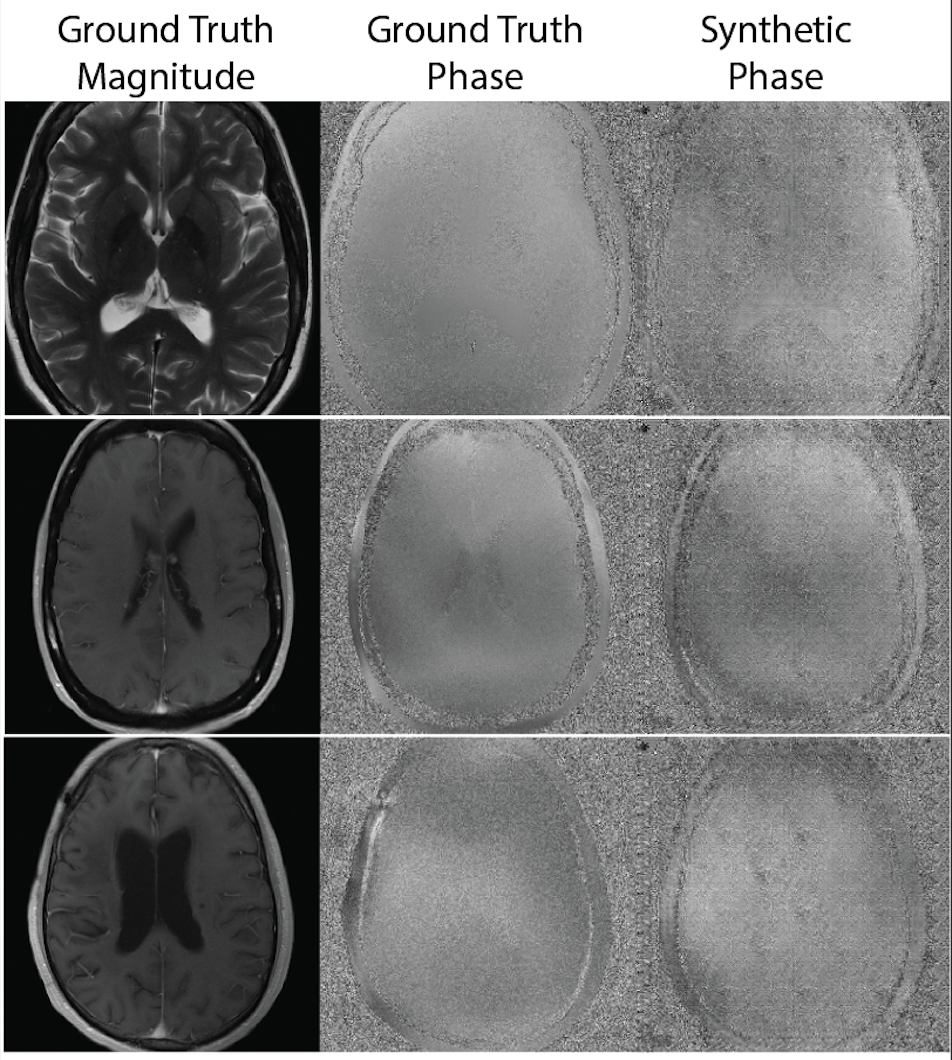
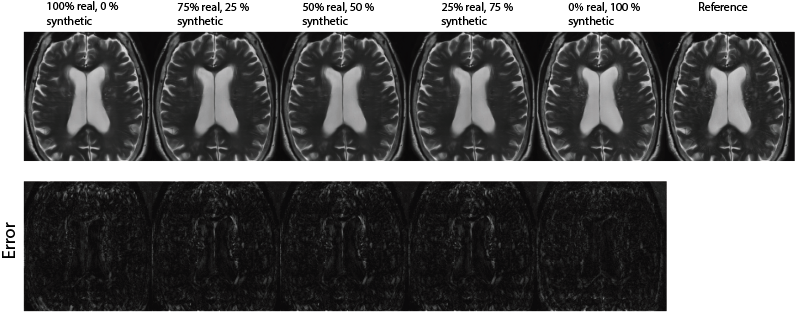
Figure 1 shows synthetic phase maps generated using our prior reported method. The images showcase low spatial-frequency components and tissue contrast but suffer from some blocking artifacts. From Figure 2, reconstructed images trained on increasing synthetic data have slightly more prominent error maps compared to images trained on more real data, although visually there are no obvious artifacts in either method. Additionally we can see more errors in high resolution features, possibly due to the lack of high frequency details in the synthetic phase images. These lack of details could also manifest during image reconstruction where the model tries to "fill in" features that it never sees. Table 1 shows measured PSNR, NMSE, and SSIM on the 5 trained variational networks. From the table, a small increase in real data resulted in better metrics in all 3 measurements, however increasing amount of real data proportion in the training dataset seems to have diminishing returns.Conclusion
In this work we assessed the effect of mixing real and synthetic MR phase on the performance of MRI reconstruction using Variational Network. Our results suggest that mixing a little amount of real phase into the training data (25%) can have a noticeable impact on image reconstruction performance, but the impact diminishes as the proportion of real data increasing in the training set.Acknowledgements
No acknowledgement found.References
[1] Efrat Shimron, Jonathan I. Tamir, Ke Wang, and Michael Lustig. Implicit data crimes: Machine learning bias arising from misuse of public data. Proceedings of the National Academy of Sciences, 119(13), March 2022.
[2] Kerstin Hammernik, Thomas Ku ̈stner, Burhaneddin Yaman, Zhengnan Huang, Daniel Rueckert, Florian Knoll, and Mehmet Akc ̧akaya. Physics-driven deep learning for computational magnetic resonance imaging, 2022.
[3] Nikhil Deveshwar, Abhejit Rajagopal, Sule Sahin, Efrat Shimron, and Peder E. Z. Larson. Synthesizing complex-valued multicoil MRI data from magnitude-only images. Bioengineering, 10(3):358, March 2023.
[4] Phillip Isola, Jun-Yan Zhu, Tinghui Zhou, and Alexei A. Efros. Image-to-image translation with conditional adversarial networks. In 2017 IEEE Conference on Computer Vision and Pattern Recognition (CVPR). IEEE, July 2017
[5] Anuroop Sriram, Jure Zbontar, Tullie Murrell, Aaron Defazio, C. Lawrence Zitnick, Nafissa Yakubova, Florian Knoll, and Patricia Johnson. End-to-end variational networks for accelerated MRI reconstruction. In Medical Image Computing and Computer Assisted Intervention – MICCAI 2020, pages 64–73. Springer International Publishing, 2020.
[6] Florian Knoll, Tullie Murrell, Anuroop Sriram, Nafissa Yakubova, Jure Zbontar, Michael Rabbat, Aaron De-fazio, Matthew J. Muckley, Daniel K. Sodickson, C. Lawrence Zitnick, and Michael P. Recht. Advancingmachine learning for MR image reconstruction with an open competition: Overview of the 2019 fastMRIchallenge. Magnetic Resonance in Medicine, 84(6):3054–3070, June 2020.
[7] Martin Uecker, Peng Lai, Mark J. Murphy, Patrick Virtue, Michael Elad, John M. Pauly, Shreyas S. Vasanawala,and Michael Lustig. ESPIRiT-an eigenvalue approach to autocalibrating parallel MRI: Where SENSE meetsGRAPPA. Magnetic Resonance in Medicine, 71(3):990–1001, May 2013.8
Figures