2789
Accelerating MR Reconstruction with encoding perturbations using a diffusion model1University of Queensland, Brisbane, Australia, 2Soochow University, Suzhou, China, 3Central South University, Changsha, China, 4Northwestern Polytechnical University, Xi An, China, 5University of Queensland, Brisbane, China
Synopsis
Keywords: Image Reconstruction, Machine Learning/Artificial Intelligence
Motivation: Image distortions caused by encoding perturbations and slow MR acquisitions compromise real-time MRI-guided radiotherapy treatments.
Goal(s): We aim to develop and investigate a diffusion model-based method to accelerate MR reconstruction with encoding perturbations.
Approach: The diffusion model was trained by 180,670 T1-weighted brain images from a public MR dataset and nonuniform fast Fourier transform was applied to operate forward encoding process with perturbations.
Results: Imaging results showed that the proposed network enabled fast MR image reconstruction with corrected geometric distortions for any subsampling patterns.
Impact: The developed diffusion model to accelerate MR reconstruction with perturbations. The results demonstrated that the proposed method enabled fast distortion-corrected image reconstruction for any subsampling patterns.
Introduction
Conventional clinical MRI image reconstruction is operated under the assumption that encoding fields are perfectly linear. However, due to the hardware limitations and system imperfections, gradient field nonlinearity and B0 field inhomogeneity will inevitably exist cross the field of view (FOV), which causes perturbations in the encoding process [1]. The encoding perturbations will introduce image distortions and limit geometric fidelity, potentially compromising MRI-guided radiotherapy treatments where geometric precision within sub millimetre is required. In addition, slow MR acquisition and image reconstruction hinder the application of real-time image guidance. Recently, we developed an interpretable DCReconNet to rapidly reconstruct distortion-corrected images from the k-space, and imaging results have demonstrated better performance than the conventional compressed sensing (CS)-based method [2]. However, this supervised deep learning method requires paired data for training and has limited generalizability for different subsampling patterns. In this work, we proposed a diffusion model-based reconstruction pipeline to accelerate MR reconstruction with encoding perturbations. Simulated and experimental brain dataset with fully sampled and retrospectively subsampled acquisitions from an MRI-Linac were used to investigate the proposed method.Method
The forward MRI encoding model with perturbationsThe forward MRI encoding process with perturbations can be formulated as:
$$m\tilde{F}x = b$$ (1)
where $$$b$$$ is the measured k-space signal; $$$m$$$denotes the undersampling matrix and $$$x$$$is the distortion-corrected image. $$$\tilde{F}$$$ is the Fourier transform matrix with the kernel of $$$\tilde{e}=e^{-2\pi jk\tilde{L}}$$$, where $$$\tilde{L}$$$ is the distorted position caused by encoding perturbations, e.g., gradient nonlinearity and B0 inhomogeneity. It is noted that $$$\tilde{F}x $$$ represents a nonuniform Fourier transform operation and can be calculated by Type-I Nonuniform Fast Fourier Transform (NUFFT).
The Diffusion model for MR Reconstruction with encoding perturbations
Recently, the denoising diffusion probabilistic model (DDPM) has shown superior performances in the image generation field and thus can be used as a deep generative prior for MR image reconstruction [3]. Due to its generative nature, the DDPM-based MR reconstruction method has great generalization capability, making it agnostic to subsampling patterns. The diffusion process, gradually introduces Gaussian noise into the original image, progressively diminishing image fidelity until it ultimately converges to a representation of Gaussian noise [4]. The diffusion process is exclusively applied during the training phase. The reverse process employs the trained network and data consistency to complete the transformation from Gaussian noise to image data ultimately. The problem could be formulated as:
$$s = arg{min}_s ||m\tilde{F}s - b|| + \lambda D(s)$$, (2)
where $$$||m\tilde{F}s - b||$$$ represents the data fidelity term and $$$m\tilde{F}s$$$ is data consistency term. Moreover, $$$s$$$ should adhere to specific prior knowledge regarding MR images, as characterized by the regularization term denoted as $$$D(*)$$$. Here $$$D(s)$$$ is generated by the reverse process of the diffusion model.
Data preparation and network training
In this work, 180,670 T1-weighted brain images from a public MR dataset (IXI dataset) [5] were used to train the diffusion model. The imaging parameters were: voxel size = 150 × 256 × 256. The proposed model was trained on an Nvidia Tesla V100 GPU (32G) for 100 epochs (~450 hours) using these images with Adam optimizer. Another 300 brain images were used to simulate testing data with AF=4 and AF=6. The spherical harmonic method was applied to generate encoding perturbation information as shown in Eq. (1).
Results
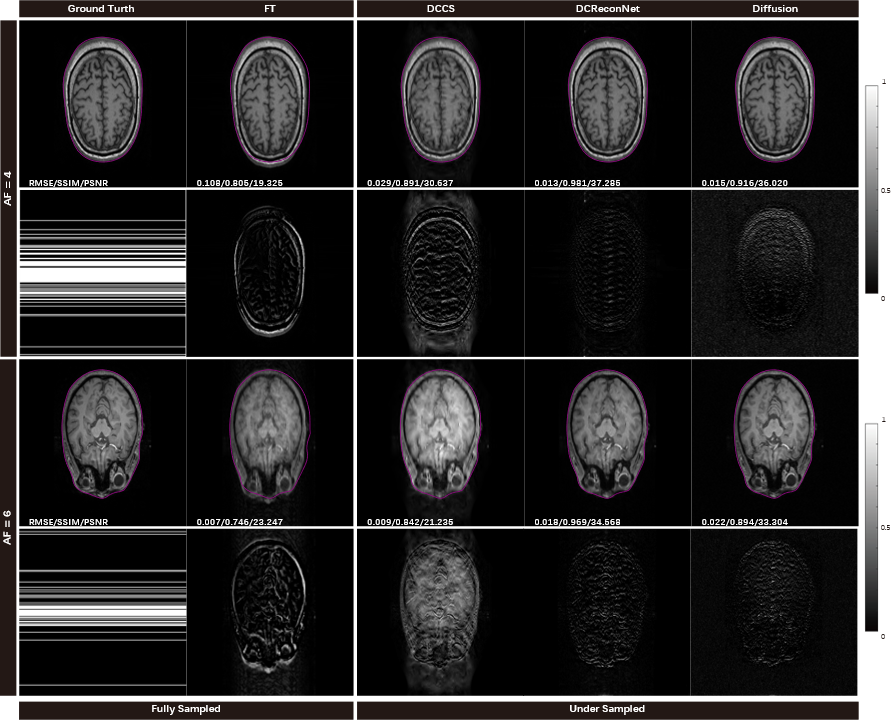
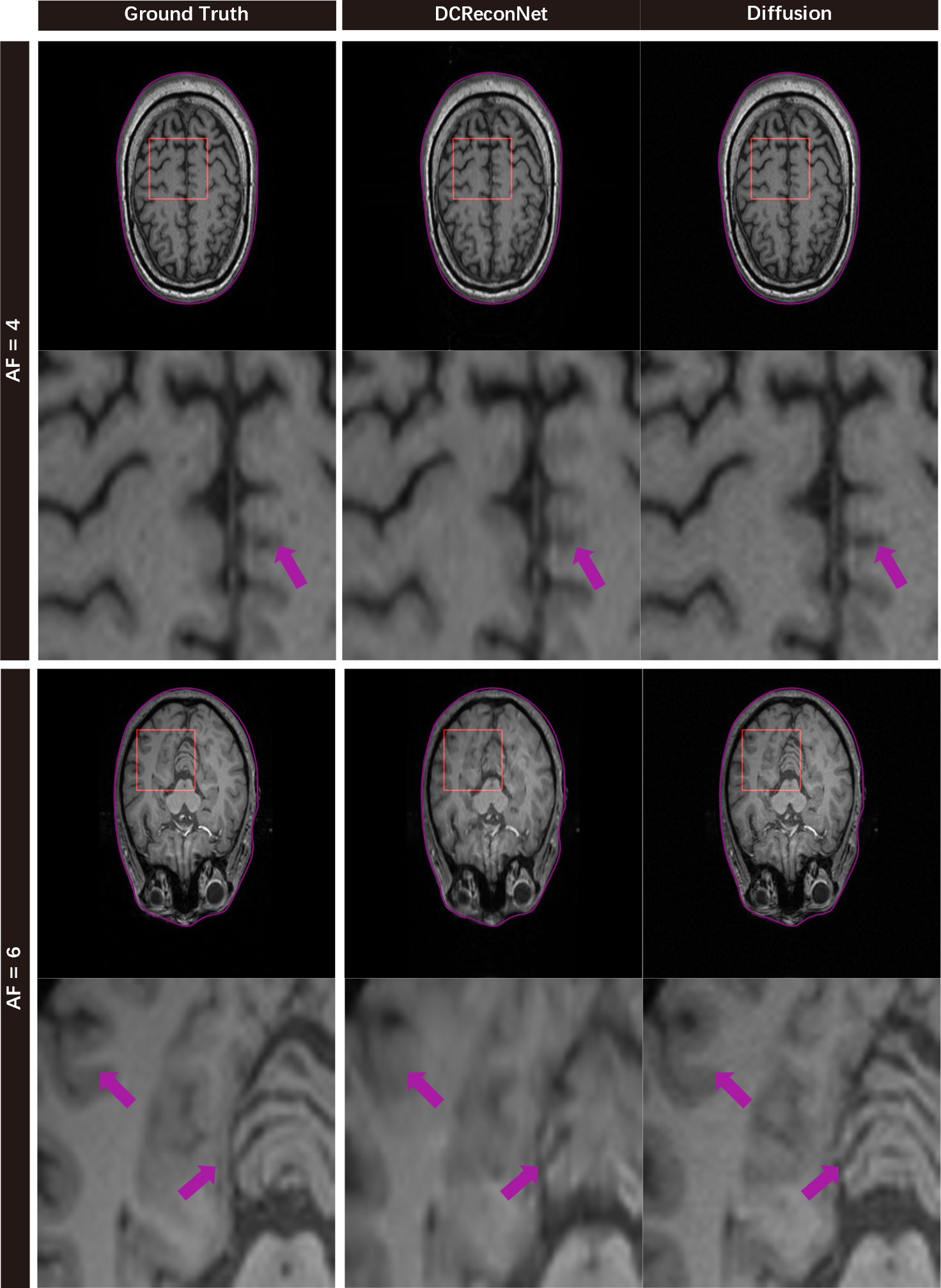
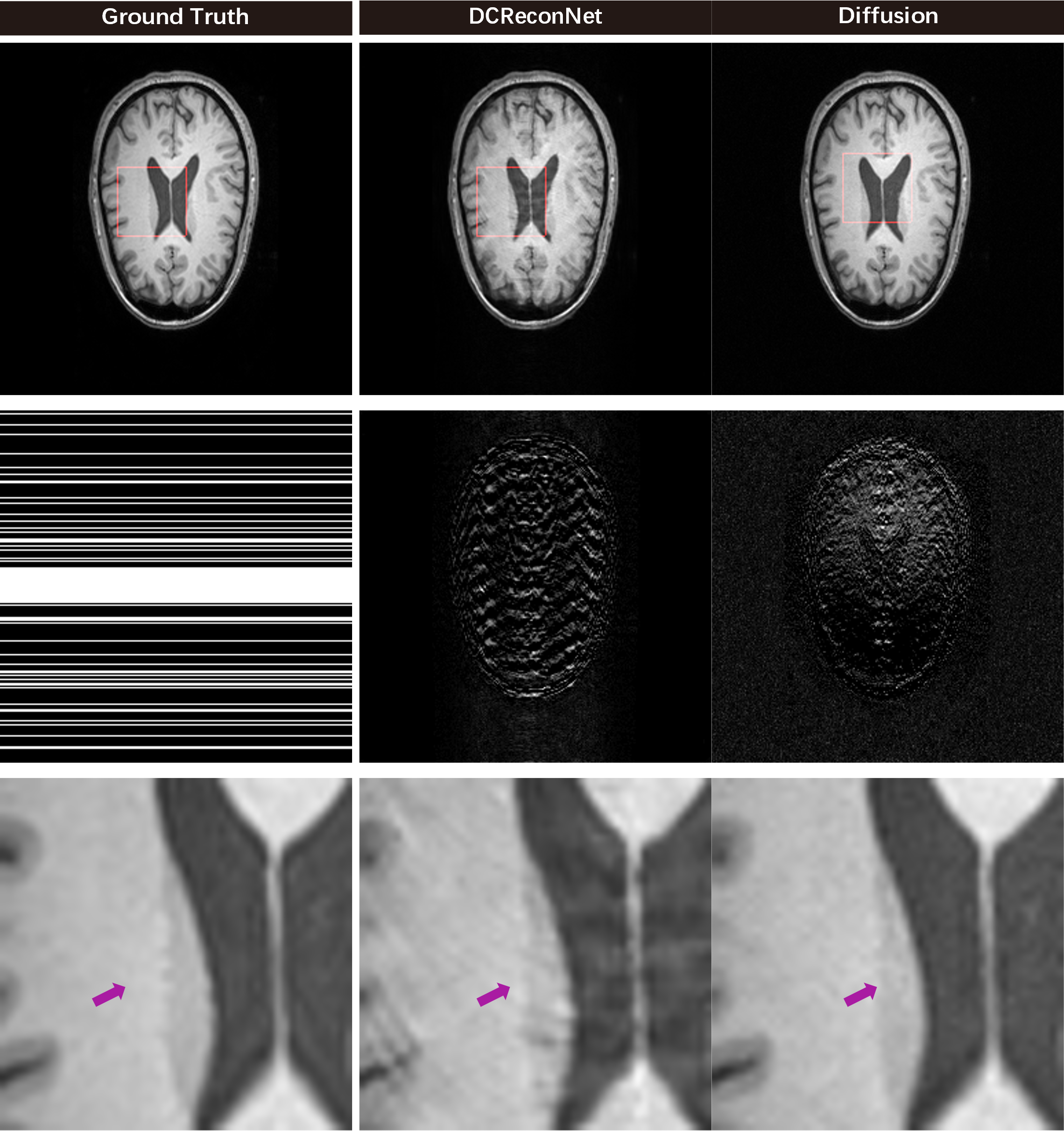
The outcomes and discrepancies arising from the application of subsampling masks with acceleration factors (AF) of 2 and 4 to the non-uniformity-affected k-space data, followed by reconstruction through conventional CS-based regularization, B0ReconNet, and the diffusion model, are depicted in Figure 1. Nevertheless, it is worth noting that reconstructed images derived from k-space data affected by non-uniformity exhibit geometric distortions when traditional Fourier transform (FT) reconstruction is employed. Although the outcomes are illustrated in Figure 1, the assessment metrics reveal that DCReconNet surpasses Diffusion in terms of performance. However, the detailed depiction presented in Figure 2 reveals that DCReconNet exhibits a limitation in terms of image smoothing, while Diffusion retains a higher level of image detail. The noise in the image background diminishes the evaluation value for the diffusion model. Replacing the undersampling mask with a random mask that was not employed during the training of DCReconNet results in a degradation of the performance of DCReconNet, leading to the appearance of artifacts, as depicted in the detailed view provided in Figure 3.Discussion and conclusion
In this work, the diffusion model was developed to accelerate MR reconstruction with encoding perturbations. Imaging results demonstrated that the proposed method enabled fast distortion-corrected image reconstruction for any subsampling patterns.Acknowledgements
No acknowledgement found.References
[1] S. Tao et al., “Gradient nonlinearity calibration and correction for a compact, asymmetric magnetic resonance imaging gradient system,” Physics in medicine & biology, vol. 62, no. 2, pp. N18–N31, 2017, doi: 10.1088/1361-6560/aa524f.
[2] S. Shan et al., “Distortion-corrected image reconstruction with deep learning on an MRI-Linac,” Magnetic resonance in medicine, vol. 90, no. 3, pp. 963–977, 2023, doi: 10.1002/mrm.29684.
[3] A. Kazerouni et al., “Diffusion models in medical imaging: A comprehensive survey,” Medical image analysis, vol. 88, pp. 102846–102846, 2023, doi: 10.1016/j.media.2023.102846.
[4] P. Cheng et al., “Towards performant and reliable undersampled MR reconstruction via diffusion model sampling,” arXiv (Cornell University), 2022, doi: 10.48550/arxiv.2203.04292.
[5] Imperial College London, “IXI Dataset,” Imperial College London. [Online]. Available: https://brain-development.org/ixi-dataset/
Figures