2746
Tabletop Magnetic Particle Imaging Using Deep FPGA-based Convolutional Neural Network1Shenzhen Instituteof Advanced Technology, Chinese Academy of Sciences, Shenzhen, China, 2Chongqing University of Technology, Chongqing, China, 3University of Chinese Academy of Sciences, Shenzhen, China
Synopsis
Keywords: Machine Learning/Artificial Intelligence, Machine Learning/Artificial Intelligence, MPI, FPGA, Deep Learning, Reconstruction
Motivation: When using complex prior parameters for regularization in the MPI reconstruction method based on the system matrix, the process is very time-consuming and the preprocessing process is complex.
Goal(s): The purpose of this study is to simplify the reconstruction process and achieve efficient real-time reconstruction of magnetic particle images.
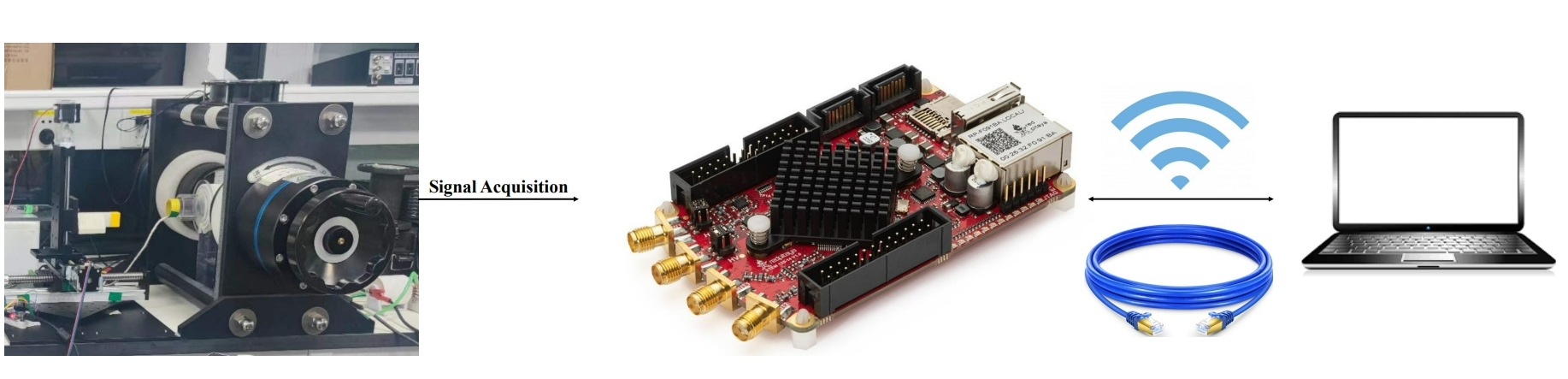
Approach: Therefore, this study uses CNN neural network for reconstruction on FPGA, and tests the neural network reconstruction effect through simulation and customized MPI system(Fig. 1).
Results: The results show that it is feasible to use CNN neural network for reconstruction on FPGA, achieving high efficiency and real-time performance of magnetic particle image reconstruction.
Impact: FPGA-based CNN reconstruction network can make desktop magnetic particle imaging easier and more efficient.
Introduction
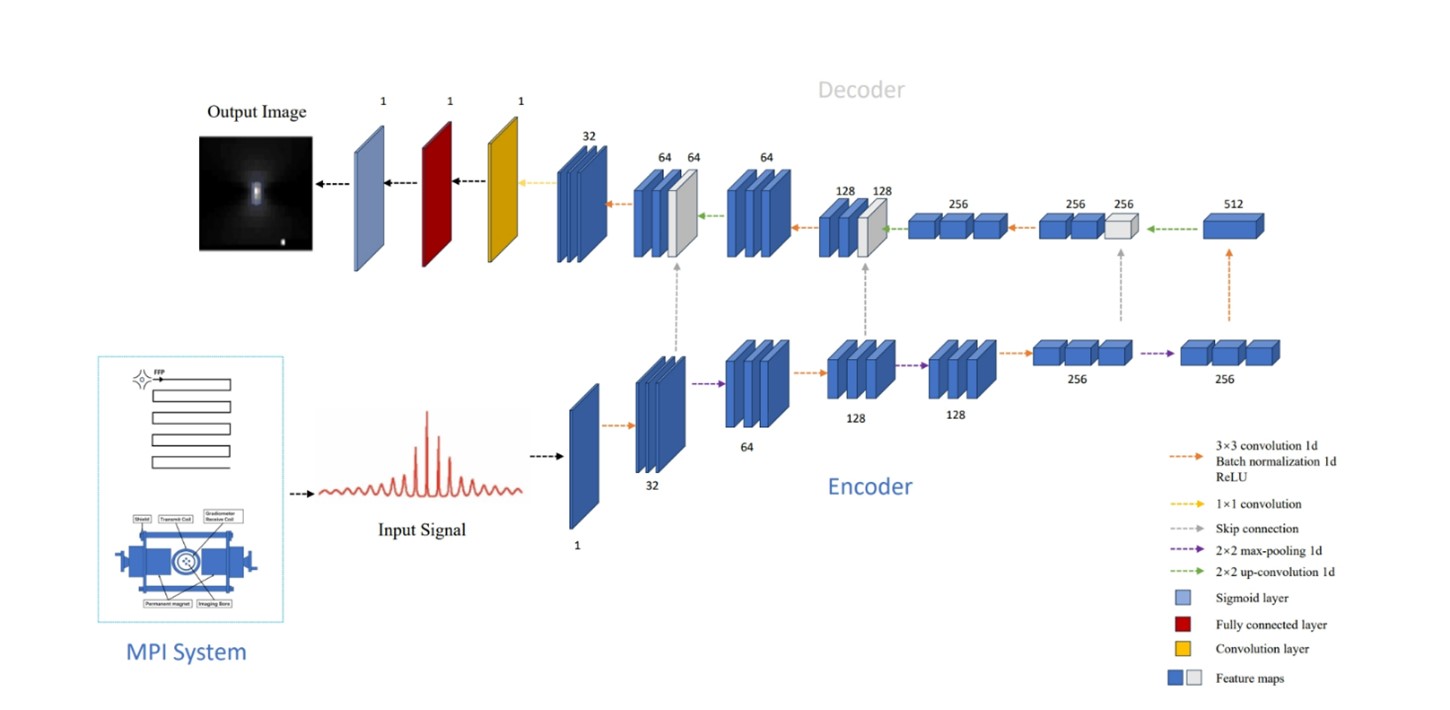
Magnetic nanoparticle imaging is a new type of highly sensitive and high-resolution tomographic imaging technology. The reconstruction method based on the system matrix is the current mainstream image reconstruction algorithm[1]. It is a common method that relies on regularization iteration, such as the Kaczmarz method[2]. When using complex prior parameters for regularization, this process is very time-consuming.Neural networks have strong fitting capabilities and can capture potential mapping relationships in MPI systems. Therefore, the end-to-end neural network can directly generate magnetic particle concentration distribution images based on the collected signals(Fig. 2). This article designs and implements a CNN reconstruction neural network that can be used on FPGA[3][6]. This method can reconstruct MPI images without any prior knowledge, and the reconstruction process is more convenient and efficient than system matrix reconstruction.Methods
The one-dimensional signal equation for MPI can be expressed as follows:$$s(t)=B_{1}\frac{\text{d}\phi}{\text{d}t}=B_{1}m\rho(x)*L^{'}[kGx]|_{x=x_s(t)}kGx_s^{'}(t) (1)$$
In the equation,$$$B_{1}$$$represents the sensitivity of the receiving coil,while$$$\phi$$$stands for the magnetic flux.The term m denotes the magnetic moment of a single magnetic particle, and L signifies the Langevin function. The parameter k is associated with the properties of the magnetic particles, and G corresponds to the gradient of the selection field.Based on the system matrix reconstruction algorithm, the linear relationship between the induction signal and the particle concentration distribution can be expressed as follows:
$$Sc=u (2)$$
Here,S is the system matrix,c is the vector containing the unknown particle distribution and u is the measurement vector.
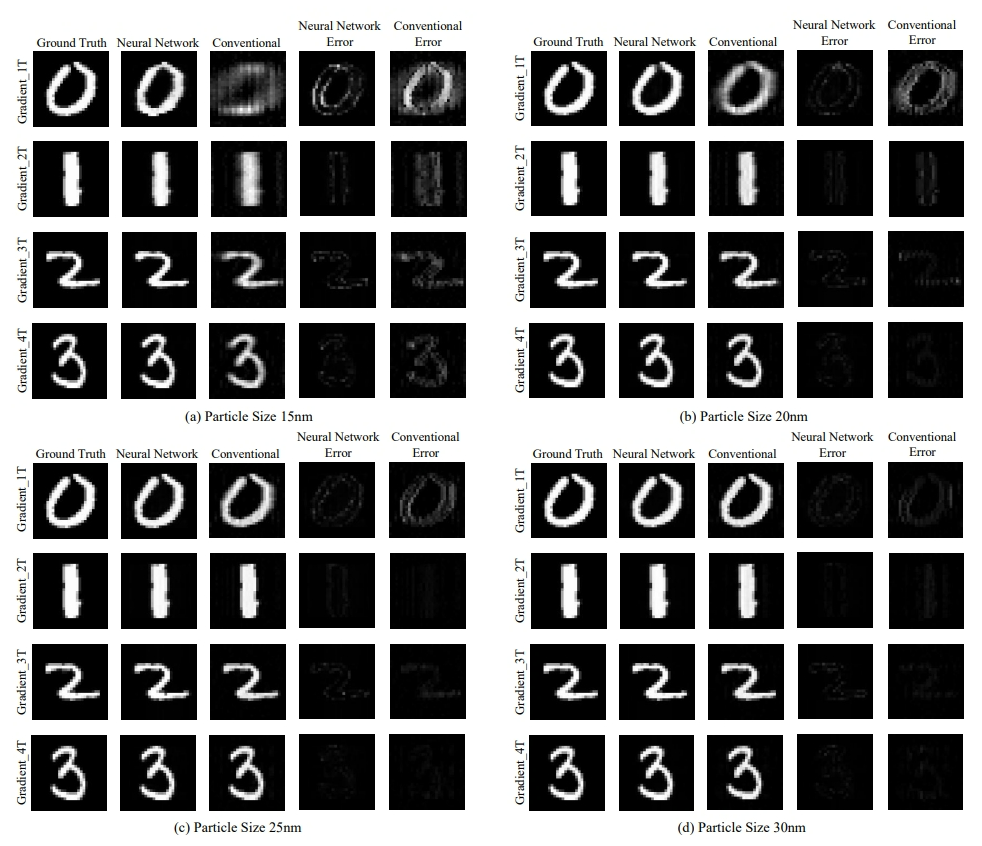
This simulation experiment constructs simulation models based on (1) and (2) respectively. The CNN network uses the handwritten digit image data set MINST to simulate the magnetic particle concentration distribution. The image is a numerical value from 0 to 9, and the image size is 28×28 pixels. Based on the magnetic particle concentration distribution map simulated by the handwritten digital image, the signal is generated using the signal model and spatial coding principle. According to the model, 5000 training samples are generated as the training set, 1000 samples as the verification set, and 100 samples as the test set. In the experiment, the selection field gradients were set to 1T, 2T, 3T, and 4T, and the magnetic particle sizes were 15nm, 20nm, 25nm, and 30nm, forming 16 combinations. Each combination generated a corresponding data set, a total of 16 data sets. After multiple rounds of hyperparameter adjustments and training set iterations, the final training hyperparameters were: learning rate 0.01, batch size 200, moment 0.5, and epochs 100.
Custom-made MPI scanners have been validated for magnetic spectroscopy and 2D imaging[4]. At the same time, the MPI scanner uses a gradient receiving coil, and an active double-T filter is connected after the receiving coil[5][7][8]. During the actual test experiment, the trained CNN model was transplanted to the FPGA board Redpitay equipped with the Linux system, and the small test model was used to complete the test of the network reconstruction capability.
Results
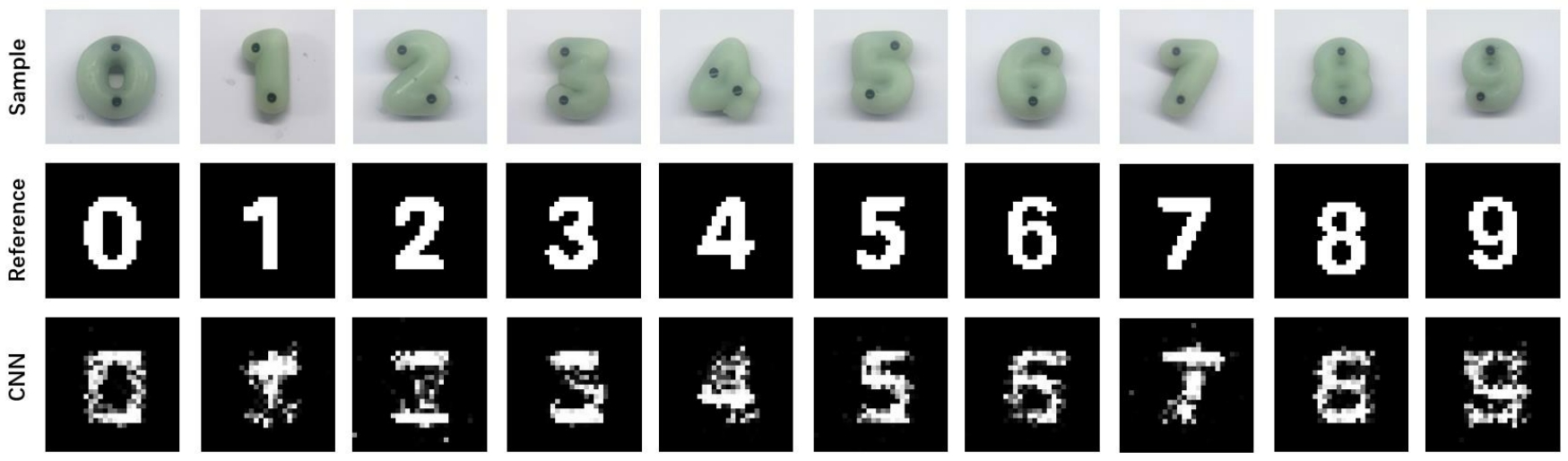
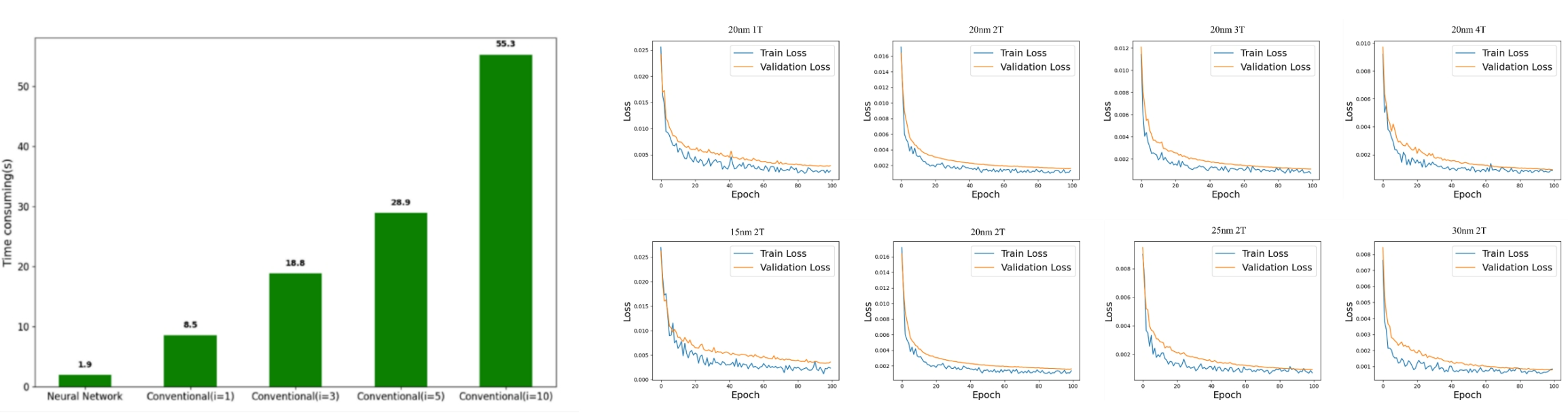
In the simulation experiment, the effects of the neural network and the traditional reconstruction method were compared by setting different particle sizes and magnetic field gradients. It can be seen from the results that the image obtained by the CNN neural network has a higher signal-to-noise ratio, more accurate reconstruction, and fewer errors(Fig. 3). Actual experimental results on a customized MPI system show that real-time and efficient MPI image reconstruction can be achieved by installing a CNN reconstruction network on an FPGA(Fig. 4).At the same time, It also shows the time required for reconstruction of the neural network and the traditional method, as well as the loss diagram during neural network training. It can be seen from the results that the time required by the neural network is much smaller and the convergence speed is faster than the traditional method, and the calculation time of the traditional method increases as the number of iterations increases (Fig. 5).Conclusions and Discussion
This paper proposes a CNN reconstruction network that can be installed on FPGA to achieve real-time and efficient reconstruction of MPI images. Simulation experiments show that compared with traditional reconstruction methods, this neural network significantly improves the quality and accuracy of reconstructed images in MPI image reconstruction. In addition, the article also verifies the feasibility of neural network reconstruction in actual systems. Experimental results show that end-to-end network reconstruction is feasible, and the reconstruction process is also very convenient and efficient. Although the reconstructed image is not ideal, it can be gradually improved in future research.Acknowledgements
Maofan Li and Kangjian Huang contributed equally to this work. This work was partially supported by the National Natural Science Foundation of China (61871373, 62271474, 81830056, U1805261, 81729003, 81901736,12026603, and 81971611), the Strategic Priority Research Program of Chinese Academy of Sciences (XDB25000000 and XDC07040000), the High-level Talent Program in Pearl RiverTalent Plan of Guangdong Province(2019QN01Y986), the Key Laboratory for Magnetic Resonance and Multimodality Imaging of Guangdong Province (2020B1212060051), the Science and Technology Plan Program of Guangzhou (202007030002), the Key Field R&D Program of Guangdong Province (2018B030335001), the Shenzhen Science and Technology Program,Grant Award (JCYJ20210324115810030), the National Key R&D Program of China (2023YFB3811400),and the Shenzhen Science and Technology Program (Grant No. KQTD20180413181834876, JCYJ20210324115810030, and KCXF20211020163408012).References
[1]Shi, Gen, et al. "Progressive Pretraining Network for 3D System Matrix Calibration in Magnetic Particle Imaging." IEEE Transactions on Medical Imaging (2023).
[2] T. Knopp, A. Weber, "Sparse reconstruction of the magnetic particle imaging system matrix," IEEE Transactions on Medical Imaging, vol. 32, no. 8, pp. 1473-1480, 2013.
[3] Anand S, Stockmann J P, Wald L L, et al. A low-cost (< $500 USD) FPGA-based console capable of real-time control[J]. Proc. Jt. Annu. Meet. ISMRM-ESMRM, 2018: 0948.
[4] Liu, Congcong, et al. "Design and Implementation of Low-Cost Distributed Tabletop Magnetic Particle Imaging System." IEEE Transactions on Magnetics 58.7 (2022): 1-15.
[5] Kangjian Huang, et al. "Design and Implement Active Twin-T Notch Filter for Signal Reception in Magnetic Particle Imaging". Proc. of the International Society for Magnetic Resonance in Medicine (ISMRM) Annual Meeting and Exhibition, Toronto, Canada, June 2023. Abstract Number: 2819.
[6]Negnevitsky, Vlad, et al. "MaRCoS, an open-source electronic control system for low-field MRI." Journal of Magnetic Resonance 350 (2023): 107424.
[7] Jing, Pei, Huang Dan, and Jiang Qiyun. "Optimal design on twin-T notch filter in electromagnetic exploration equipments." 2011 International Conference on Electric Information and Control Engineering. IEEE, 2011.
[8] Irfan, M., H. Mossa, and N. Dogan. "Analog filters for Enhanced Signal Reception of Magnetic Particle Imaging (MPI) Scanner." 2021 Medical Technologies Congress (TIPTEKNO). IEEE, 2021.
Figures