2743
Alternating unrolling network using jointly low-rank and sparse tensor prior for accelerating dynamic MRI1Harbin Institute of Technology, Harbin, China, China
Synopsis
Keywords: Image Reconstruction, Image Reconstruction, deep unrolling network, dynamic MRI, low-rank, sparse
Motivation: The unrolling networks that combine low-rank (LR) and sparse priors have the potential to enhance the reconstruction performance. However, the underlying iterative algorithm for solving the model of joint LR and sparse constraint is complicated, resulting in redundant network structure.
Goal(s): To propose a simple yet effective alternating unrolling framework that exploits jointly LR and sparse prior for robust reconstruction of highly accelerated dynamic MRI data.
Approach: Instead of strictly unrolling the iterative algorithm, we propose a novel "DC-LowRank-DC-Sparse" alternating framework.
Results: The proposed network (AlteRS-Net) outperforms the SOTA unrolling networks regarding both visualization and quantitative evaluation of PSNR and SSIM.
Impact: A novel alternating framework for unrolling network of jointly low-rank and sparse prior is established for accelerating dynamic MRI. This alternating concept could serve as an inspiration for the design of unrolling networks that combine other priors in various applications.
Introduction
Accelerating MRI scans is one of the principal outstanding problems in the MRI research community1. Compared with 2D MRI, the spatiotemporal tensor structure of dynamic MRI significantly amplifies the volume of data to be acquired, making acceleration highly necessary.Currently, model-based deep unrolling networks2-8, embedding fixed steps of iterative algorithms into the architecture of deep learning networks, stand as the outstanding method for dynamic MRI reconstruction. Unrolling networks combining both low-rank (LR) and sparse priors hold the potential to further enhance reconstruction performance4,5. However, the underlying iterative algorithm of jointly LR and sparse prior is complicated, leading to redundant net structure.
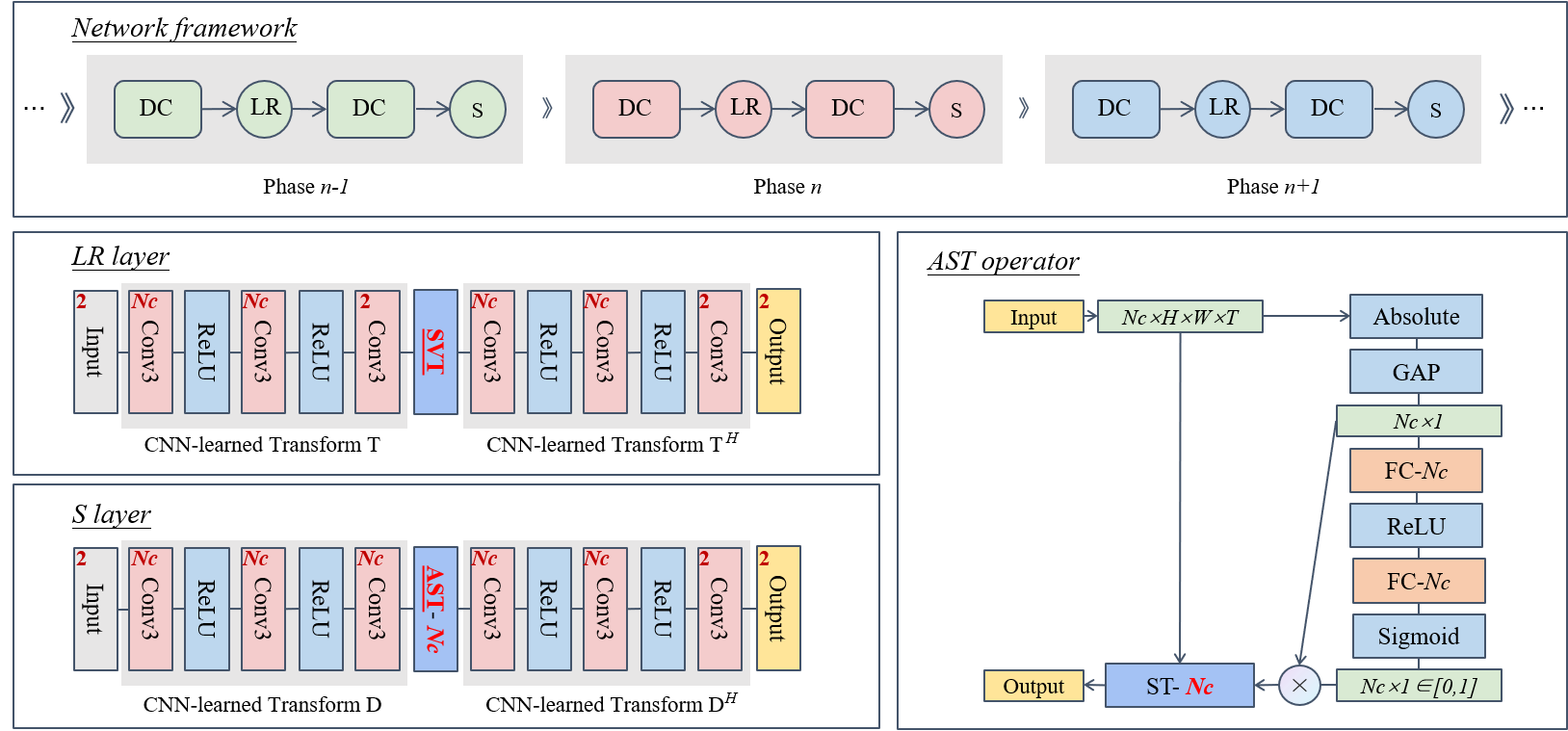
In this paper, we explore a simple yet effective framework and propose a novel alternating unrolling network using jointly LR and sparse prior for accelerating dynamic MRI, termed AlteRS-Net. Specifically, "DC-LR-DC-S" structure is exploited, alternatively enforcing LR and sparse constraint in the dynamic image. Experimental results in accelerating dynamic MRI demonstrate that the alternating network can achieve superior performance over the strictly unrolled one, and the proposed AlteRS-Net outperforms the SOTA unrolling networks.
Methods
For the dynamic MR reconstruction model of single prior, the optimization problem can be formulated as,$$\min_{\mathcal{X}} \frac12 \| \mathsf{A}(\mathcal{X}) - \mathbf{b} \|_2^2 + \lambda \mathscr{P}(\mathcal{X}).$$
where $$$\mathcal{X}$$$ denotes distortion-free dynamic MR image, $$$\mathbf b$$$ is the observed undersampled $$$k$$$-space data, $$$\mathsf A$$$ is the Fourier undersampling operator, $$$\mathscr{P}(\mathcal{X})$$$ denotes the constraint for utilizing the given prior, and $$$\lambda$$$ is the balance parameter. We could use the proximal gradient decent (PGD) algorithm to solve the above optimization problem by iteratively updating the following two steps,
$$ \begin{cases} &\mathcal{Z}_{k} = \mathcal{X}_{k} - \mu \mathsf{A}^H(\mathsf{A}(\mathcal{X}_k)-\mathbf{b}), \\ &\mathcal{X}_{k+1} = proj(\mathcal{Z}_{k}, \lambda \mu), \end{cases}$$
where the first step is a gradient descent regarding the data fidelity term, and the second is the proximal map step regarding the prior term. $$$\mu$$$ is the step size, and $$$proj(\cdot, \lambda \mu)$$$ denotes the proximal operator with $$$\lambda \mu$$$ being the threshold.
If low-rank tensor prior in the transformed $$$\mathsf{T}$$$ domain3 is adopted, the proximal operator becomes,
$$proj_{_R}(\mathcal{Z}_{k}, \lambda \mu) = \mathsf{T}^H \circ \operatorname{SVT}_{\lambda\mu} \circ \mathsf{T}(Z_{k}),$$
where $$$\operatorname{SVT}_{\lambda\mu}$$$ denotes the singular value thresholding operator on each frame matrix, and $$$\circ$$$ is the composition operator. If sparse tensor prior in the transformed $$$\mathsf{D}$$$ domain4,6,8 is adopted, the proximal operator can be expressed as,
$$proj_{_S}(\mathcal{Z}_{k}, \lambda \mu) = \mathsf{D}^H \circ \operatorname{ST}_{\lambda\mu} \circ \mathsf{D}(Z_{k}),$$
where $$$\operatorname{ST}_{\lambda\mu}$$$ denotes the soft thresholding operator with $$$\lambda\mu$$$ being the threshold.
The two PGD algorithms of tensor LR prior and sparse prior exhibit simple structure and remarkable similarity. However, if we ever want to combine these two priors, the algorithm becomes complicated. The PGD algorithm no longer works, and we must incorporate ADMM or other algorithms to solve the optimization problem4. Therefore, we propose a novel simple yet efficient alternating design, i.e., the "DC-LR-DC-S" structure,
$$ \begin{cases} \mathbf{DC}&: \quad \mathcal{R}_{k} = \mathcal{X}_{k} - \mu \mathsf{A}^H(\mathsf{A}(\mathcal{X}_k)-\mathbf{b}) \\ \mathbf{LR}&: \quad \mathcal{R}_{k}^{'} = \mathsf{T}^H \circ \operatorname{SVT}_{\zeta} \circ \mathsf{T}(\mathcal{R}_{k}) \\ \mathbf{DC}&: \quad \mathcal{S}_{k} = \mathcal{R}_{k}^{'} - \gamma \mathsf{A}^H(\mathsf{A}(\mathcal{R}_k^{'})-\mathbf{b}) \\ \mathbf{\quad S}&: \quad \mathcal{X}_{k+1} = \mathsf{D}^H \circ \operatorname{AST}_{\mathbf{\tau}} \circ \mathsf{D}(\mathcal{S}_{k}) \end{cases}.$$
Finally, the AlteRS-Net could be obtained by unrolling this alternating design, as shown in Fig.1.
Results and discussion
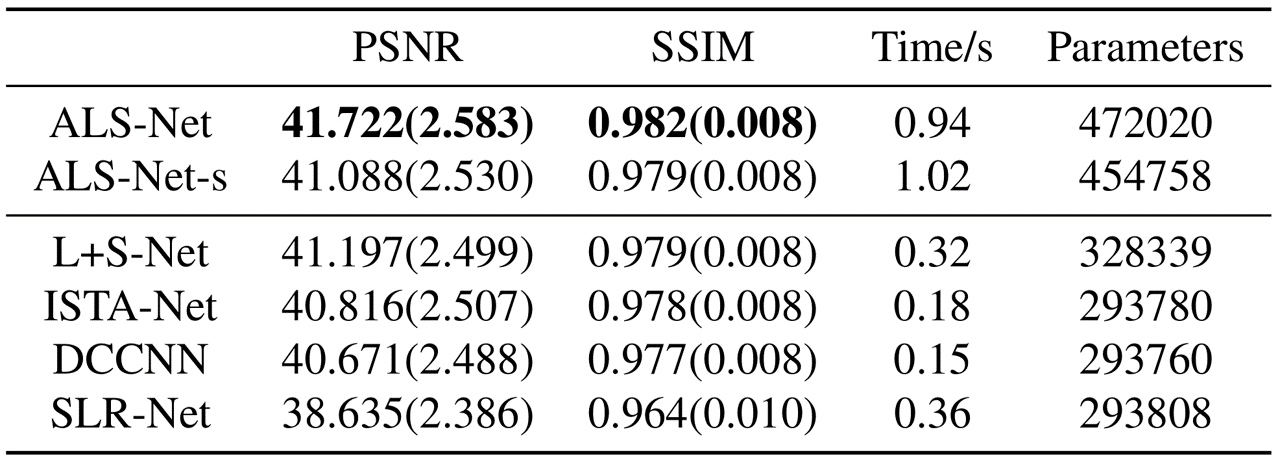
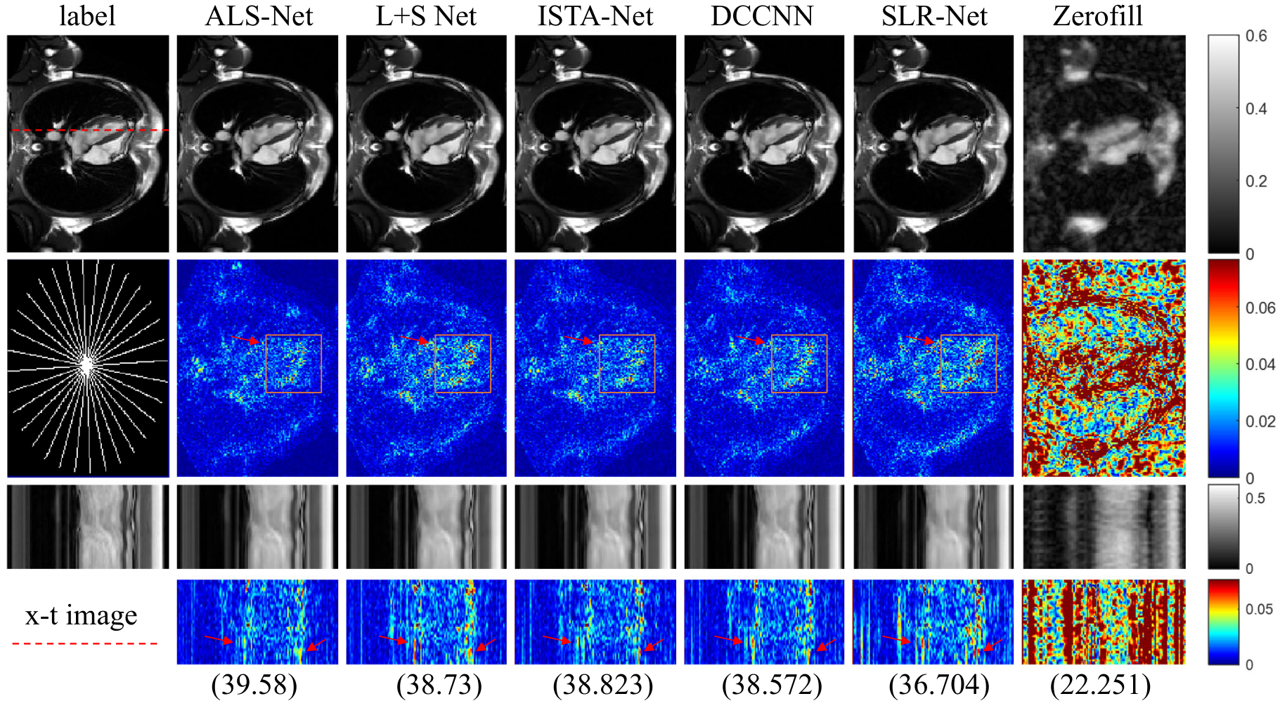
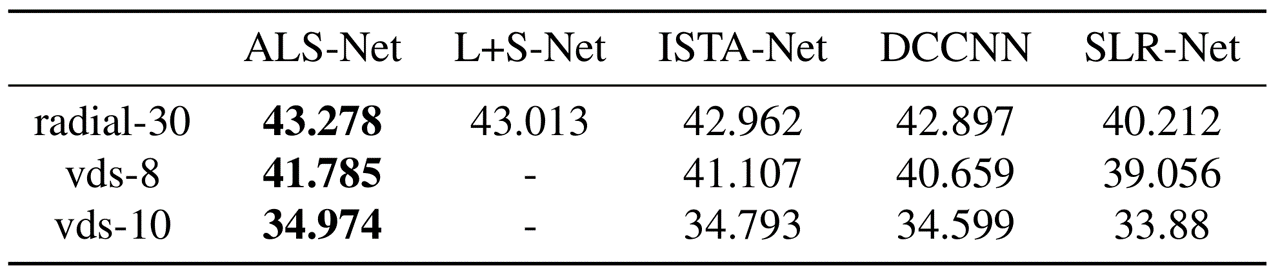
We set AlteRS-Net with 10 iteration modules and evaluate it using the open-access real-time OCMR dataset9. We compared the proposed AlteRS-Net with four SOTA unrolling networks, i.e., L+S-Net5, ISTA-Net6, DCCNN7, and SLR-Net4. To address the effectiveness of the alternating skeleton, we also implemented a strictly unrolled version, similar in structure to SLR-Net4, which we refer to as AlteRS-Net-s.Quantitative reconstruction results under pseudo-radial sampling with 16 lines are provided in Fig.2, with visualization results depicted in Fig.3. We further extended our evaluation by employing various sampling masks, including 30 radial lines and variable density sampling (vds) with 8- and 10-fold acceleration. The corresponding results can be found in Fig.4. Both the visual and quantitative results affirm the superior performance of AlteRS-Net in comparison to the SOTA unrolling networks. The efficacy of the alternating skeleton is further validated by comparing AlteRS-Net with its strictly unrolled counterpart, AlteRS-Net-s.
Conclusion
In this work, a novel alternating framework for the unrolling networks of jointly low-rank and sparse priors is introduced. The tensor low-rank and sparse priors in the CNN-learned domain are incorporated to formulate our proposed AlterRS-Net. Experimental results demonstrate that the alternating network can achieve superior performance over the strictly unrolled one, and the proposed AlteRS-Net outperforms the SOTA unrolling networks. We believe that this alternating concept could be extended to the design of unrolling networks that combine other priors and also to other applications.Acknowledgements
This work is supported by Natural Science Foundation of Heilongjiang YQ2021F005 and China NSFC 62371167.References
1. Muckley M J, Riemenschneider B, Radmanesh A, et al. Results of the 2020 fastMRI challenge for machine learning MR image reconstruction. IEEE transactions on medical imaging, 2021, 40(9): 2306-2317.
2. Liang D, Cheng J, Ke Z, et al. Deep magnetic resonance image reconstruction: Inverse problems meet neural networks. IEEE Signal Processing Magazine, 2020, 37(1): 141-151.
3. Zhang Y, Li P, Hu Y. Dynamic MRI Using Learned Transform-Based Tensor Low-Rank Network (LT2LR-NET). 2023 IEEE 20th International Symposium on Biomedical Imaging (ISBI). IEEE, 2023: 1-4.
4. Ke Z, Huang W, Cui Z X, et al. Learned low-rank priors in dynamic MR imaging. IEEE Transactions on Medical Imaging, 2021, 40(12): 3698-3710.
5. Huang W, Ke Z, Cui Z X, et al. Deep low-rank plus sparse network for dynamic MR imaging. Medical Image Analysis, 2021, 73: 102190.
6. Zhang J, Ghanem B. ISTA-Net: Interpretable optimization-inspired deep network for image compressive sensing. Proceedings of the IEEE conference on computer vision and pattern recognition. 2018: 1828-1837.
7. Schlemper J, Caballero J, Hajnal J V, et al. A deep cascade of convolutional neural networks for dynamic MR image reconstruction. IEEE transactions on Medical Imaging, 2017, 37(2): 491-503.
8. Zhang Y, Li X, Li W, et al. Deep Unrolling Shrinkage Network for Dynamic MR Imaging. 2023 IEEE International Conference on Image Processing (ICIP). IEEE, 2023: 1145-1149.
9. Chen C, Liu Y, Schniter P, et al. OCMR (v1. 0)--open-access multi-coil k-space dataset for cardiovascular magnetic resonance imaging. arXiv preprint arXiv:2008.03410, 2020.
Figures