2737
Enhancing CS-MRI Reconstruction Using Improved ESSGAN with Convolutional Block Attention Module1China Jiliang University, Hangzhou, China, 2Fujian Medical University, Fuzhou, China, 3Karolinska Institute, Stockholm, Sweden, 4Karolinska University Hospital, Stockholm, Sweden
Synopsis
Keywords: Image Reconstruction, Brain
Motivation: Inspired by DR-CAM-GAN's progress in CS-MRI, we embraced ESSGAN with self-attention mechanisms.
Goal(s): To assess CBAM's impact on ESSGAN's ability to enhance CS-MRI reconstruction across diverse sampling rates.
Approach: Implemented ESSGAN+CBAM and performed experiments using T1-weighted brain images from the MICCAI 2023 dataset. Ablation studies compared DR-CAM-GAN, ESSGAN, ESSGAN+CAM, and ESSGAN+CBAM across varying sampling rates.
Results: At a 10% low sampling rate, ESSGAN and ESSGAN+CBAM demonstrated similar performance. Nevertheless, at higher sampling rates (≥20%), ESSGAN+CBAM outperformed all other models, affirming its effectiveness across evaluation metrics.
Impact: The study reveals that the integration of CBAM modules significantly enhances ESSGAN's performance in CS-MRI, particularly at higher undersampling rates, making it a valuable tool for rapid and accurate image reconstruction in clinical settings.
INTRODUCTION
In recent developments, our research introduced the DR-CAM-GAN model, a cutting-edge approach that significantly elevates the field of Compressed Sensing MRI (CS-MRI) reconstruction. This model harnesses the power of Generative Adversarial Networks (GANs) and integrates key components like dilated residual networks and channel attention mechanisms1. In this study, we embark on further advancements, building upon our prior accomplishments. Our next step involves adopting the ESSGAN model2, which has already showcased impressive potential, and integrating it with self-attention mechanisms to enhance image reconstruction even further. Our ambition is to redefine the boundaries of image reconstruction, pushing the envelope of what is currently achievable. To this end, we introduce an innovative integration of the Convolutional Block Attention Module (CBAM) into the ESSGAN framework. This integration is designed to achieve state-of-the-art results in the realm of CS-MRI reconstruction, raising the bar for the quality and precision of this crucial medical imaging technique1,2.METHODS
As illustrated in Figure 1, our network is based on the ESSGAN architecture2, with the addition of the CBAM module3 integrated after the Residual in Residual Block. This augmentation enhances attention weights both within and between layers. Incorporating CBAM into the ESSGAN framework offers the flexibility to enable or disable the spatial attention module, allowing us to fine-tune the reconstruction process. To assess the performance of our proposed network, we conducted experiments using the publicly available MICCAI 2023 grand challenge dataset. We considered various undersampling rates (10%, 20%, 30%, and 50%) achieved using 2D Gaussian filters. A comprehensive comparative analysis was carried out, comparing our model to the baseline model and other attention-augmented variants. Additionally, we conducted a series of ablation studies to evaluate the impact of CBAM on reconstruction quality. From the MICCAI dataset, we randomly selected 200 T1-weighted whole-brain volumes, each volume was resized into 150 slices of tissue containing images. The dataset was divided into a 7:2:1 ratio for training, validation, and testing, respectively. The model was implemented using the PyTorch framework on a Linux cluster equipped with 2 Tesla T4 GPUs. During the training phase, we employed the L1 loss function4 and the AdamW optimizer 5with parameters 𝛽1=0.9, 𝛽2=0.999, and 𝜖=10-8. The batch size was set to 12, and the initial learning rate was 0.0001 for 80 epochs. We evaluated image quality using PSNR, SSIM, and MSE.RESULTS
Table 1 summarizes image quality data across diverse sampling scenarios, with corresponding visualization in Figure 2. Figures 3 and 4 showcase reconstruction results for a representative coronal slice and the associated MSE maps. As previously reported, ESSGAN outperformed DR_CAM_GAN slightly. A comparative analysis of various ESSGAN models at four undersampling levels was conducted. Notably, at a 10% low undersampling rate, ESS_CBAM_GAN's performance closely matched the baseline ESSGAN model, with the introduction of CAM or CBAM modules yielding minimal improvements. However, at higher undersampling rates (≥20%), the integration of CAM or CBAM modules notably enhanced SSIM, PSNR, and MSE performance.DISCUSSION
At an exceedingly low undersampling rate of 10%, ESS_CBAM_GAN demonstrated comparable performance to the baseline ESSGAN, suggesting that under such low undersampling conditions, image reconstruction primarily relies on the model's inherent priors. In this context, the attention masks based on noisy feature maps appeared to have limited effectiveness. However, as the undersampling rate was progressively increased, the advantages of the CBAM mechanism began to manifest. ESS_CBAM_GAN showcased superior performance in all evaluated image quality metrics, including PSNR, SSIM, and MSE. These enhancements highlight the critical role of the CBAM module in refining the model's ability to capture intricate image details. These findings imply that, while ESSGAN benefits from its UNET++-like architecture5, the incorporation of spatial and channel attention mechanisms, such as CBAM, further bolsters its capacity to preserve and reconstruct image details effectively.CONCLUSION
This study highlights CBAM's efficacy in ESSGAN for CS-MRI across various undersampling rates. Results emphasize its value in enhancing CS-MRI quality, especially in clinical scenarios requiring rapid, accurate reconstruction. At 10% undersampling, ESS_CBAM_GAN matched baseline ESSGAN, but higher rates showed significant CBAM benefits in PSNR, SSIM, and MSE. Integrating spatial and channel attention strengthens ESSGAN's ability to preserve image details, vital for clinical use.Acknowledgements
This research was supported by a grant from the Zhejiang Natural Science Foundation of China (No. LY23F010005), the ALF foundation in the Stockholm Region, and the Joint China–Sweden Mobility program from STINT (Dnr: CH2019-8397).
References
1. Li, X., Zhang, H., Yang, H., Li, T. Q. CS-MRI Reconstruction Using an Improved GAN with Dilated Residual Networks and Channel Attention Mechanism. Sensors (Basel) 23, doi:10.3390/s23187685 (2023). 2. Zhou, W., Du, H., Mei, W., Fang, L. Efficient structurally-strengthened generative adversarial network for MRI reconstruction. Neurocomputing 422, 51-61, doi:10.1016/j.neucom.2020.09.008 (2021). 3. Woo, S., Park, J., Lee, J.-Y., Kweon, I.-S. CBAM: Convolutional Block Attention Module. ArXiv abs/1807.06521 (2018). 4. Zhao, J., Hou, X., Pan, M., Zhang, H. Attention-based generative adversarial network in medical imaging: A narrative review. Comput Biol Med 149, 105948, doi:10.1016/j.compbiomed.2022.105948 (2022). 5. Zhou, Z., Siddiquee, M. M. R., Tajbakhsh, N., Liang, J. UNet++: A Nested U-Net Architecture for Medical Image Segmentation. Deep Learn Med Image Anal Multimodal Learn Clin Decis Support (2018) 11045, 3-11, doi:10.1007/978-3-030-00889-5_1 (2018).
Figures
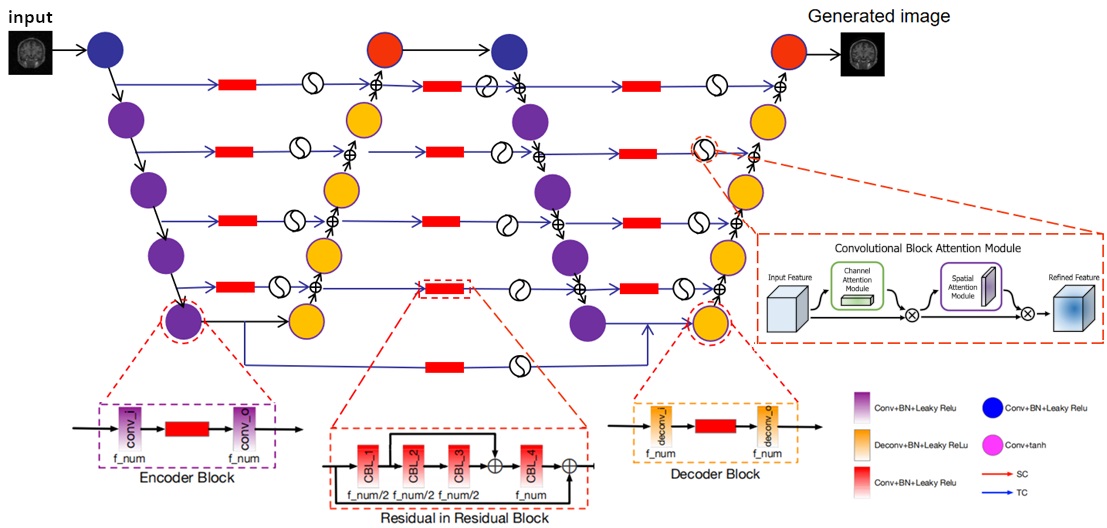
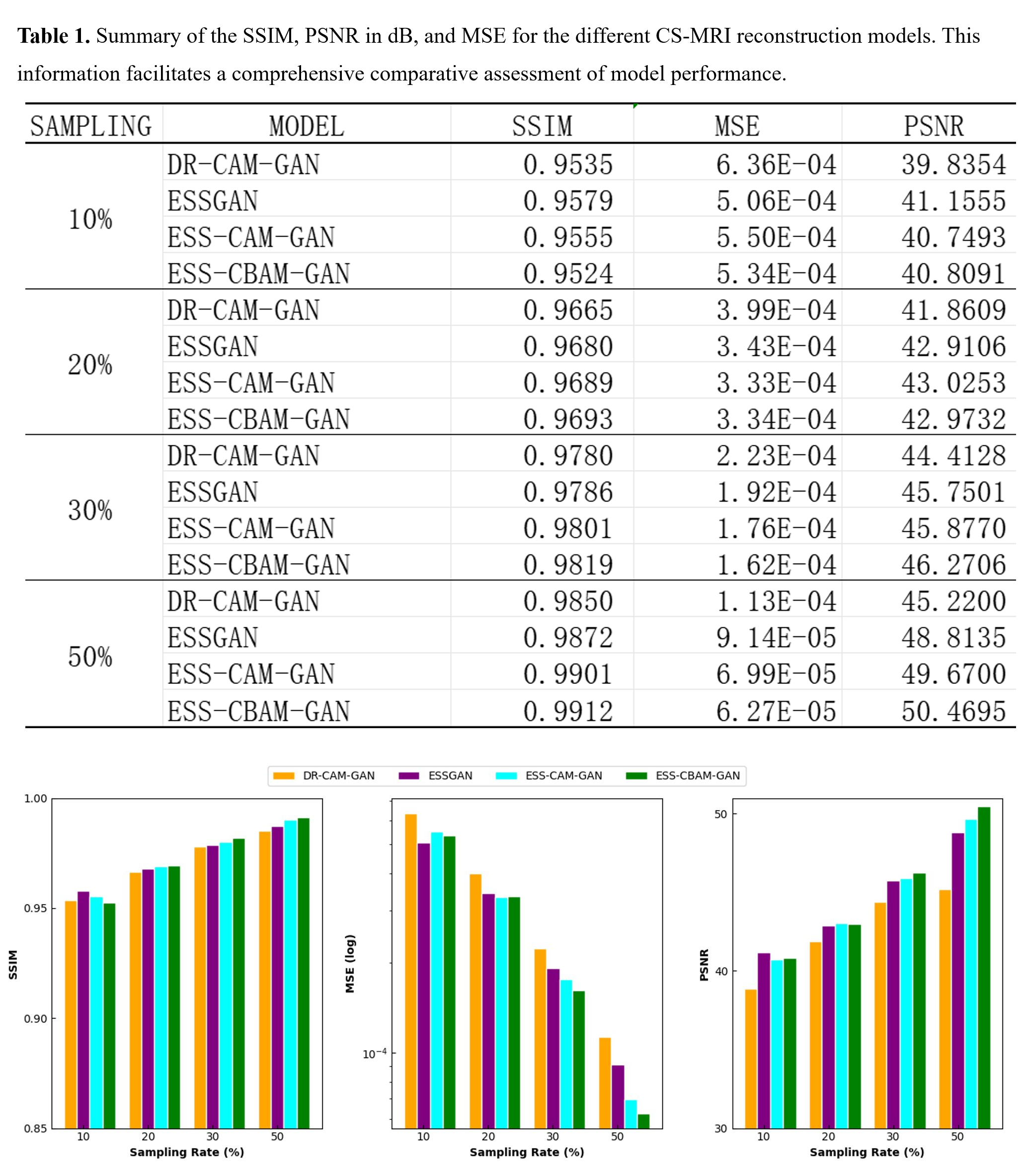
Figure 2: Bar graphs of comparative image quality metrics summarized in Table 1, including SSIM, PSNR and MSE. The data illuminates the relative efficacy of each technique in enhancing image quality and preserving details.
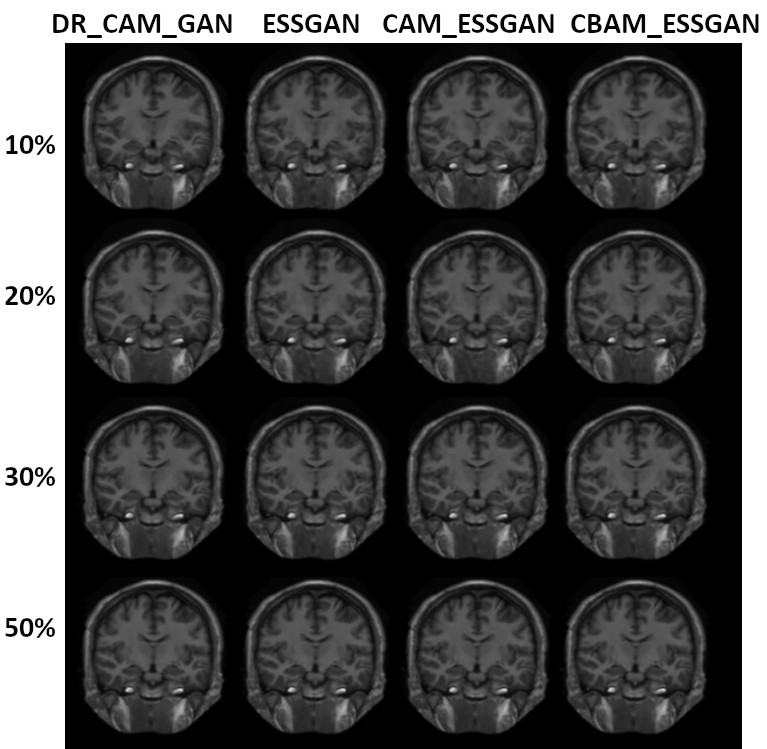
Figure 3: A representative coronal slice from a T1-weighted volume reconstructed by various models (columns), featuring our proposed ESS_CBAM_GAN framework, across four distinct undersampling levels (Rows).
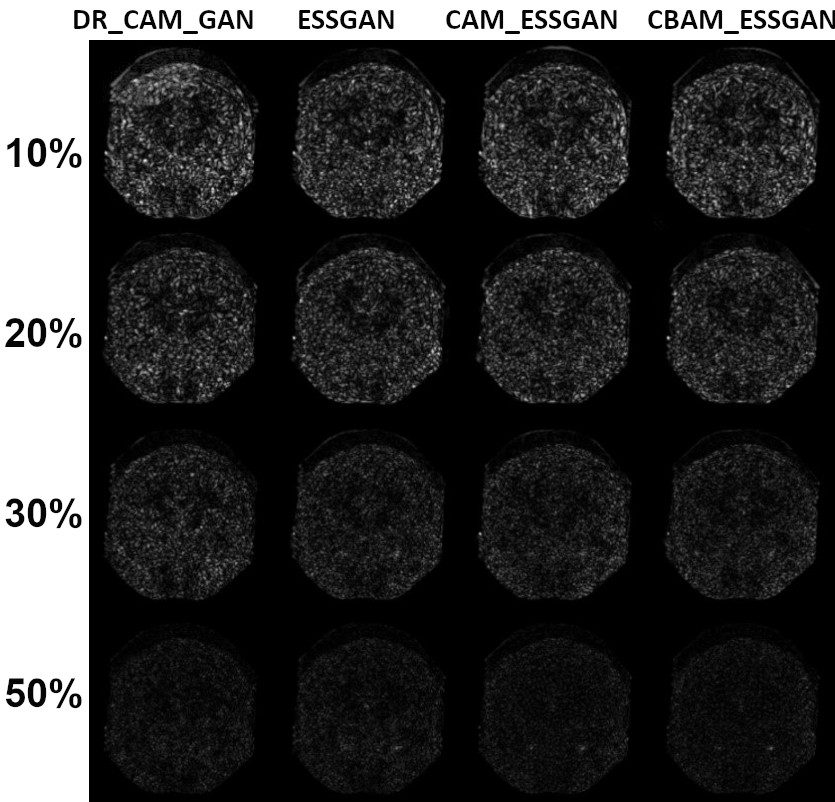
Figure 4: MSE Maps for the Coronal Slice in Figure 3, revealing the Influence of various reconstruction models (columns) across four different CS undersampling rates (rows) on image quality and detail preservation.