2736
DeepSNMs for highly accelerated multi-contrast volumetric brain imaging1Shenzhen Institute of Advanced Technology, Chinese Academy of Sciences, Shenzhen, China, 2University of Chinese Academy of Sciences, Beijing, China, 3Paul C. Lauterbur Research Center for Biomedical lmaging, Shenzhen Institute of Advanced Technology, Shenzhen, China, 4Research Center for Medical AI, Shenzhen Institute of Advanced Technology, Shenzhen, China, 5Inner Mongolia University, Hohhot, China
Synopsis
Keywords: Image Reconstruction, Multi-Contrast
Motivation: The conventional multi-contrast 3D reconstruction process is time-consuming and lacks sufficient acceleration factors.
Goal(s): To achieve highly accelerated multi-contrast brain imaging while enhancing reconstruction efficiency, the learnable CNN network is utilized.
Approach: Deep learning regularized SNMs (Deep SNMs) is developed by unrolling parallel imaging reconstruction using spatial nulling maps (SNMs) with CNN regularization. The network is iteratively expanded by gradient descent blocks and 2D convolution blocks.
Results: Compared to L1 regularized SNMs, the learnable CNN regularization simplifies reconstruction complexity and attains higher image quality. DeepSNMs achieves multi-contrast volumetric brain imaging reconstruction under caipirinha 9x and 12x acceleration.
Impact: This work successfully accomplishes multi-contrast volumetric brain imaging with 9-fold and 12-fold caipirinha acceleration. By addressing the time-consuming challenge of reconstructing multi-contrast 3D images, this work effectively utilizes and integrates information from multiple contrasts concurrently.
Introduction
Combined Compressed Sensing and Parallel Imaging (CSPI) combines the transformation sparsity of MRI images with spatial coding capabilities to accelerate MRI reconstruction and reduce parallel imaging noise, achieving multi-contrast MRI reconstruction simultaneously.[1] However, the CSPI approach faces several challenges: lengthy reconstruction time and the need of empirical selection of sparse regularization weights, especially for images with multiple contrasts.[2][3] Meanwhile the fixed sparse transform domain is not necessarily optimal for different contrast images.[4] In addition, compressed sensing is commonly used to address random sampling issues, whereas regular sampling is considered more suitable for optimal sampling in parallel imaging. A recent parallel imaging technique, called SNMs, reconstructs multi-channel images by building an image-domain nulling system.[5] SNMs enables faster calibration and reconstruction compared to previous parallel imaging methods such as SPIRiT[6][7] and ESPIRiT[8]. This work extended SNMs with CNN regularization and solved by gradient descent algorithm. The Iterative CNN regularization network mitigated the challenges mentioned above, leading to multi-contrast volumetric brain imaging reconstruction under caipirinha 9x and 12x undersampled mask.Methods
The learnable CNN regularized SNMs in hybrid-domian is derived below. Here, $$$N$$$ is the image-domian nulling system, $$$\hat{x}$$$ is the missing kspace data, $$$y$$$ is the acquired kspace data, Dc and D correspond to the sampling operator of x and y respectively, $$$\theta$$$ is the learnable parameters.$$\hat{x} = \mathop{\arg\min}\limits_{\hat{x}} ||D_cFNF^HD_c^H\hat{x}+D_cFNF^HD^Hy||_2^2 + \lambda\ {CNN}_{\theta}\{IFFT(\hat{x}+y)\}$$
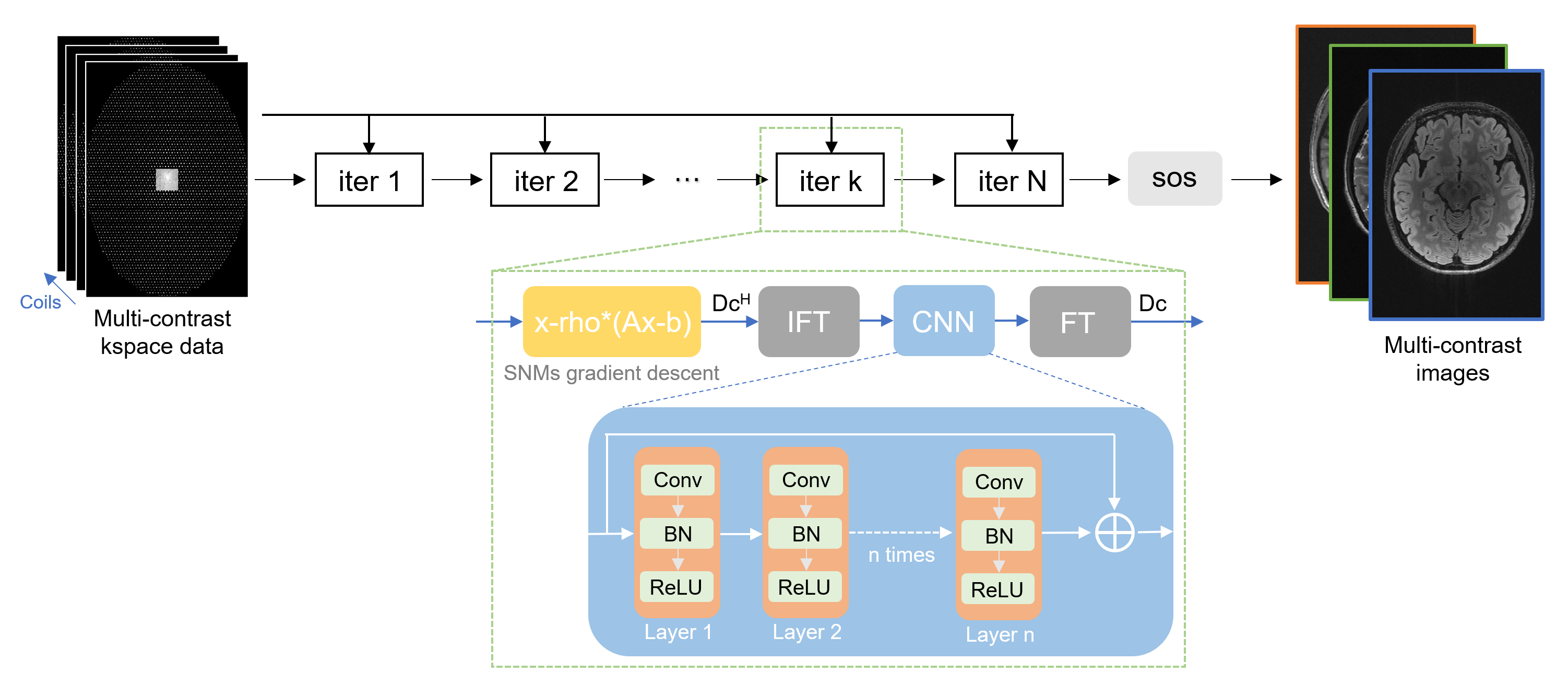
The whole 3D reconstruction is decomposed to 2D reconstruction tasks after 1D inverse Fourier Transform (FT) along the fully sampled readout. Each layer of the network is iterated by a block of gradient descent and a 2D CNN block. To speed up the iteration, we use Ax-b instead of gradient A^H(Ax-b), thanks to the Positive definite properties of forward matrix symmetry A. Experiments show that Ax-b is a good approximation of the gradient. The structure of the proposed DeepSNMs network is illustrated in Figure 1.
Institutional Review Board approved in-vivo experiments with informed consent obtained from all volunteers. Three contrast scans including T1, T2 and FLAIR were performed on a 3T scanner (uMR 790, United Imaging Healthcare, China) with a 32-channel head and neck coil. Common imaging parameters included: T1 GRE, T2 MATRIX, T2 FLAIR MATRIX, whole brain and neck coverage, FOV = 256 (RO) x 256 (PE1) x 176 (PE2)$$$mm^3$$$, imaging resolution = 1 $$$mm^3$$$.
Fully sampled multi-contrast brain imaging was performed on seven healthy volunteers. Five datasets were undersampled by 9-fold and 12-fold caipirinha and used for training, while the other two datasets were used for validation and retrospective testing, respectively. The DeepSNMs network employs three contrast hybrid training strategies. The network was implemented in PyTorch 1.13 and trained on an NVIDIA Tesla A100 GPU with 80 GB memory.
Result
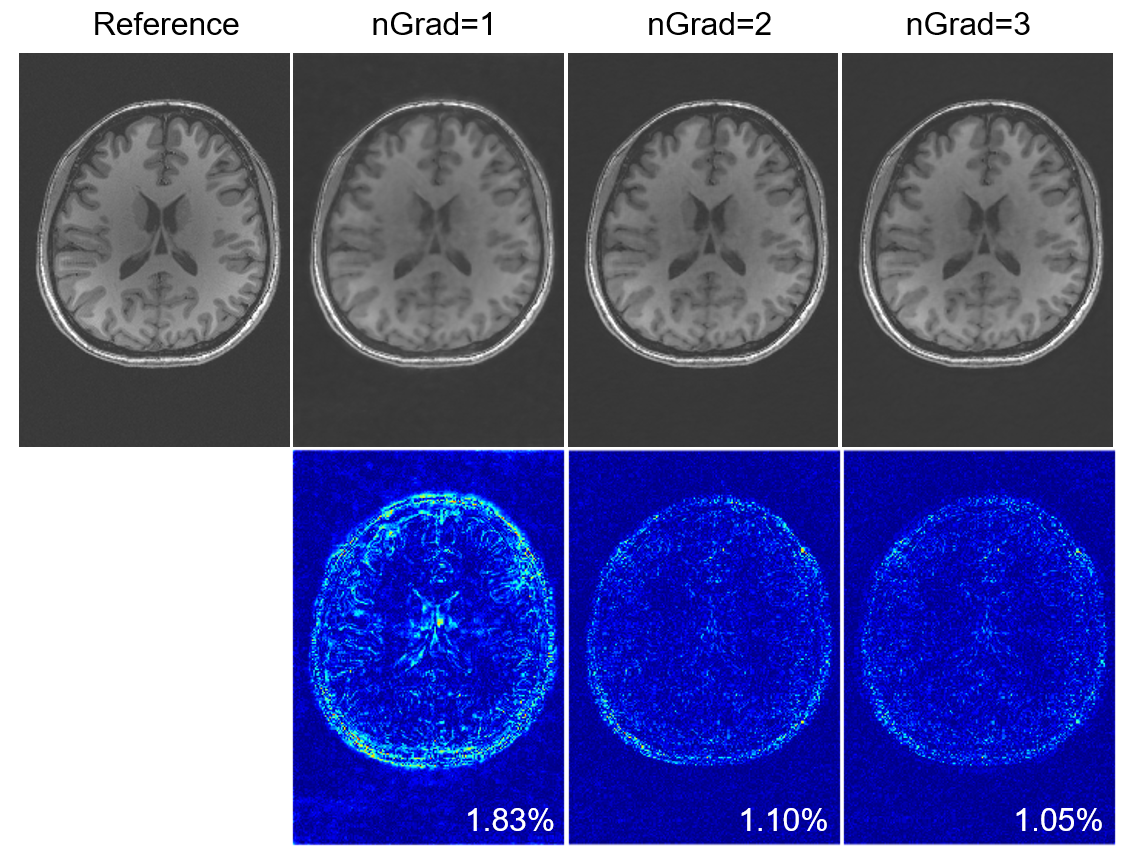
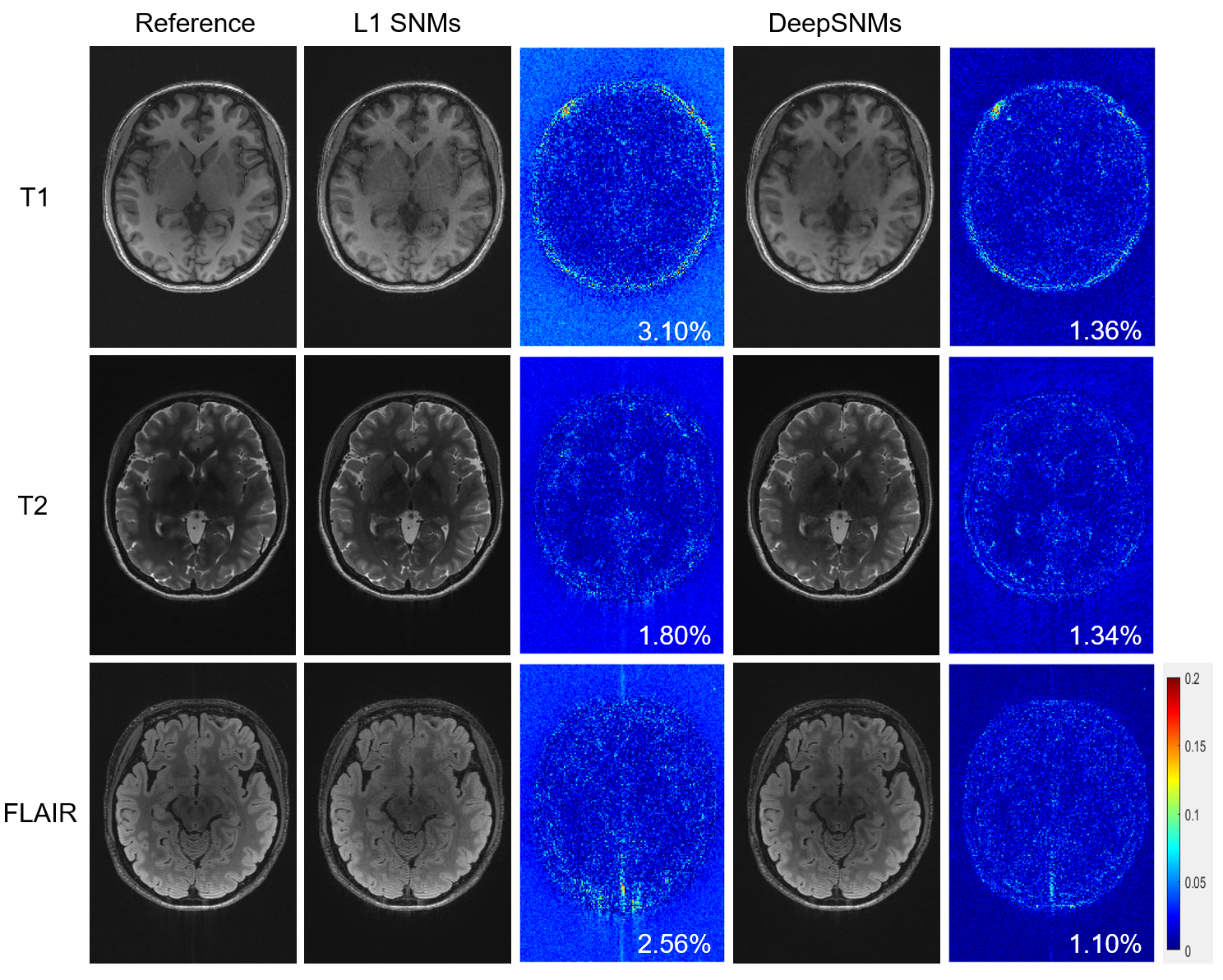
Figure 2 investigates the impact of the number of gradient descent iterations on the outcomes of DeepSNMs reconstruction. Increasing the number of gradient descents leads to enhanced image quality, albeit with a trade-off of longer iteration times. We selected a conservative value of 2 iterations, which results in a clear image and an acceptable reconstruction time.Figure 3 and 4 shows the proposed DeepSNMs reconstruction results compared with L1SNMs at 9x and 12x acceleration respectively. Traditional L1-SNMs requires 60-80 iterations to reconstruct an 2D image, while DeepSNMs requires only 10 layers with two gradient descends per layer. Compared to L1-SNMs, DeepSNMs reconstruction is more accurate.
Figure 5 illustrates the superior noise suppression of CNN regularization than L1 regularization. The results also indicate that the stability of the fixed sparse transform domain varies for different contrast images, as the inconsistent image quality across contrasts.
Discussion
This work introduced DeepSNMs reconstruction for accelerated multi-contrast brain imaging with 9-fold and 12-fold caipirinha acceleration. DeepSNMs is developed by unrolling the traditional L1-SNMs optimization combined with CNN regularization to enhance the accuracy and efficiency of the reconstruction process. The inclusion of learnable CNN regularization demonstrates superior performance to the iterative L1-SPIRiT approach with 2D sparsity regularization in a fixed transform domain. The efficiency of calibration and reconstruction with SNMs also benefits the process of DeepSNMs reconstruction. Nevertheless, the image details obtained through deep learning-based reconstruction remain insufficiently elucidated. Further work will focus on the image detail enhancement and robustness of DeepSNMs, while investigating effective leverage on multi-contrast information.Acknowledgements
This work is supported by the State Key Program of National Natural Science Foundation of China (Grant No. 81830056, 2021YFF0501503 and 2022YFA1004203) and the National Natural Science Foundation of China (Grant No. 62125111).References
- Huang J, Chen C, Axel L. Fast multi-contrast MRI reconstruction[J]. Magnetic resonance imaging, 2014, 32(10): 1344-1352.
- Kopanoglu E, Güngör A, Kilic T, et al. Simultaneous use of individual and joint regularization terms in compressive sensing: Joint reconstruction of multi‐channel multi‐contrast MRI acquisitions[J]. NMR in Biomedicine, 2020, 33(4): e4247.
- Sun L, Fan Z, Fu X, et al. A deep information sharing network for multi-contrast compressed sensing MRI reconstruction[J]. IEEE Transactions on Image Processing, 2019, 28(12): 6141-6153.
- Huang J, Wang S, Zhou G, et al. Evaluation on the generalization of a learned convolutional neural network for MRI reconstruction[J]. Magnetic resonance imaging, 2022, 87: 38-46.
- Hu J, Yi Z, Zhao Y, et al. Parallel imaging reconstruction using spatial nulling maps[J]. Magnetic Resonance in Medicine, 2023.
- Lustig M, Pauly J M. SPIRiT: iterative self‐consistent parallel imaging reconstruction from arbitrary k‐space[J]. Magnetic resonance in medicine, 2010, 64(2): 457-471.
- Jia S, Cheng J, Cui Z, et al. Deep Learning regularized SPIRiT reconstruction accelerates joint intracranial and carotid vessel wall imaging into 3.5 minutes[J].
- Uecker M, Lai P, Murphy M J, et al. ESPIRiT—an eigenvalue approach to autocalibrating parallel MRI: where SENSE meets GRAPPA[J]. Magnetic resonance in medicine, 2014, 71(3): 990-1001.
Figures
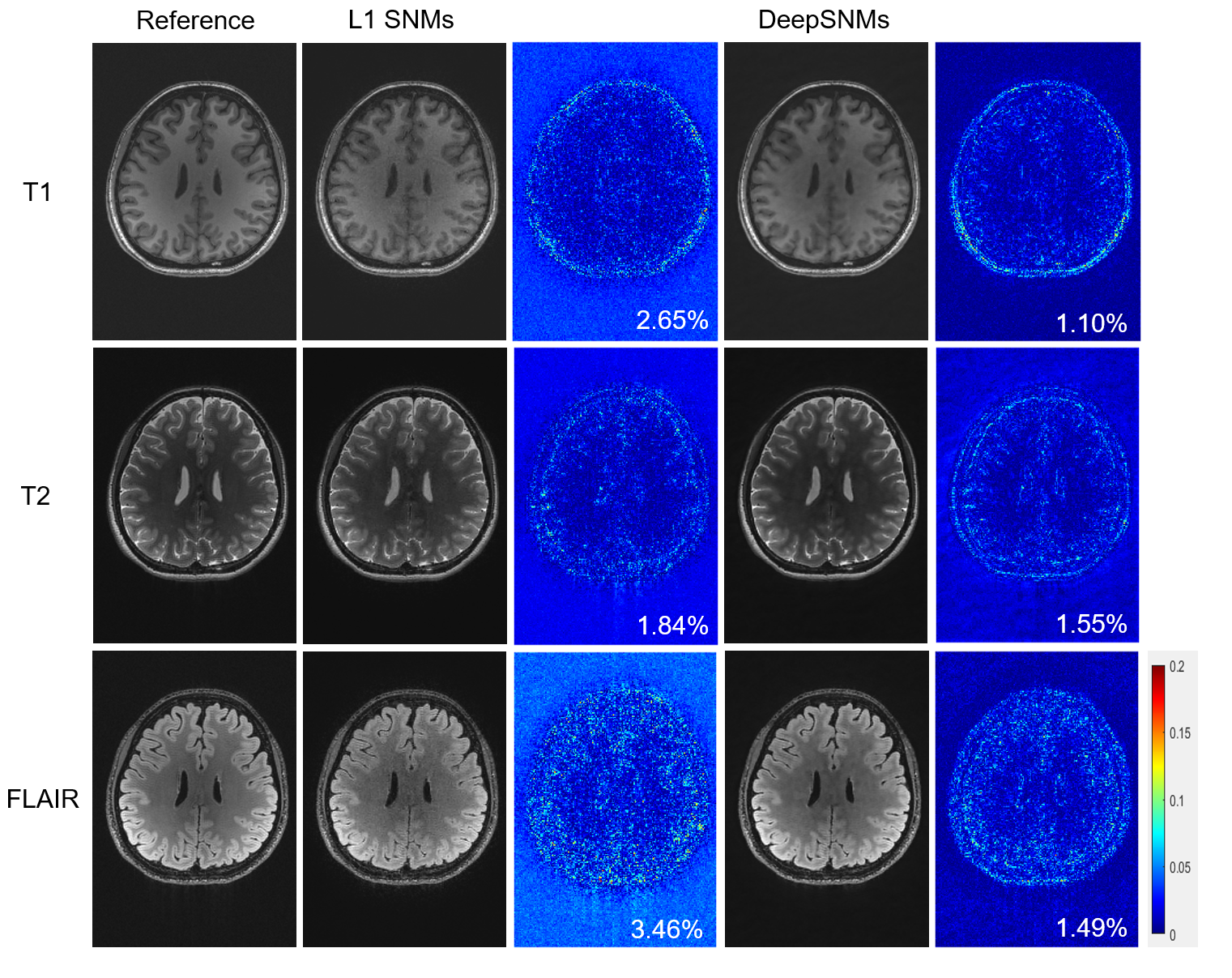
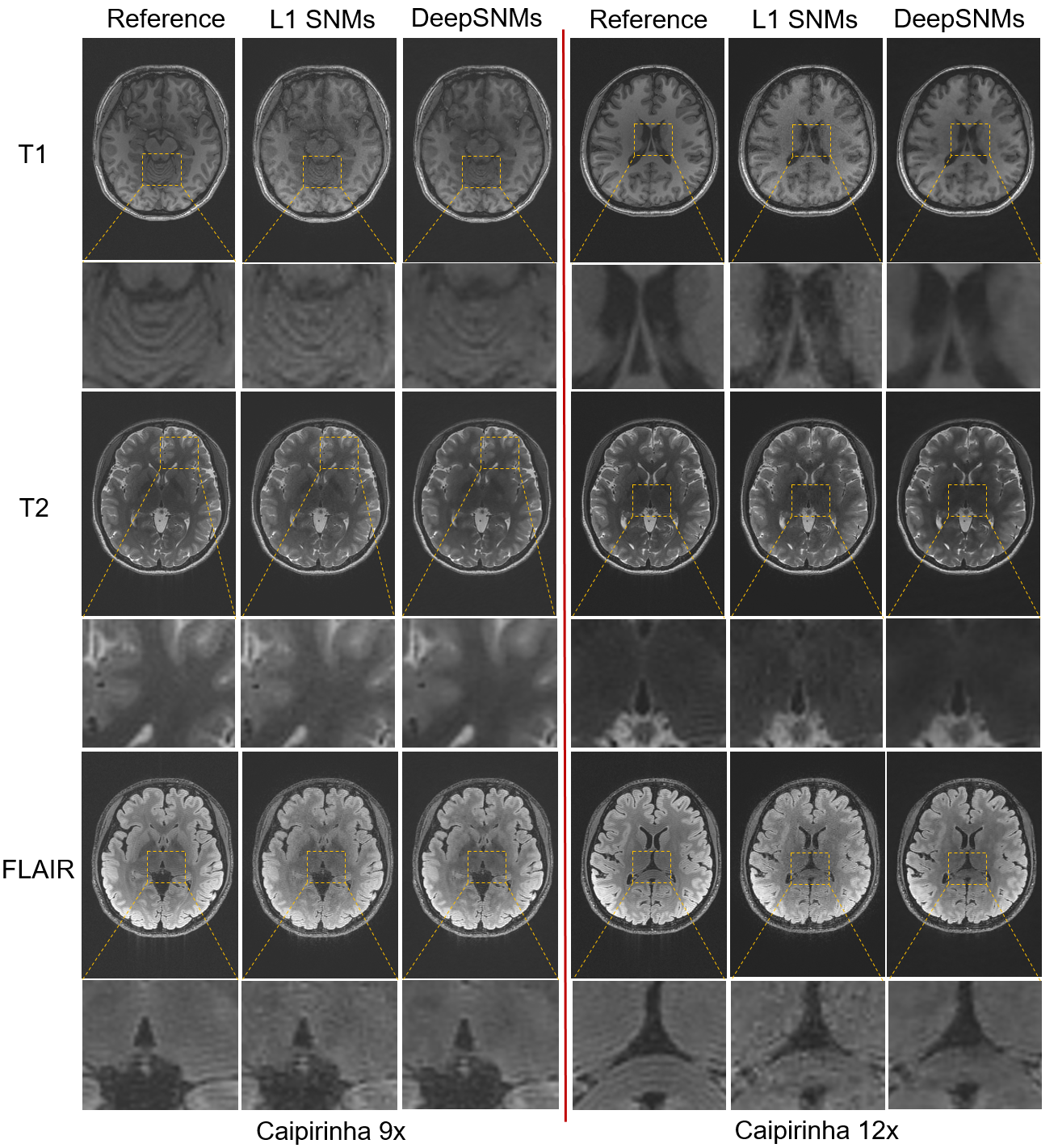
Fugure 5. DeepSNMs performs better than L1-SNMs on noise suppression and image quality. Compared to L1 regularization, the use of learnable CNN regularization demonstrates improved stability across different contrasts, resulting in superior image quality.