2717
MR-Guided Percutaneous Interventions: Needle Insertion with a Compact Assistance System and T2-weighted Imaging in 2 Orthogonal Slices1Division of Medical Physics, Department of Diagnostic and Interventional Radiology, Medical Center University of Freiburg, Faculty of Medicine, University of Freiburg, Freiburg, Germany, 2Department of Diagnostic and Interventional Radiology, University Medical Center Freiburg, Faculty of Medicine, University of Freiburg, Freiburg, Germany, 3Interventional Systems GmbH, Kitzbuehel, Austria, 4ACMIT Gmbh, Wiener Neustadt, Austria
Synopsis
Keywords: Interventional Devices, Interventional Devices, Pulse sequence design
Motivation: MR-guided percutaneous interventions at closed-bore high-field systems profit from remote device manipulation with real-time needle tracking.
Goal(s): To integrate a sequence capable of acquiring two T2-weighted orthogonal slices simultaneously (Ortho-SSFP-Echo) into the device-assisted needle intervention workflow during needle insertion.
Approach: The assistance system (GantryMate) was coupled with a real-time POCC sequence to target a lesion. Once the lesion was identified, its position information was used in a real-time Ortho-SSFP-Echo acquisition to dynamically monitor the needle insertion.
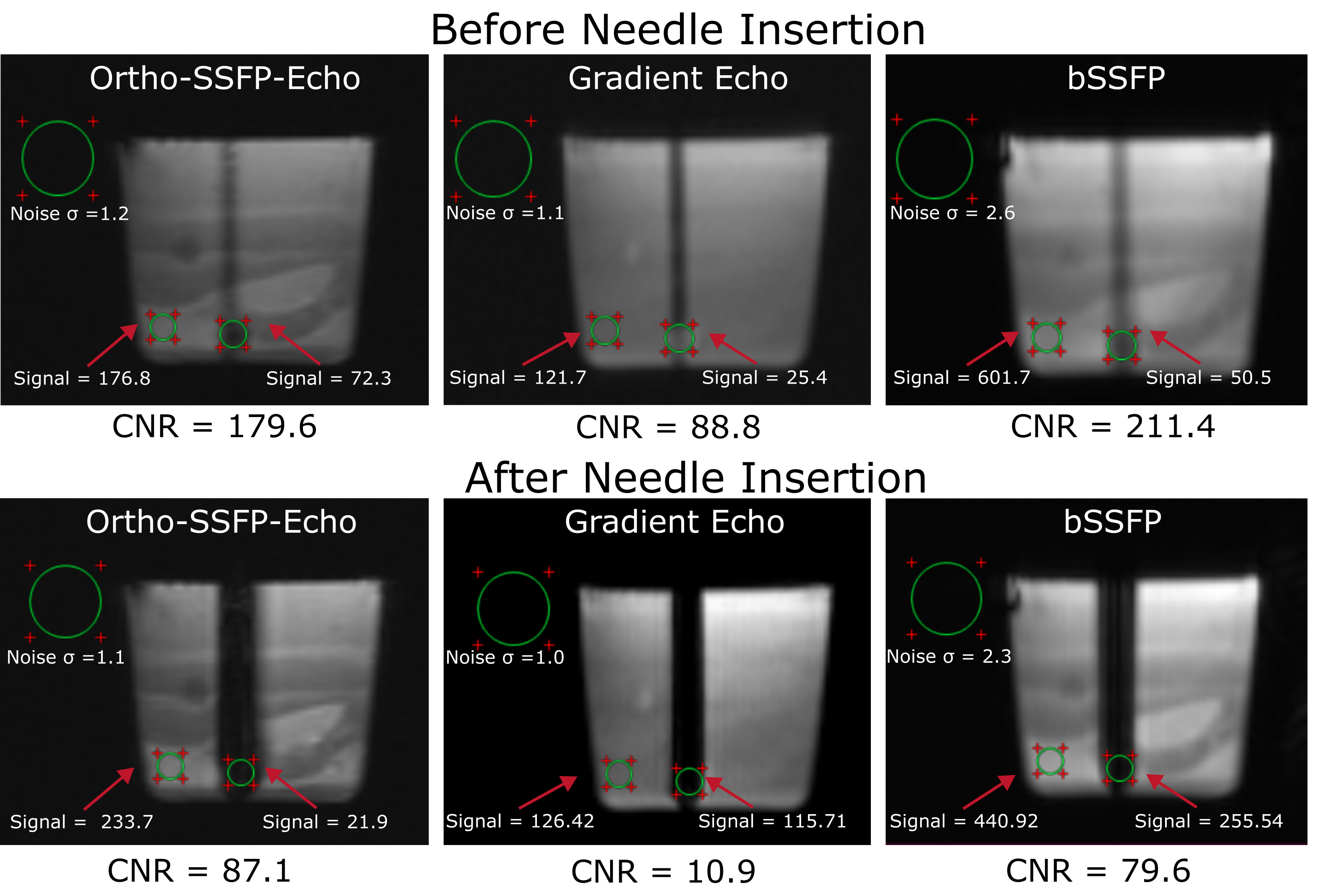
Results: The Ortho-SSFP-Echo sequence enables simultaneous needle visualization in two planes, offering higher CNR than GRE and comparable to bSSFP, without banding artifacts.
Impact: Combining an Ortho-SSFP-Echo sequence with a compact needle assistance system provides a streamlined interventional workflow with decreased complexity and improved image contrast for MR-guided percutaneous interventions at high field.
Introduction
Percutaneous interventions under MR guidance offer excellent contrast and signal-to-noise ratios (CNR and SNR) when performed in high-field systems, but access to the patient is restricted by the narrow bore design. To overcome this limitation, compact assistance systems such as GantryMate1 (Interventional Systems GmbH, Kitzbühel, Austria) allow needle positioning from outside the bore. When combined with a tracking sequence that uses phase-only cross-correlation (POCC) 2-6, real-time imaging can follow dedicated markers in real-time while the needle is aligned with the target.Currently, real-time targeting in the POCC sequence is limited to a single slice orientation. Therefore, the sequence must be stopped and restarted to image in a second orthogonal plane. Ideally, sequences with simultaneous imaging in two orthogonal planes 7-9 would be better suited to monitor needle deflections. While sequences like CROSS 8 and SOPI 9 can simultaneously image in two orthogonal slices with a T1-weighted contrast, T2-weighting would be advantageous for tumor visualization 10.
A new sequence, Ortho-SSFP-Echo 7, combines a pre-excitation refocused steady-state sequence with an orthogonal acquisition scheme to simultaneously acquire two orthogonal T2-weighted MR slices. Here, we demonstrate the integration of the Ortho-SSFP-Echo sequence into a workflow for MR-guided percutaneous interventions to enhance real-time visualization of the needle during insertion.
Methods
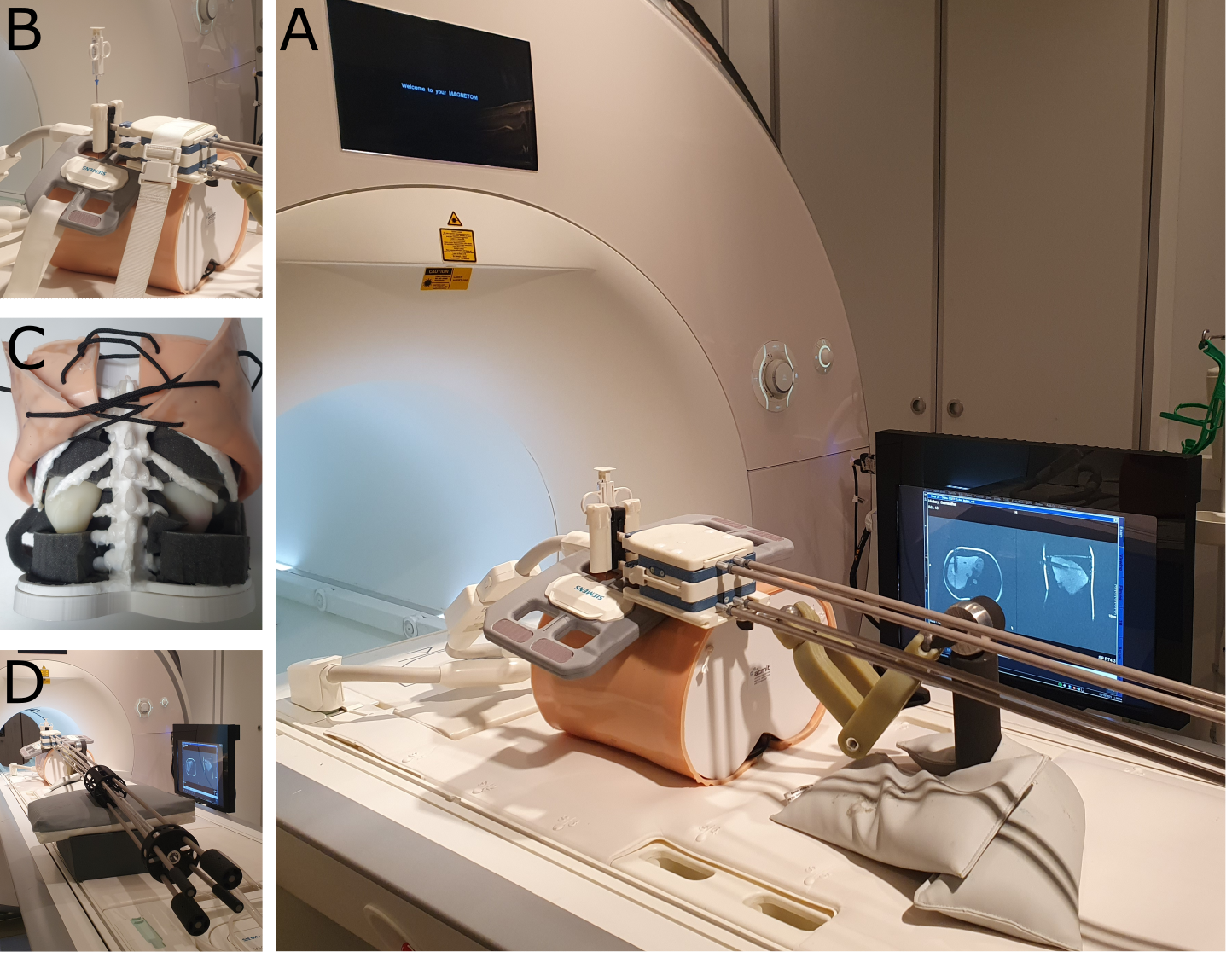
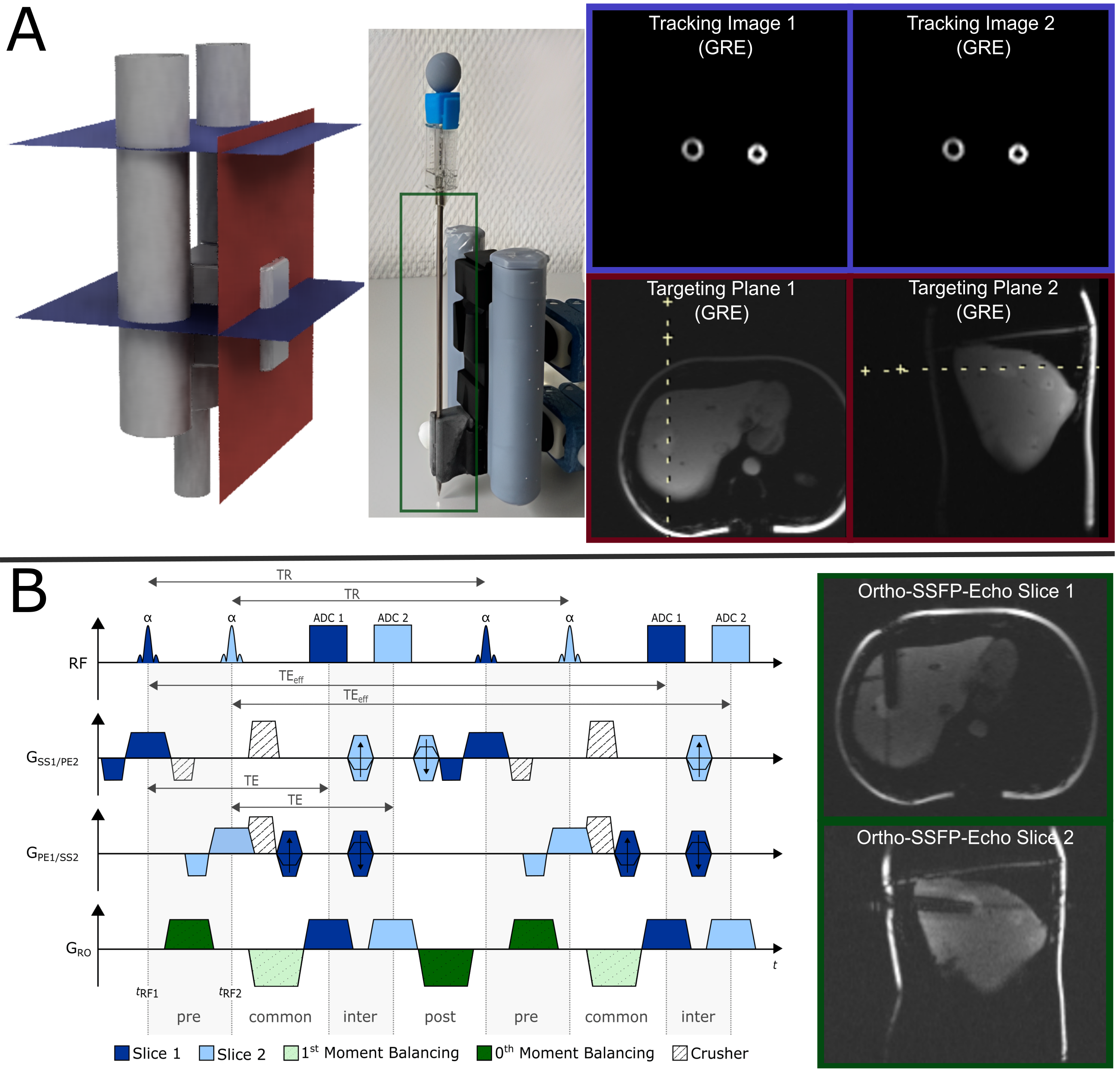
The Ortho-SSFP-Echo sequence was integrated into the workflow of an MR-guided percutaneous needle intervention to simultaneously visualize the needle insertion in two planes. Using an assistance system (GantryMate)1 to control the needle alignment (Fig. 1a & b), the system’s needle holder was manually adjusted with control rods (Fig. 1d) from outside of the magnet bore. The experiments were performed on a clinical 3T whole-body MR system (MAGNETOM Prisma; Siemens Healthineers, Erlangen, Germany), using a flex coil for signal reception. The GantryMate end-effector is equipped with two coaxial cylinders filled with contrast agent solution (Magnevist®/H2O:1/200, Bayer Schering Pharma AG, Berlin, Germany), which are detected in real time using a POCC tracking sequence (Fig. 2a). The sequence acquires two cross-sectional GRE images, in which the cylinders appear as two rings. The needle targeting plane is then projected (20 mm) from the cylinders in line with the needle and acquired (Fig. 2a). The POCC sequence acquires a single targeting plane orientation, in which the needle is aligned with the prospective target. Once aligned, the position information can then be transferred to the Ortho-SSFP-Echo sequence to monitor the needle insertion (Fig. 2b).The Ortho-SSFP-Echo7 sequence (Fig. 2b) acquires two orthogonal slices simultaneously, using principles of the pre-excitation refocused steady-state sequence (SSFP-Echo)11. During a real-time Ortho-SSFP-Echo acquisition, the user inserted the needle (ITP, Bochum, Germany) through the needle guide (Fig. 1a). The sequence parameters were: α = 30°, TR/TEeff = 7.77/11.65 ms, BW = 930 Hz/px, slice thickness = 6 mm, FOV = 340 × 340 mm, matrix = 192 × 192, partial Fourier = 6/8, phase resolution = 80%, GRAPPA = 2, and TA = 0.53 s for 2 slices. Targeting experiments were conducted in two phantoms and compared to a standard GRE and bSSFP sequence. An agar phantom with fiducial markers and an abdominal phantom (Fig. 1c) containing artificial organs (ACMIT, Wiener Neustadt, Austria) were used for the experiments. The contrast-to-noise ratio was assessed for the Ortho-SSFP-Echo, GRE, and bSSFP sequences in the target region, both before and after needle insertion.
Results & Discussion
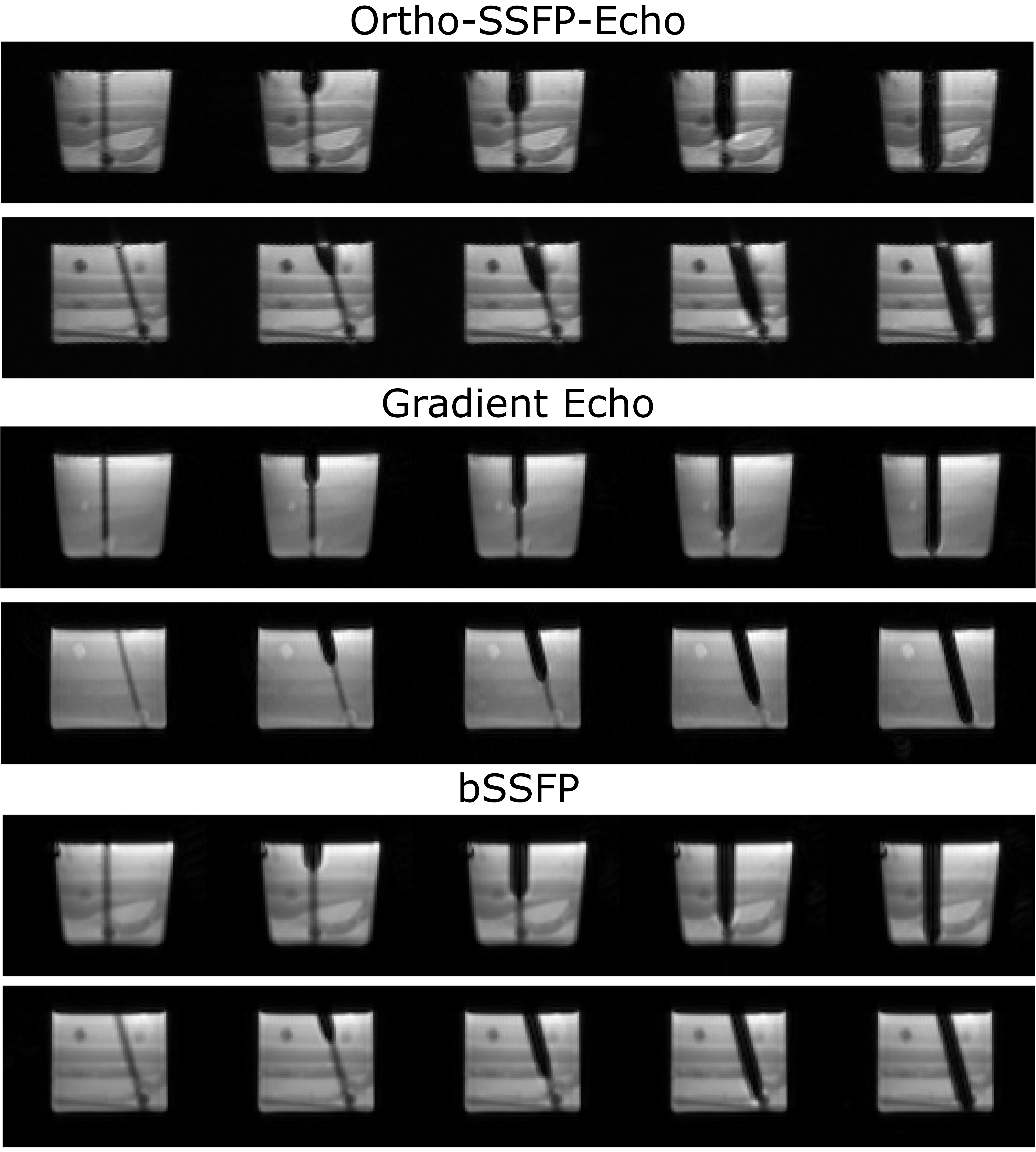
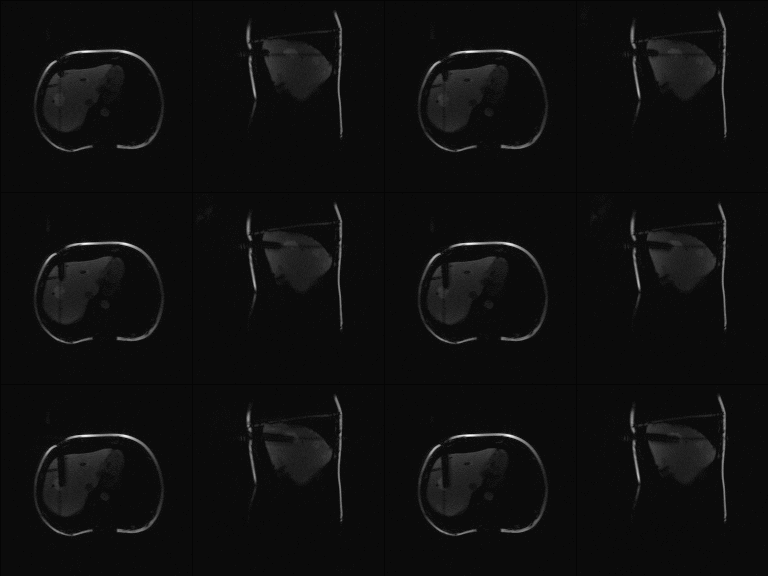
The Ortho-SSFP-Echo sequence enabled a truly simultaneous visualization of needle insertion in two orthogonal slices, as demonstrated in an agar phantom (Fig. 3). Successful needle insertion was also achieved in an abdominal phantom (Fig. 4). Compared to the GRE sequence, Ortho-SSFP-Echo exhibited a substantially higher CNR (Fig. 5). The CNR achieved with Ortho-SSFP-Echo in the range of that observed in the bSSFP sequence (Fig. 5) but remained free from the banding artifacts commonly associated with bSSFP sequences. In the Ortho-SSFP-Echo sequence, a saturation band occurs at the slice overlap region. Nevertheless, the needle artifact was larger than the saturation band and thus did not affect the needle visualization.In the future, the Ortho-SSFP-Echo sequence should be integrated into the POCC sequence for real-time targeting and needle insertion in two orthogonal planes. This integration will create a streamlined workflow and enable more effective needle positioning in two planes simultaneously, potentially increasing the acceptability of MR-guided percutaneous interventions.
Conclusion
The integration of Ortho-SSFP-Echo into the GantryMate-assisted percutaneous needle intervention workflow enabled a more effective visualization of the needle insertion in two orthogonal slices simultaneously. This real-time T2-weighted acquisition offered by Ortho-SSFP-Echo accelerated the procedure and enhanced the contrast for improved precision.Acknowledgements
This work was supported in part by a grant from the German Federal Ministry for Economic Affairs and Energy (BMWi) under the grant program “Zentrales Innovationsprogramm Mittelstand (ZIM),” grant number ZF4535603BA9, as part of the IraSME funding “E‐GantryMate”.
References
1. Reichert A, Bock M, Vogele M, Joachim Krafft A. GantryMate: A Modular MR-Compatible Assistance System for MR-Guided Needle Interventions. Tomography. 2019 Jun;5(2):266-273. doi: 10.18383/j.tom.2019.00007.
2. de Oliveira A, Rauschenberg J, Beyersdorff D, Semmler W, Bock M. Automatic passive tracking of an endorectal prostate biopsy device using phase-only cross-correlation. Magn Reson Med. 2008 May;59(5):1043-50. doi: 10.1002/mrm.21430.
3. Krafft, A. J. et al. Passive marker tracking via phase-only cross correlation (POCC) for MR-guided needle interventions: Initial in vivo experience. Phys. Med. 29, 607–614 (2013).
4. Reichert, A. et al. Simultaneous slice excitation for accelerated passive marker tracking via phase-only cross correlation (POCC) in MR-guided needle interventions. Magn. Reson. Mater. Phys. Biol. Med. 31, 781–788 (2018).
5. Reichert A, et al.. Passive needle guide tracking with radial acquisition and phase-only cross-correlation. Magn Reson Med. 2021 Feb;85(2):1039-1046. doi: 10.1002/mrm.28448. Epub 2020 Aug 7.
6. Reichert, A, et al. Passive Real-Time Needle Tracking and Needle Tip Estimation. in Proc. Intl. Soc. Mag. Reson. Med. vol. 30 (2022).
7. Hickey S, et al. Simultaneous T2 -weighted real-time MRI of two orthogonal slices. Magn Reson Med. 2023 Dec;90(6):2388-2399. doi: 10.1002/mrm.29795. Epub 2023 Jul 10.
8. Krafft AJ, et al. Crushed rephased orthogonal slice selection (CROSS) for simultaneous acquisition of two orthogonal proton resonance frequency temperature maps. J Magn Reson Imag 2013:38(6): 1510-1520.
9. Mickevicius NJ, et al. Simultaneous orthogonal plane imaging. Magn Reson Med. 2017;78(5):1700-1710.10. Dimopoulos JC, et al. Recommendations from Gynaecological (GYN) GEC-ESTRO Working Group (IV): Basic principles and parameters for MR imaging within the frame of image based adaptive cervix cancer brachytherapy. Radiother Oncol. 2012 Apr;103(1):113-22. doi: 10.1016/j.radonc.2011.12.024. Epub 2012 Jan 30.
11. Gyngell ML. The application of steady-state free precession in rapid 2DFT NMR imaging: FAST and CE-FAST sequences. Magn Reson Imaging. 1988;6(4):415-419.
Figures