2706
Principal component analysis assisted deep learning method for motion artifacts correction in MR thermometry1School of Medicine, Tsinghua University, Beijing, China, 2Department of Engineering Physics, Tsinghua University, Beijing, China
Synopsis
Keywords: Thermometry/Thermotherapy, Motion Correction
Motivation: To improve the performance of convolutional neural network (CNN) for motion artifacts correction and demonstrate the feasibility of using motion-related information provided by principal component analysis (PCA).
Goal(s): To achieve high accuracy of temperature mapping for motion existing organs like abdominal and thus expand a wide range of MR-thermometry in clinical applications.
Approach: We proposed a combination method of PCA and basic CNN model to correct artifacts in abdominal MR-thermometry.
Results: Preliminary results showed that the proposed method outperforms conventional CNN in terms of temperature mapping accuracy. The new method reduces the motion-related phase errors by leveraging PCA.
Impact: Our proposed method has a high potential to handle motion organs with non-rigid motion. The PCA method in combination of CNN for its efficient reduction of motion induced errors may improve the feasibility and accessibility of MR-thermometry in abdominal applications.
Introduction
Magnetic resonance temperature imaging methods are essential for the success of MR-guided microwave ablation surgery. However, several factors may severely influence the accuracy of temperature monitoring particularly in abdominal. Reduction of non-rigid motion caused by respiratory and other factors becomes a challenging problem in abdominal. Most early method was proposed based on “Multi-baseline” and “Referenceless” to correct artifacts in phase imaging1. Recently, a deep learning based method was proposed, which mainly used convolution to extract features from MR imaging for motion correction2. However, an end-to-end model like this relies on large amounts of data to achieve good performance, which is often unavailable in practical applications, leading to difficulties to capture detail information.Studies have shown that principal component analysis (PCA) has the ability to extract motion information from MR images3. In this work, we proposed a motion correction method based on CNN assisted by the information provided by PCA. We demonstrated the feasibility of this method by improving the image quality compared to the network which used CNN only.
Method
1. MR data Acquisition:A volunteer was scanned by an EPI sequence on a 3T Philips Ingenia using the following acquisition parameters: matrix size=228×336, resolution=0.73×0.73mm2, repetition time=100ms, echo time=26ms, bandwidth in readout direction=2085Hz, flip angle=35°. A set of dynamic imaging was obtained during 150s at an imaging frequency of 10Hz. The first 60 seconds of images were used as the training data of our model. The remaining 90 seconds of images were used to mimic an interventional procedure to evaluate the results. Meanwhile, motion surrogate signals were acquired by the respiratory belt.
2. Extracting respiratory information with PCA from MR imaging
An overview of our proposed architecture is shown in Figure 1.
The first 30 seconds of images were used to calculate the covariance matrix to get a set of linearly independent orthogonal basis B and the coordinate vectors s=[σ1(t),σ2(t),σ3(t), ... ,σn(t)] with respect to the basis B(Fig.2). The information of motion is extracted to these coordinate vectors. For each element in the same coordinate vectors, a channel attention block was used to give them different weights. Inspired by the work of Karras T4,5, a fully connected neural network was used to map the coordinate vectors to an intermediate latent space. Then a series of deconvolution layers was used to increase spatial dimension to generate PCA feature maps.
3.PCA-assisted convolutional neural network for phase generation.
Using a CNN encoder similar to U-net to generate a set of feature maps from the two-dimensional magnitude image. The feature maps generated by U-net and PCA were then concatenated. Using a CNN decoder to generate a two-dimensional phase image. The neural network is implemented in TensorFlow. The network was trained using Adam optimizers and mean square error (MSE) as the loss function. We also use mean absolute error (MAE) to quantify the performance.
Results
1. As shown in Figure 2(b), the σ1(t) and the motion surrogate signal shows good consistency. The result demonstrates the feasibility of extracting respiratory information with PCA.2. Image quality and convergence comparison
Figure 4 shows that PCA-assisted method can outperform the CNN-only methods, which generates higher-quality phase images. In addition, Figure 3 shows the PCA-assisted method took fewer iterations to converge, which can reduce the iteration times.
Discussion and Conclusion
The PCA method provides more motion-related information at a single time point in comparison with the motion surrogate signals acquired by a respiratory belt. Experimental results confirmed the PCA-assisted CNN has improved accuracy over the basic CNN method. The proposed method indicates the potential value of PCA for deep learning methods in a wide range of applications in MR-guided therapy.Acknowledgements
No acknowledgement found.References
1. Grissom W A, Rieke V, Holbrook A B, et al. Hybrid referenceless and multibaseline subtraction MR thermometry for monitoring thermal therapies in moving organs. Medical physics, 2010, 37(9): 5014-5026.
2. de Senneville B D, Coupé P, Ries M, et al. Deep correction of breathing-related artifacts in real-time MR-thermometry. Computerized Medical Imaging and Graphics, 2021, 87: 101834.
3. de Senneville B D, El Hamidi A, Moonen C. A direct PCA-based approach for real-time description of physiological organ deformations. IEEE Transactions on Medical Imaging, 2014, 34(4): 974-982.
4. Karras T, Aila T, Laine S, et al. Progressive growing of gans for improved quality, stability, and variation. arXiv preprint arXiv:1710.10196, 2017.
5. Karras T, Laine S, Aila T. A style-based generator architecture for generative adversarial networks. Proceedings of the IEEE/CVF conference on computer vision and pattern recognition. 2019: 4401-4410.
Figures
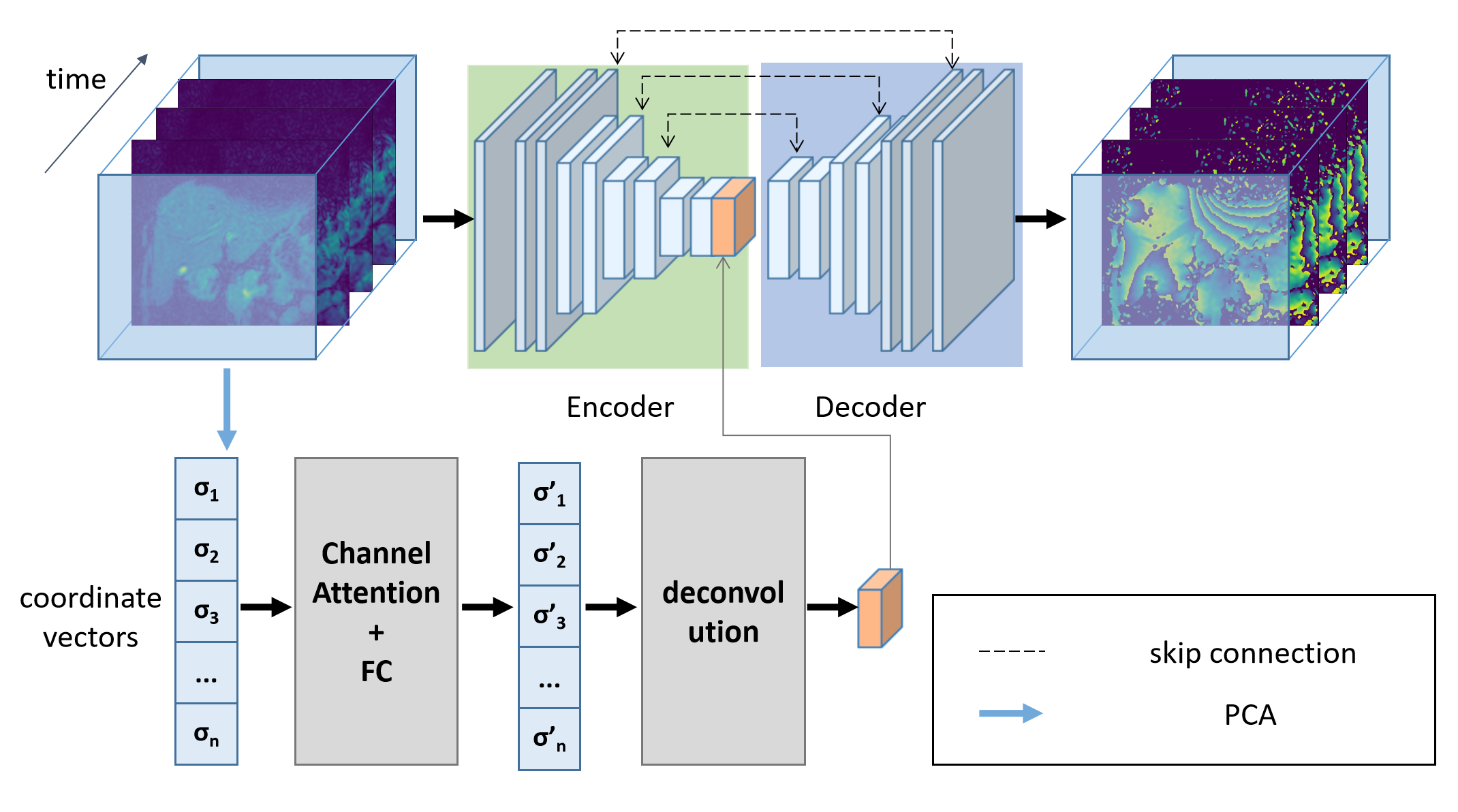
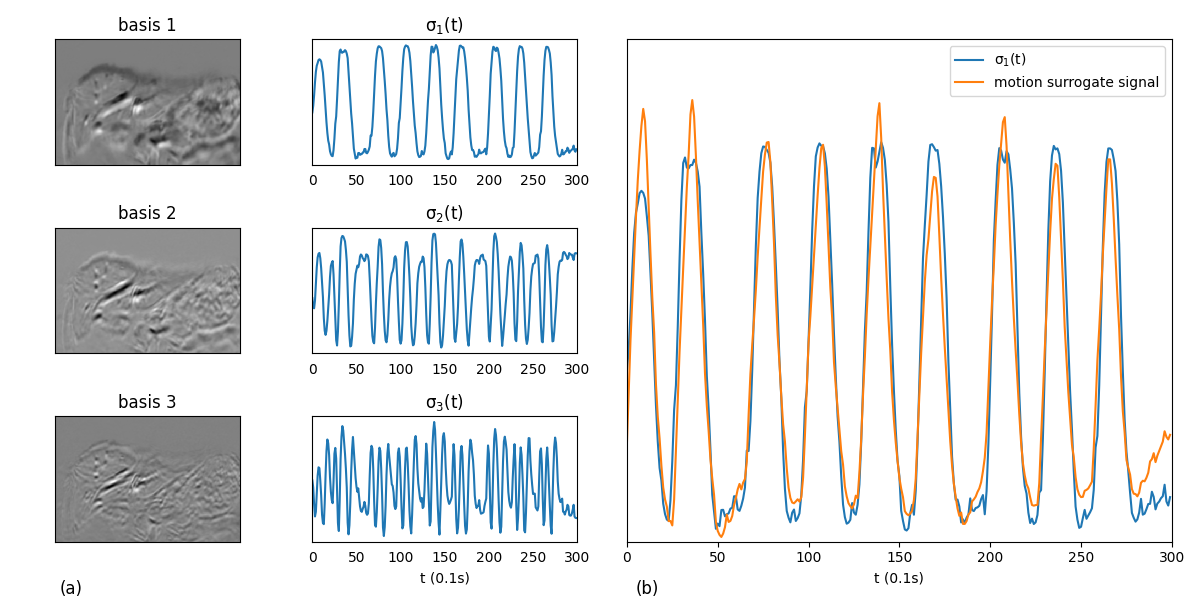
Figure2. (a): basis 1, basis 2, basis 3 and σ with respect to them.
(b): plot of σ1 and motion surrogate single change over time. The values of the two curves are adjusted to the same scale.
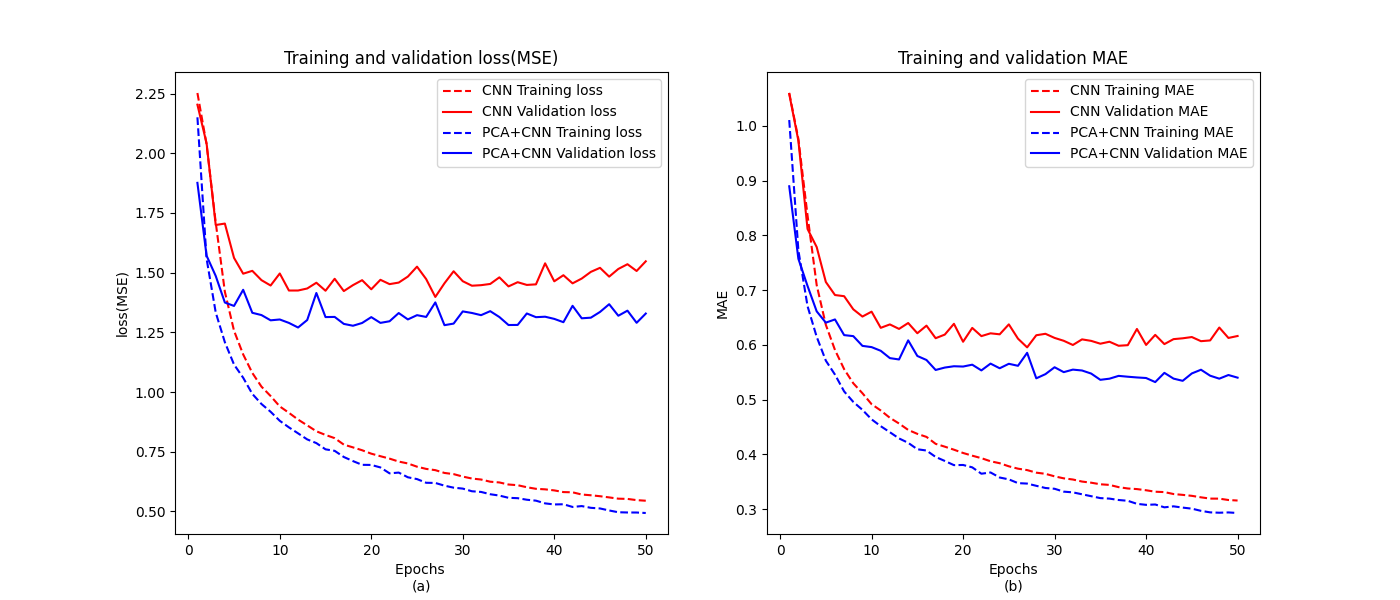
Figure 3. Mean square error (MSE) and mean absolute error (MAE) curves for different iterations. For each number of epochs, MSE and MAE are plotted, respectively. Red color lines represent results of CNN, blue color lines represent results of the proposed method. The first 60 seconds of images were used as the training data, the remaining 90 seconds of images were used as the validation data.
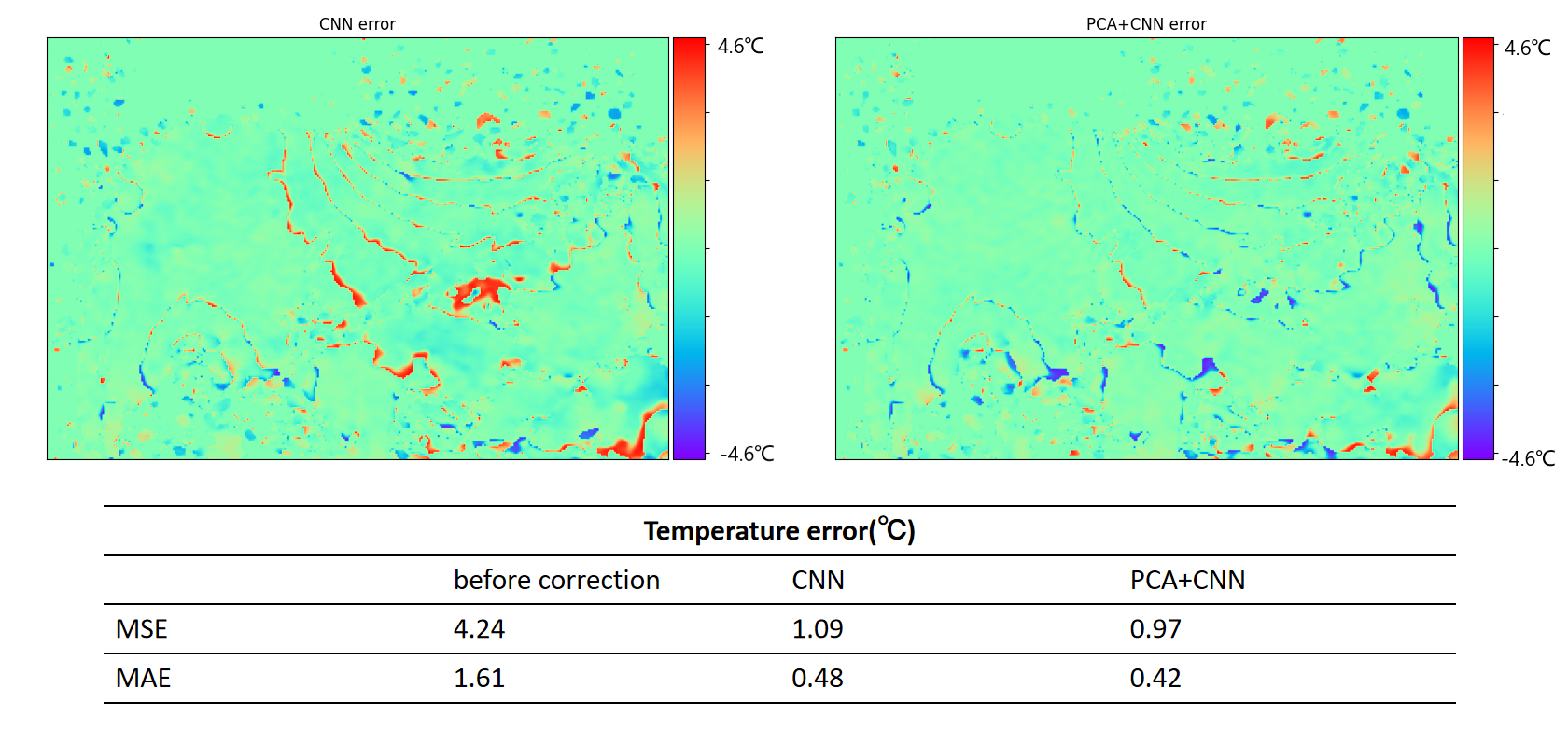
Figure 4. Results and error maps of different methods. PCA-assisted CNN model demonstrates better quality in detail compared to the CNN model. MSE and MAE show the proposed method overperforms CNN method.