2697
Numerical Study of Superconducting, Low Temperature and Room Temperature RF Coils at Ultra-Low Field 70mT/3MHz MRI1Biomedical Engineering, The State University of New York at Buffalo, Buffalo, NY, United States
Synopsis
Keywords: Low-Field MRI, Simulations
Motivation: Due to its convenience and affordability, ultra-low field MR imaging is growing in popularity. However, poor SNR requires a solution.
Goal(s): This research aims to determine if superconducting coils or low temperature coils are still beneficial in terms of SNR in ultra-low-field MR.
Approach: Our method compares RF coils made from different conductivities. This comparison will help us determine superconductor importance in coil performance.
Results: The findings highlight the significance of superconductor materials and how they can be used to improve imaging performance at lower field strengths.
Impact: This study investigates signal-to-noise ratio (SNR) in superconducting, low temperature and room temperature RF coils for affordable ultra-low-field MR imaging and determines if superconducting or low temperature coils are still beneficial in SNR at 0.07T. It shows how superconductor materials improve imaging performance, especially at lower field strengths.
Introduction
Ultra-low-field MR imaging systems are becoming more popular as a result of the lower costs associated with them, effectively making MR imaging more accessible to a larger population. Furthermore, the advancement of artificial intelligence and its incorporation into MRI to compensate for lower SNR by using denoising algorithms is increasing the popularity of ultra-low-field MR imaging. However, the lower sensitivity, lower SNR, and lack of important spatial information in the images cannot be overlooked and must be addressed in terms of RF hardware development. The conducting materials used in coil fabrication or coil temperature could be one area for improvement1-6. Because of its low cost and high conductivity, copper is the most commonly used material as a conductor in coil fabrication. Copper exhibits an increase in electrical conductivity when subjected to lower temperatures and has been used in a low temperature state for coil fabrication in an attempt to improve imaging performance. This study aims to take a similar approach, especially for ultra-low-field MR imaging, by investigating a multi-turn solenoid coil made up of super conductor, low-temperature copper and room-temperature copper to investigate the performance in terms of SNR in ultra-low-field 0.07T MR applications.Method
In three cases, a 16-turn solenoid coil was numerically simulated. The cases involved varying the conductive material used for the coil, and the materials included: room temperature copper, liquid nitrogen-cooled copper, and the simulation suite's Perfect electric conductor condition. Copper has a conductivity of 5.96e+07 S/m at room temperature (200C). Copper's resistivity at 20°C is 1.68e-8, and the temperature coefficient is 0.0039, so copper's resistivity at liquid nitrogen temperature (-193.80°C) is 2.79e-9, which can be used to estimate conductivity of 37e+07 S/m. The simulation suite's perfect electric conductor condition assumes that the material has zero electrical resistance, resulting in a material with infinite conductivity that does not exist in practice. Figure 1 shows a coil constructed from the materials listed below. Figure 1 depicts a simulation setup for a 16-turn solenoid coil with a length of 255mm and a diameter of 259.9mm. A cylindrical phantom with a length of 200mm and a diameter of 140mm is also included in the simulation setup. The cylindrical phantom's material properties were as follows: Ɛr: 100, σ: 0.09 S/m. The solenoid coil was simulated with the specified materials as the conductor, and performance parameters like Q-factors, H-field efficiency, Electric fields, and normalized SNR distribution were evaluated and compared extensively.Results
The S-parameter reflection coefficient for three solenoid coil simulations is shown in Figure1D. PEC had the highest Q-factor of 82.01, followed by LNC copper (72.01) and RT copper (59.91). In the cylindrical phantom, Figure2A,B shows the normalized H-field distribution along the axial planes at various points and in the central sagittal plane. The LNC copper coil had almost 35% higher H-field efficiency over the axial and sagittal plane than the room temperature copper coil, while the PEC coil had 131% higher efficiency. Figure3 shows the electric field distribution in the central sagittal plane of the phantom. LNC copper coils have 35% higher peak electric fields than RT copper coils, and PEC coils have 140% higher peak electric fields. Figure4 shows normalized SNR90 distribution maps in the coil and phantom center's central axial and sagittal planes. PEC had almost 60% higher SNR than RT copper, while LNC copper had 12.54% higher SNR. The H-field and SNR distributions' 1D profiles in the central axial and sagittal plane are shown in Figures 5A and 5B.Conclusion
Our research shows that superconducting materials and low-temperature copper improve ultra-low-field MR imaging performance, which could improve diagnostics and research. An idealized perfect electric conductor and liquid nitrogen-cooled copper have many advantages over room temperature copper. There are still practical obstacles to using superconducting materials in MR imaging.Acknowledgements
No acknowledgement found.References
1. Ma QY, Chan KC, Kacher DF, Gao E, Chow MS, Wong KK, Xu H, Yang ES, Young GS, Miller JR, Jolesz FA. Superconducting RF coils for clinical MR imaging at low field. Acad Radiol. 2003 Sep;10(9):978-87. doi: 10.1016/s1076-6332(03)00110-7. PMID: 13678086.
2. Styles, P., et al. "A high-resolution NMR probe in which the coil and preamplifier are cooled with liquid helium." Journal of Magnetic Resonance (1969) 60.3 (1984): 397-404.
3. Hall, A. S., et al. "Investigation of a whole‐body receiver coil operating at liquid nitrogen temperatures." Magnetic resonance in medicine 7.2 (1988): 230-235.
4. Jerosch-Herold, Michael, and Randall K. Kirschman. "Potential benefits of a cryogenically cooled NMR probe for room-temperature samples." Journal of Magnetic Resonance (1969) 85.1 (1989): 141-146.
5. Okada, Hidehiko, et al. "RF coil for low-field MRI coated with high-temperature superconductor." Journal of Magnetic Resonance, Series B 107.2 (1995): 158-164.
6. Seton, H. C., D. M. Bussell, and S. JM. "Hutchison,“A liquid heliumcooled RF coil and DC SQUID amplifier for MRI at 0.01 T,”." Proc. Soc. Magn. Reson. Vol. 2. 1995.
Figures
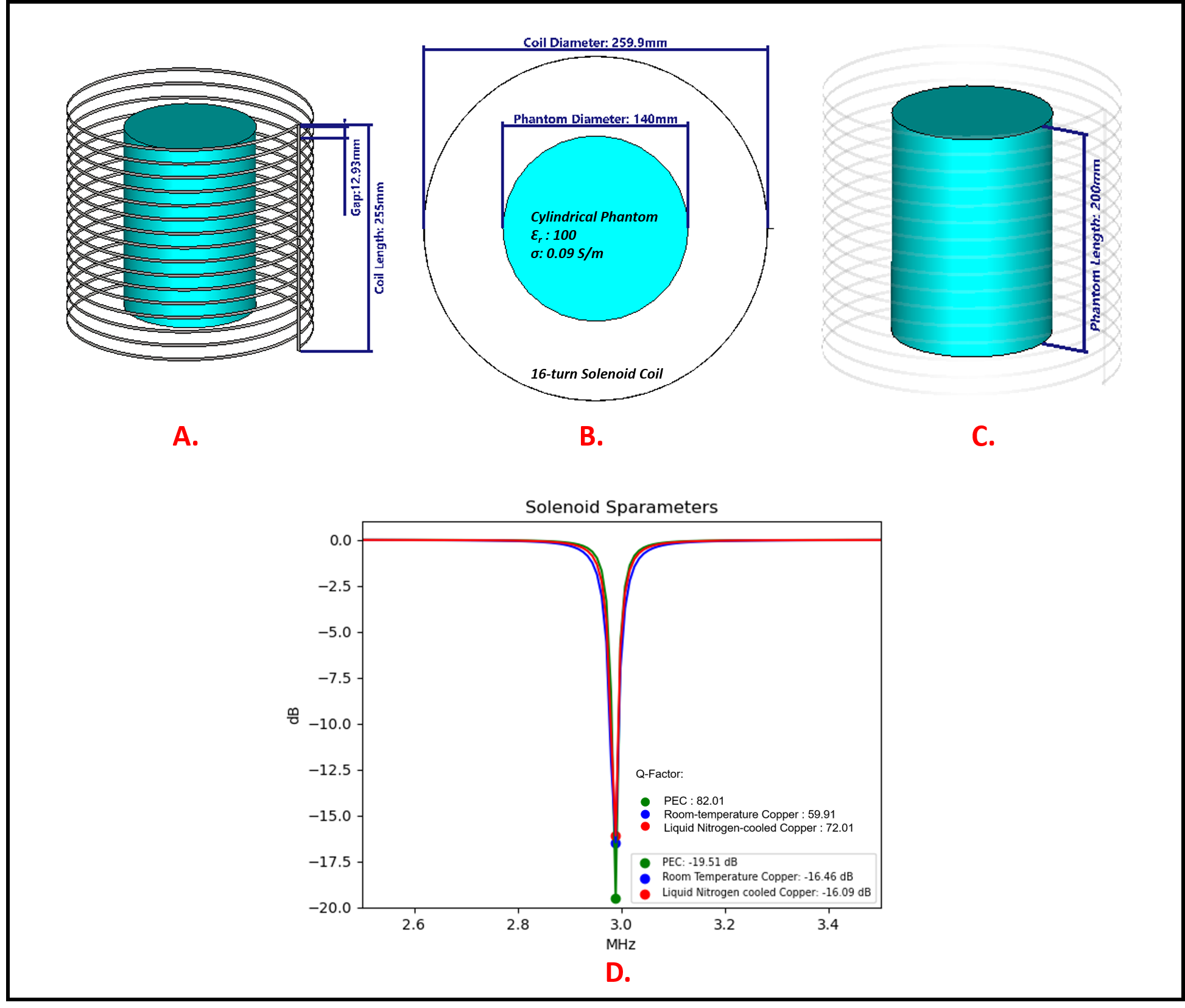
Figure1. (A) A perspective view of the simulation setup with the solenoid coil surrounding the cylindrical phantom. (B) A top view of the cylindrical phantom in the center of the coil. (C) The cylindrical phantom. (D) The reflection coefficient S-parameters for solenoids made from various conductive materials.
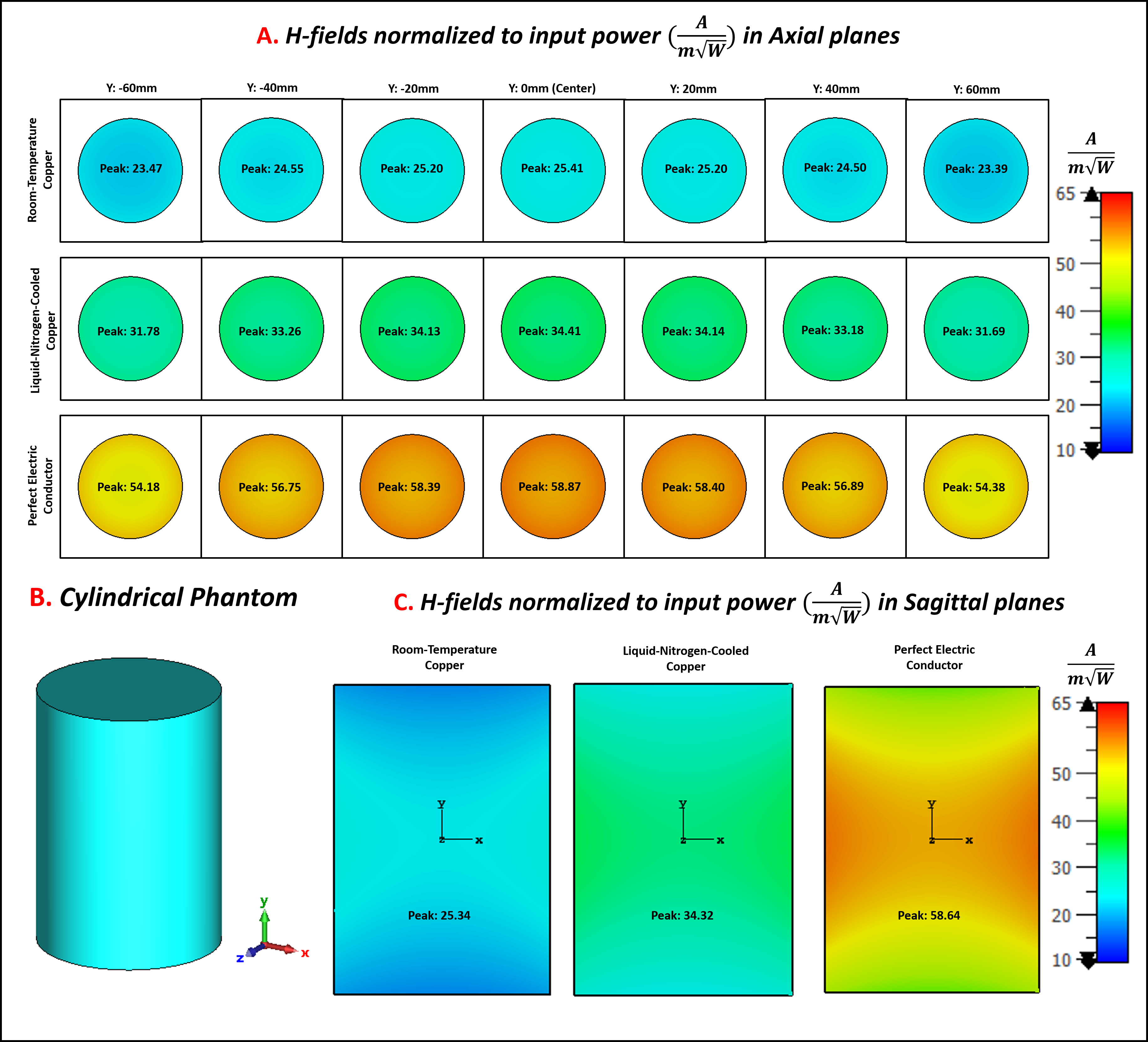
Figure2. (A) Normalized H-fields plotted in the axial planes of the phantom at various precisions, as labeled for each evaluated case. (B) A cylinder was used to plot the field distributions. (C) Normalized H-fields in the phantom's central sagittal plane for the evaluated cases.
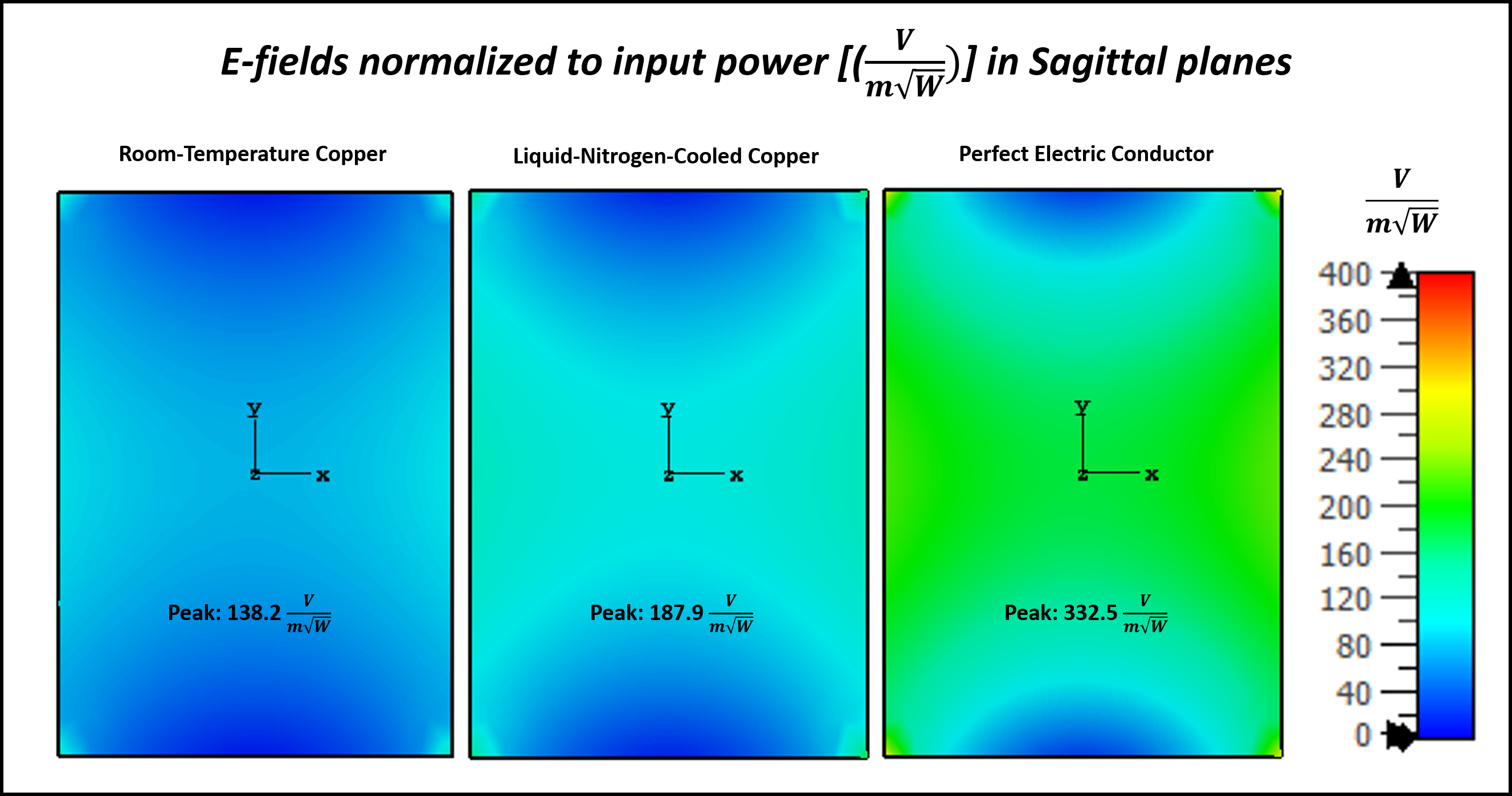
Figure3. The normalized electric fields in the cylindrical phantom's central sagittal plane for various conductivity materials.
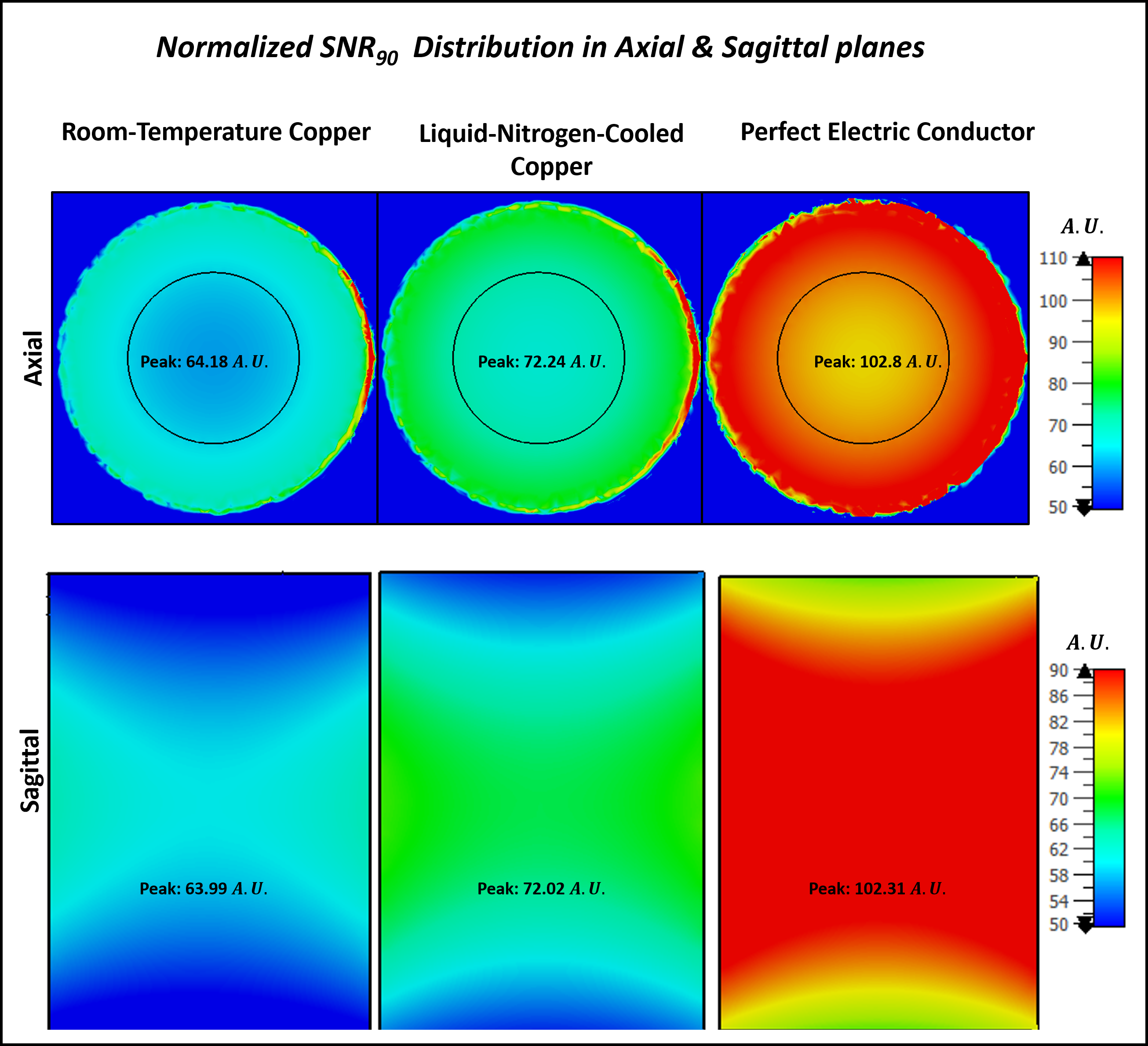
Figure4. The normalized SNR90 distribution maps in the phantom and coil center's central axial and sagittal planes.
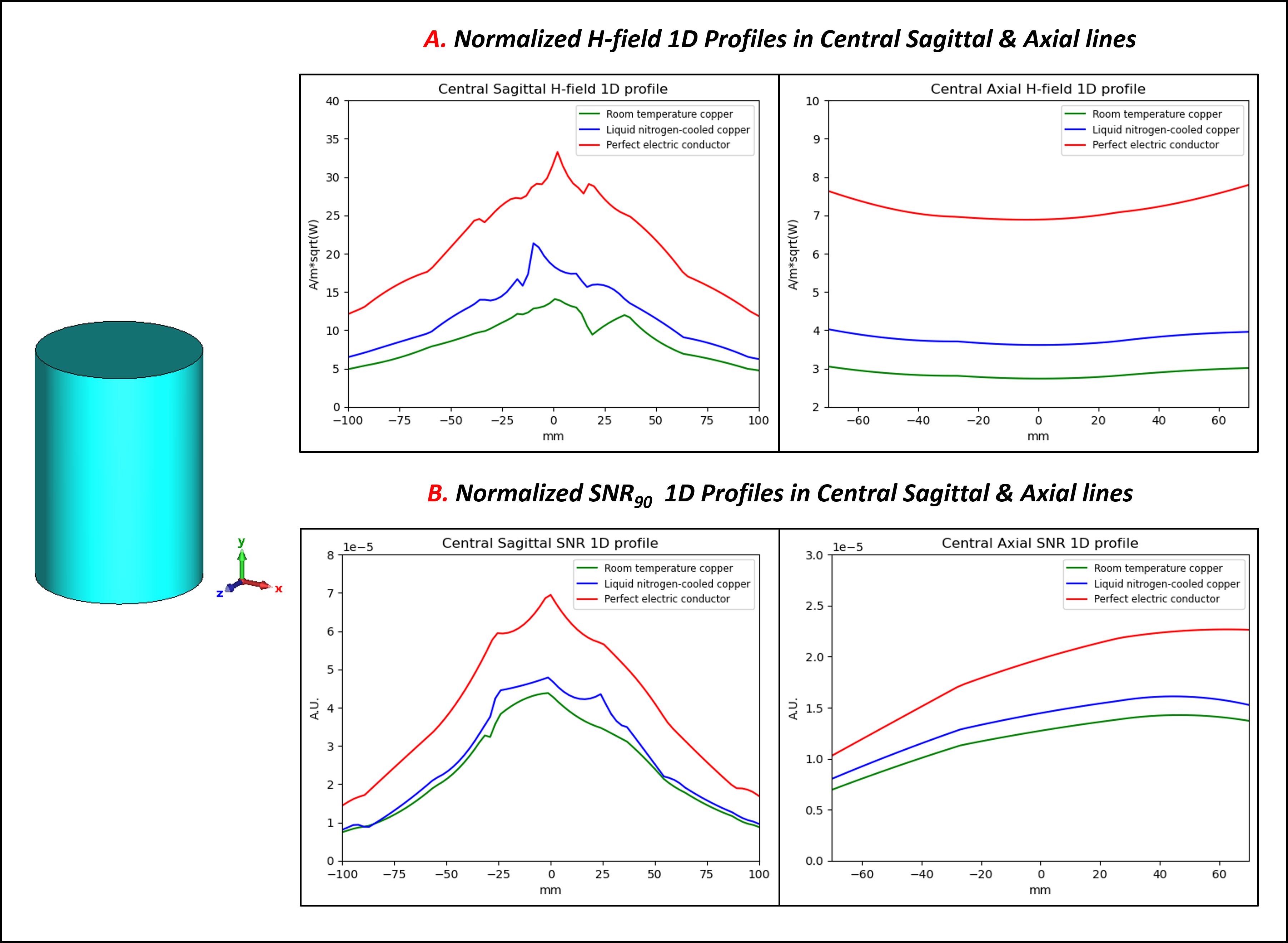
Figure 5: 1D profiles of normalized H-fields and SNR90 maps in the central axial and sagittal lines of the phantom for the three evaluated cases.