2695
Diffusion tensor imaging in portable low-field MRI1School of Biomedical Engineering, Shanghai Jiao Tong University, Shanghai, China, 2National Engineering Research Center of Advanced Magnetic Resonance Technologies for Diagnosis and Therapy (NERC-AMRT), Shanghai Jiao Tong University, Shanghai, China
Synopsis
Keywords: Low-Field MRI, Low-Field MRI, Diffusion
Motivation: DWI/DTI are very challenging in portable MRI system, while they play a pivotal role in timely triage, diagnosis and treatment for patients with suspected acute conditions such as stroke.
Goal(s): To mitigate the effects of eddy currents and achieve multi-directional diffusion-weighted imaging and diffusion tensor imaging in portable MRI system.
Approach: With the three-axis gradient coil accompanied with anti-eddy plate and image-phase based eddy current correction, we applied multi-scaning average to suppress noise and adopted eddy correction to mitigate the motion blurring.
Results: We succeed obtain visible multi-direction diffusion-weighted imaging and DTI imaging in portable MRI system.
Impact: With the three-axis gradient coil accompanied with anti-eddy plate and image-phase based eddy current correction, we succeed in obtaining multi-direction diffusion-weighted imaging and DTI images with the portable MRI system.
Introduction
Diffusion-weighted imaging (DWI) offers valuable information about the microscopic movement of water molecules within tissues, particularly in the context of neurological disorders(1). Notably, DWI is widely recognized for its superior capabilities in the early detection of acute infarcts with the most relevant contrast, enabling the identification of reduced water diffusion mere minutes after the onset of ischemia(2). In clinical practice, neuroimaging, often driven by DWI MRI, plays a pivotal role in timely triage, diagnosis and treatment for patients with suspected acute conditions such as stroke(3). However, despite the exceptional image quality of conventional high-field MRI systems, their accessibility remains limited by the high cost and immobility(4). Therefore, the application of DWI, a clinically indispensable imaging protocol, in the context of portable MRI is of significant importance. However, this transition to portable MRI is still challenging. The strong diffusion gradient employed in DWI is sensitive to eddy currents induced by gradient changes(5). In this work, we mitigate the effects of eddy currents and achieve multi-directional diffusion-weighted imaging.Methods
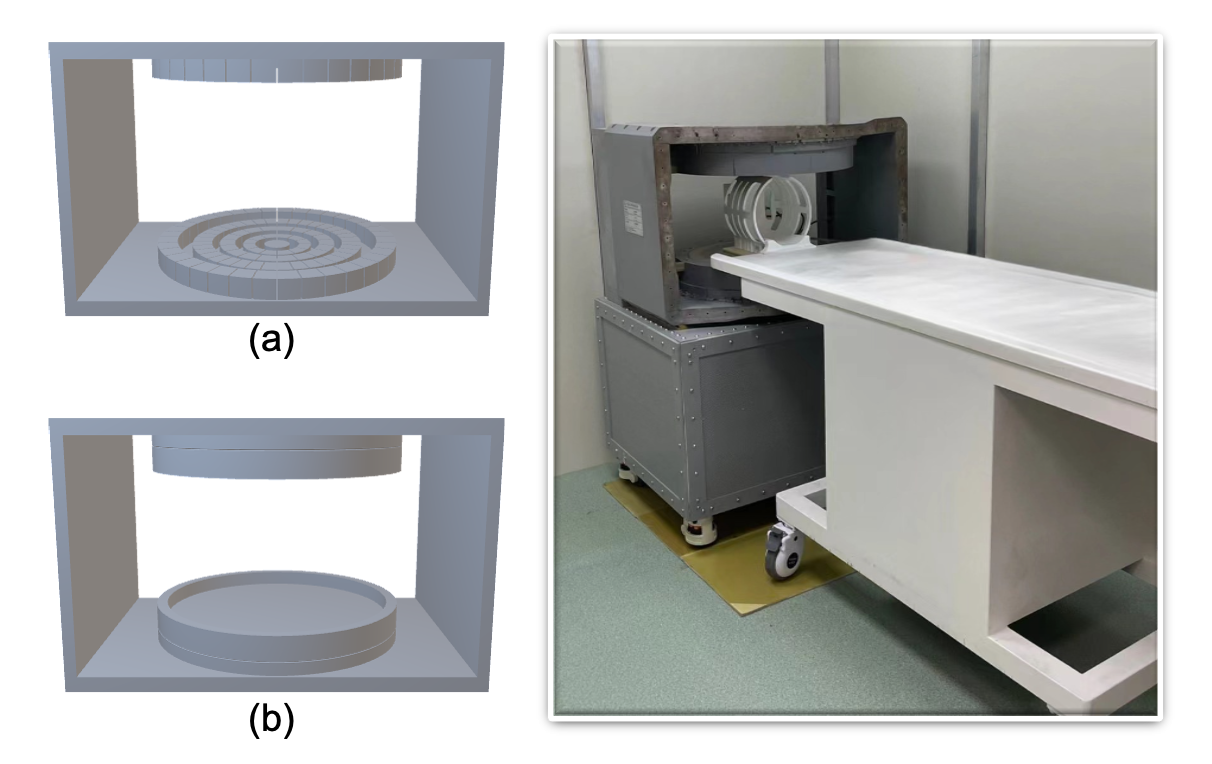
Scanner system. The experimental setup in our study featured a 110 mT scanner system, as depicted in Figure 1. Some existed low-field portable scanner utilize the permanent magnet design as shown in Figure 1a and are prone to significant eddy current generation within their associated gradient system. The 110 mT scanner we used employs a different magnet configuration with open space in the middle depicted in Figure 1b, facilitating the integration of three-axis gradient coils and an anti-eddy plate. To address the potential eddy current artifacts, we adopted an image-phase-based method in conjunction with the field probe, ultimately leading to effective first-order eddy current correction and enabling eddy-current-induced field shift reduced to about 15ppm. This enable the possibility for the DWI in portable low-filed condition.Experiments. In-vivo experiments were performed with DTI sequence on the 110 mT portable low-field MRI shown in Figure 1. Parameters of DTI sequence include 5000ms TR, 125ms TE 240x240 mm2 FOV, 80x80 matrix size, 10mm slice thickness, 64 uniformly distributed diffusion directions, 1000smm2 b-value, 5 and 20 repetitions.
Data analysis. DWI data were corrected for eddy current distortions and residual bulk motion and co-registered using the “eddy” function from the FMRIB Software package (FSL, http://fsl. fmrib.ox.ac.uk/fsl/fslwiki/). The diffusion tensor model was then fitted using FSL’s “dtifit” function to derive the fractional anisotropy (FA) and the primary eigenvector (V1).
Results and Discussion
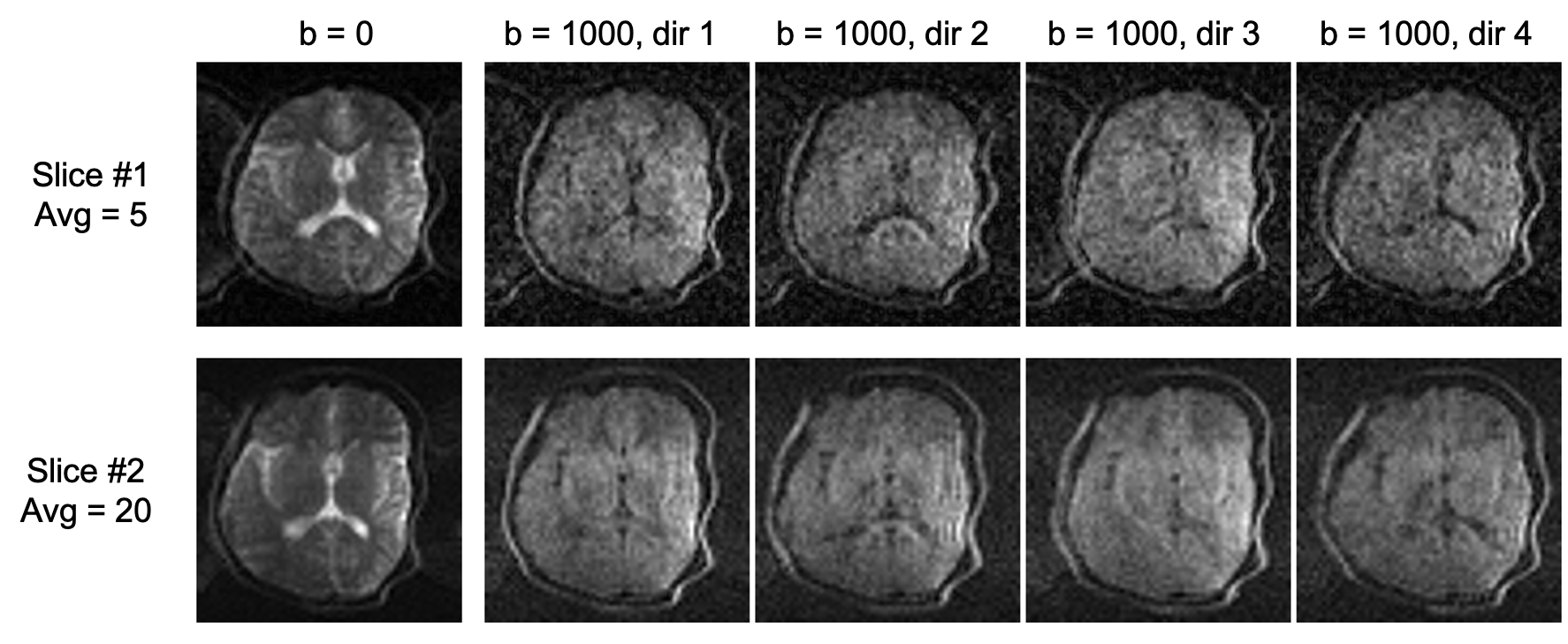
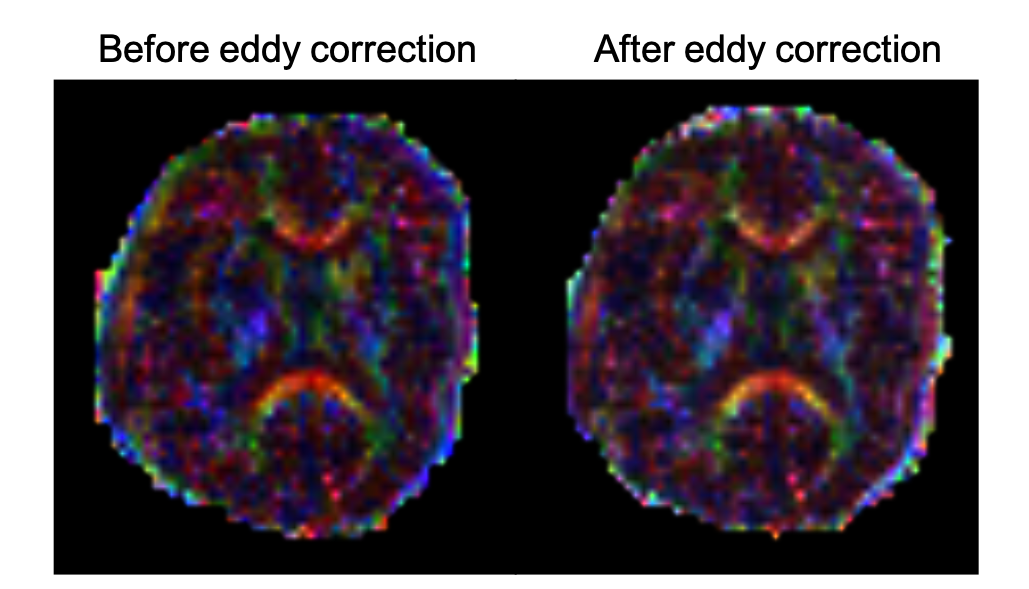
Figure 2 shows the DWI results obtained form four diffusion encoding directions of two slices using the 110 mT portable MRI system, with b-values of 0 and 1000 s/mm2. The top row showcases the DWI results with an acquisition of 5 averages, while the bottom row presents the DWI results obtained with 20 averages. It is evident that various diffusion encoding directions yield distinct contrast patterns, and the increased number of averages notably enhances the Signal-to-Noise Ratio (SNR).Figure 3 shows the color FA images with/without eddy-corrected images. The eddy correction in FSL can remove blurring caused by motion from direction to direction.
With the three-axis gradient coil accompanied with anti-eddy plate and image-phase based eddy current correction, we obtained visible DTI imaging with the portable MRI system. Based on this, we applied multi-average to suppress noise and adopted eddy correction to mitigate the motion blurring. In future work, we can use “topup” to correct the distortion along the phase-encoding direction and optimize diffusion encoding direction to reduce the necessary direction numbers reducing the scanning time.
Conclusions
We succeeded in obtaining multi-direction diffusion-weighted imaging and visible DTI imaging with the portable MRI system.Acknowledgements
This work is supported by the National Natural Science Foundation of China National Science Foundation of China (No. 62001290 and 62301309), Shanghai Science and Technology Development Funds (21DZ1100300) and sponsored by the National Science and Technology Innovation 2030 Major Project (2022ZD0208601).References
[1]. Schaefer PW, Grant PE, Gonzalez RG. Diffusion-weighted MR imaging of the brain. Radiology 2000;217(2):331-345.
[2]. Albers GW. Diffusion-weighted MRI for evaluation of acute stroke. Neurology 1998;51(3 Suppl 3):S47-S49.
[3]. Kimberly WT, Sorby-Adams AJ, Webb AG, Wu EX, Beekman R, Bowry R, Schiff SJ, de Havenon A, Shen FX, Sze G. Brain imaging with portable low-field MRI. Nature Reviews Bioengineering 2023;1(9):617-630.
[4]. Liu Y, Leong AT, Zhao Y, Xiao L, Mak HK, Tsang ACO, Lau GK, Leung GK, Wu EX. A low-cost and shielding-free ultra-low-field brain MRI scanner. Nature communications 2021;12(1):7238.
[5]. Bodammer N, Kaufmann J, Kanowski M, Tempelmann C. Eddy current correction in diffusion‐weighted imaging using pairs of images acquired with opposite diffusion gradient polarity. Magnetic Resonance in Medicine: An Official Journal of the International Society for Magnetic Resonance in Medicine 2004;51(1):188-193.
Figures