2691
Comb EMI: a hardware-free, training-free approach to EMI correction1Department of Biomedical Engineering, Yale University, New Haven, CT, United States, 2Department of Radiology, Yale School of Medicine, New Haven, CT, United States
Synopsis
Keywords: Low-Field MRI, Sparse & Low-Rank Models, Electromagnetic Interference
Motivation: Point-of-care MRI systems need electromagnetic interference (EMI) cancellation with limited passive shielding to improve cost and portability. Existing methods require external hardware or training, which increases costs and design complexity.
Goal(s): This novel solution targeting narrowband EMI is hardware-free, training-free, introduces no white-noise and can be used in conjunction with other methods.
Approach: Exploiting the sparsity, L1-regularized compressed sensing is used to extract EMI from a comb-shaped sampling window that consists of noise-dominated regions in acquisition.
Results: With proof-of-concept implementation, robust EMI cancellation is demonstrated on both simulated and experimental data, with comparable performance to collector-based method despite the lack of extra hardware.
Impact: Point-of-care MRI systems can further push SNR and save scan time by removing narrowband EMI without the cost of additional hardware or training data, enabling new design possibilities for fast, portable, and economically accessible MRI.
Introduction
While point-of-care MRI extended the portability and accessibility of MRI systems, electromagnetic interference (EMI), unwanted radiofrequency noise, has always been a key limitation on the signal-to-noise ratio. Some existing solutions include passive shielding, real-time EMI measurement using an external collector and transfer function1,2, and deep learning3. While those methods successfully cancel EMI to various degrees, they either introduce extra hardware, which limits the cost and design of the system, or require training data, which may provide limited generalizability. Thus, we introduce a new EMI-correction method targeting narrowband EMI using noise-dominated sections of the acquisition combined with broad assumptions about the general structure of EMI. Since the noise-sampling windows often resemble a comb, we refer to the approach as Comb EMI.Narrowband EMI, which is commonly induced by other electronics in the surroundings, is continuous, discrete in the frequency domain, and can be assumed to have constant frequency and amplitude over short periods (e.g., a single TR). Thus, when sampling for EMI, reconstruction methods such as compressed sensing can be used to extract the narrowband EMI from patches of noise-dominated data.
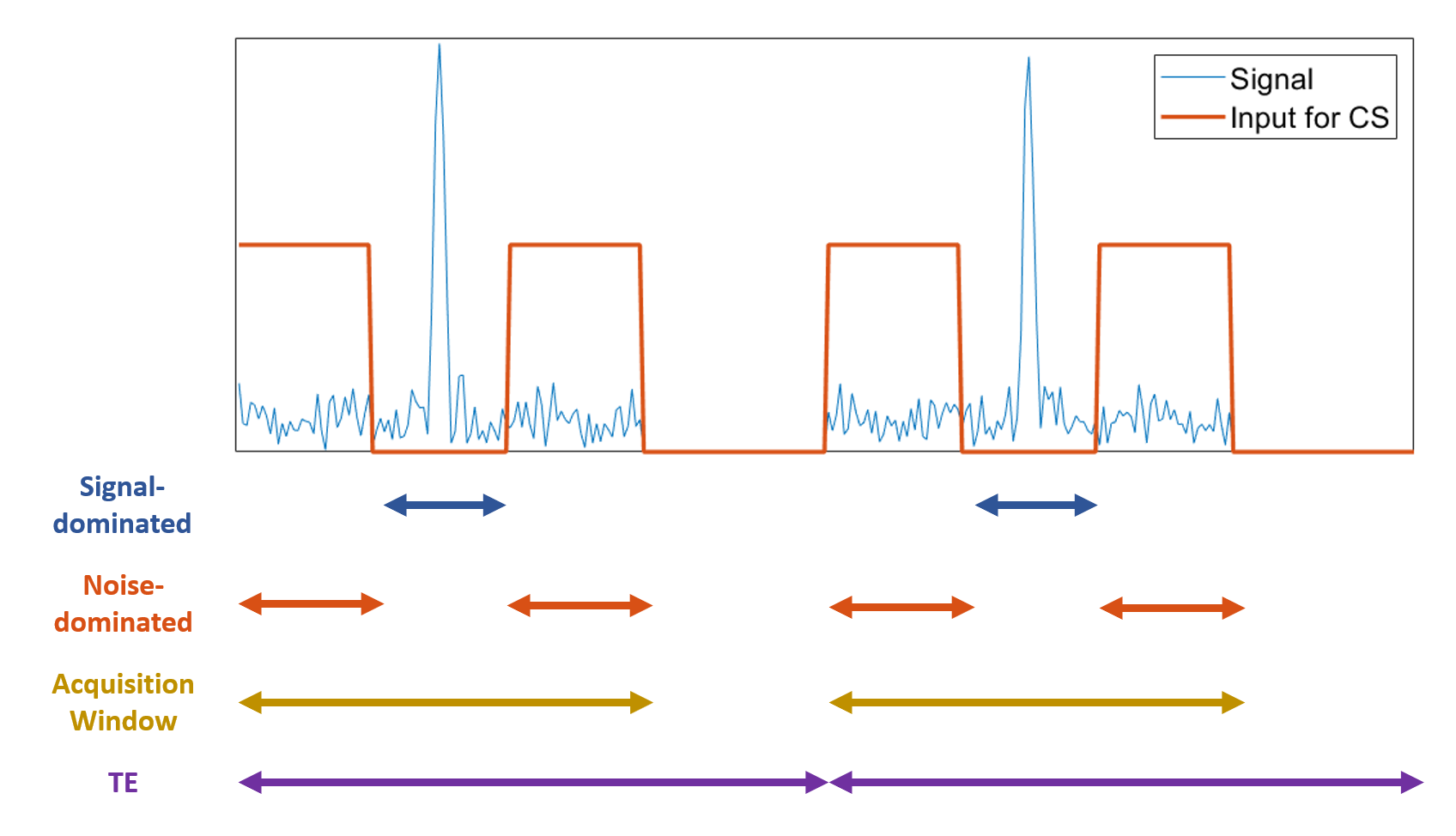
With sequences that have relatively strong encoding within each TE, the acquisition window can be long enough such that the wings of each echo is dominated by noise and interference signal (Fig 1). Furthermore, for sequences with long echo trains, these samples amount to an undersampled time domain with high spectral resolution. We present a proof-of-concept implementation of our approach using the edges of echo windows as samples of noise embedded in each scan. Using sparsity in frequency domain as an assumption about EMI structure, the narrowband EMI can be recovered and removed from the original data.4
Methods
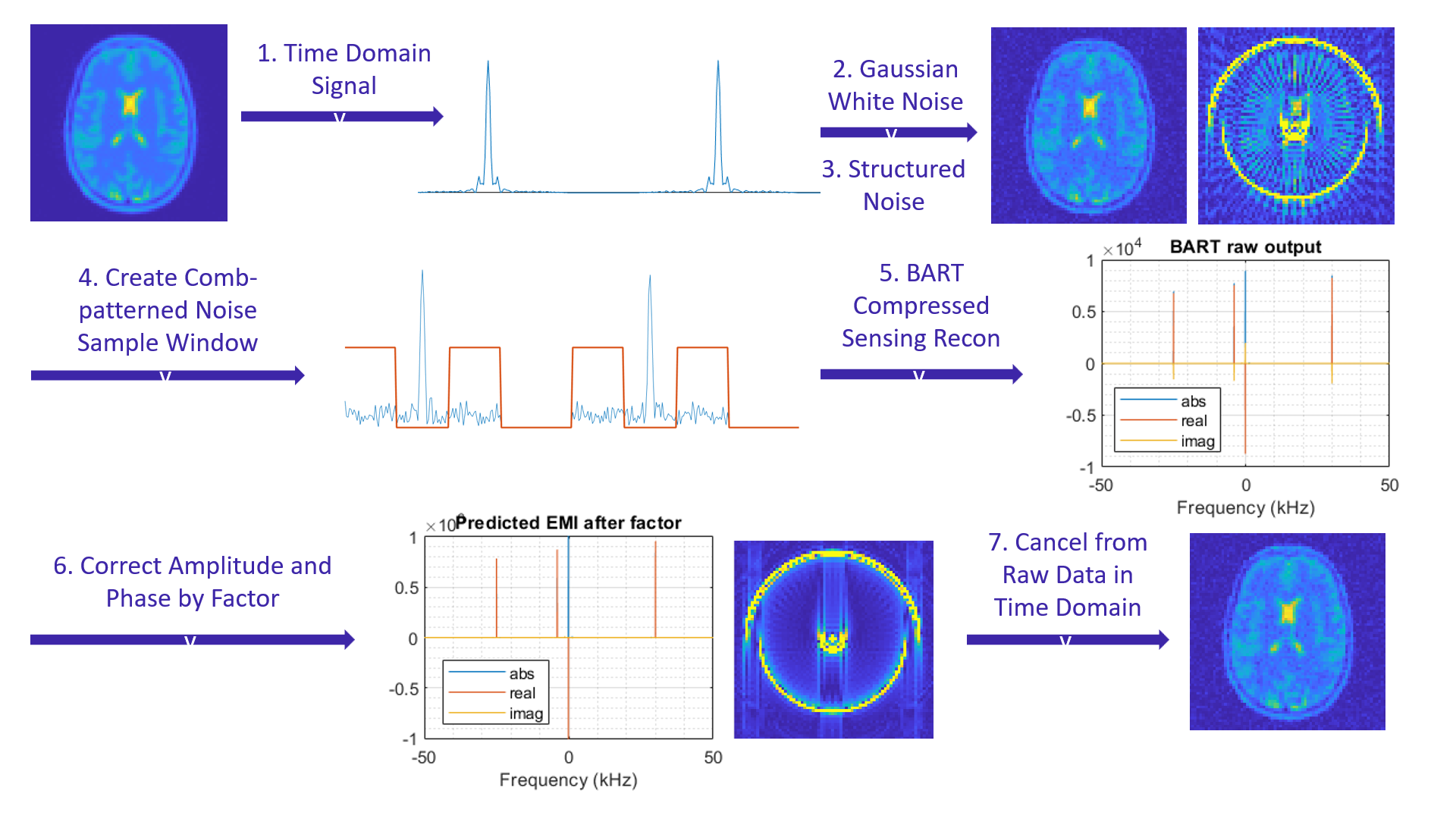
The approach was implemented on MATLAB with the BART toolbox5 and demonstrated(Fig. 2). For simulation, a brain phantom6 was used as the ground truth, reverted to the time domain by Radon and Fourier Transform to simulate radial MRI, known to be prone to EMI artifacts. Spacing is added between acquisition windows to match an experimentally realistic TE. Then, gaussian white noise and multiple complex structured noises of different frequencies and amplitudes were added. The noise-dominated part of each echo was used as an input for BART compressed sensing reconstruction, and a weighted L1-norm term was used to ensure sparsity:$$min \|x\|_1: Ax = b$$
Following the correction of a complex scaling factor introduced by the package and found from separate simulations of EMI only, the scaled output is subtracted from the simulated noisy signal. A collector-based EMI correction is also simulated for comparison assuming a perfect transfer function, where the collector-detected EMI is the injected EMI with different white noise.
Signal acquired with a CPMG Sequence with visually distinguishable EMI contamination was used for experimental validation. The data was acquired on NuB0, an open MRI system featuring a strong nonlinear field for polarization which is ramped down during readout.7 Experimental spatial encoding was performed with the Bloch-Siegert shift from a 5-channel RF array. Data processing was as in simulation, except that the scale factor between BART raw output and comb estimated noise is determined by $$$\frac{\|\text{BART input}\|_1}{\|\text{BART output(N)}\|_1}$$$ where $$$N$$$ is the mask for noise. Three external real-time EMI probes were used to perform a collector-based EMI cancellation using a 1-D implementation of the EDITER method.1
Results & Discussion
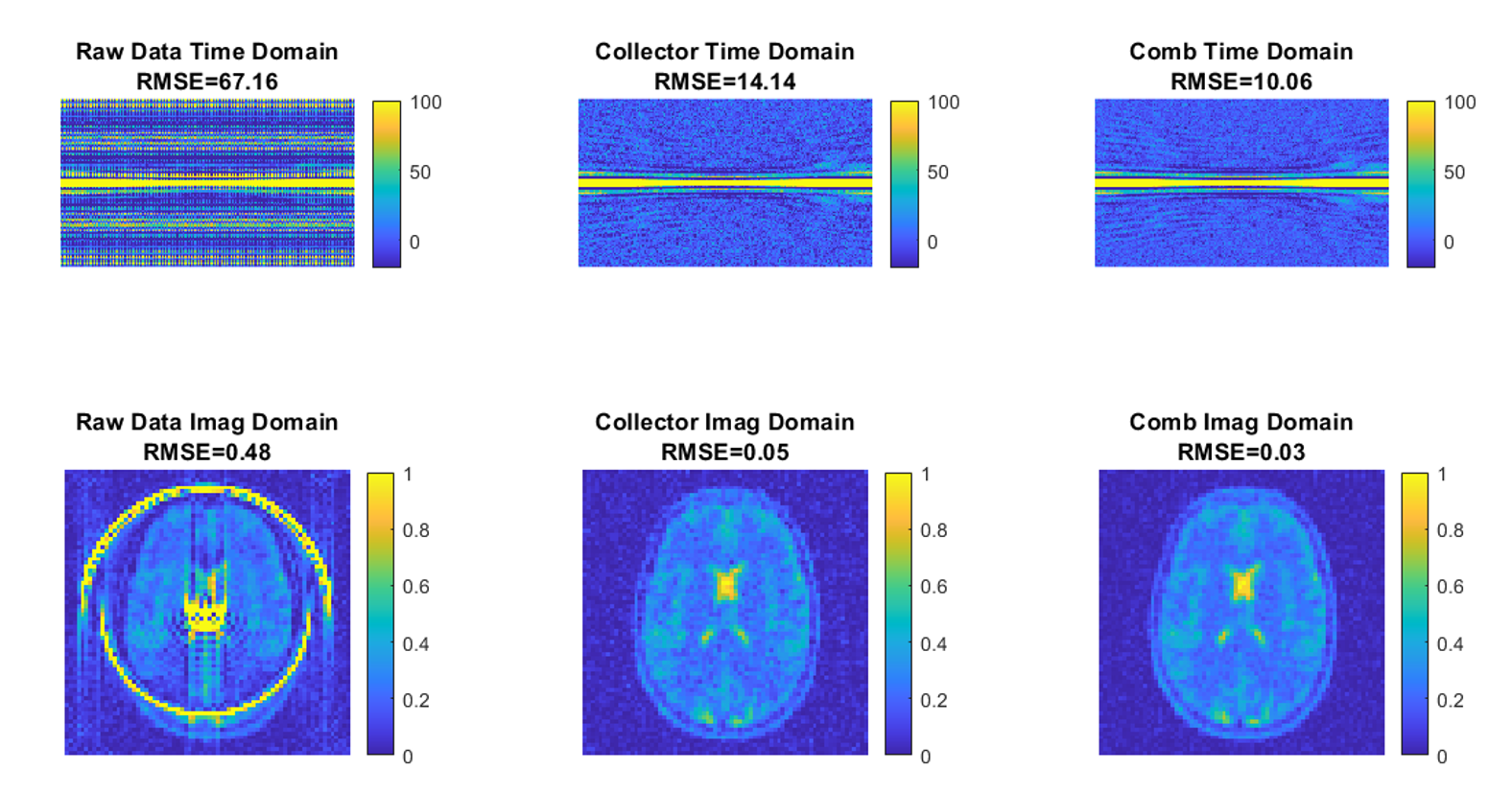
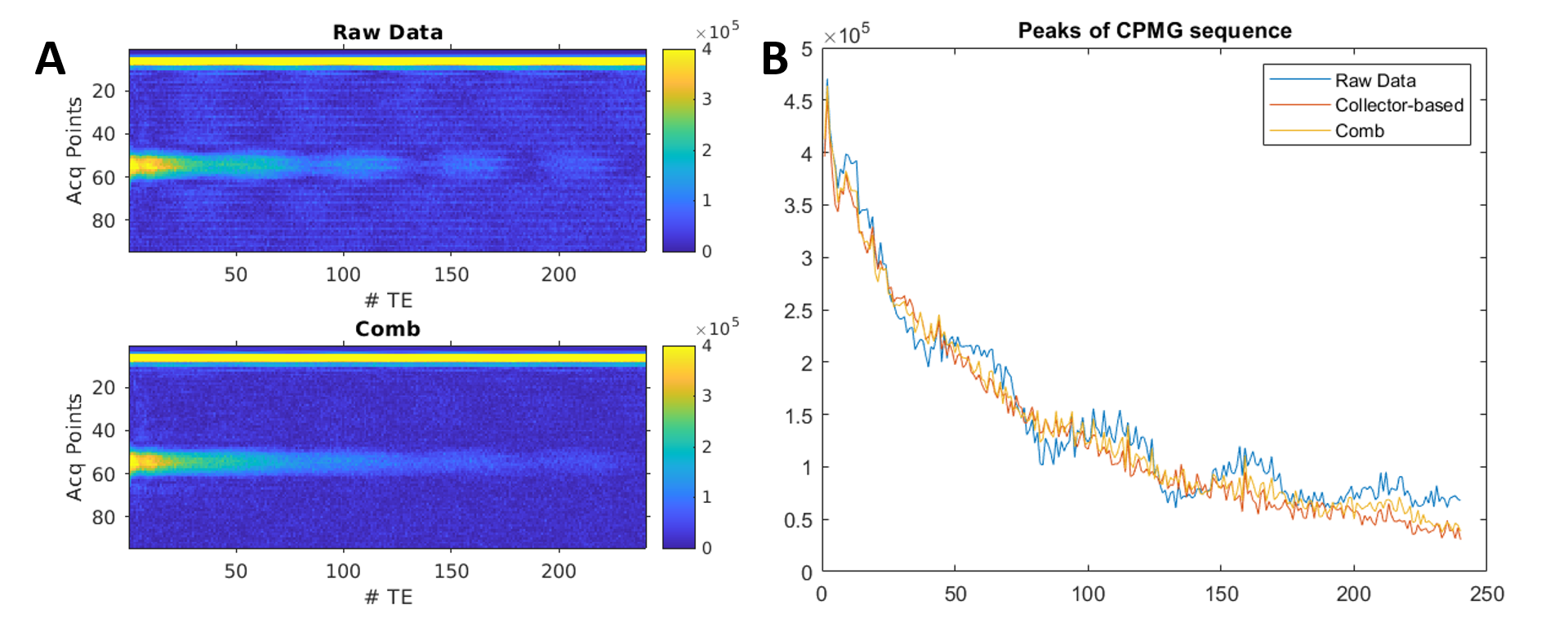
In the sample simulation, Comb was able to successfully remove 98.8% of the injected EMI (Fig. 3). While the collector-based correction was also able to achieve a clean correction of injected EMI, it introduces more white noise due to the use of external collector, causing a higher RMSE. Comb was also able to remove a visible background EMI in a CPMG experiment, and the result agrees with the collector-based cancellation (Fig. 4).Some optimizable factors include the percentage size of the signal-dominated region to the acquisition window (Fig. 1) and the weight of the L1-norm for compressed sensing. In the simulation, prior knowledge of the white noise level, as well as the number, amplitude, frequency, and phase of the injected EMI are also suspected to affect the cancellation result. More investigation of the factors will be done to optimize the method with a prior understanding of the noise environment.
Conclusion & Future Directions
With the proof-of-concept implementation, Comb EMI demonstrated its potential in removing narrowband EMI. Some future steps include a dedicated version of compressed sensing for 1D under-sampled EMI, as well as complementary methods addressing broadband EMI. This will allow us to further explore different constraints and test the method in a controlled experimental setting.Acknowledgements
No acknowledgement found.References
1. Srinivas SA, Cauley SF, Stockmann JP, et al. External Dynamic InTerference Estimation and Removal (EDITER) for low field MRI. Magn Reson Med 2022;87(2):614-628.
2. Yang L, He W, He Y, Wu J, Shen S, Xu Z. Active EMI Suppression System for a 50 mT Unshielded Portable MRI Scanner. IEEE Transactions on Biomedical Engineering 2022;69(11):3415-3426.
3. Zhao Y, Xiao L, Liu Y, Leong AT, Wu EX. Electromagnetic interference elimination via active sensing and deep learning prediction for radiofrequency shielding‐free MRI. NMR in Biomedicine 2023.
4. Chen SS, Donoho DL, Saunders MA. Atomic Decomposition by Basis Pursuit. SIAM Journal on Scientific Computing 1998;20(1):33-61.
5. BART Toolbox for Computational Magnetic Resonance Imaging, DOI: 10.5281/zenodo.592960.
6. Guerquin-Kern M, Lejeune L, Pruessmann KP, Unser M. Realistic Analytical Phantoms for Parallel Magnetic Resonance Imaging. IEEE Transactions on Medical Imaging 2012;31(3):626-636.
7. Selvaganesan K, Wan Y, Ha Y, et al. Magnetic resonance imaging using a nonuniform Bo (NuBo) field-cycling magnet. PLOS ONE 2023;18(6):e0287344.
Figures