2682
Multi-Channel PROPELLER-MRI Acceleration using NUFFT Compressed Sensing at Mid-Field MRI of 0.5T1GE HealthCare, Bangalore, India
Synopsis
Keywords: Low-Field MRI, Data Acquisition, PROPELLER, Image Reconstruction, Compressed Sensing, NUFFT, Acceleration
Motivation: Mid-field MRI have lower SNR so data acquisition is associated with longer data acquisition time. Therefore, develop fast imaging technique with motion robust data acquisition with minimal SNR penalty due to fast imaging.
Goal(s): Develop a robust image reconstruction technique for compressed sensing (CS) accelerated PROPELLER acquisitions.
Approach: A new iterative reconstruction technique based on NUFTT and CS for PROPELLER acquisitions.
Results: MRI imaging of ISMRM-NIST phantom and volunteer scan were acquired and reconstructed with minimal under-sampling artifacts such as haze and streaks with PROPELLER acceleration.
Impact: Compressed sense accelerated PROPELLER can acquire high quality motion robust MRI images at mid-field MRI. Proposed MR image reconstruction technique for compressed sensing accelerated PROPELLER technique can enable acquisitions requiring longer scan time due to SNR.
INTRODUCTION
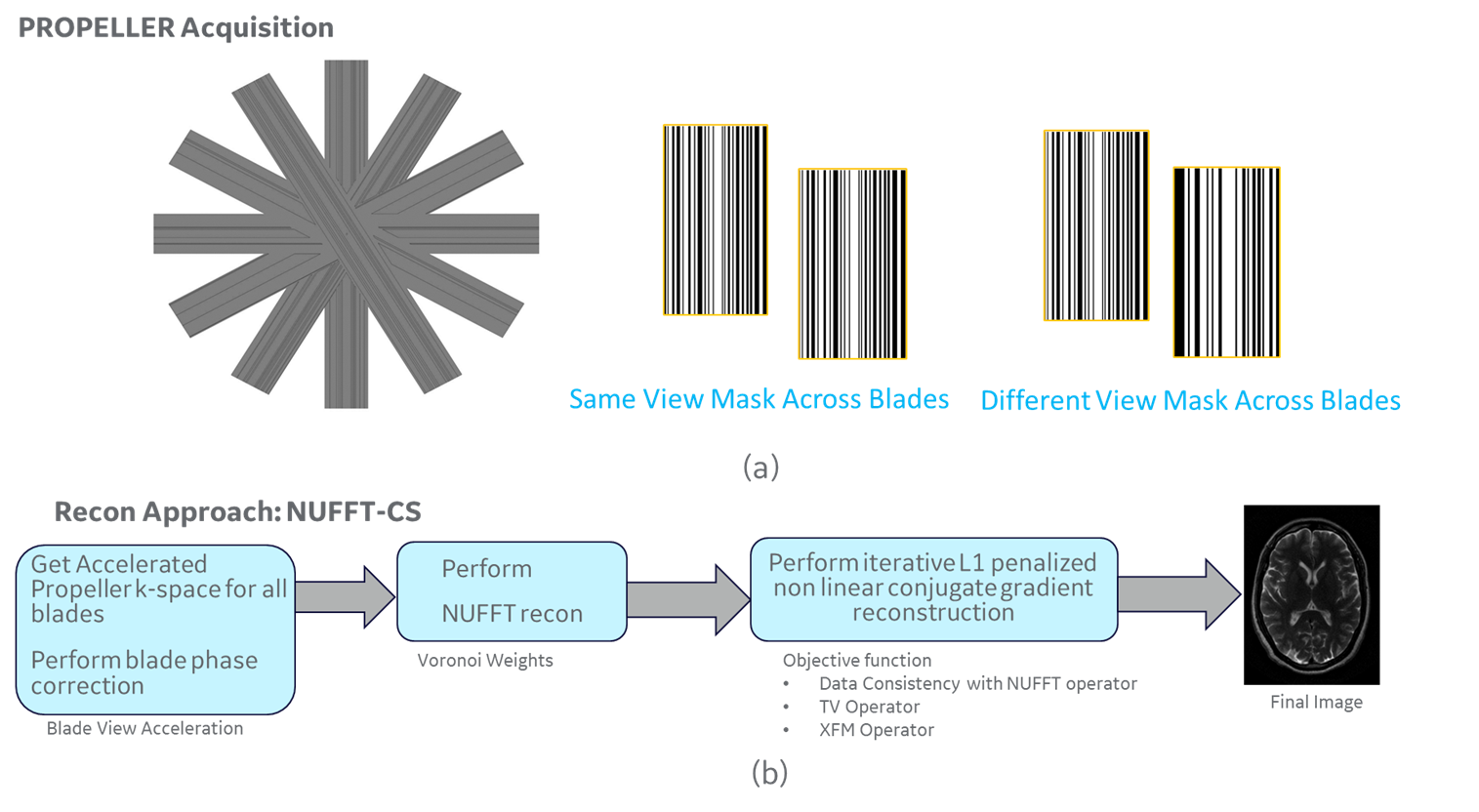
Periodically rotated overlapping parallel lines with enhanced reconstruction (PROPELLER) acquisition technique has been proven to be quite effective in reduction of motion artifacts [1] and B0 inhomogeneities. This acquisition involves data collection over rectangular strips, called blades, rotated about k-space origin. As a certain portion of the central k-space region is sampled in each blade, it makes propeller acquisition slower as compared to conventional FSE acquisitions. A blade dropping approach has been proposed elsewhere [2]. In this manuscript, a PROPELLER acquisition can be accelerated by partially acquiring views in each blade. This type of acquisition is done using 1D random sampling mask scheme with denser sampling near the center of the blade k-space. Each blade is acquired either with same or different sampling view mask as shown in Figure 1(a). It was demonstrated that, when compared with fully sampled PROPELLER, a combination of the proposed under-sampling pattern and iterative NUFFT [3] based CS [4] reconstruction reduces imaging time and produces images with negligible aliasing artifacts, haze and without any additional significant increase in the noise.METHOD
Fast MR Image Reconstruction: The proposed MR image reconstruction consist of two steps. First at the blade level each subsampled blade is inverse Fourier transformed from k-space to image-space using NUFFT [4] and phase correction is done to make sure that the point of rotation is at the center of k-space. The phase corrected image-space blade is then Fourier transformed to k-space to give phase corrected subsampled k-space. Second, an iterative conjugate gradient optimization method is used to combine the phase corrected blade k-space into final reconstructed image. Phase corrected blade k-space is used as ground truth data and L1 norm is used for regularization in iterative conjugate gradient method. Voronoi based density correction factor [5] is used to accelerate convergence of the iterative NUFFT image estimate. The flow diagram for reconstruction chain is shown in Figure 1(b). Data Acquisition: Data was acquired using a research 0.5T MR system which is obtained by ramping down commercial GE 1.5T MRI to 0.5T and modified transmit and receive RF chain. A health volunteer was scanned in an institutions IRB approved study with signed informed consent. Scanner software was modified to acquire fully sampled and prospectively subsampled Diffusion NIST phantom and a healthy volunteer. Number of phase encoding lined in the blade were reduced by factor of R as compared to fully sampled blade using variable density compressed sensing sampling. Number of blades in fully sampled and prospectively subsampled acquisition could be different as number of acquired views in each blade has to be the multiple of echo train length.RESULT
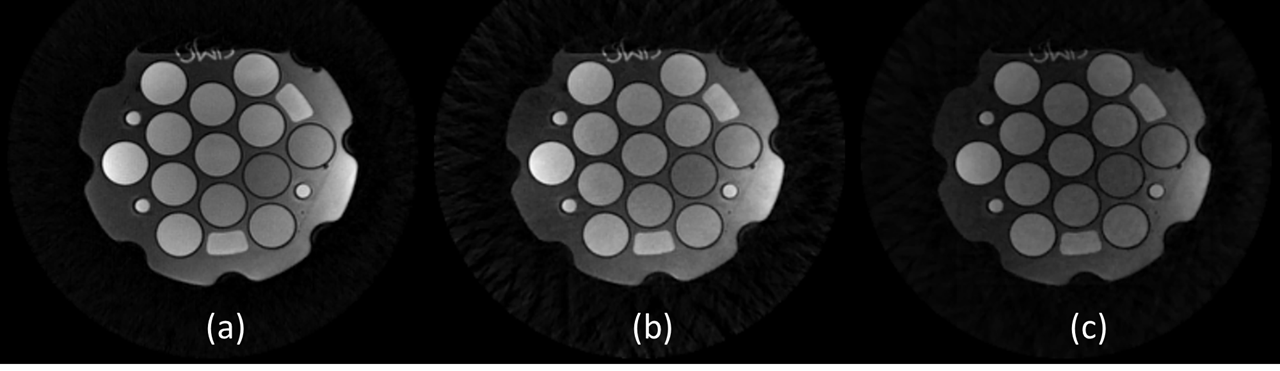
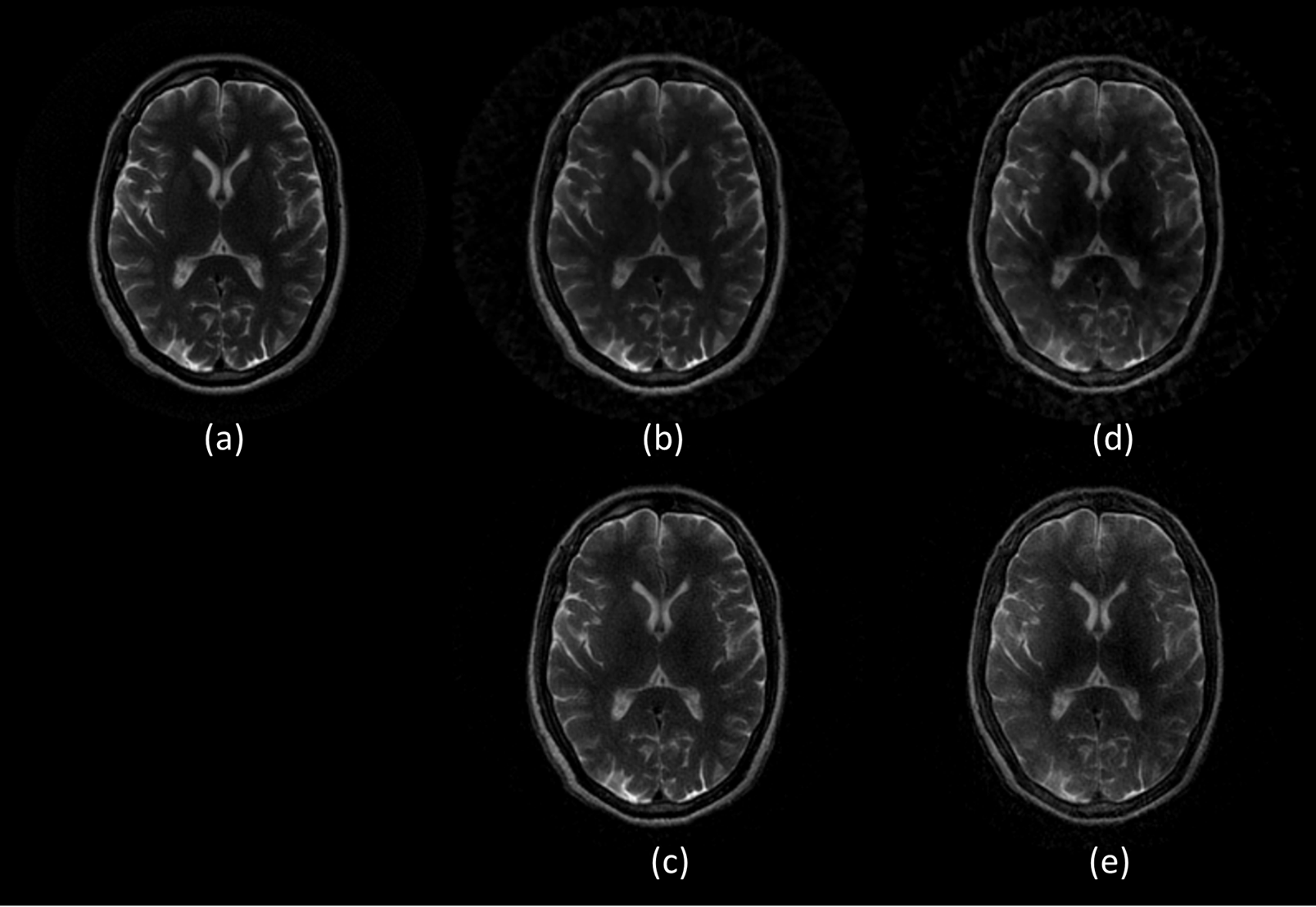
Figure 2 shows phantom images with unaccelerated and accelerated proposed fast image reconstruction technique reconstructed MRI image. The proposed fast image reconstruction technique is used to reconstruct prospectively subsampled PROPELLER acquisition with acceleration factors of 2.0 and 3.0. The view subsampling mask is same across all the blades for this acquisition. Figure 3 shows Axial T2w MRI of brain with unaccelerated and accelerated (R=2.0) fast MRI image reconstruction. The accelerated data acquisition is done for same view mask across blades and different view mask across the blades.DISCUSSION AND CONCLUSION
Fast MR image reconstruction technique proposed in this abstract successfully reconstructed blade level compressed sensing subsampled PROPELLER acquisition. Un-sampling artifacts such as haze and streaks were not visible in the reconstructed MRI images. Same and different sub-sampling mask for each blade was compared and shown similar qualitative performance. Accelerated PROPELLER MRI at 0.5T is essential to acquire motion robust high SNR MR image reconstruction during long acquisition times. Compared to parallel imaging, center of k-space is fully sampled in compressed sensing so compressed-sensing is more SNR efficient sampling pattern. Successful accelerated phantom and volunteer images acquired at 0.5T with proposed fast MR image reconstruction technique shows feasibility of longer higher resolution motion robust data acquisition at 0.5T.Acknowledgements
NAReferences
1. James G. Pipe, Wende N. Gibbs, Zhiqiang Li, et al., Revised motion estimation algorithm for PROPELLER MRI. Magnetic Resonance in Medicine. 2014;72:430–437.2. Konstantinos Arfanakis, Ashish A. Tamhane, James G. Pipe and Mark A. Anastasio, k-Space undersampling in PROPELLER imaging. Magnetic Resonance in Medicine 2005;53:675–683.
3. Ashish A. Tamhane, MS, Mark A. Anastasio, Minzhi Gui and Konstantinos Arfanakis, Iterative Image Reconstruction for PROPELLER-MRI using the Non Uniform Fast Fourier Transform. J Magn Reson Imaging. 2010;32:211-217.
4. Michael Lustig, David Donoho and John M. Pauly, Sparse MRI: The application of compressed sensing for rapid MR imaging. Sparse MRI: The application of compressed sensing for rapid MR imaging. Magnetic Resonance in Medicin., 2007;58(6):1182-1195.
5. V. Rasche, R. Proksa, R. Sinkus, P. B¨ornert, and H. Eggers, Resampling of data between arbitrary grids using convolution interpolation. IEEE Transactions on Medical Imaging. 1999;18(5):385–392.
Figures