2661
Rapid FLASH scout and guidance lines for robust retrospective motion correction across all 2D TSE contrasts1Siemens Healthineers, Erlangen, Germany, 2Siemens Medical Solutions, Boston, MA, United States, 3Siemens Shenzhen Magnetic Resonance Ltd, Shenzhen, China, 4Massachusetts General Hospital, Boston, MA, United States, 5A. A. Martinos Center for Biomedical Imaging, Boston, MA, United States
Synopsis
Keywords: Motion Correction, Motion Correction
Motivation: Motion remains a common source of artifacts in brain imaging.
Goal(s): To facilitate retrospective motion correction across all 2D TSE contrasts.
Approach: A 1-2 sec pre-scan (scout) using a saturation preparation and FLASH readout precedes the TSE imaging scan and is then compared to two additional rapid FLASH k-space encoding lines (guidance lines) inserted after every TSE echo train. The contrast-matched scout and guidance line data provide fully separable estimation of motion parameters shot-by-shot using a SENSE+motion model.
Results: In vivo, rapid motion trajectory estimation and robust artifact mitigation is demonstrated in T1w, T2w and FLAIR TSE scans with instructed subject motion.
Impact: We present a generalized strategy for retrospective motion correction in 2D TSE brain imaging using an ultra-fast pre-scan and the repeated acquisition of two additional k-space lines. This facilitates rapid motion estimation and robust artifact mitigation across all TSE contrasts.
Background
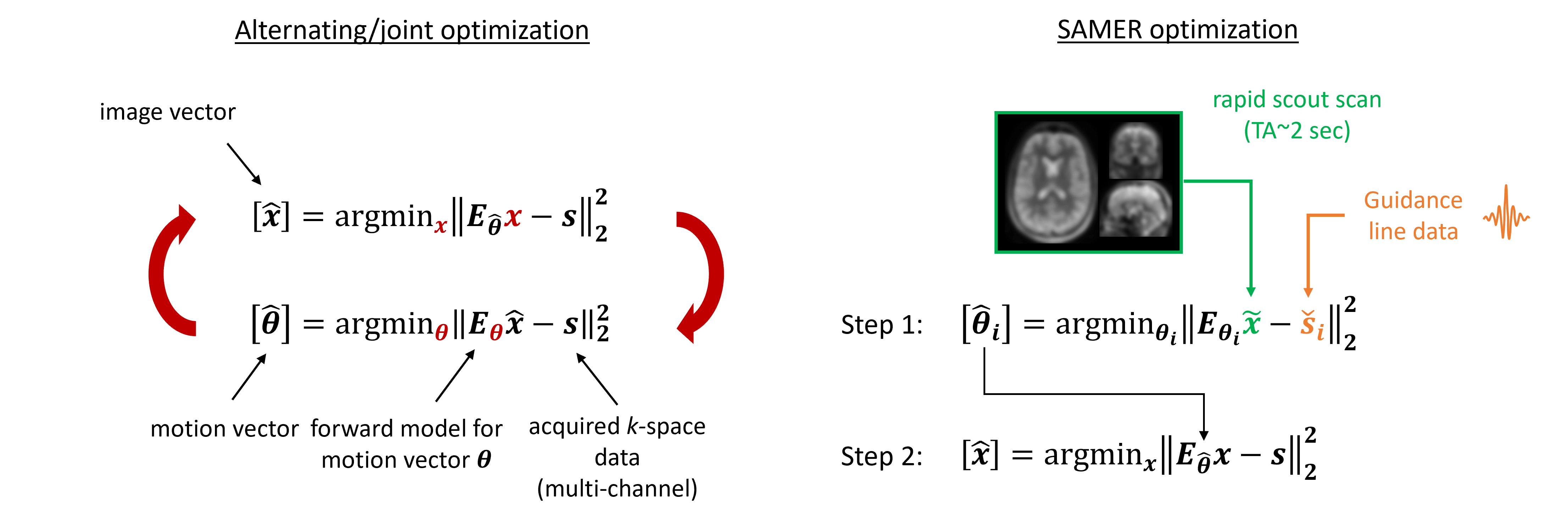
Navigator-free retrospective motion correction1–4 often employs computationally demanding alternating/joint optimization, which can only be initiated upon completion of the acquisition (Fig. 1). The recently proposed SAMER technique5,6 leverages an ultra-fast, low-resolution scout and repeated acquisition of a small number of motion guidance lines to decouple motion estimation from image reconstruction (Fig. 1). The SAMER approach has previously been applied across a limited number of sequence variants, where very rapid and fully separable estimation of motion parameters shot-by-shot (TMotEst~1 sec / shot) was demonstrated6.For SAMER to produce accurate motion estimates, it is critical that motion guidance lines and scout have similar image contrast and that the scout is motion-free. In 3D multi-shot sequences with large turbo factor (e.g., ~200 in MPRAGE), guidance lines can be acquired as part of the echo train and the contrast-matched motion-free scout is obtained very rapidly using just a single TR of data acquisition (TA: ~1 sec). In 2D TSE, guidance lines can be appended at the end of each echo train6, however, the scan time of the contrast-matched scout can be prohibitively long and susceptible to motion artifacts. This issue is exacerbated in scans with two slice concatenations (e.g., 2D FLAIR TSE). That is, the acquisition of odd and even (scout) slices are separated by half the scan time (1-2 min) which is well above the time needed to ensure a motion-free scout (~1-2 sec). To overcome these limitations, we propose a novel scout and guidance line approach based on rapid FLASH scans. Our method is applicable to all TSE contrasts and allows highly efficient motion estimation.
Methods
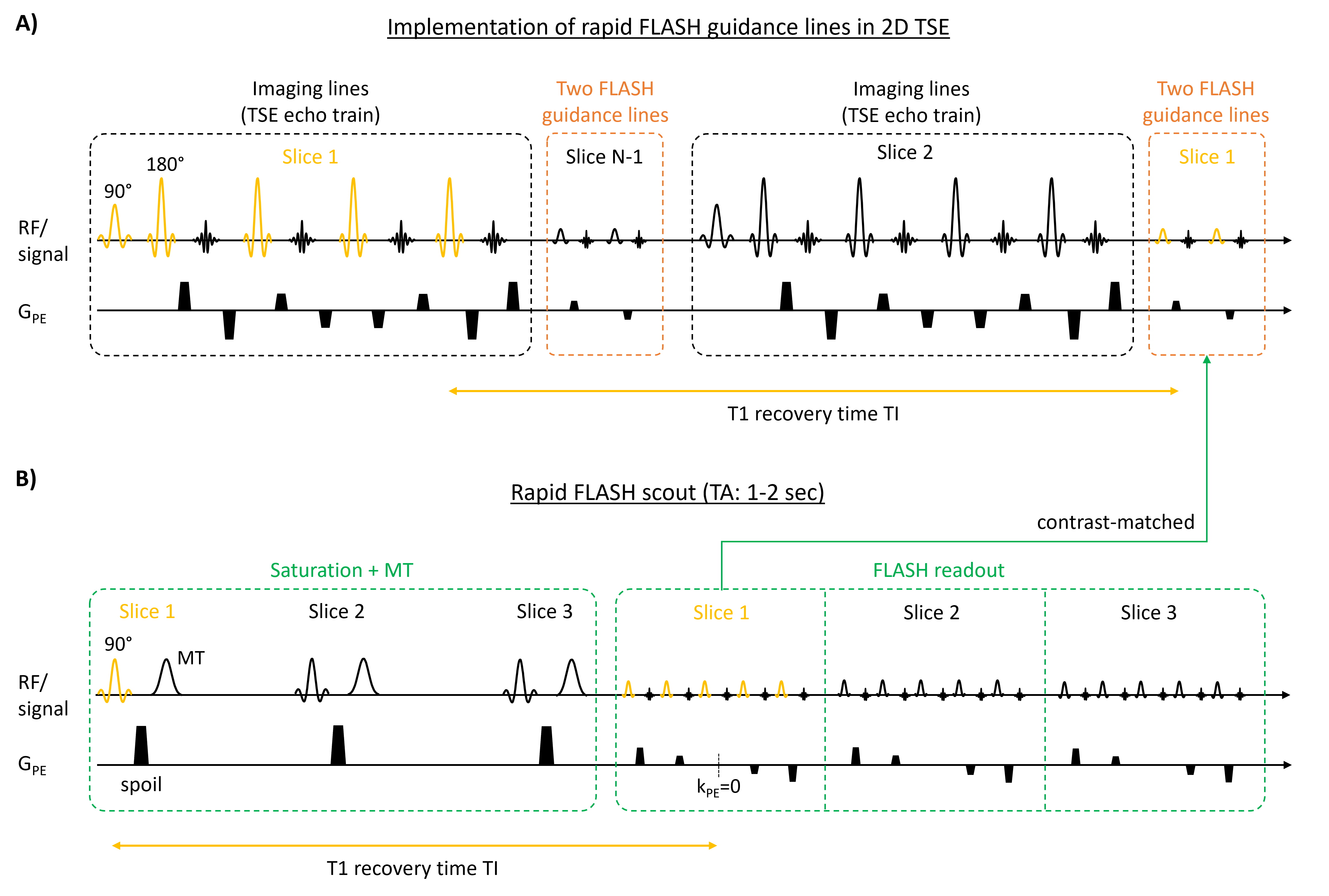
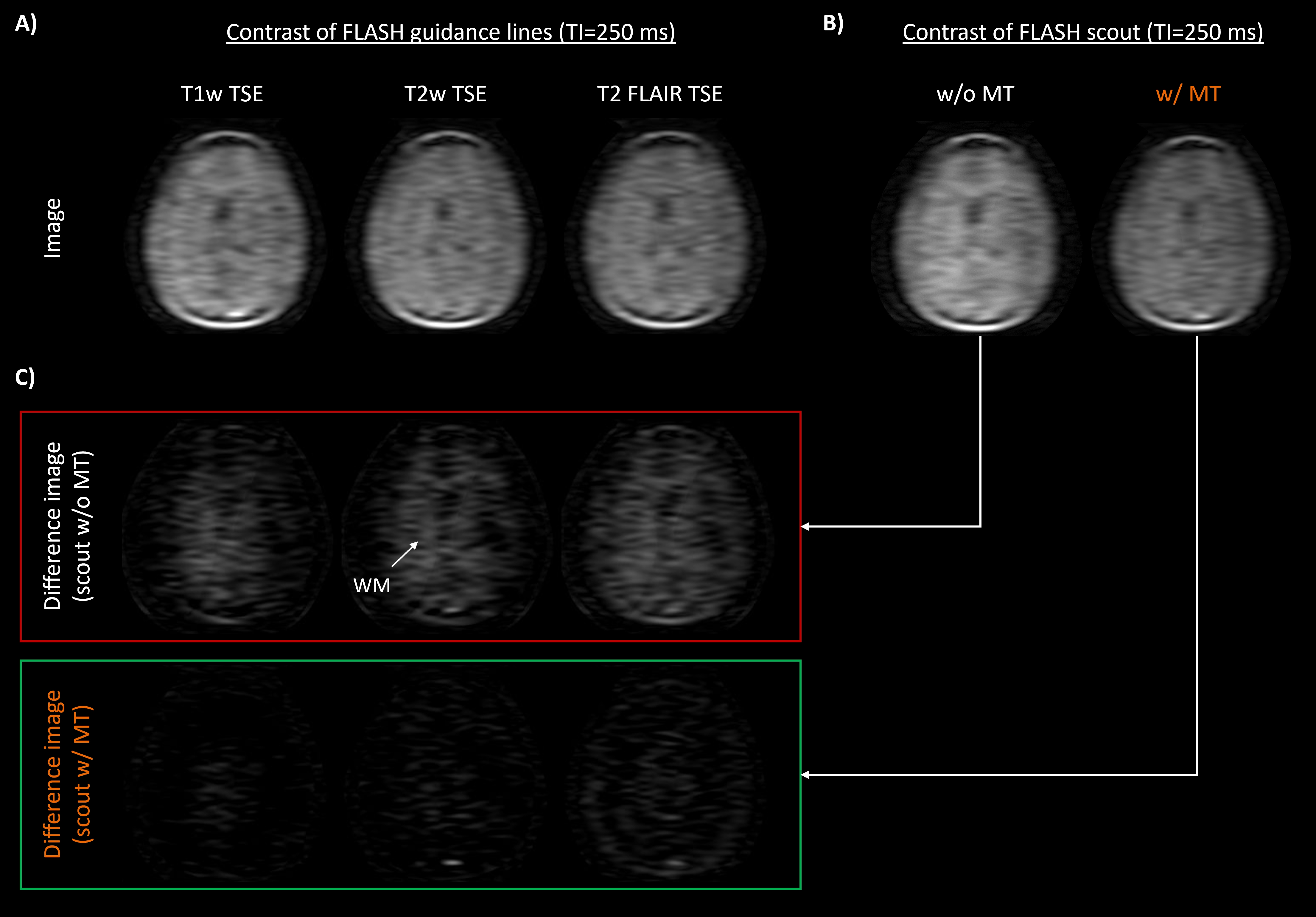
In standard 2D TSE sequences, the 90° excitation pulses flip the longitudinal magnetization into the transversal plane while the 180° refocusing pulses suppress substantial longitudinal re-growth over the echo train. The spin evolution after the echo train is primarily governed by T1 recovery and is independent of the TSE contrast (identical in T1w/T2w TSE), or whether contrast preparation is used. We leverage this property to obtain contrast-independent guidance lines shortly after the TSE echo train by incorporating rapid FLASH acquisitions (Fig. 2A). A short wait-time (TI) ensures sufficient T1 signal recovery before the acquisition of guidance line data. Changes to the desired TSE imaging contrast are minimized due to small flip angles used to acquire the FLASH guidance lines. The 1-2 sec contrast-matched and motion-free scout scan is generated using an interleaved saturation recovery sequence with matched TI and FLASH readouts (Fig. 2B). Magnetization transfer pulses (MT) were included to closely match the contrast of the guidance lines.At 3T (MAGNETOM Vida; Siemens Healthineers, Erlangen, Germany), we first analyzed potential contrast differences between the scout and guidance line data. Specifically, we investigated the use of MT pulses in the scout acquisition and compared the scout’s and guidance line’s contrast across motion-free T1w, T2w and T2 FLAIR TSE scans. Note, in this experiment eight guidance lines (R=2) were collected to allow for an image space comparison. All subsequent TSE scans were acquired with only two guidance lines per echo train.
To assess the motion-estimation accuracy and potential computational advantages of SAMER, we first compared against an alternating/joint motion optimization4. Additional experiments were performed to demonstrate the robustness of our approach across different TSE contrasts and motion patterns.
Results
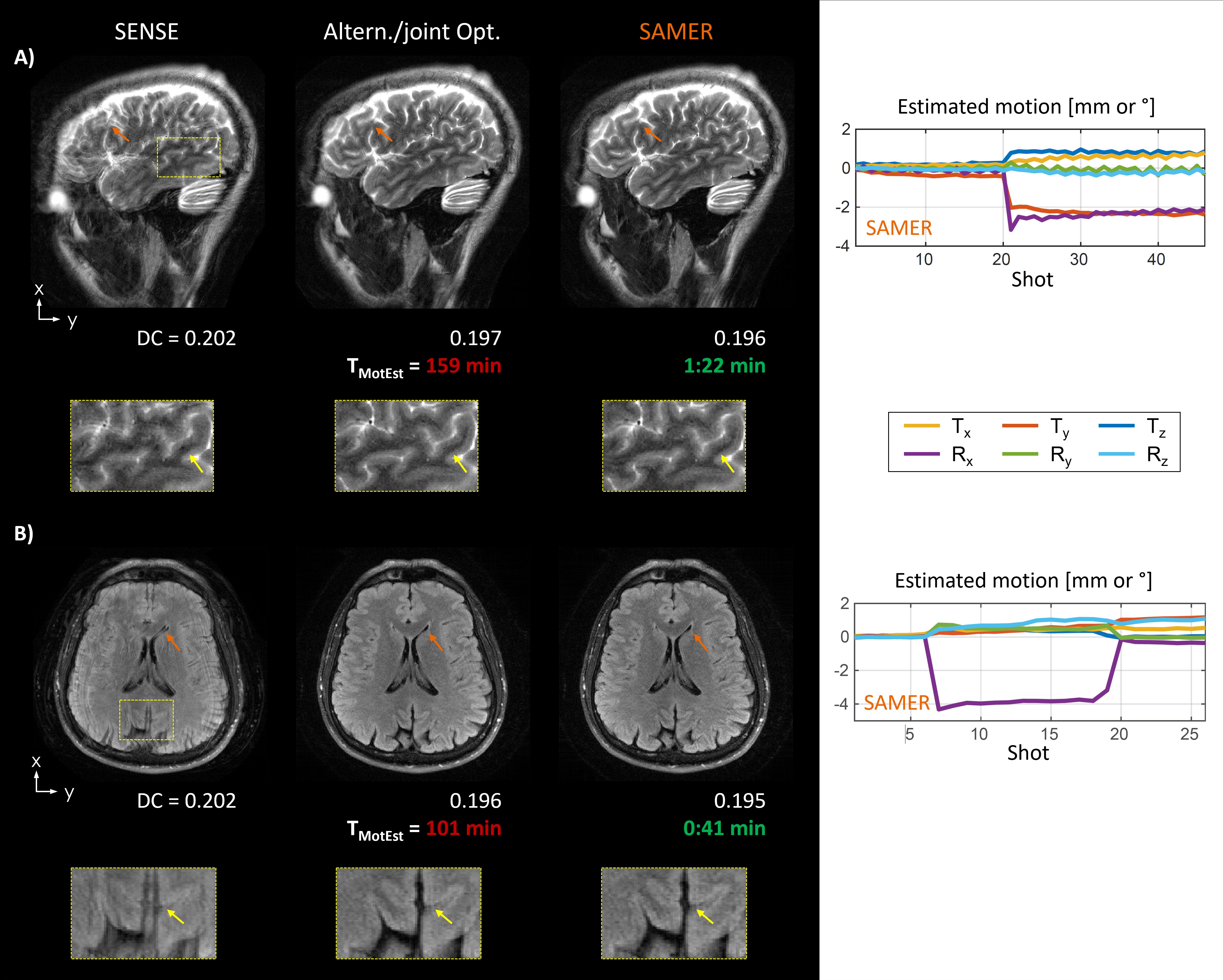
Figure 3 shows comparable guidance line contrast within the three most common TSE scans and good agreement with the rapid scout that employed MT preparation. Note, MT effects in TSE primarily attenuate white-matter signal which gives rise to the contrast differences observed in the scout without MT pulses.Figure 4 shows comparable image-quality improvement and final data consistency error in reconstructions using SAMER and a joint/alternating optimization approach. However, SAMER resulted in approximately 120-times lower computation time.
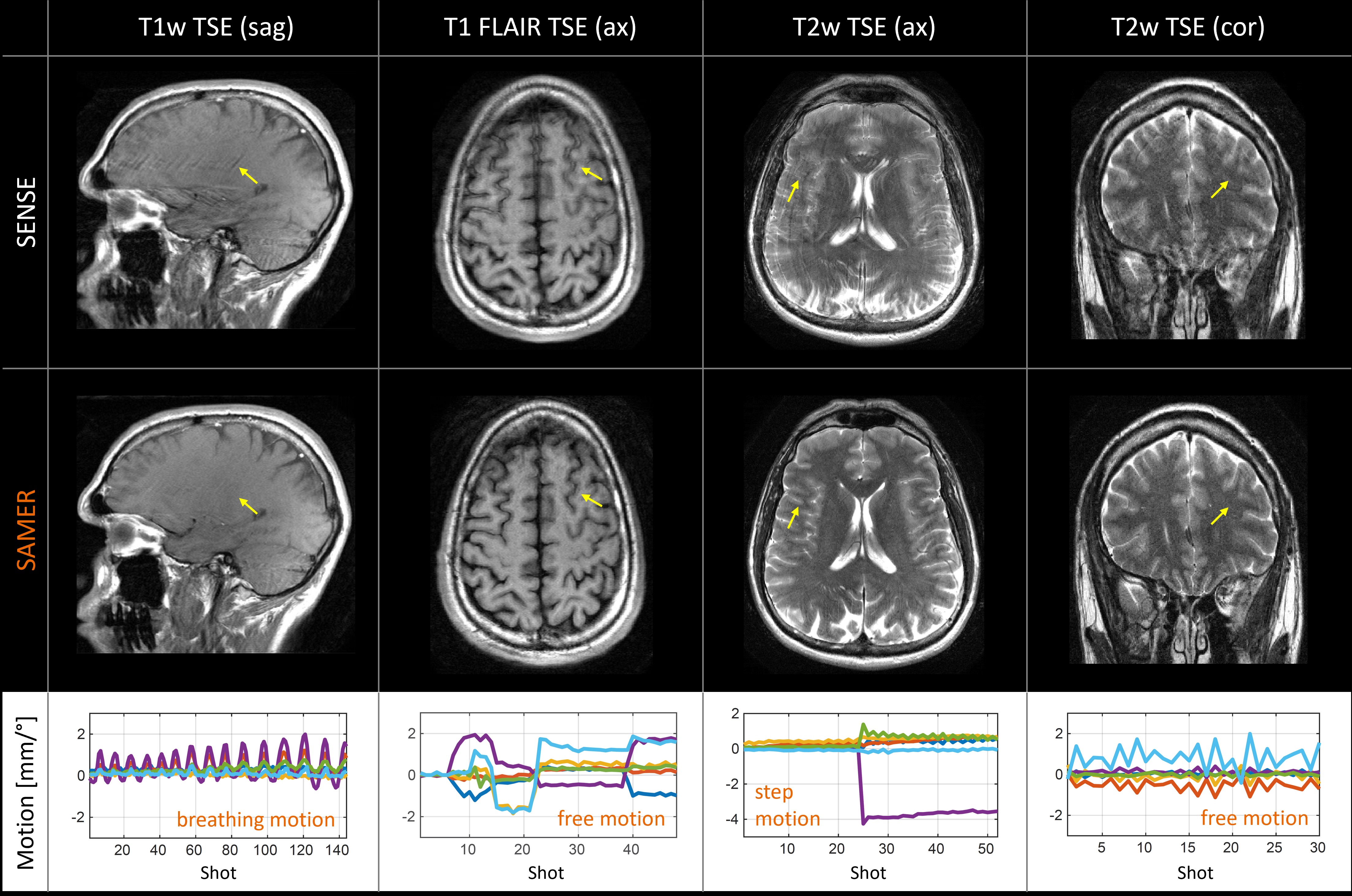
Figure 5 demonstrates SAMER motion mitigation in scans with instructed nodding/breathing, step and unsupervised free motion, where reduced streaking artifacts and an increase of spatial resolution was observed.
Conclusions
In this work, we proposed FLASH scout and guidance lines for retrospective motion correction in 2D TSE. Our SAMER approach enabled very efficient motion trajectory estimation and robust artifact mitigation across clinical TSE contrasts and motion patterns. FLASH guidance lines are very rapid (<5 ms) and thus can be integrated into TSE with minimal disruption of the standard sequence timing, i.e., in typical T1w, T2w and FLAIR scans the standard imaging protocol can be maintained. Utilizing standard vendor computational resources, SAMER facilitates on-the-fly motion estimation and <1 min post-reconstruction time. This will allow for widespread adoption of the method without disruptions to clinical workflows.Acknowledgements
No acknowledgement found.References
1. Haskell MW, Cauley SF, Wald LL. TArgeted Motion Estimation and Reduction (TAMER): Data consistency based motion mitigation for mri using a reduced model joint optimization. IEEE Trans Med Imaging. 2018;37(5):1253-1265. doi:10.1109/TMI.2018.2791482
2. Loktyushin A, Nickisch H, Pohmann R, Schölkopf B. Blind multirigid retrospective motion correction of MR images. Magn Reson Med. 2015;73(4):1457-1468. doi:10.1002/mrm.25266
3. Cordero-Grande, L., Teixeira, R., Hughes, E., Hutter, J., Price, A., & Hajnal J, Cordero-Grande L, Teixeira RPAG, et al. Sensitivity Encoding for Aligned Multishot Magnetic Resonance Reconstruction. IEEE Trans Comput Imaging. 2016;2(3):266-280. doi:10.1109/tci.2016.2557069
4. Cordero-Grande L, Hughes EJ, Hutter J, Price AN, Hajnal J V. Three-dimensional motion corrected sensitivity encoding reconstruction for multi-shot multi-slice MRI: Application to neonatal brain imaging. Magnetic Resonance in Medicine. 2018:1365-1376.
5. Polak D, Splitthoff DN, Clifford B, et al. Scout accelerated motion estimation and reduction (SAMER). Magn Reson Med. 2022;87(1):163-178. doi:10.1002/mrm.28971
6. Polak D, Hossbach J, Splitthoff DN, et al. Motion guidance lines for robust data consistency–based retrospective motion correction in 2D and 3D MRI. Magn Reson Med. 2023;89(5):1777-1790. doi:10.1002/mrm.29534
Figures