2660
Hybrid Motion Correction: Latency Compensation In The Presence Of Respiratory Motion1TracInnovations, Ballerup, Denmark, 2Athinoula A. Martinos Center for Biomedical Imaging, Massachusetts General Hospital, Charlestown, MA, United States, 3Copenhagen University Hospital, Rigshospitalet, Copenhagen, Denmark
Synopsis
Keywords: Motion Correction, Motion Correction, hybrid motion correction
Motivation: Prospective motion correction (PMC) techniques face challenges due to inherent latency and filter-induced delays, particularly impactful in cases of periodic motion, like breathing.
Goal(s): This study examines how periodic motion affects PMC with increased latency and employs retrospective techniques to compensate for latency-induced discrepancies.
Approach: Brain MRI scans were conducted on a volunteer performing exaggerated breathing using a PMC-enabled sequence. Retrospective motion correction was used to reverse latency-induced errors and compensate for residual motion.
Results: The hybrid approach combining PMC and RMC yielded superior results when compared to no correction and PMC-only, emphasizing the importance of addressing latency in motion correction for MRI.
Impact: Breathing motion can lead to suboptimal results in prospective motion correction. Implementing this technique broadens PMC's applicability, aiding its integration into clinical practice.
Introduction
Prospective Motion Correction (PMC) in MRI has been shown effective in reducing motion artifacts in a range of MR applications. One significant challenge inherent to the real-time nature of PMC is latency in the delivery of pose estimates that can have a detrimental impact on PMC performance [1], particularly when dealing with periodic motion. This study investigates the impact of tracking latency on prospectively corrected heavy breathing motion. Errors from PMC latency is mitigated using a hybrid motion correction (hybridMC) approach that retrospectively counteracts latency using retrospective motion correction (RMC) following PMC.Methods
Data acquisition was performed on a 3T MRI scanner (PRISMA, Siemens Healthcare, Erlangen, Germany) using a prospective motion correction (PMC) enabled, prototype inversion recovery 3D GRE (MPRAGE) sequence (TR=2000, TI=900, TE=2.32, resolution=0.9x0.9x0.9mm3, acquisition time=4:40min) (1).A reference still scan without PMC (stillPMCoff) was followed by a scan with exaggerated breathing without PMC (brPMCoff), with PMC (brPMCon), and a scan with an added latency of 600ms (brPMCon600).
To guide the breathing pattern of the volunteer, a video on an in-room display (cf. Fig.1).
Rigid-body head motion was measured with an optical, markerless motion tracking system (Tracoline TCL 3.2, TracInnovations, Ballerup, Denmark) [3,4]. Pose updates are provided to the PMC enabled sequence 30 times per second. Updates are applied to the scanner field-of-view for each readout with a total intrinsic latency of approximately 120ms.
Retrospective correction of the total latency (intrinsic + filter-latency) was performed based on the residual motion, computed as the difference between the applied pose updates logged by the PMC sequence and the latency-compensated tracking matrices. Necessary time synchronization between the motion tracker and the scanner was performed based on trigger signals sent by an EPI bold sequence, which was played out prior to the MPRAGE acquisitions.
Image quality was assessed based on the structural similarity index measure (SSIM) [5] with an artifact-free PMCoff still scan as reference. Before calculation of SSIMs, all images were aligned to the reference image using simpleITK rigid registration using default parameters and sinc interpolation. A mask, derived from the reference image (Freesurfer skull strip) was used on each image set.
Results
The resulting tracking of a volunteer scan is illustrated in Figure 1, showcasing the exaggerated respiratory motion combined with sudden changes every 60s. Breathing motion is most noticeably observed along translation in head-food direction and rotation about x-axis (nodding). A closer inspection of the tracking data in Figure 2 reveals the discrepancy between the original tracking used for PMC (blue lines) and the latency compensated tracking (green lines). The residual motion (orange line) between the original tracking and the latency-compensated tracking is corrected using RMC.Reconstructed images from the described experiments are shown in figure 3. The motion-free reference scan (Fig.3: stillPMCoff) serves as the basis for computing Structural Similarity Index (SSIM) values for each experiment.
Discussion
While the positive effect of a hybrid motion correction on latent PMC has been explored previously [1], this study showed that such an approach specifically shows promise in mitigating the detrimental effects of latency in PMC during MRI acquisitions with respiratory motion.It should be noted that the appearance of artifacts due to periodic motion are very versatile [6]. To avoid coherence effect between k-space sampling and motion the duration of the consecutive respiratory cycles were randomly chosen between 3s, 4s and 5s.
Tracking latency was introduced via the tracking software, simulating a situation likely to be encountered when using a real-time filter during PMC. However, to cover a broader patient population, the experiments should be repeated varying both the filter width and the breathing frequency.
This study focused on the technical aspects of hybridMC. For widespread clinical adoption, further validation studies with a larger and more diverse patient population, along with comparison to existing motion correction techniques, are essential.
Conclusion
In the presence of respiratory motion, PMC is a valuable tool for reducing motion artifacts in MRI. However, the inherent latency in PMC can compromise its efficacy, particularly when latency approaches half the period of respiratory motion. This study introduced a combined technique, hybridMC, which integrates retrospective motion correction to account for latency in motion correction after PMC. The results demonstrate the effectiveness of this approach in significantly improving image quality, approaching the level of motion-free scans. The proposed technique offers a promising solution for enhancing the performance of PMC in scenarios with latency challenges, particularly when dealing with periodic motion such as breathing.Acknowledgements
No acknowledgement found.References
[1] Hucker, P., Dacko, M., & Zaitsev, M. (2021). Combining prospective and retrospective motion correction based on a model for fast continuous motion. Magnetic Resonance in Medicine, 86(3), 1284-1298.
[2] Frost R, Wighton P, Karahanoğlu FI, et al. Markerless high-frequency prospective motion correction for neuroanatomical MRI. Magn. Reson. Med. 2019;82:126–144 doi: 10.1002/mrm.27705
[3] Olesen OV, Paulsen RR, Hojgaard L, Roed B, Larsen R. Motion Tracking for Medical Imaging: A Nonvisible Structured Light Tracking Approach. IEEE Trans. Med. Imaging 2012;31:79–87 doi:
[4] Slipsager JM, Glimberg SL, Højgaard L, et al. Comparison of prospective and retrospective motion correction in 3D-encoded neuroanatomical MRI. Magn. Reson. Med. 2022;87:629–645 doi: 10.1002/mrm.28991.
[5] Wang, Zhou; Bovik, A.C.; Sheikh, H.R.; Simoncelli, E.P. (2004-04-01). "Image quality assessment: from error visibility to structural similarity". IEEE Transactions on Image Processing. 13 (4): 600–612
[6] Zaitsev, M., Maclaren, J. and Herbst, M. (2015), Motion artifacts in MRI: A complex problem with many partial solutions. J. Magn. Reson. Imaging, 42: 887-901
Figures
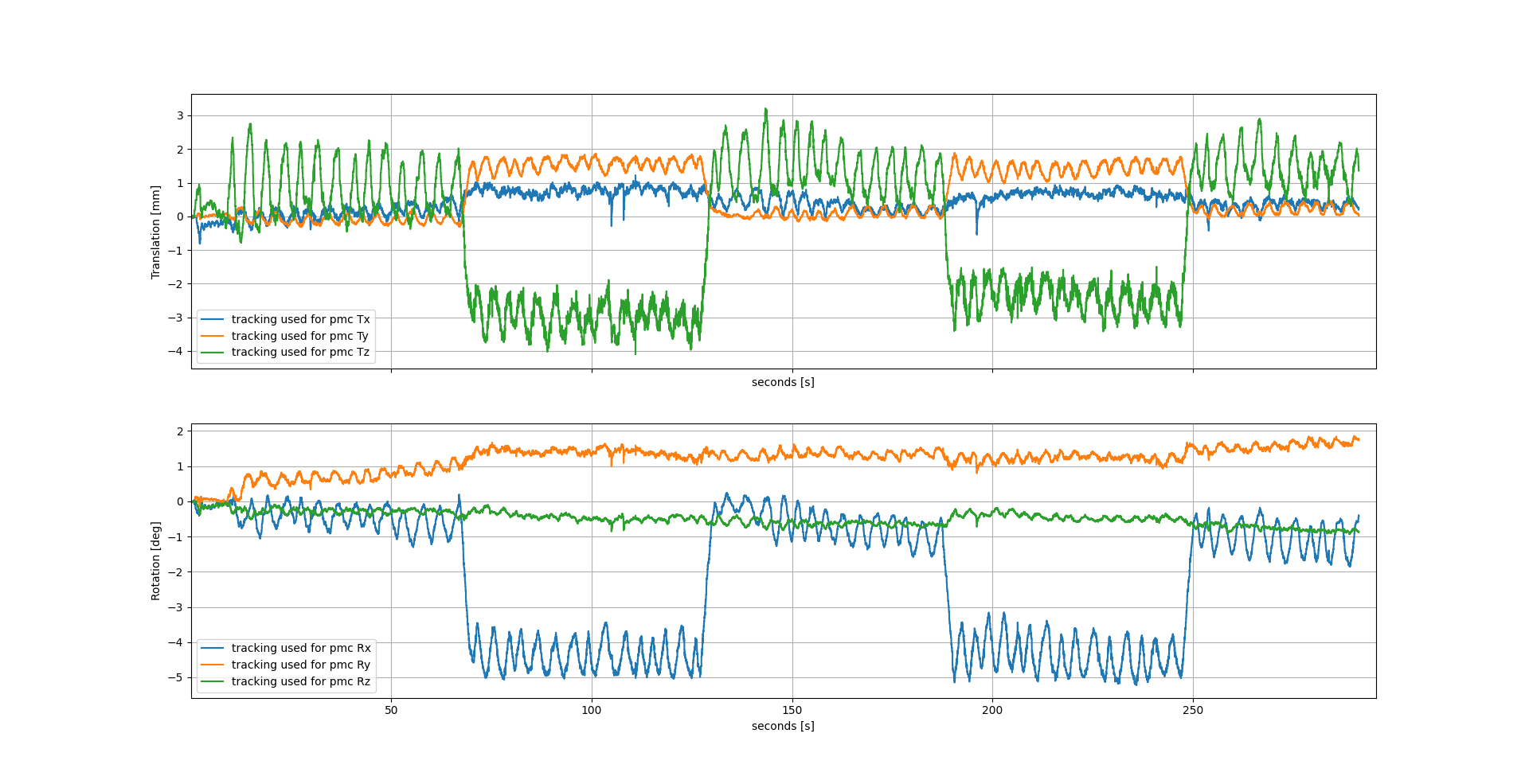
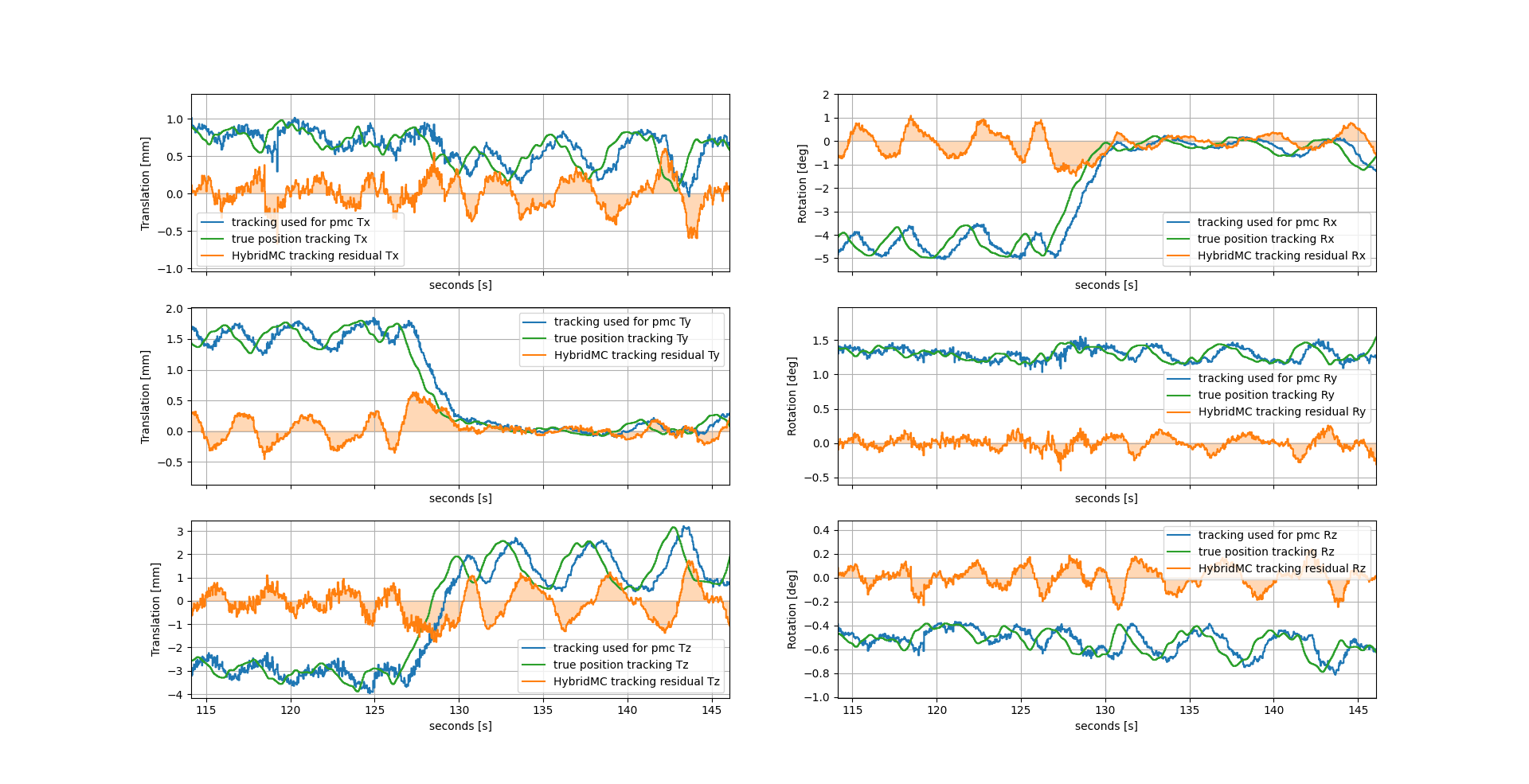
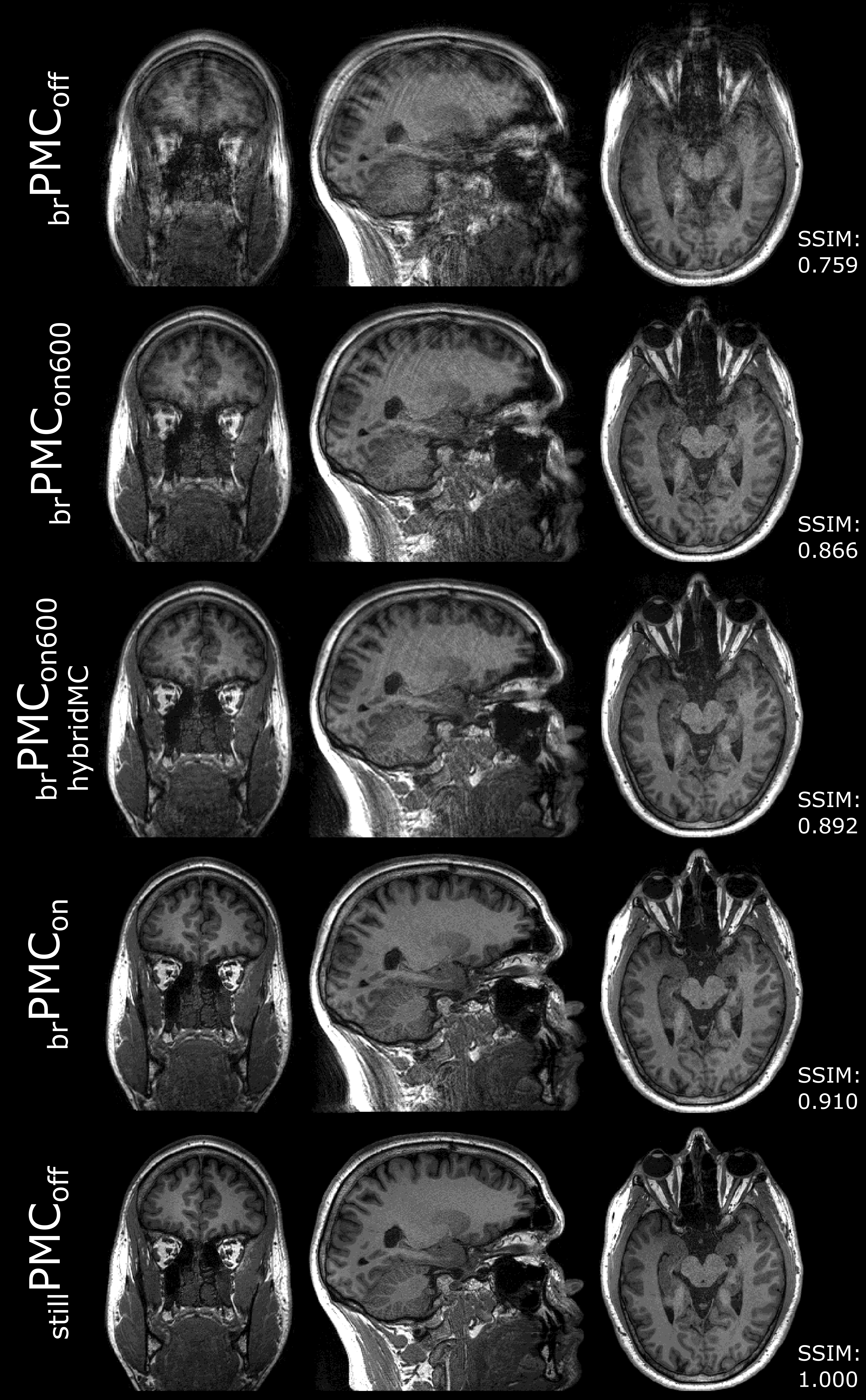
Fig.3: Reconstruction results of the non motion corrected acquisition (brPMCoff), the prospectively corrected scan with increased latency (brPMCon600), the prospectively corrected scan with minimal latency (brPMCon), and the increased latency scan reconstructed using hybridMC (brPMC on600hybridMC).