2658
Relationship between Head Motion and Scattering: in-Silico Evaluation of Linearity1Wellcome Centre for Integrative Neuroimaging, FMRIB, University of Oxford, Oxford, United Kingdom, 2Digital Technology and Innovation, Siemens Healthineers, Princeton, NJ, United States
Synopsis
Keywords: Motion Correction, RF Arrays & Systems
Motivation: To investigate the relationship between head motion and scattering for potential future work on motion correction, using radio frequency sensors to detect changes in head pose.
Goal(s): Establish if scattering changes are linearly related to head translations or rotations.
Approach: Simulations were run using the Sim4Life EM FDTD software with a human model at different positions relative to a coil model.
Results: Translations in the x and y directions varied co-linearly with scattering. However, rotations and z-translation display both linear and non-linear relationships.
Impact: These results allow for a greater understanding of the relationship between head motion and scattering, and demonstrates the potential for scattering to be used as a rapid, contact-free head pose tracker.
Introduction
Subject motion during Magnetic Resonance Imaging(MRI) remains a significant source of artifacts and motion correction remains an unsolved problem with many partial solutions1. Optical devices (structured light, cameras) have great temporal fidelity but rely on line of sight, navigators2 don't require any additional hardware and can measure B0 fields, but require pulse sequence timing adaptations. However, radio frequency (RF) sensors, such as pilot-tone and scattering3 are capable of sensing motion at the same time as imaging using no (or minimal) additional hardware.3,4The scattering matrix describes energy not absorbed by the load of a multiport network(subject), and when the subject moves the load changes. Previous work on cardiac and head scattering3,5,6 has demonstrated the feasibility of a linear relationship but, in the case of the head, the relationship between rigid-body head motion and scattering has not been established. In this work we examine the relationship between RF scattering and head motion in simulations.
Methods
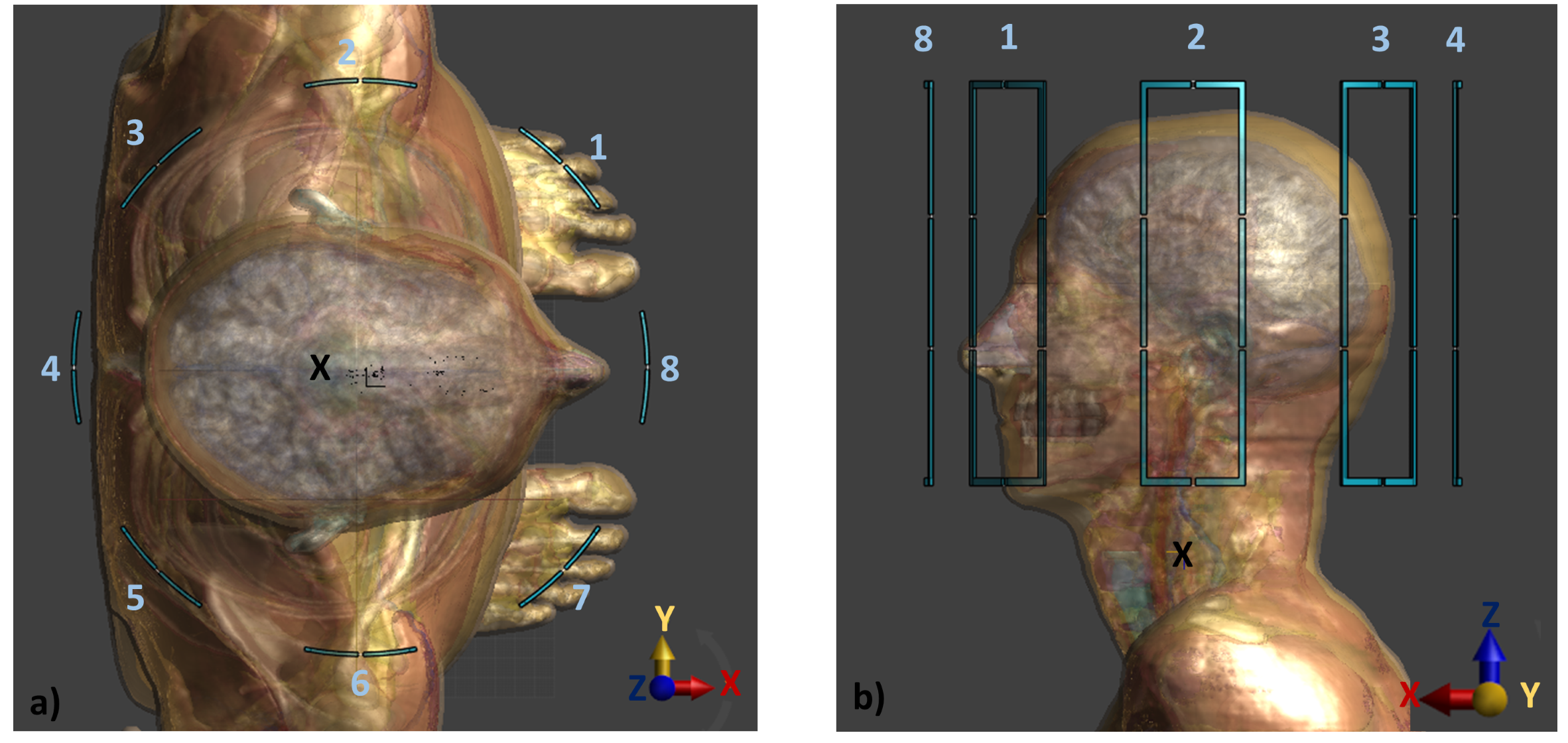
Simulations were run in Sim4Life (Zurich MedTech, Switzerland) V7.2.3.12730 using the Electro-Magnetism Finite-Difference Time-Domain solver. An 8 transmit channel head loop array was constructed with 6 capacitors on each coil as described in [7]. Duke was approximately centred within the array as shown in Figure 1.The simulations were run at 297MHz (7T) with a voxel size of 3mm on an ASUS desktop computer. Four different pose changes were investigated, relative to a central position (Figure 1): x,y and z translation of -2mm to 2mm in 1mm steps, and one extra translation at -10mm. Rotation was in the x-z plane, about the y-axis, with a pivot placed in the neck, of -4° to 4° in steps of 2°. The simulations were run for each of the different head positions.
For analysis, the absolute value was taken of all scattering constants before normalisation about the central head location.
Results
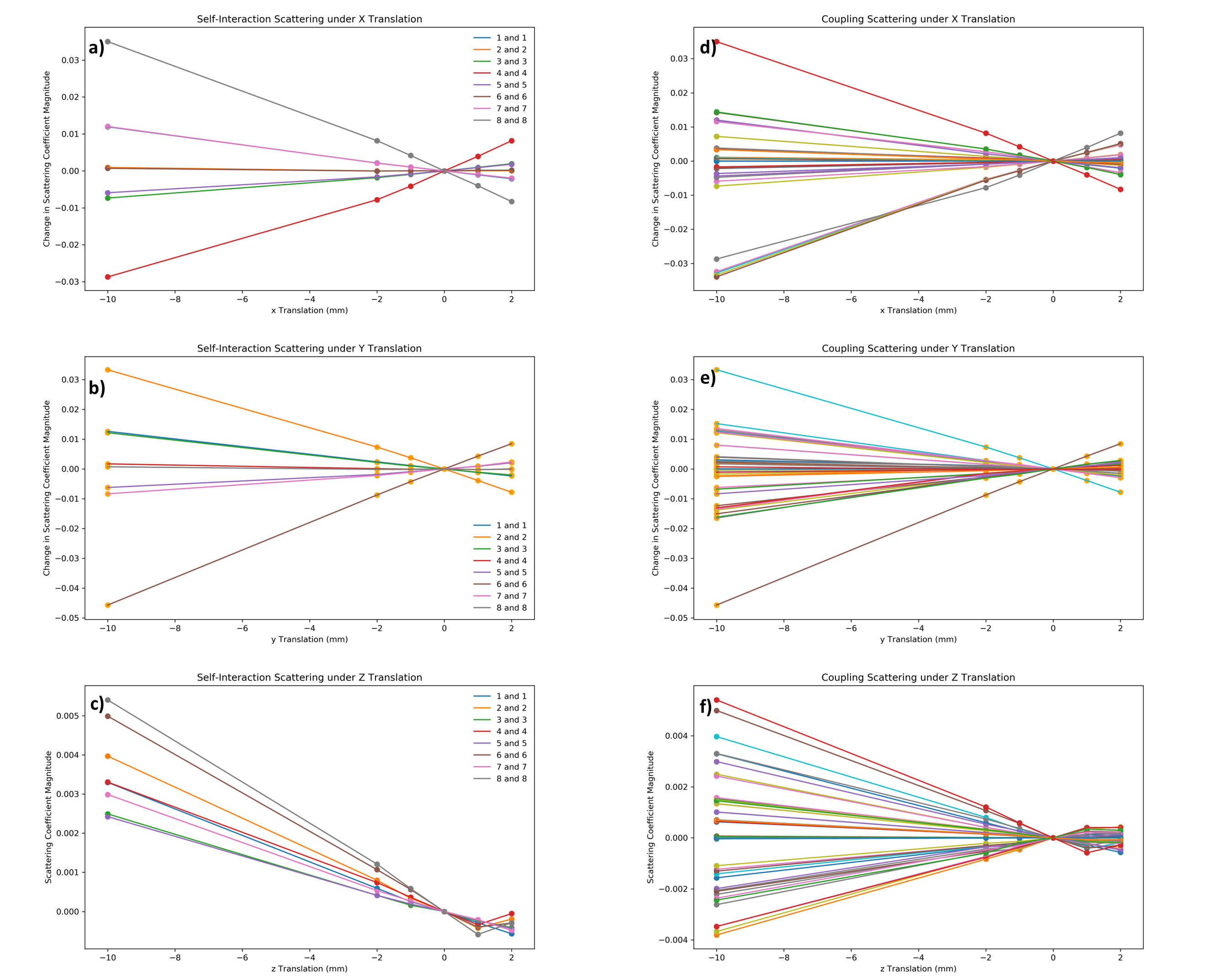
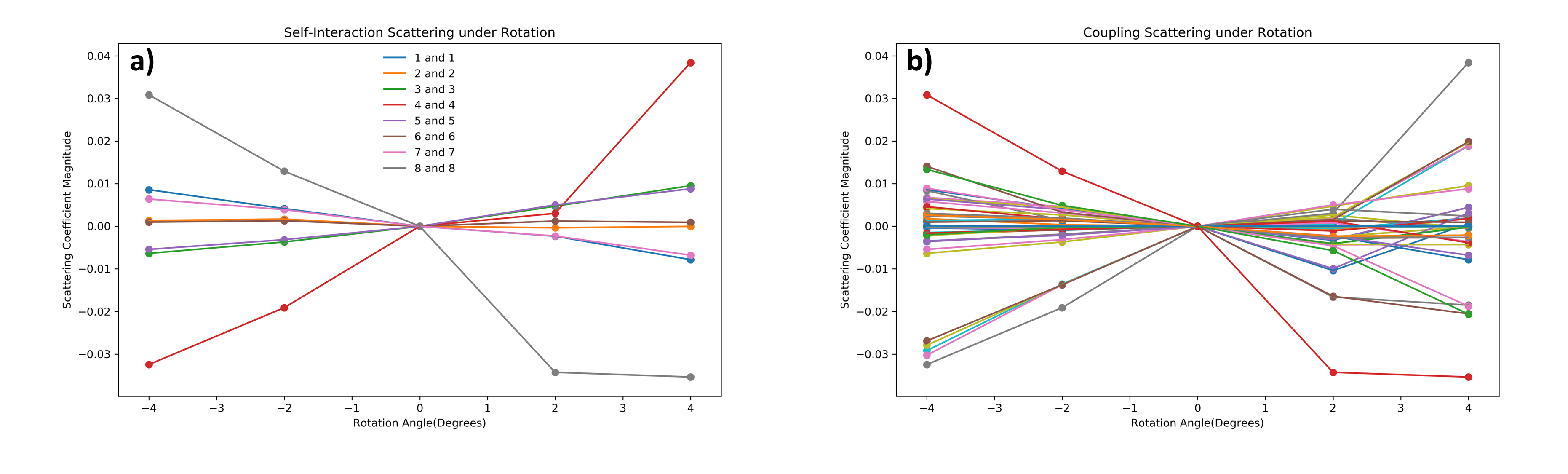
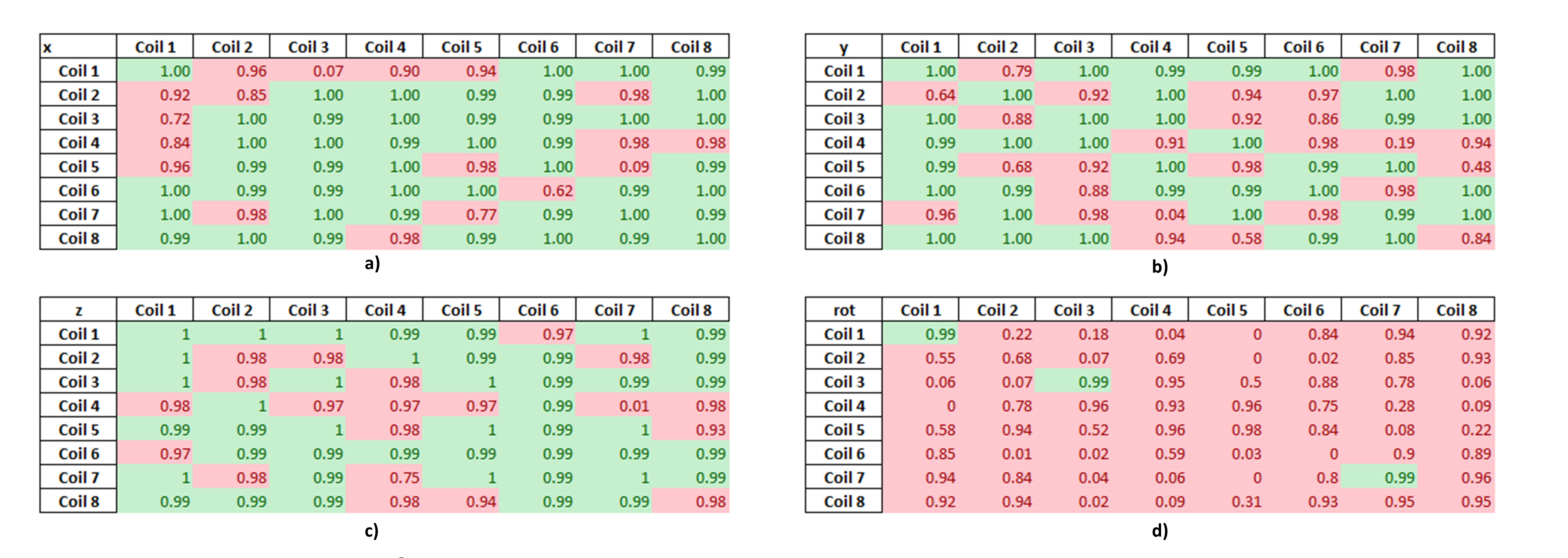
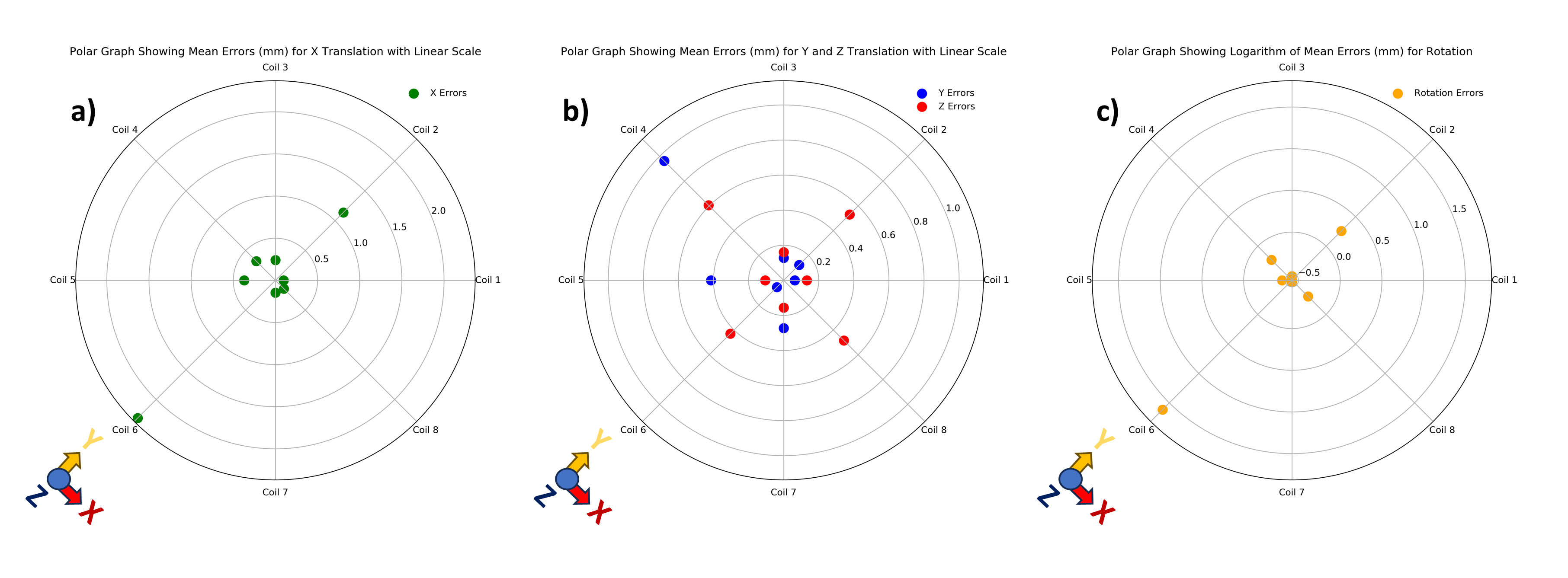
The change in scattering for self-interactions (diagonal) and coupling are plotted in Figures 2 and 3. The goodness of fit to a linear approximation is shown as the R2 values(Figure 4) and the mean error for self-interactions(Figure 5).The change in self-interactions (diagonal of scattering matrix) under x- and y-translation had the highest R2 and lowest error (R2>0.99 for coils sensitive to motion). Comparison between Figures 1, 2 and 3 demonstrate that the coils parallel to the axis of motion are most sensitive; coils 4 and 8 for x-translation. Furthermore, there is a symmetry in the results about the axis of motion, pairing the coils into similar behaviour eg. respectively 1 with 7, 2 with 6, and 3 with 5 as observed in the self-interaction sub-figures of Figures 2, 3. Consequently, as coils 2 and 6 have no component orthogonal to x translation, we would expect them to be insensitive and this is born up by the reduced R2 for those coils and the minimal change in scattering observed. In many cases the coupling terms for x- and y-translation presented a good linear approximation (R2>0.99) but with some terms presenting lower linearity (eg. S5,7 in Figure 4a).
In the case of rotation, the most sensitive responses, both self-interacting and coupling, are non-linear (Figure 3b). The response to z-translation is similar across all coils due to similar orientation to the axis of motion, for -Z (towards feet) translation was predominantly linear, and +Z (towards head) being non-linear with errors close to those for x- and y-translation (Figure 5).
Discussion
In-silico modelling is an effective mechanism for evaluating electrical systems. The results demonstrate the sensitivity of scattering to rigid-body head motion and highlight that, a good linear agreement exists between scattering and x-y, and -Z translation, however for many terms, the errors remained greater than 0.1mm. To capture rotations with scattering and reduce the error for translations, a non-linear model should be evaluated.One limitation of this work is that soft-tissue deformation (like mouth and eye movement) were not considered, these are likely to impact on scattering, as scattering of an 8 channel system has 36 independent complex measurements, future work will explore ways to harness this redundancy to mitigate unwanted effects.
Future work will evaluate the co-variance of these parameters, field-strength, inter-subject variation, pilot-tone and the effect of non-rigid motion.
Conclusion
The change in RF scattering detected in-silico is linear for small translations in the x- and y-directions for all sensitive coil scattering terms and for certain self-interaction terms under rotation in the x-z plane. Coils orthogonal to motion were found to detect the largest changes in scattering, and similar response functions could be predicted using symmetry about the axis of motion.Acknowledgements
This research was funded by EPSRC through an iCASE award in collaboration with Siemens Healthineers and supported by the NIHR Oxford Health Biomedical Research Centre (NIHR203316).
The Wellcome Centre for Integrative Neuroimaging is supported by core funding from the Wellcome Trust (203139/Z/16/Z and 203139/A/16/Z).
The views expressed are those of the author(s) and not necessarily those of the NIHR or the Department of Health and Social Care.
Disclaimer: The concepts and information presented in this abstract are based on research results that are not commercially available. Future commercial availability cannot be guaranteed.
References
[1] Zaitsev M, Maclaren J, Herbst M. Motion artifacts in MRI: A complex problem with many partial solutions. J Magn Reson Imaging. 2015 Oct;42(4):887-901. doi: 10.1002/jmri.24850. Epub 2015 Jan 28. PMID: 25630632; PMCID: PMC4517972.
[2] Tisdall MD, Hess AT, Reuter M, Meintjes EM, Fischl B, van der Kouwe AJ. Volumetric navigators for prospective motion correction and selective reacquisition in neuroanatomical MRI. Magn Reson Med. 2012 Aug;68(2):389-99. doi: 10.1002/mrm.23228. Epub 2011 Dec 28. PMID: 22213578; PMCID: PMC3320676.
[3] Kent J. L., et al., Pilot Tone vs pTx Scattering: A Comparison between ‘RF Sensor’ Methods for Rigid Body Motion Detection of the Brain at 7T, Proc. Intl. Soc. Mag. Reson. Med. 2022
[4] Speier S, et al., 2015. PT-Nav: A Novel Respiratory Navigation Method for Continuous Acquisition Based on Modulation of a Pilot Tone in the MRReceiver. ESMRMB 129:97-98, 2015. Doi: 10.1007/s10334-015-0487-2.
[5] Papp D, et al., Simultaneous detection of cardiac, respiratory, and rigid body head motion using the scattering of a parallel transmit RF coil at 7T, Proc. Intl. Soc. Mag. Reson. Med. 26 (2018)
[6] Jaeschke SHF, Robson MD, Hess AT. Scattering matrix imaging pulse design for real-time respiration and cardiac motion monitoring. Magn Reson Med. 2019 Dec;82(6):2169-2177. doi: 10.1002/mrm.27884. Epub 2019 Jul 17. PMID: 31317579; PMCID: PMC6771869.
[7] Matthijs H. S. de Buck, Peter Jezzard, Hongbae Jeong, Aaron T. Hess. An investigation into the minimum number of tissue groups required for 7T in-silico parallel transmit electromagnetic safety simulations in the human head. Magnetic Resonance in Medcine, 2020, pages 1113 – 1120. doi.org/10.1002/mrm.28467
Figures