2651
A deep-learning-based Signal-to-Noise Ratio (SNR) adaptive uniformity correction method1Shanghai United Imaging Healthcare Co., Ltd., Shanghai, China
Synopsis
Keywords: Artifacts, Machine Learning/Artificial Intelligence
Motivation: Intensity normalization in MRI is crucial for consistent image analysis. However, naïve uniformity correction (UC) using pre-collected coil sensitivity distribution may over-compensate low-SNR regions and reduce visual quality.
Goal(s): This study aims to develop an SNR-adaptive UC method to prevent over-compensation in low-SNR regions.
Approach: We propose using a deep network to learn an SNR-aware uniformity correction map by suppressing over-compensation on low-SNR regions. During training, the original uniformity correction map is used to guide the weighing between consistency loss and over-compensation suppression loss.
Results: The proposed method has been demonstrated to effectively suppress over-compensation on low-SNR regions in various head imaging protocols.
Impact: The proposed method can improve MRI image quality by adaptively compensating for intensity variations based on the noise level in different regions. It may lead to more accurate diagnoses and better identification of subtle changes in MRI images.
Introduction
Intensity normalization in magnetic resonance imaging (MRI) aims at standardizing the pixel intensities within an MRI image1. The unwanted variations in image intensities can make it challenging to perform accurate diagnosis or identify subtle changes. One major source of intensity variations is the coil sensitivity distribution in parallel imaging, where regions with low coil sensitivity correspond to regions with low intensity in the uncorrected image. Thus, a common intensity normalization method compensates for low-intensity regions proportional to the corresponding combined coil sensitivity map. However, the regions with low intensities or poor coil sensitivities also tend to have reduced SNR. Direct intensity compensation using the reciprocal of coil sensitivity map (referred to as sense map hereafter) may over-compensate these low SNR regions and lead to a visually unaccepted appearance. To mitigate this challenge, we propose using a deep neural network to learn an SNR-aware sense map by suppressing over-compensation in low-SNR regions. The original sense map is also utilized to guide the weighting between consistency loss and over-compensation suppression loss during training. Extensive experiments demonstrate that the proposed method can realize noise adaptive intensity normalization.Methods
MR intensity normalization via the pre-acquired sensitivity map can be described as the following process:$$I_{cor}=I_0 M$$
Where $$$I_0$$$ is the un-corrected image with intensity variations, $$$M=1/S$$$ is the reciprocal of the pre-acquired sensitivity map $$$S$$$, $$$I_{cor}$$$ is the intensity normalized image.
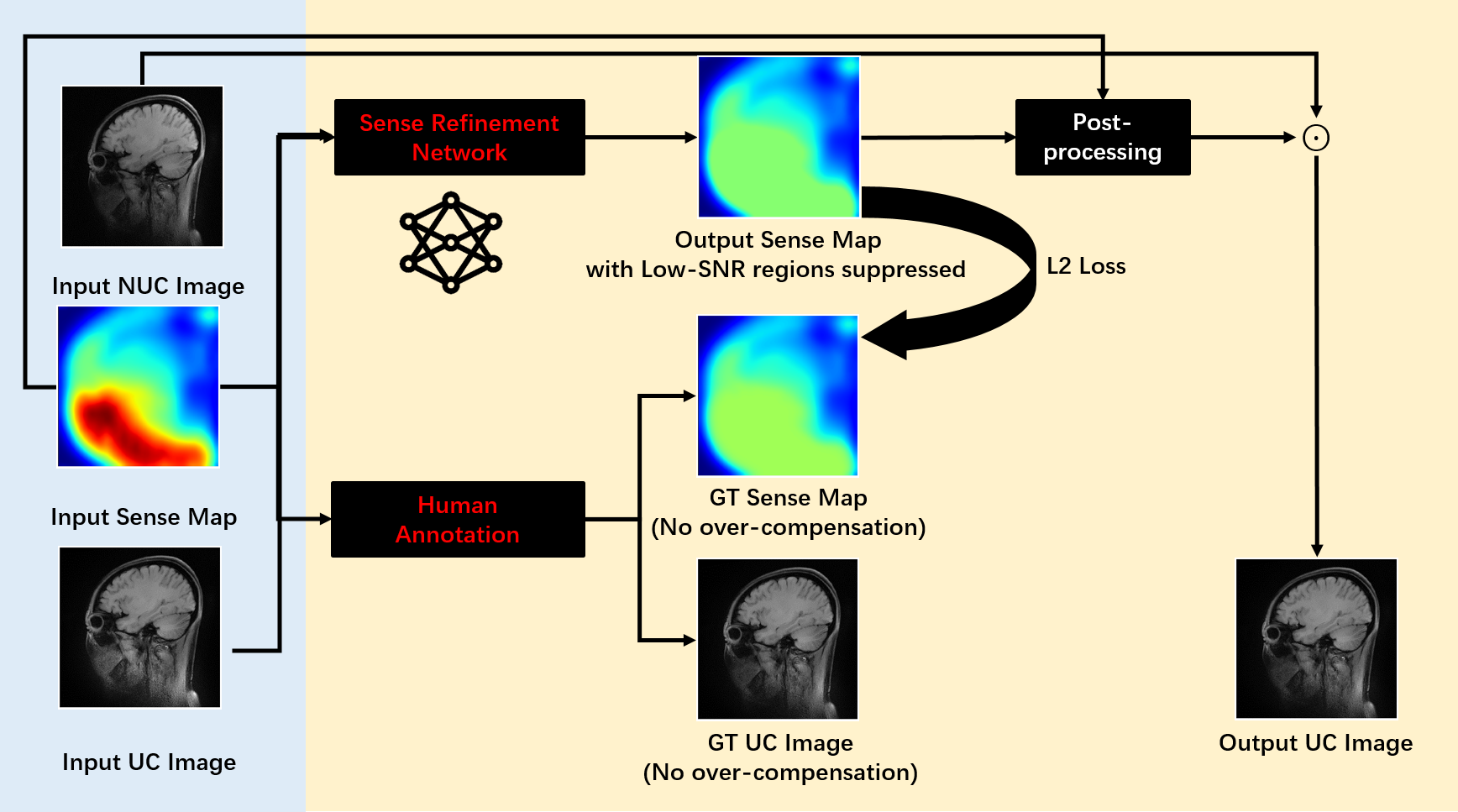
In this work, we propose to improve the intensity normalization by suppressing the intensity compensation for low SNR regions (Figure 1). A deep network $$$f_\theta$$$ is utilized to learn an SNR-aware sense map by suppressing over-compensation on low-SNR regions from the intensity-normalized image $$$I_{cor}$$$ along with the guidance from the pre-acquired intensity compensation map $$$M$$$.
$$M_{net}=f_\theta (I_{cor},M)$$
The original sense map $$$M$$$ can serve as attention for the network to learn where to suppress. In addition, the original sense map $$$M$$$ is also utilized to guide the weighting between consistency loss and over-compensation suppression loss during training. The consistency loss is defined as a sense map $$$M$$$ weighted L2 loss between the network output and ground truth. The over-compensation suppression loss is defined as a sense map $$$M$$$ weighted TV-loss of the $$$M
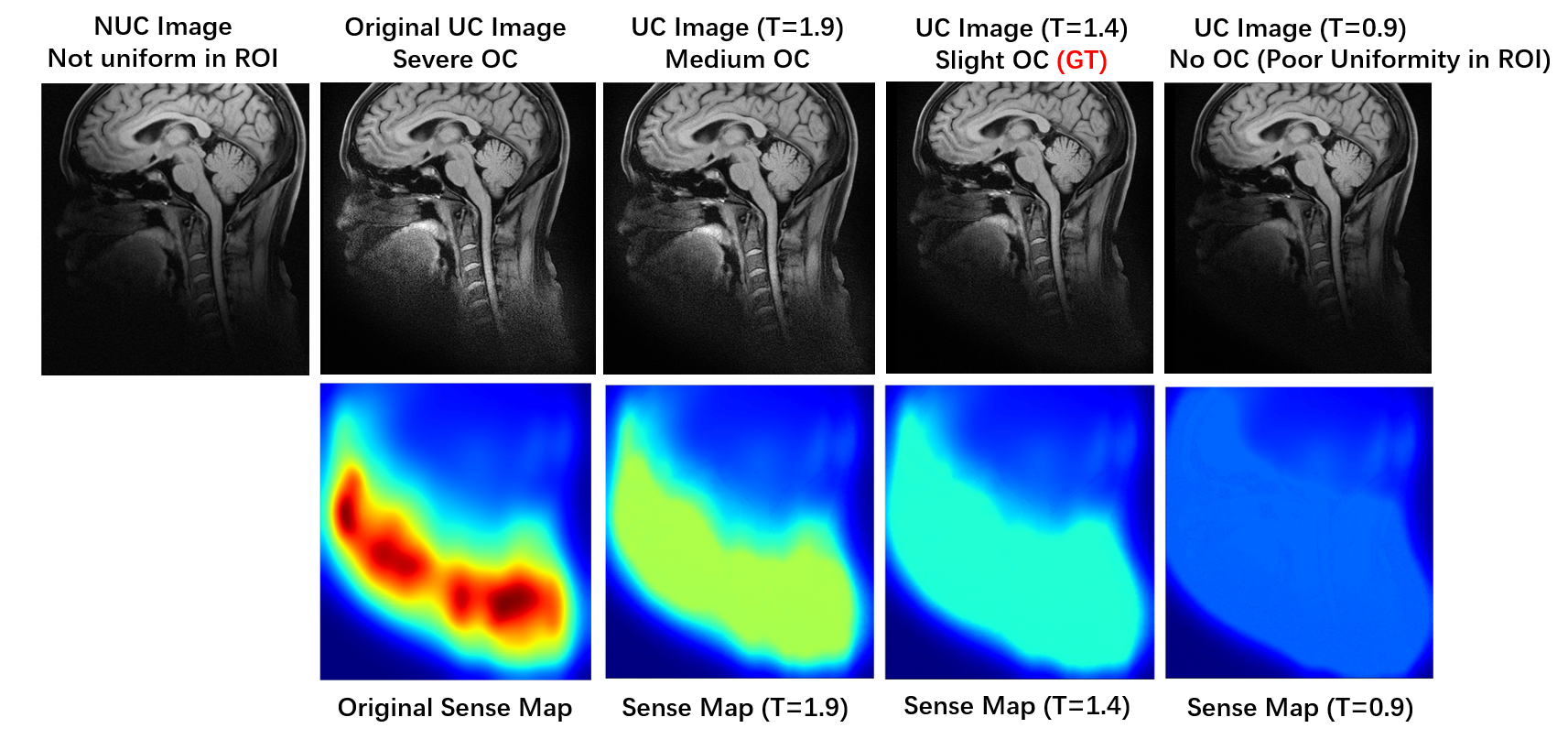
_{net}$$$ corrected UC image. This additional over-compensation suppression loss can further enhance suppression in low-SNR regions compared to the ground truth. The sense map refinement network $$$f_\theta$$$ is modified from the U-Net2. The ground truth of the training data was labeled by two human annotators by selecting various clip thresholds on the original sense map $$$M$$$ (Figure 2).
After post-processing including smoothing on the network-generated sense map $$$M_{net}$$$, the original image $$$I_0$$$ can be uniformity corrected with the compensation for low-SNR regions adaptively suppressed:
$$I_{cor}' = I_0 M_{net}$$
Results
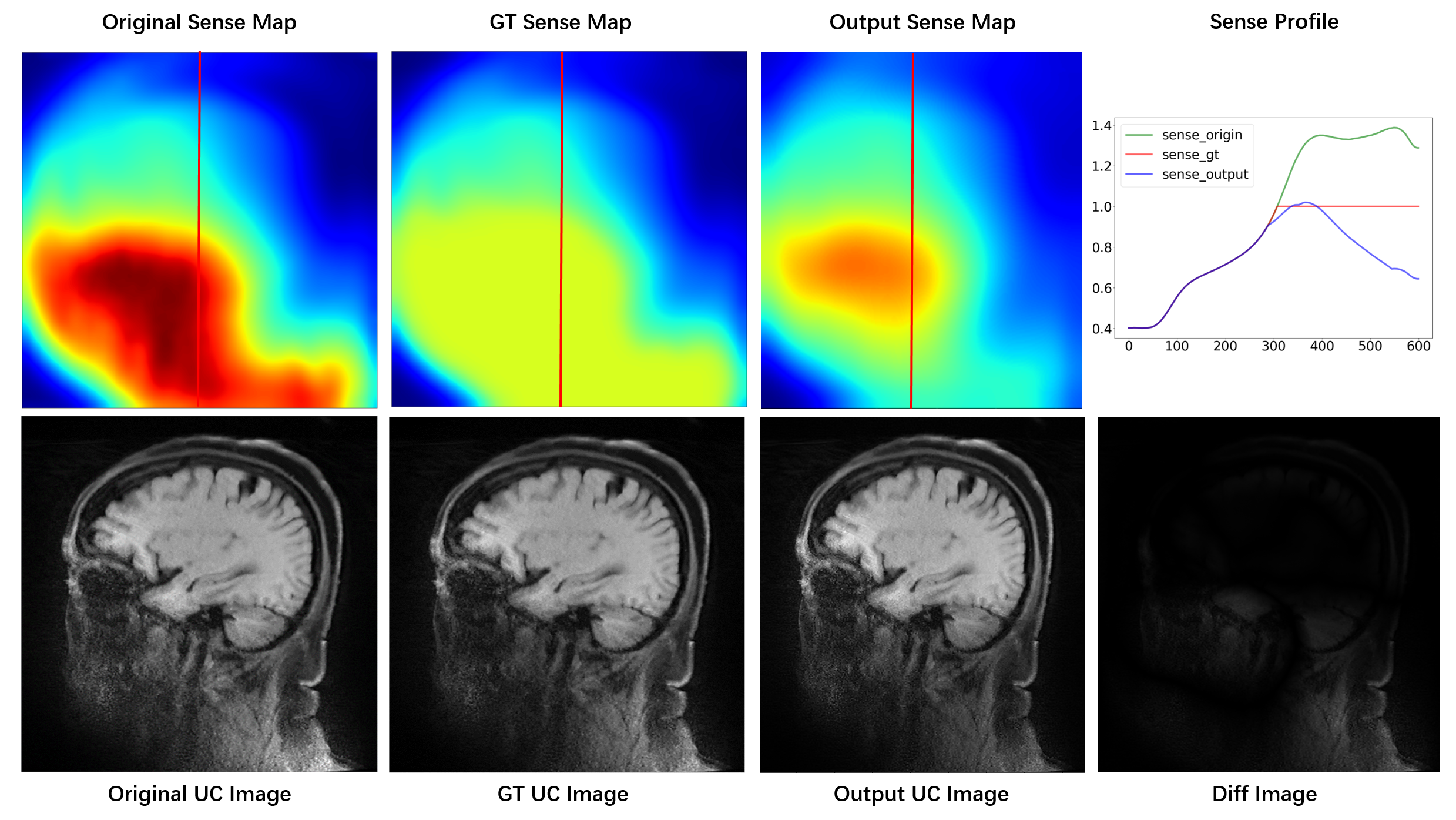
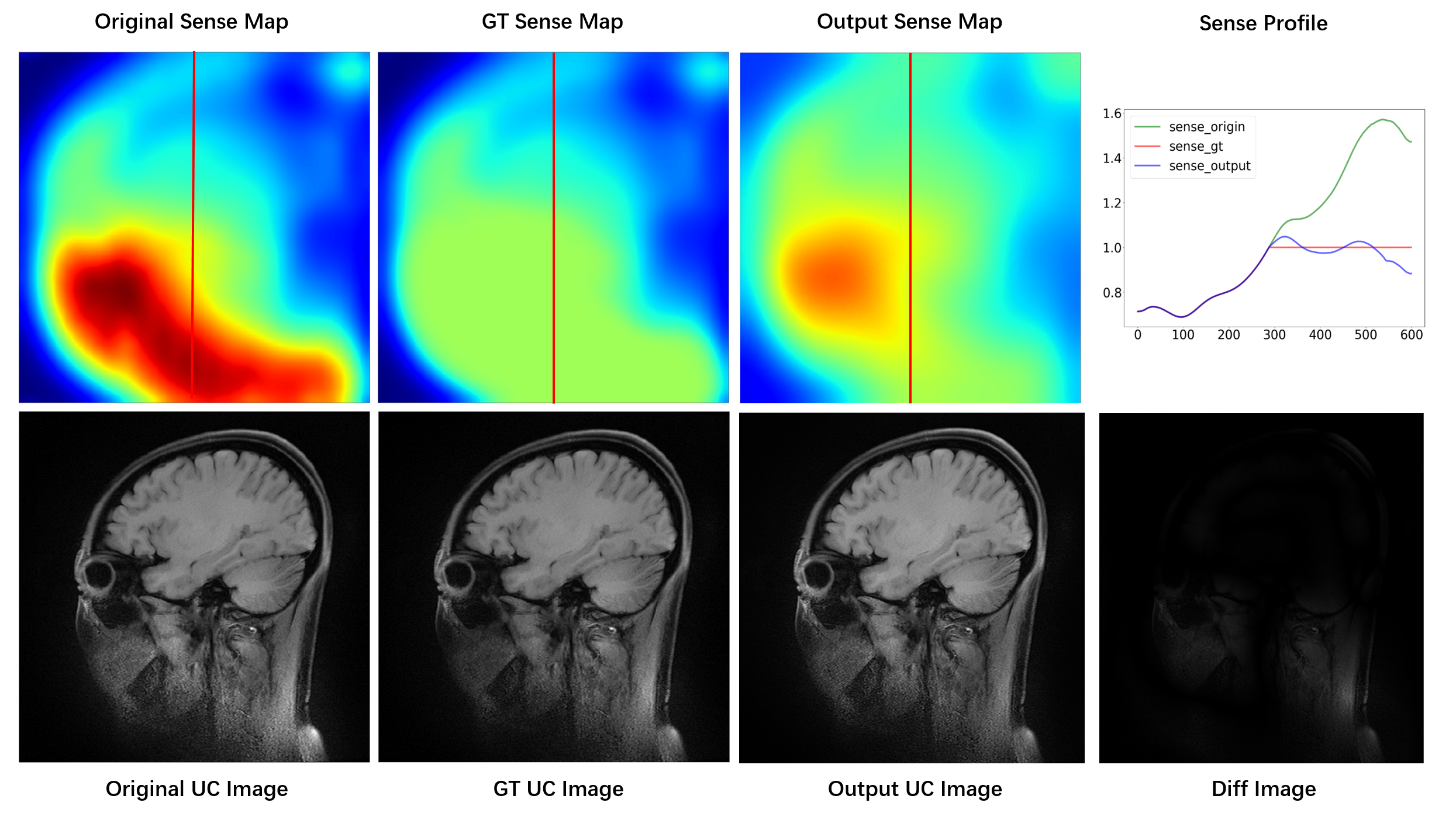
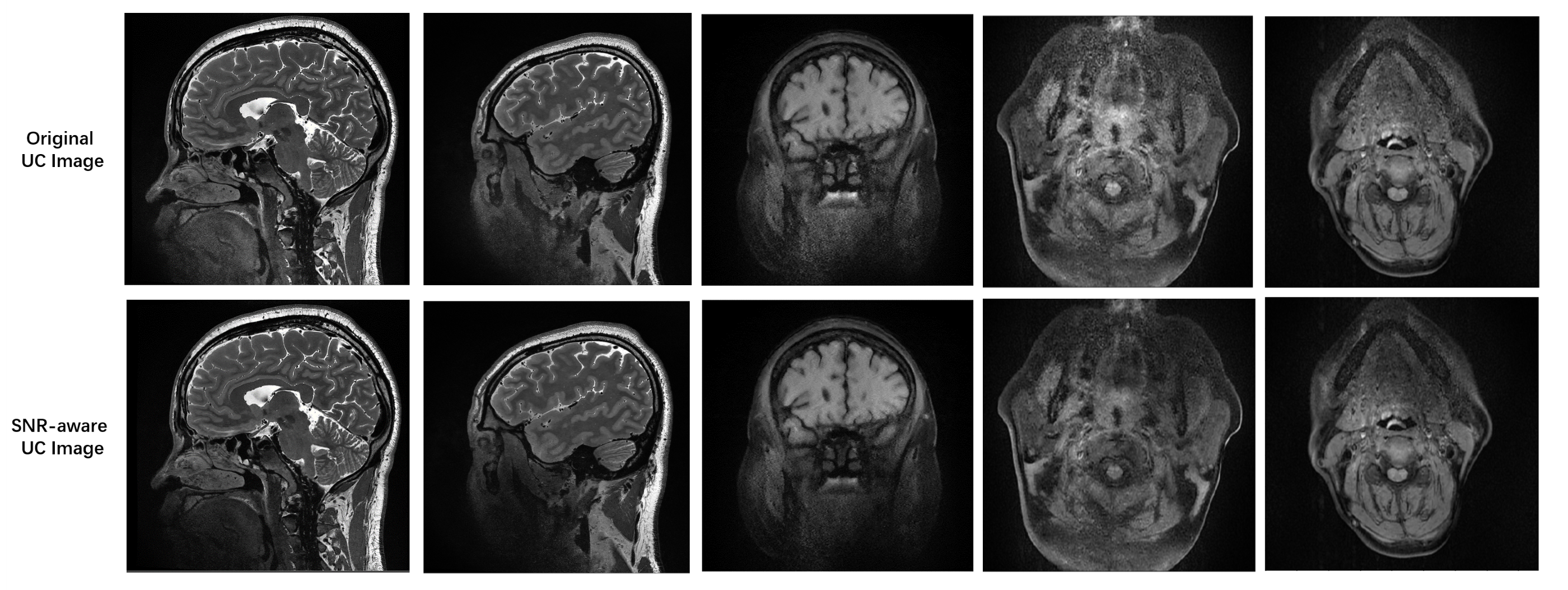
We conducted experiments on 300 head MRI data collected from 10 healthy volunteers on a 5T scanner (uMR Jupiter, United Imaging Healthcare, China). The deep network was trained with composed consistency loss and over-compensation suppression loss for 200 epochs. Two examples of the network-generated SNR-aware sense maps and the corresponding UC images are demonstrated in Figure 3 and Figure 4. The visual quality of the corrected images using a network-generated sense map is comparable with the human-annotated ground truth. With the help of over-compensation suppression loss, the network can further enhance suppression in low-SNR regions compared to the ground truth. A set of exemplary original UC images and deep learning-based SNR-aware UC images are presented in Figure 5.Conclusions
The proposed deep learning-based noise adaptive intensity normalization method can suppress over-compensation of low SNR areas without sacrificing high SNR regions. The experiments show that our method is robust in 5T head imaging with various contrast and scanning orientations.Acknowledgements
No acknowledgement found.References
1. Belaroussi B., Milles J., Carme S., Zhu YM, and Benoit-Cattin H. (2006). Intensity non-uniformity correction in MRI: existing methods and their validation. Medical image analysis, 10(2), 234-246.
2. Ronneberger O, Fischer P, and Brox T. (2015). U-net: Convolutional networks for biomedical image segmentation. In Medical Image Computing and Computer-Assisted Intervention–MICCAI 2015: 18th International Conference, Munich, Germany, October 5-9, 2015, Proceedings, Part III 18 (pp. 234-241). Springer International Publishing.
Figures