2649
Highly segmented skipped-CAIPI 3D-EPI with a modified interleaved Flyback and partial Fourier acquisition for fast MR angiography1MR Physics, DZNE, Bonn, Germany, 2Department of Physics and Astronomy, University of Bonn, Bonn, Germany
Synopsis
Keywords: Artifacts, Velocity & Flow, 3D-EPI
Motivation: As of yet, ghosting and signal dropouts limit the usability of EPI sequences for MRA-TOF compared to well-established methods such as GRE-TOF.
Goal(s): Our goal was to mitigate flow artifacts in MRA-TOF images at short acquisition times whilst improving the efficiency of previous techniques
Approach: We introduced a novel Flyback sampling approach in a highly segmented skipped-CAIPI 3D-EPI sequence with phase partial Fourier to acquire in vivo data at a resolution of 0.6mm isotropic at 7T within about one minute.
Results: The in vivo measurements show a significant reduction in ghosting and signal dropout and improved resolution of small vessels in TOF MIPs.
Impact: Reduced acquisition times and flow artifacts of highly segmented skipped-CAIPI 3D-EPI with a modified, interleaved Flyback acquisition and partial Fourier may increase the applicability of EPI for fast MRA-TOF.
Introduction
Long acquisition times limit the usability of GRE 3D-TOF MRA at high spatial resolution1. Substantially accelerating GRE-TOF through state-of-the-art parallel imaging with highly-segmented 3D-EPI2, is not straight-forward: EPI is susceptible to phase errors from motion along the phase and frequency encoding axes (y and x, respectively, w.l.o.g.), resulting in image artifacts such as ghosting, blurring, signal dropouts and displacements3,4,5. With partial Fourier (PF) sampling, phase errors from flow along y can be reduced6. Here, we introduce a novel Flyback trajectory to additionally reduce phase errors from flow along x.Method
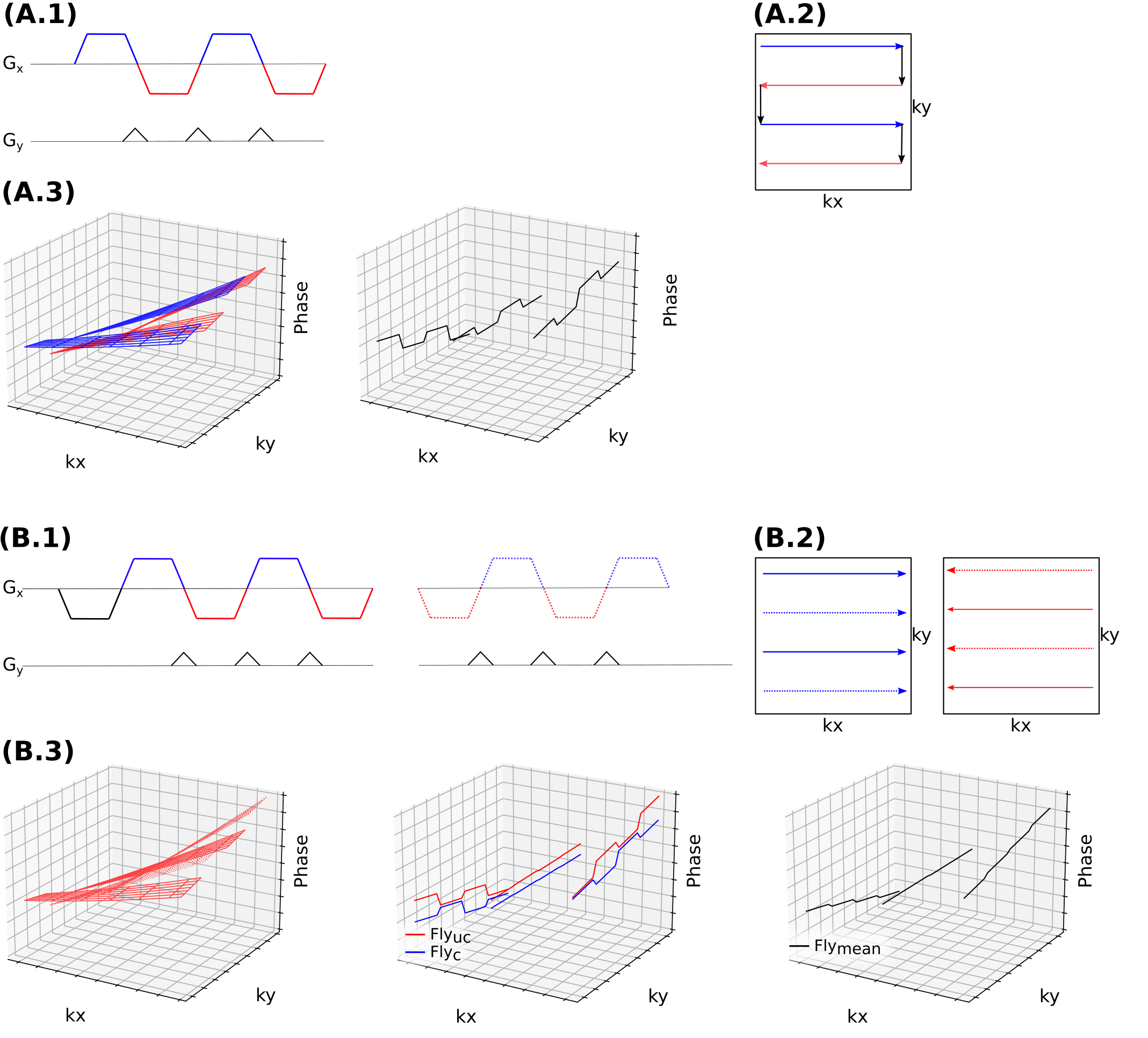
Sequence Design:Alternating readout gradient polarities in EPI in the presence of flow along x lead to severe ghosting artifacts in usual EPI images, which result from phase discontinuities between even and odd echoes3,4 (Fig. 1 A). A modified EPI trajectory has previously been proposed acquiring only even echoes by “flying back” before acquiring another k-space line3. This doubles the total acquisition time (TA) and may introduce artifacts related to small y-bandwidths. To partially retain efficiency and increase y-bandwidth, a partial Flyback approach has been proposed previously for flow imaging with EPI6. Alternatively, if regular odd echoes are acquired during Flyback rephasing (with the same phase encoding), scan efficiency can be completely retained, as two images are acquired in the same time7. However, if parallel imaging cannot be increased further, both images still suffer from low y-bandwidth, and one image has a slightly prolonged TE8. Instead, we propose to keep the phase encode blips before all “Flyback readouts” and acquire the thereby skipped lines in an interleaved fashion with inverted frequency encode polarity (Fig. 1 B). Thus, two cohesive images acquired only with positive and negative frequency encoding are obtained7,8, but with identical TE and using the high y-bandwidth of the original EPI. One of the acquisitions needs an additional prephaser (Fig. 1 B.1) to ensure that, for instance, all positive frequency-encoded echoes are flow-compensated3, i.e. x-flow-related phase is zero at kx=0 for all ky (non-zero, but constant for the uncompensated k-space, cf. Fig. 1 B.3).
Experiments:
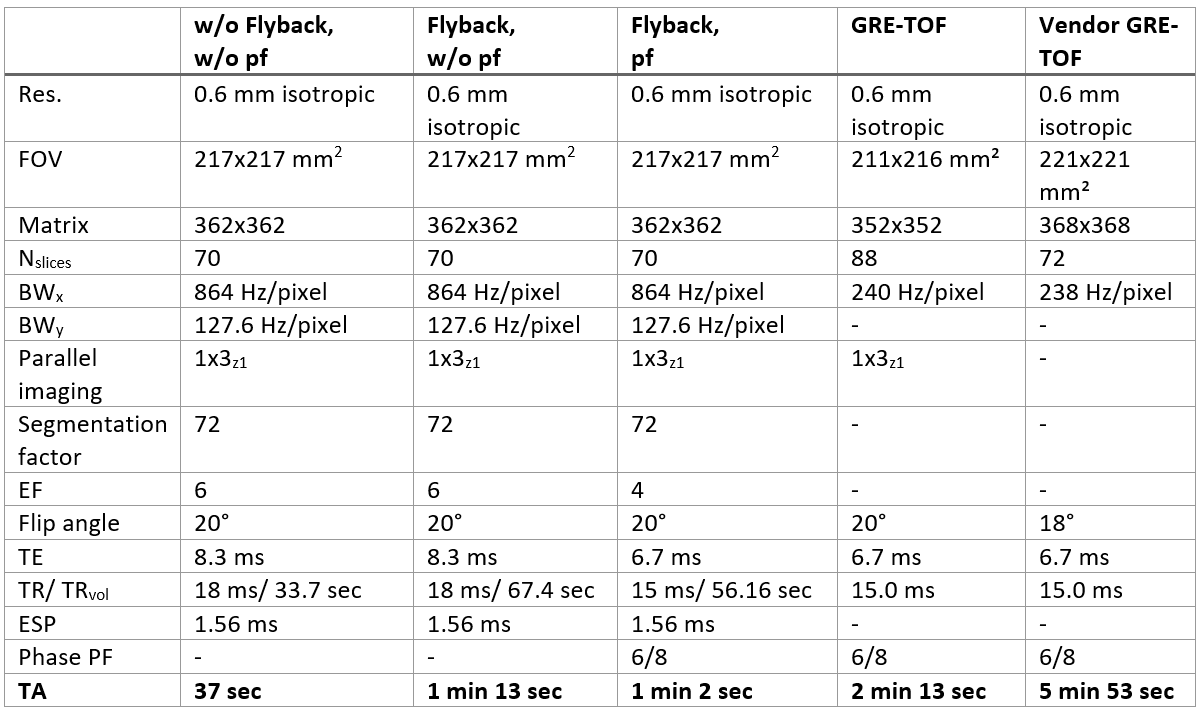
Dephasing due to flow along x was simulated for a segmented EPI trajectory both with and without the modified Flyback approach. MRI measurements were obtained with a skipped-CAIPI 3D-EPI sequence employing 1x3z1-fold parallel imaging acceleration2. TOF-MRA based magnitude images were acquired with and without PF for comparison. To improve SNR, the magnitudes of both reconstructed Flyback images are averaged. Three 3D-EPI sequences at 0.6mm isotropic resolution were acquired in a healthy volunteer on a MAGNETOM 7T Plus scanner (Siemens Healthineers, Erlangen, Germany) with the parameters specified in Table 1. A vendor-provided GRE-TOF and a modified GRE with identical CAIPIRINHA pattern and reconstruction as the 3D-EPI-TOF were measured for comparison.
Results
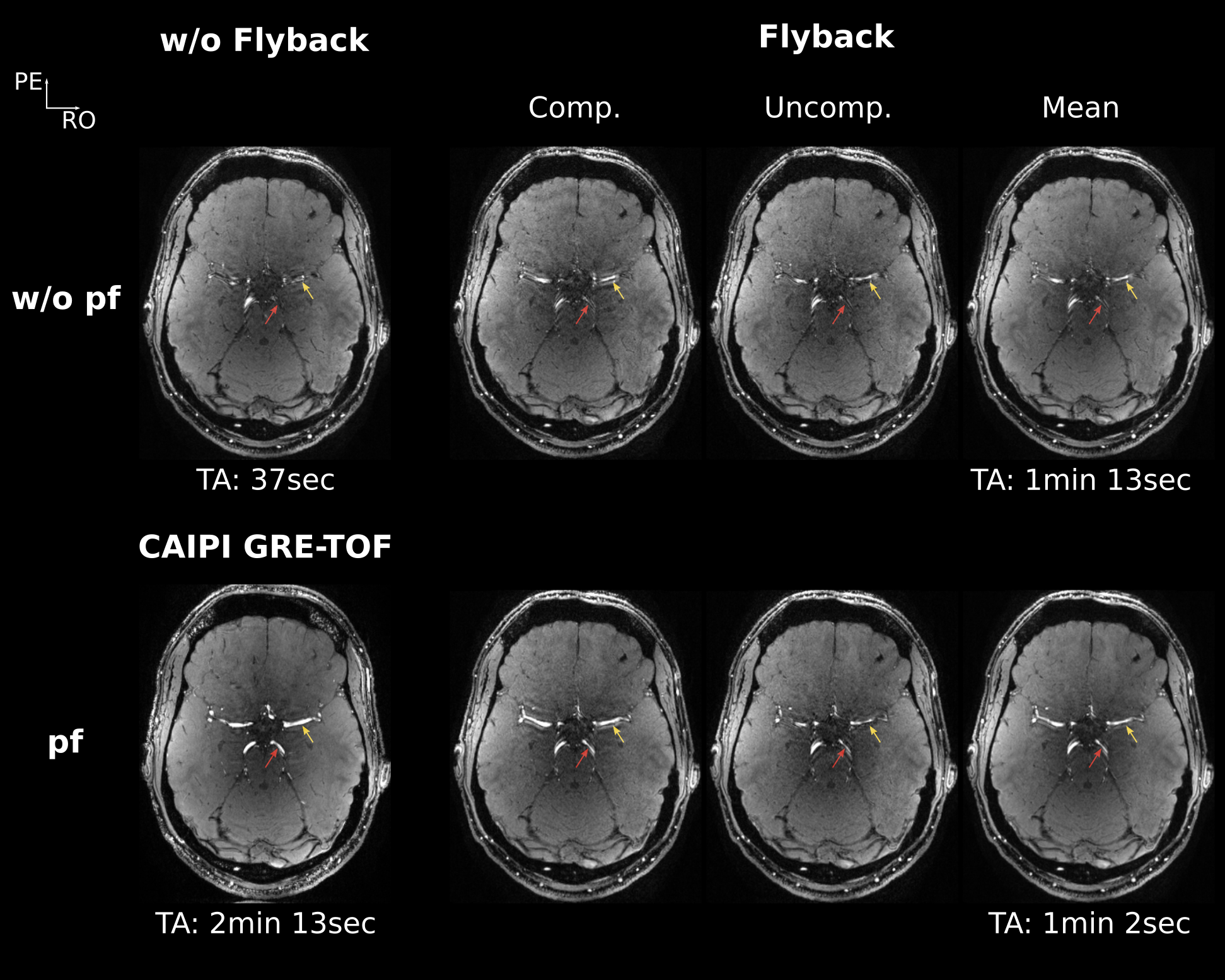
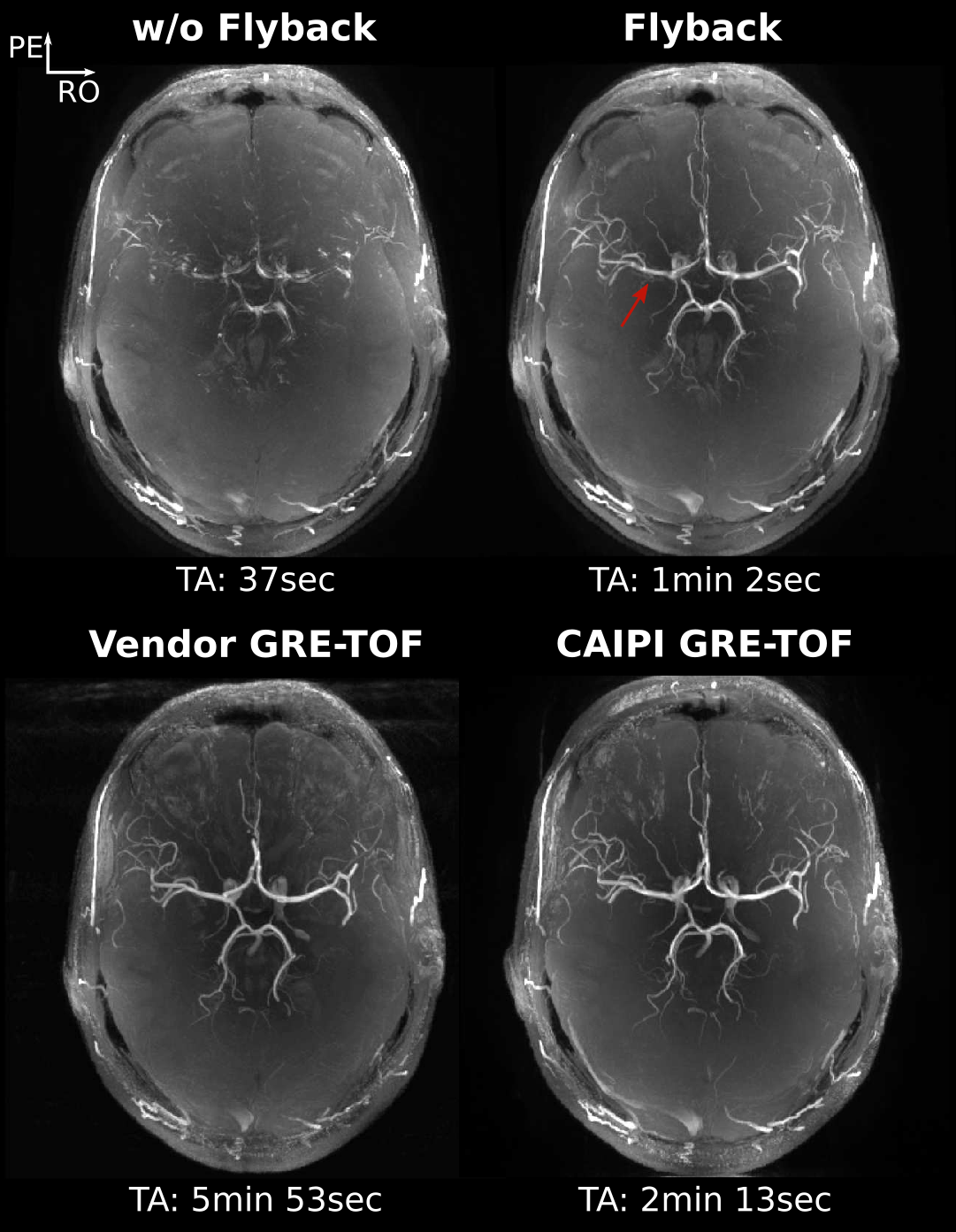
Figures 1 A.3 and B.3 show the simulated phase error in k-space due to flow along x for segmented EPI without and with the proposed Flyback approach, respectively. The results from the in-vivo measurement are shown in Figure 2. Using PF leads to a significant mitigation of signal loss when flow along y is present. Reduced ghosting artifacts can be observed in the images with Flyback compared to the regular EPI scan for all vessels oriented along the x direction. Complementary ghosting artifacts can be observed in the uncompensated Flyback image. Averaging both images leads to a high SNR EPI-TOF image without major flow artifacts. Only small ghosting artifacts along large vessels remain (Figure 3, red arrow).Discussion
We demonstrated that highly segmented skipped-CAIPI EPI is suitable for ultra-fast MRA-TOF at 0.6mm isotropic resolution. Within about 1 minute total scan time for a 42mm slab, the proposed Flyback approach reduced ghosting artifacts in two simultaneously acquired images with high y-bandwidths (comparable to typical GRE x-bandwidths). Combining both Flyback images improved SNR and further reduced residual flow artifacts still present in the individual images (see complementary phase jumps for kx≠0). However, residual ghosting can remain in large vessels along x, presumably due to higher order phase terms (pulsation). Magnitude rather than complex averaging was performed to avoid signal cancellation due to phase differences in areas with large flow along x. In the future, it might be possible to exploit this phase difference for velocity mapping. Future investigations will also include optimization of the TOF contrast, phantom experiments and comparisons to double-sampled EPI approaches7,8 with matched phase encode bandwidth through higher segmentation.Acknowledgements
This work received financial support from Helmholtz Association Initiative and Networking Fund, funding code ZT-IPF-4-042 (Helmholtz Imaging Project “HighLine”).References
- Meixner CR, Liebig P, Speier P, et al. High resolution time-of-flight MR-angiography at 7 T exploiting VERSE saturation, compressed sensing and segmentation. Magnetic Resonance Imaging. 2019;63:193-204.
- Stirnberg R, Stöcker T. Segmented K-space blipped-controlled aliasing in parallel imaging for high spatiotemporal resolution EPI. Magn Reson Med. 2021;85(3):1540-1551.
- Duerk JL, Simonetti OP. Theoretical aspects of motion sensitivity and compensation in echo-planar imaging. J Magn Reson Imaging. 1991;1(6):643-650.
- Butts K, Riederer SJ. Analysis of flow effects in echo-planar imaging. J Magn Reson Imaging. 1992;2(3):285-293.
- Nishimura DG, Irarrazabal P, Meyer CH. A Velocity k-Space Analysis of Flow Effects in Echo-Planar and Spiral Imaging. Magn Reson Med. 1995;33(4):549-556.
- Pat GTL, Meyer CH, Pauly JM, et al. Reducing flow artifacts in echo-planar imaging. Magn Reson Med. 1997;37(3):436-447.
- Yang QX, Posse S, Bihan DL, et al. Double-Sampled Echo-Planar Imaging at 3 Tesla. Journal of Magnetic Resonance, Series B. 1996;113(2):145-150.
- Poser BA, Barth M, Goa PE, et al. Single-shot echo-planar imaging with Nyquist ghost compensation: Interleaved dual echo with acceleration (IDEA) echo-planar imaging (EPI). Magnetic Resonance in Medicine. 2013;69(1):37-47.
Figures