2646
Mitigating Distortion Artifacts in Accelerated-EPI Using an Ensemble of k-t GRAPPA Kernels (EnKT-GRAPPA)1Center for Biomedical imaging Research, Tsinghua University, Beijing, China, 2Electrical Engineering, Stanford University, Stanford, CA, United States, 3Radiology, Stanford University, Stanford, CA, United States
Synopsis
Keywords: Artifacts, Artifacts
Motivation: EPI suffers from field-inhomogeneity distortions. Employing large inplane acceleration (Rinplane) can mitigate this issue at a cost of increase noise and artifacts, while postprocessing correction can lead to resolution-loss.
Goal(s): Develop a reconstruction method based on an ensemble of k-t GRAPPA-kernels (EnKT-GRAPPA) for use on moderately-accelerated EPI, to both fill missing-kspace and reduce distortion.
Approach: EnKT-GRAPPA kernels are trained using k-t calibration data to fill missing-kspace and correct for cumulative-phase of field-inhomogeneity in one step, where phase/distortion correction level can be flexibly tuned.
Results: For the same distortion mitigation level, EnKT-GRAPPA-reconstructed-images exhibit higher-SNR compared to those from conventional GRAPPA-reconstructed-images of a higher-Rinplane acquisition.
Impact: EnKT-GRAPPA enables moderately accelerated EPI to achieve a high level of distortion mitigation while preserving SNR. This method should be useful in many applications such as fMRI, diffusion and perfusion imaging.
Introduction
EPI 1, despite its rapid imaging capability, is prone to distortions from magnetic-field-inhomogeneity and related issues 2.Postprocessing solutions such as TOPUP 3,4 is effective at gross-scale mitigation but can cause compromised resolution, particularly in image compression areas. To overcome this, high inplane-acceleration (Rinplane) can be employed (Figure1.b) , but can lead to large $$$g\sqrt{R_{inplane}}$$$ SNR-penalty 5, especially beyond Rinplane =3.
This work introduces an ensemble of k-t GRAPPA 6 kernels (EnKT-GRAPPA) approach for use on moderately-accelerated EPI, to fill missing-kspace and correct for cumulative-phase of field-inhomogeneity in one step, where phase/distortion correction level can be flexibly tuned to tradeoff distortion mitigation vs. noise amplification. We show that such an approach improves the trade-off between distortion mitigation and SNR-reduction in accelerated-EPI.
Methods
In this abstract, Rinplane denotes the inplane undersampling performed during acquisition, while Rrecon represents the equivalent factor in terms of distortion-mitigation achieved through EnKT-GRAPPA reconstruction.We validate the proposed EnKT-GRAPPA approach through comparing reconstructions performed on simulated k-t data generated from a ground truth GRE and a B0 map (used to simulate phase-accumulation along the EPI-readout) 7. The data were collected on a healthy volunteer using a 3T scanner with 48-channel coils. For our target brain-imaging application, Rinplane = 2 was chosen for use with EnKT-GRAPPA for 1mm EPI-acquisition, where the echo-spacing was assumed to be 1ms (Figure2) . This choice effectively curtails the amount of phase-accumulation that needs to be mitigated, while preserving a good level of SNR due to reasonably low $$$g\sqrt{R_{inplane}}$$$ SNR-penalty (Figure1.c). Based on this, we trained spatio-temporal GRAPPA kernels in a confined self-calibration region of k-space, achieving results with minimal distortion. We delve into three key facets:
- Training a Spatio-Temporal GRAPPA-Kernel for Magnetic-Field-Inhomogeneity Correction(Figure1.d)
This trained kernel can correct B0-inhomogeneity phase-accumulation of the calibration area at a specific time-point to the phase at the target time-point. Utilizing EnKT-GRAPPA kernels, each data point sampled at a specific temporal-instance can be synchronized to a chosen target time-point. This creates a consistent phase across different rows within the EPI-dataset. By applying these kernels to various rows, we align the phase of data points from disparate temporal-coordinates to a common reference-time. This harmonization effectively eliminates inter-row phase discrepancies, thus preventing distortion in the aggregated-data.
- Using EnKT-GRAPPA Kernel for Concurrent Image Distortion-Correction & K-space Filling(Figure1.e)
- Determining the Optimal Phase-Correction Magnitude(Figure1.f)
Results
The distortion mitigation outcomes from EnKT-GRAPPA demonstrate superior-corrections compared to conventional-GRAPPA , particularly as the Rrecon value increases. This is particularly evident in the compressed air-tissue interface region with large B0-inhomogeneity, circled in red.Figure 4 shows comparison of GRAPPA vs EnKT-GRAPPA reconstructed images for various simulated-EPI acquisitions with added-noise at different level of Rinplane accelerations; all reconstructed to the same level of image-distortion (Rrecon 4). GRAPPA reconstruction of Rinplane 4 acquisition resulted undesirably large noise-amplification and artifacts. EnKT-GRAPPA reconstruction of Rinplane 1 data, reconstructed to Rrecon 4 achieves improved results with less noise. However, the large amount of phase-correction, required by k-t GRAPPA kernels, can cause reconstruction errors as seen by prominent stripes in the red boxes. The synergistic use of Rinplane 2 acquisition-acceleration, with a further 2x distortion mitigation via EnKT-GRAPPA to achieve Rrecon 4 provide the best trade-off with high quality reconstruction.
Conclusion and Discussion
Our simulation results demonstrate that EnKT-GRAPPA can efficiently address missing k-line fillings and phase-correction. By merging parallel imaging with phase-correction through a unified kernel-set, we maintain high-SNR, reduced-distortion, and a minimized g-factor, ensuring more enhanced noise-management.Acknowledgements
This work is partially supported by R01MH116173, R01EB019437, U01EB025162, P41EB030006, R01EB033206, U24NS129893.References
1. Stehling MK, Turner R, Mansfield P. Echo-planar imaging:magnetic resonance imaging in a fraction of a second. Science. 1991;254:43-50.
2. P. Munger, G. R. Crelier, T. M. Peters, G. B. Pike. An inverse problem approach to the correction of distortion in EPI images. IEEE Transactions on Medical Imaging. July 2000;19(7):681-689.
3. J.L.R. Andersson, S. Skare, J. Ashburner. How to correct susceptibility distortions in spin-echo echo-planar images: application to diffusion tensor imaging. NeuroImage. 2003;20(2):870-888.
4. S.M. Smith, M. Jenkinson, M.W. Woolrich, et al. Advances in functional and structural MR image analysis and implementation as FSL. NeuroImage. 2004;23(S1):208-219.
5. Pruessmann, Klaas P., Markus Weiger, Markus B. Scheidegger, Peter Boesiger. SENSE: sensitivity encoding for fast MRI. Magnetic Resonance in Medicine. 1999;42(5):952-962.
6. Griswold M. A., Jakob P. M., Heidemann R. M., et al. Generalized autocalibrating partially parallel acquisitions (GRAPPA). Magnetic Resonance in Medicine. 1991;47(6):1202-1210.
7. Liao, C., Bilgic B., Tian, Q., et al. Distortion-free, high-isotropic-resolution diffusion MRI with gSlider BUDA-EPI and multicoil dynamic B0 shimming. Magnetic Resonance in Medicine. 2001;86: 791–803.
Figures
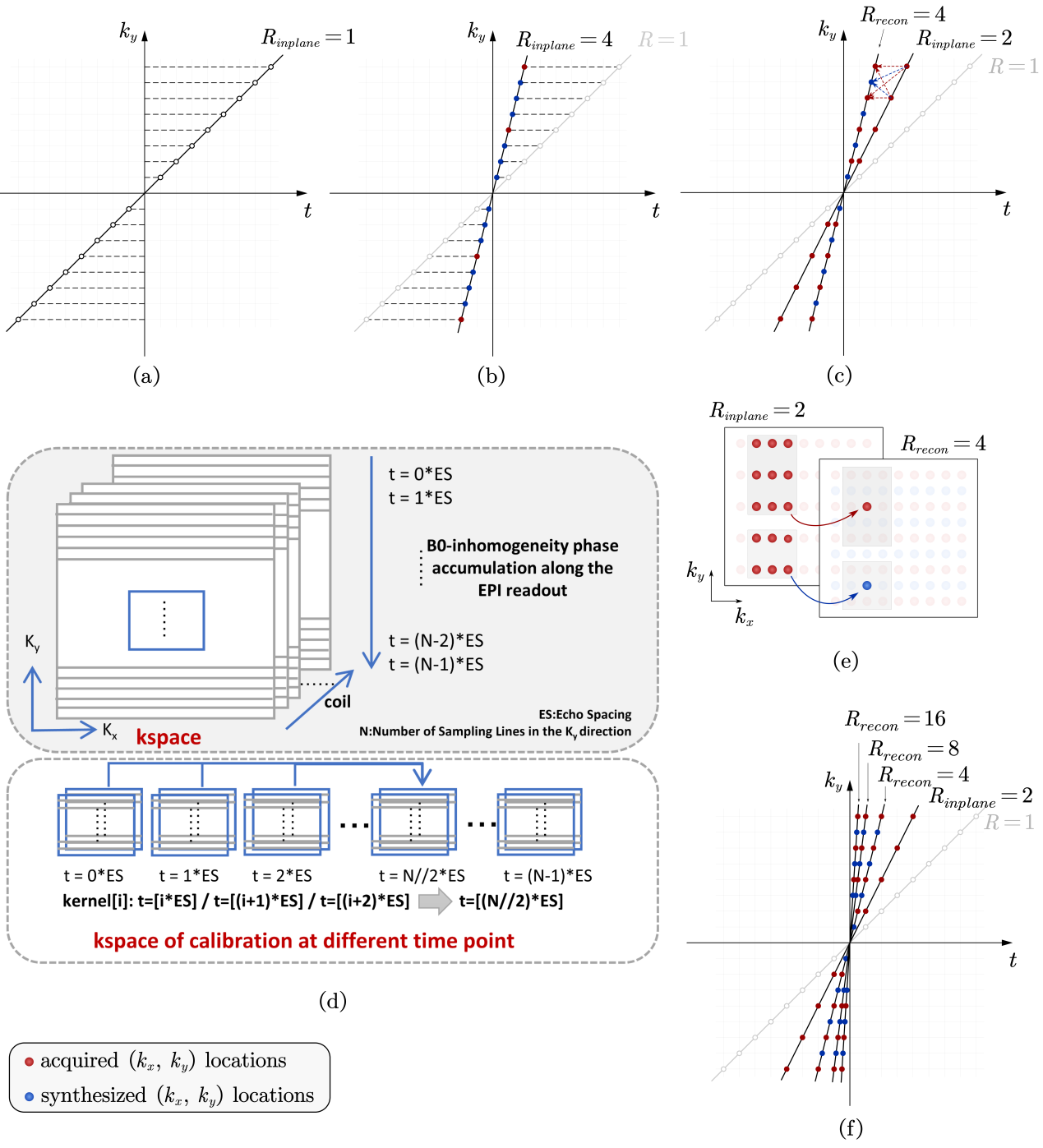
a. Fully sampled single shot EPI data (Rinplane = 1) in ky-t space.
b. Illustrates sampling and unsampled point interpolation in ky-t space with GRAPPA at Rinplane =4.
c. Undersampling at Rinplane=2, kspace data is reconstructed using EnKT-GRAPPA to Rrecon =4.
d. Training of EnKT-GRAPPA kernels.
e. Demonstrates dual-function EnKT-GRAPPA kernel application on undersampled EPI data at R=2 for phase rewinding and kspace filling.
f. EnKT-GRAPPA reconstruction at different Rrecon factors (4, 8, 16) for Rinplane 2 acquisition, where higher factors require more phase rewinding.
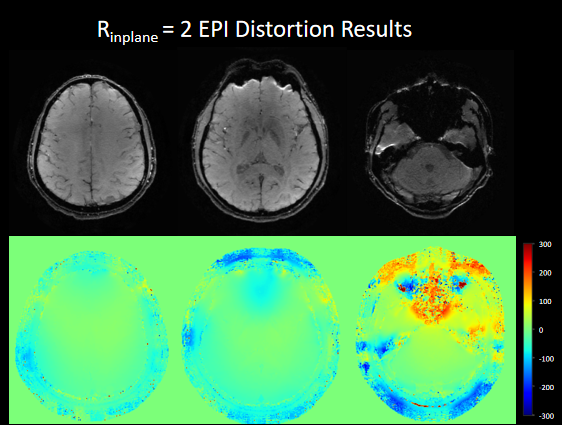
This figure is the simulation of in vivo data. The top are Rinplane 2 EPI distorted imges of diferent slices and the bottom are B0 maps. The first row employs the GROUND TRUTH of the corresponding layer, simulates the temporal phase accumulation encountered during normal GRAPPA to perform kspace filling for Rinplane =2 EPI data. The images in the second row, progressing from left to right, depict the escalating effects of B0 inhomogeneity within the human brain.
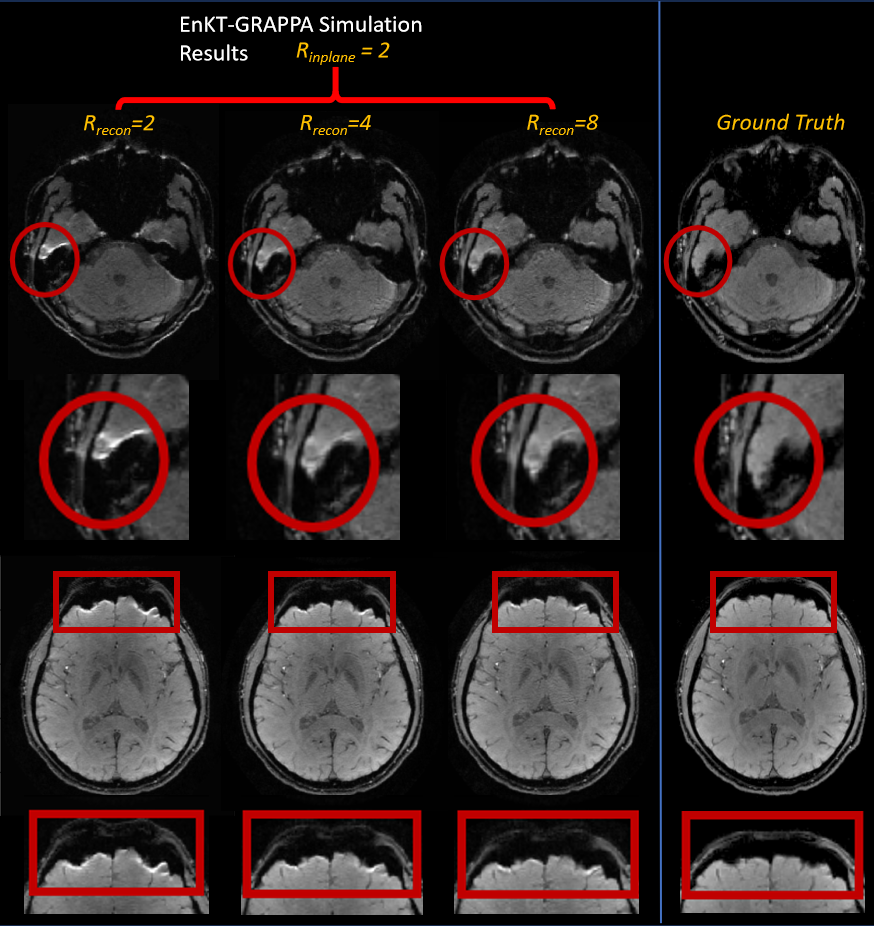
Reconstruction results on two slices of simulated EPI data for Rinplane 2 acquisition, from left to right: i) GRAPPA reconstruction, ii) EnKT-GRAPPA Rrecon =4, iii) EnKT-GRAPPA Rrecon = 8. Far left shows the ground truth GRE acquisition with no distortion. EnKT-GRAPPA is shown to be effective at mitigating distortion as highlighted by the zoom in region with large B0 variations.
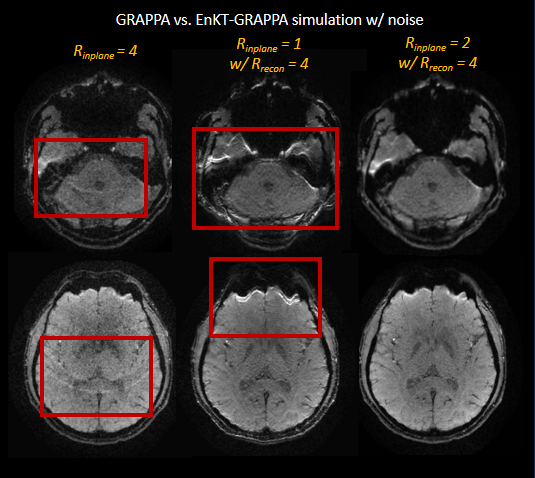
Comparison of reconstructed data at matching distortion-mitigation level for: i) GRAPPA Rinplane 4, ii) EnKT-GRAPPA with Rinplane1 and Rrecon 4, iii) EnKT-GRAPPA with Rinplane2 and Rrecon4, where the same i.i.d. noise level were added to raw k-space data for all cases. The use of Rinplane 2 along with Rrecon 4 in EnKT-GRAPPA enable the best reconstruction performance with high SNR and lower errors, where the phase rewinding that needs to be performed by EnKT-GRAPPA is reduced when compare to the Rinplane 1 case.