2644
A low rank k-space approach to channel-by-channel reduced FOV imaging1Imaging Institute, The Cleveland Clinic Foundation, Cleveland, OH, United States, 2Radiology, University of California, Los Angeles, Los Angeles, CA, United States, 3Medical Research, Matai Medical Research Institute, Gisborne, New Zealand, 4The Pennsylvania State University, University Park, PA, United States, 5The University of Southern California, Los Angeles, CA, United States, 6The University of California, Los Angeles, Los Angeles, CA, United States
Synopsis
Keywords: Artifacts, Image Reconstruction, beamforming, phased-array
Motivation: To introduce a channel-by-channel reduced field-of-view (FOV) method for an arbitrary region of interest (ROI).
Goal(s): With Nc channels as input, we output Nc channels, with the signal outside of the target ROI vectorially nulled while preserving the original channel sensitivity profiles and relative phases for each channel.
Approach: Using a full-FOV calibration set, we learned the linear operators needed to be applied on local k-space neighbors across all channels in order to vectorially cancel the signal outside of the target-ROI for any channel.
Results: We were able to generate reduced FOV images in phantom and in vivo settings.
Impact: A reduced FOV method is introduced that determines the linear operators needed to vectorially cancel the signal outside the target ROI. The output is the Nc channels with the region outside of the target ROI cancelled while preserving channel sensitivities.
Introduction
Transmitting RF pulses in MRI often excites spins from spatial regions outside the target region-of-initerest (ROI). Spatially encoding only for the desired ROI results in aliased signal interfering with the target anatomy. Kim et al1 developed a reduced FOV method titled "Region-Optimized Virtual Coils" (ROVir), which is based on Walsh et al's2 adaptive coil combine method. ROVir determines a set of $$$N_v$$$ virtual channels from the original $$$N_c$$$ channels that optimize the power within the target ROI, $$$r\in\Omega$$$, to the power outside ("interference"), $$$r\in\Gamma$$$, where $$$r$$$ is used to denote spatial-location.An alternative means using the phased-array for reduced FOV imaging is introduced here, titled this "low rank reduced FOV" or "LR-rFOV." LR-rFOV generates a k-space for each channel that only encodes for the spins in the target-ROI. This is different from ROVir, which compresses the channels to virtual coils.
Theory
The k-space of channel $$$l$$$ can be characterized as the sum of the k-space of from $$$r \in \Gamma$$$ and $$$r \in \Omega$$$:$$d_l(k)=d_l^{r \in \Omega}(k)+d_l^{r\in \Gamma}(k) +\eta_l(k) (eq. 1)$$
Because the k-space data is complex, we sought to determine the weights needed to vectorially cancel the $$$d_l^{r \in \Gamma}(k) $$$ term in equation 1 using all neighboring k-space entries across all channels of the acquired $$$d_l(k)$$$ such that:
$$d_l^{r \in \Omega}(k) = \sum_{j=1}^{N_c}\sum_{b=1}^{N_b} n_j^l(b) d_j(k_b) (eq. 2)$$
In equation 2, $$$N_b$$$ is the number of k-space neighbors, $$$k_b$$$ refers to a neighbor of coordinate $$$k$$$, and $$$n_j^l(b)$$$ is the weight of k-space neighbor $$$b$$$ from channel $$$j$$$ for target channel $$$l$$$. These weights can be determined by least-squares, relating the k-space of a full FOV calibration to the k-space of the calibration segmented for $$$r\in\Omega$$$.
Equation 2 can be generalized to a structured low rank problem as the following,
$$[<ker(d(k))>^T, <ker(d^{r \in \Omega}(k))>^T] \cdot w = 0 (eq. 3)$$
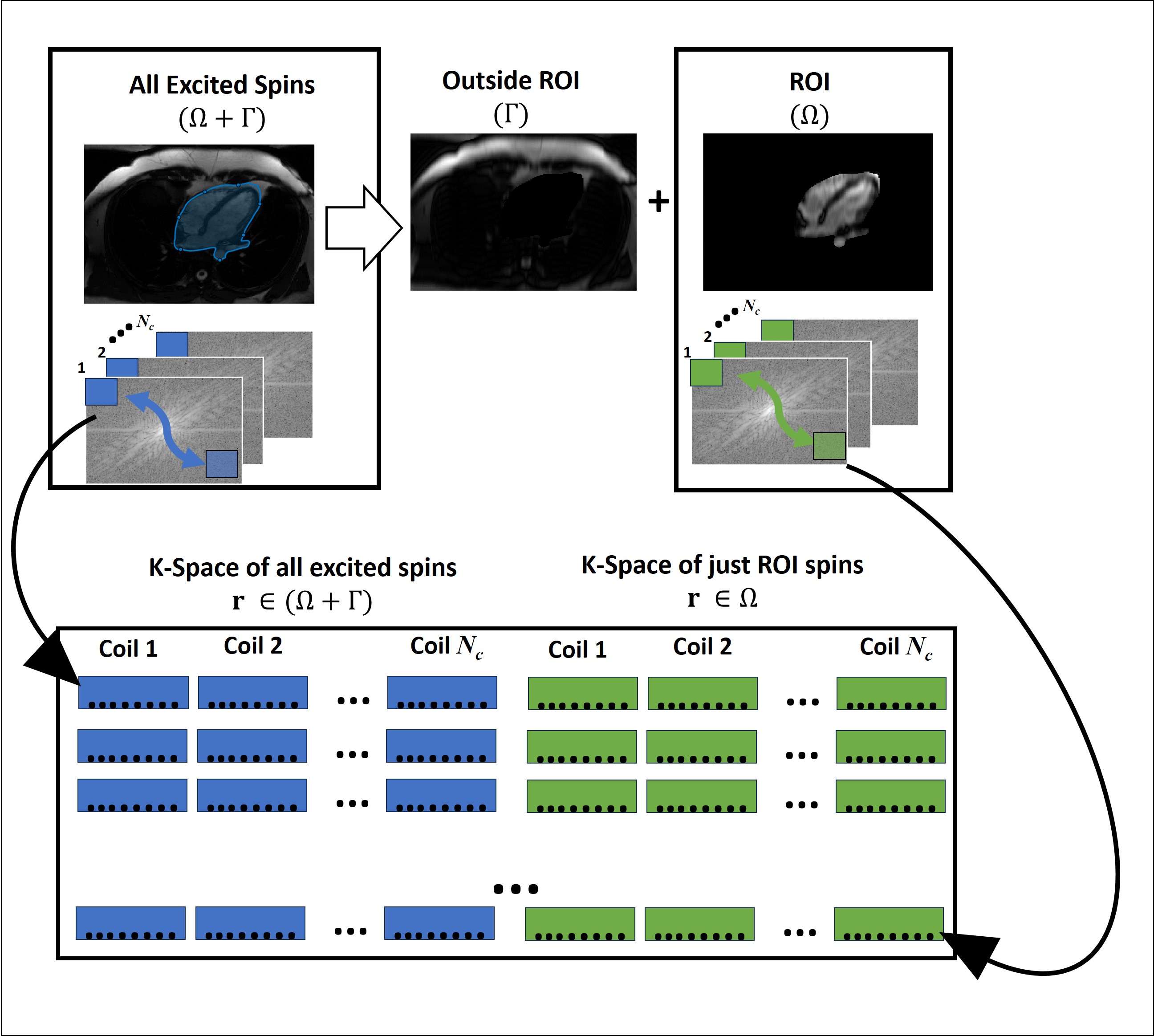
Where $$$ker$$$ is an operator that vectorizes an $$$N_b$$$-member neighborhood centered at coordinate $$$k$$$ through all channels. In equation 3, a multi-channel k-space neighborhood of all excited spins ($$$r\in(\Omega+\Gamma)$$$) and the same neighborhood of the multi-channel k-space of $$$r \in \Omega $$$ are concatenated to be a single vector (Figure 1).
Solving for a Vector Space of $$$w$$$
One can determine the span of all vectors $$$w$$$ satisfying equation 3 using the data of a full FOV calibration scan, $$$d_{\cal}(k)$$$ in the following steps:1. Segment the calibration images for $$$r \in \Omega$$$, and take its FT to have $$$d^{r \in \Omega}_{cal}(k)$$$ (Figure 1).
2. Construct an auto-calibration matrix, $$$A^{cal}$$$, where each row is $$$[ <ker(d_{cal}(k))>^T, <ker(d^{r\in \Omega}_{cal}(k))>^T]$$$ for a different coordinate of $$$k$$$ (Figure 1).
3. Determine the nullspace of $$$A^{cal}$$$, $$$V_{\perp}$$$, which are the right singular vectors corresponding to insignificant singular values. $$$V_{\perp}$$$ defines the space of all $$$w$$$ that satisfies equation 3.
Determining the reduced FOV k-Space for each Channel
Construct a calibration matrix, $$$A$$$ where each of its rows is $$$[<ker(d(k))>^T,<ker(d^{r \in \Omega}(k))>^T]$$$. All entries of $$$d^{r \in \Omega}(k)$$$ are initially zero. These missing entries can be solved iteratively by imposing the null operators3-6 on $$$A$$$ and imposing consistency with the acquired entries of $$$d(k)$$$.Methods
Phantom: Compared LR-rFOV and ROVir on a 2D FLASH acquisition carried out on the American College of Radiology (ACR) phantom with a square target ROI.In Vivo: Evaluated on a Cartesian dataset that encoded for half FOV coverage. We compared the aliased data with LR-rFOV and ROVir. We also demonstrate that LR-rFOV can be integrated with skipped k-space entries.
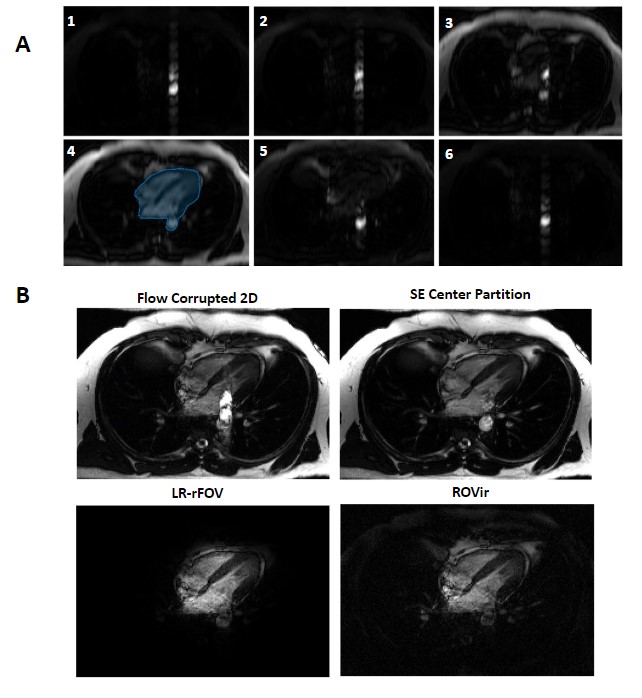
Outflow Effects in bSSFP7: A slice-encoded8 calibration with a 2D excitation profile was acquired with the target-ROI in the center-slice. Null operators were applied on flow-effected 2D bSSFP acquisitions.
Results
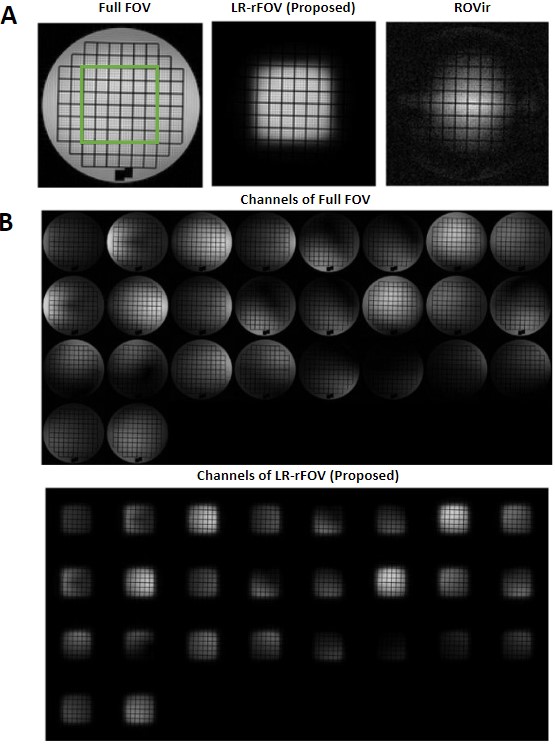
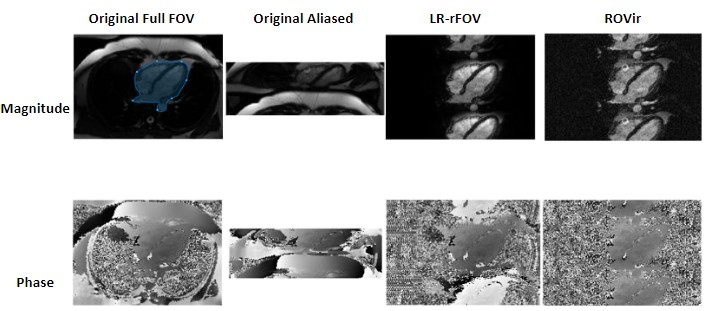
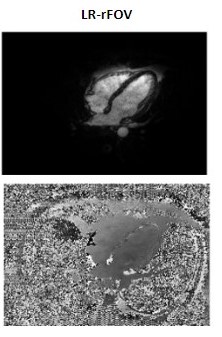
Figure 2A: Phantom images of original full FOV, LR-rFOV, and ROVir. Green box in full FOV defines $$$\Omega$$$. LR-rFOV better localized $$$\Omega$$$ 2B: Top - all original channel images. Bottom - all LR-rFOV channel images. LR-rFOV preserves the channel sensitivity profiles.Figures 3 and 4: results of the reduced FOV Cartesian dataset. The target ROI is illustrated in blue over the Original Full FOV image. This shows that LR-rFOV works effectively in the vectorial cancellation of signal from outside of the target ROI. The phase maps are displayed to show that LR-rFOV preserves the relative phase of the target ROI.
Figure 5: results cancelling outflow effects in bSSFP imaging. LR-rFOV cancelled the outflow effects without requiring the duration slice-encoding needed.
Acknowledgements
We take inspiration from ROVir, PRUNO, SAKE, AC-LORAKS, and work done on double half echoes.1-6
Further, the work contributing to the content in this abstract was supported by the following grants: NIH R01HL127153 , NIHR01AR075422.
References
1. Kim, Daeun, et al. "Region‐optimized virtual (ROVir) coils: Localization and/or suppression of spatial regions using sensor‐domain beamforming." Magnetic Resonance in Medicine 86.1 (2021): 197-212.
2. Walsh, David O., Arthur F. Gmitro, and Michael W. Marcellin. "Adaptive reconstruction of phased array MR imagery." Magnetic Resonance in Medicine: An Official Journal of the International Society for Magnetic Resonance in Medicine 43.5 (2000): 682-690.
3. Zhang, Jian, Chunlei Liu, and Michael E. Moseley. "Parallel reconstruction using null operations." Magnetic resonance in medicine 66.5 (2011): 1241-1253.
4. Haldar, Justin P. "Autocalibrated LORAKS for fast constrained MRI reconstruction." 2015 IEEE 12th International Symposium on Biomedical Imaging (ISBI). IEEE, 2015.
5. Shin, Peter J., et al. "Calibrationless parallel imaging reconstruction based on structured low‐rank matrix completion." Magnetic resonance in medicine 72.4 (2014): 959-970.
6. Bydder, Mark, et al. "Minimizing echo and repetition times in magnetic resonance imaging using a double half‐echo k‐space acquisition and low‐rank reconstruction." NMR in Biomedicine 34.4 (2021): e4458.
7. Markl, Michael, and Norbert J. Pelc. "On flow effects in balanced steady‐state free precession imaging: pictorial description, parameter dependence, and clinical implications." Journal of Magnetic Resonance Imaging: An Official Journal of the International Society for Magnetic Resonance in Medicine 20.4 (2004): 697-705.
8. Ali, Fadil, et al. "Slice encoding for the reduction of outflow signal artifacts in cine balanced SSFP imaging." Magnetic resonance in medicine 86.4 (2021): 2034-2048.
Figures