2609
STI-net: reconstruction of the susceptibility tensor using deep neural network1Biomedical Imaging Center, Pontificia Universidad Catolica de Chile, Santiago, Chile, 2Department of Electrical Engineering, Pontificia Universidad Catolica de Chile, Santiago, Chile, 3Millennium Institute Millennium Institute for Intelligent Healthcare Engineering (iHEALTH), Santiago, Chile, 4School of Electrical Engineering, Pontificia Universidad Catolica de Valparaiso, Valparaiso, Chile, 5Department of Neurology, Medical University of Graz, Graz, Austria
Synopsis
Keywords: Susceptibility/QSM, Susceptibility, Susceptibility Tensor Imaging
Motivation: When solving the Susceptibility Tensor Imaging problem, fast algorithms based on Least Squares require an elevated number of acquisitions, while more robust solvers that use DTI information may produce over-smoothed solutions.
Goal(s): To create a deep neural network based reconstruction algorithm to produce high SNR STI images with a reduced number of MRI acquisitions.
Approach: Use a physics-informed deep neural network approach, trained with various geometrical objects, capable of accurately reconstructing susceptibility tensors.
Results: We obtained susceptibility tensors with the expected anisotropy, better alignment with DTI eigenvectors and high SNR.
Impact: Our STI-net algorithm is capable of reconstructing accurate STI images with higher SNR, compared with traditional algorithms.
Introduction
Susceptibility Tensor Imaging (STI) has been recently proposed to study the anisotropic susceptibility of biological tissues1. This approach models the magnetic susceptibility as a symmetric 3x3 tensor with 6 independent variables. Consequently, the STI algorithms needs at least 6 Gradient Recalled Echo (GRE) acquisitions with different orientations relative to the main magnetic field. In practice, more than 6 acquisitions are needed to reduce noise, motion artifacts and limitations associated with head positioning within the head coil1,2, making the scanning process uncomfortable and excessively time-consuming for clinical applications3. Several STI reconstruction algorithms have been proposed. The first approach used Least Squares4, which, while computationally efficient, required a substantial number of acquisitions to minimize streaking artifacts. Mean Magnetic Susceptibility Regularized STI (MMSR-STI) iteratively assumes only the white matter being anisotropic1. However, recent studies also showed anisotropic susceptibilities in cortical gray matter and CSF due to the presence of capillaries and small veins5. Diffusion Regularized STI (DRSTI) assumes that principal eigenvectors (PEV) from STI and DTI are aligned, thereby regularizing STI reconstructions with DTI information5. This extended the acquisition time but employed low-resolution DTI images, potentially resulting in over-smoothed STI results6. DeepSTI uses deep neural networks for STI6, but using the same DTI prior. Our study introduces a novel deep neural network for STI reconstruction, STI-net, which leverages a physics-informed approach to enhance the resolution and accuracy of the results.7Methods
STI-net extents a Residual U-net7, with the decoder divided into isotropic ($$$\mathbf{\chi_I}$$$) and anisotropic ($$$\mathbf{\chi_V}$$$) paths (Figure 1). Each residual block (Figure 2) consists of convolutional 3D layers with 3x3x3 kernel size, 2x2x2 stride for subsampling, batch normalization and Leaky-ReLU as activation function. To preserve image geometry, we concatenated encoder and decoder levels and increased decoder dimensions using interpolation, followed by a 3D Convolutional layer with 3x3x3 kernel size.The training dataset was divided into susceptibility tensors ($$$\mathbf{\chi}$$$) and the system matrixes ($$$\mathbf{A}$$$) datasets, with 1mm3 isotropic resolution, 64x64x64 field of view, and 3T field strength. For the susceptibility tensor dataset, we reconstructed eigenvalues (based on 8) and eigenvectors using geometric objects (cylinders, spheres, and ellipsoids) as in 9. The acquisition dataset consisted of 100 simulated system matrices with 6 different orientations: tilting angles (along left-right, antero-posterior axes). To account for potential misalignment, we introduced a random uniformly distributed angle (±5°) for both pair of angles. This resulted in 7.4 million samples to train STI-net.
We split the dataset into 80% for training and 20% for validation using supervised learning with ground-truth figures $$$\mathbf{\chi_V}$$$ and reconstructed tensors with:
$$
\mathbf{\delta B_n(r)}=\mathcal{FT}^{-1}\left(\mathbf{A_n} \mathcal{FT}\left(\mathbf{\chi_V(r)}\right) \right)\;\;\;\;\;\;\;\;\;\;(1)
$$
where $$$\mathbf{A_n}$$$ is the system matrix that projects to $$$\mathbf{\delta B_n}$$$ at each orientation2,4.
We used a physics-informed approach10,11 to define the loss function to relate the ground truth and STI-reconstructed local fields, $$$\mathbf{\delta B}$$$ and separate $$$\mathbf{\chi_I}$$$ and $$$\mathbf{\chi_A}$$$:
$$
\begin{aligned}
\mathcal{L}\left(\mathbf{\chi_V}, \mathbf{\chi_M}, \mathbf{\delta B} \right)= & \frac{1}{N}\sum_{i=1}^{N}\left|\mathbf{\chi_{VI}} - \mathbf{\chi_{MI}}\right| + \alpha_A\frac{1}{N}\sum_{i=1}^{N}\left|\mathbf{\chi_{VA}} - \mathbf{\chi_{MA}}\right| + \\ & \alpha_{\mathbf{\delta B}}\frac{1}{N}\sum_{i=1}^{N}\lVert\mathbf{\delta B} - \mathcal{FT}^{-1}\left(\mathbf{A}\mathcal{FT}\left(\mathbf{\chi_M}\right)\right)\rVert_2^2 \;\;\;\;\;\;\;\;\;\;\;\;\;\;\;\;\;(2)
\end{aligned}
$$
where $$$\alpha_A$$$ and $$$\alpha_{\delta B}$$$ are weighting parameters.
We tested STI-net on a subset of six different orientations and from simulated eigenvalues and eigenvector derived from an in-vivo acquisition12. We reconstructed the Mean Magnetic Susceptibility (MMS), the Magnetic Susceptibility Anisotropy (MSA) and the PEV. We compared the reconstructed PEV with its DTI PEV (Eq.3). Signal-to-Noise ratio was estimated in the reconstructed MSA images. Finally, we compared the STI-net reconstructions with COSMOS STI13 from QSM RC114 and STI suite15.
$$
\left|\cos{\theta}\right|=\lvert \nu_{1,REC} \cdot \nu_{1,GT}\rvert\;\;\;\;\;\;\;\;\;\;\;\;(3)
$$
Results
Reconstructions of the MMS (first column), MSA (second column), PEV (third column) and (fourth column) of the acquired data using STI-net (first row), COSMOS STI (second column) and STI suite (third column) appears in Figure 3. The obtained SNRs of the three algorithms are also shown in Figure 3.Discussion
The MSA map reconstructed from STI-net demonstrates a highly anisotropy corpus callosum, in contrast to the reconstructions from COSMOS STI and STI suite. Additionally, PEV and $$$|\cos{\theta}|$$$ images from STI-net appear with high alignment in the corpus callosum, contrary to the other reconstructions. Finally, STI-net produces MSA images (and PEV images) with higher SNR compared to the other solvers.Acknowledgements
This work has been funded by the following grants: Fondecyt 1231535, Millennium Institute for Intelligent Healthcare Engineering, iHEALTH (ICN2021_004), and the Austrian Science Fund (FWF grant numbers: P30134, P35887).References
1. Li X, van Zijl PCM. Mean magnetic susceptibility regularized susceptibility tensor imaging (MMSR-STI) for estimating orientations of white matter fibers in human brain. Magn Reson Med. 2014;72(3):610-619. doi:10.1002/mrm.25322
2. Li W, Liu C, Duong TQ, van Zijl PCM, Li X. Susceptibility tensor imaging (STI) of the brain. NMR Biomed. 2017;30(4). doi:10.1002/nbm.3540
3. Wisnieff C, Liu T, Spincemaille P, Wang S, Zhou D, Wang Y. Magnetic susceptibility anisotropy: Cylindrical symmetry from macroscopically ordered anisotropic molecules and accuracy of MRI measurements using few orientations. Neuroimage. 2013;70:363-376. doi:10.1016/j.neuroimage.2012.12.050
4. Liu C. Susceptibility tensor imaging. Magn Reson Med. 2010;63(6):1471-1477. doi:10.1002/mrm.22482
5. Bao L, Xiong C, Wei W, Chen Z, van Zijl PCM, Li X. Diffusion-regularized susceptibility tensor imaging (DRSTI) of tissue microstructures in the human brain. Med Image Anal. 2021;67. doi:10.1016/j.media.2020.101827
6. Fang Z, Lai KW, Van Zijl P, Li X, Sulam J. DeepSTI: Towards tensor reconstruction using fewer orientations in susceptibility tensor imaging. Med Image Anal. 2023;87:102829. doi:10.1016/j.media.2023.102829
7. Khanna A, Londhe ND, Gupta S, Semwal A. A deep Residual U-Net convolutional neural network for automated lung segmentation in computed tomography images. Biocybern Biomed Eng. 2020;40(3):1314-1327. doi:10.1016/J.BBE.2020.07.007
8. Li X, Vikram DS, Lim IAL, Jones CK, Farrell JAD, van Zijl PCM. Mapping magnetic susceptibility anisotropies of white matter in vivo in the human brain at 7T. Neuroimage. 2012;62(1):314-330. doi:10.1016/j.neuroimage.2012.04.042
9. Bollmann S, Rasmussen KGB, Kristensen M, et al. DeepQSM - using deep learning to solve the dipole inversion for quantitative susceptibility mapping. Neuroimage. 2019;195:373-383. doi:10.1016/j.neuroimage.2019.03.060
10. Raissi M, Perdikaris P, Karniadakis GE. Physics Informed Deep Learning (Part I): Data-driven Solutions of Nonlinear Partial Differential Equations. Published online 2017.
11. Raissi M, Perdikaris P, Karniadakis GE. Physics Informed Deep Learning (Part II): Data-Driven Discovery of Nonlinear Partial Differential Equations.; 2017. https://github.com/
12. Muñoz N, Milovic C, Langkammer C, Tejos C. Quantitative comparison of DTI and STI principal eigenvectors. In: ISMRM & ISMRT Annual Meeting & Exhibition. ISMRM; 2023.
13. Bilgic B. COSMOS_STI_Toolbox. EMTP Hub. Published July 24, 2017. Accessed May 2, 2022. https://www.dropbox.com/s/0t7a9q2pe01xgn4/COSMOS_STI_Toolbox.zip?dl=0
14. Langkammer C, Schweser F, Shmueli K, et al. Quantitative susceptibility mapping: Report from the 2016 reconstruction challenge. Magn Reson Med. 2018;79(3):1661-1673. doi:10.1002/MRM.26830
15. Li W, Wu B, Liu C. STI Suite : a Software Package for Quantitative Susceptibility Imaging. In: ; 2013.
Figures
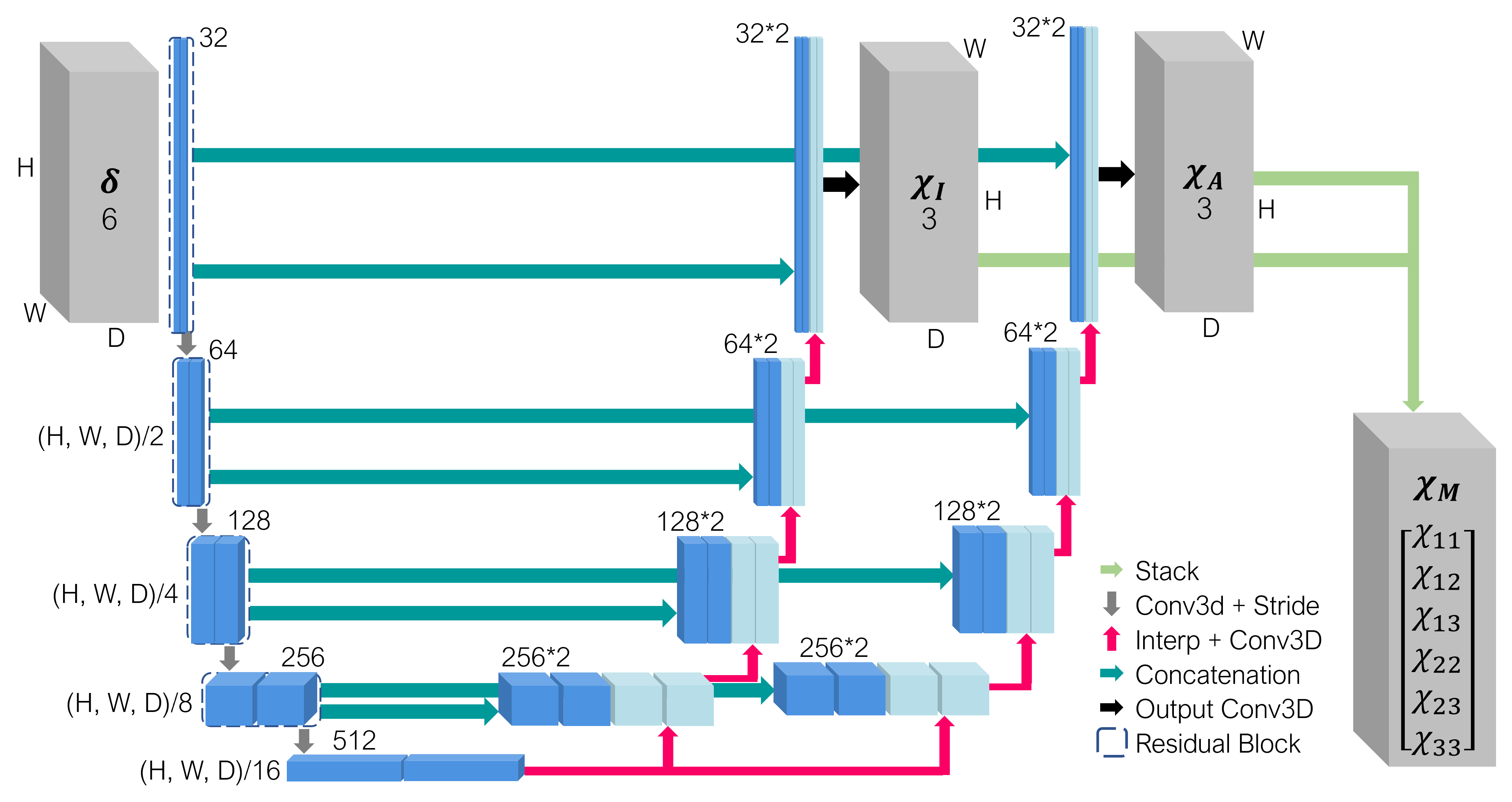
Figure 1. Architecture of STI-net. The encoder path is made by residual units, consisting of a series of 3D convolutional layers with stride 2x2x2, batch normalization and Leaky-ReLU. The decoder is divided into an isotropic ($$$\mathbf{\chi_I}$$$) and an anisotropic ($$$\mathbf{\chi_A}$$$) path, consisting of 3D convolutional, batch normalization, Leaky-ReLU layers, and an interpolation and 3D convolutional layer to increase the dimension of the image. Finally, both decoders were stacked to reconstruct the susceptibility tensor.
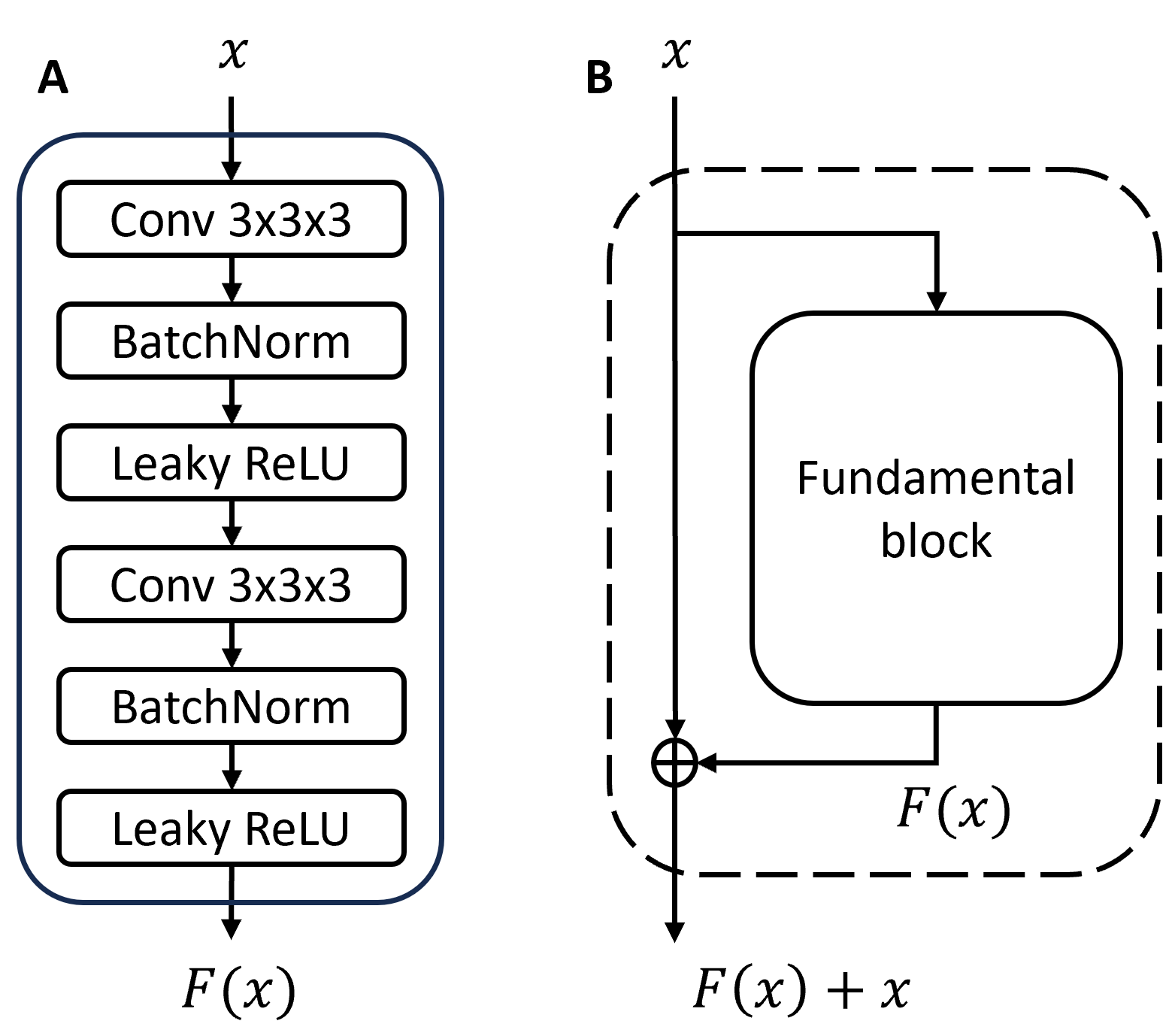
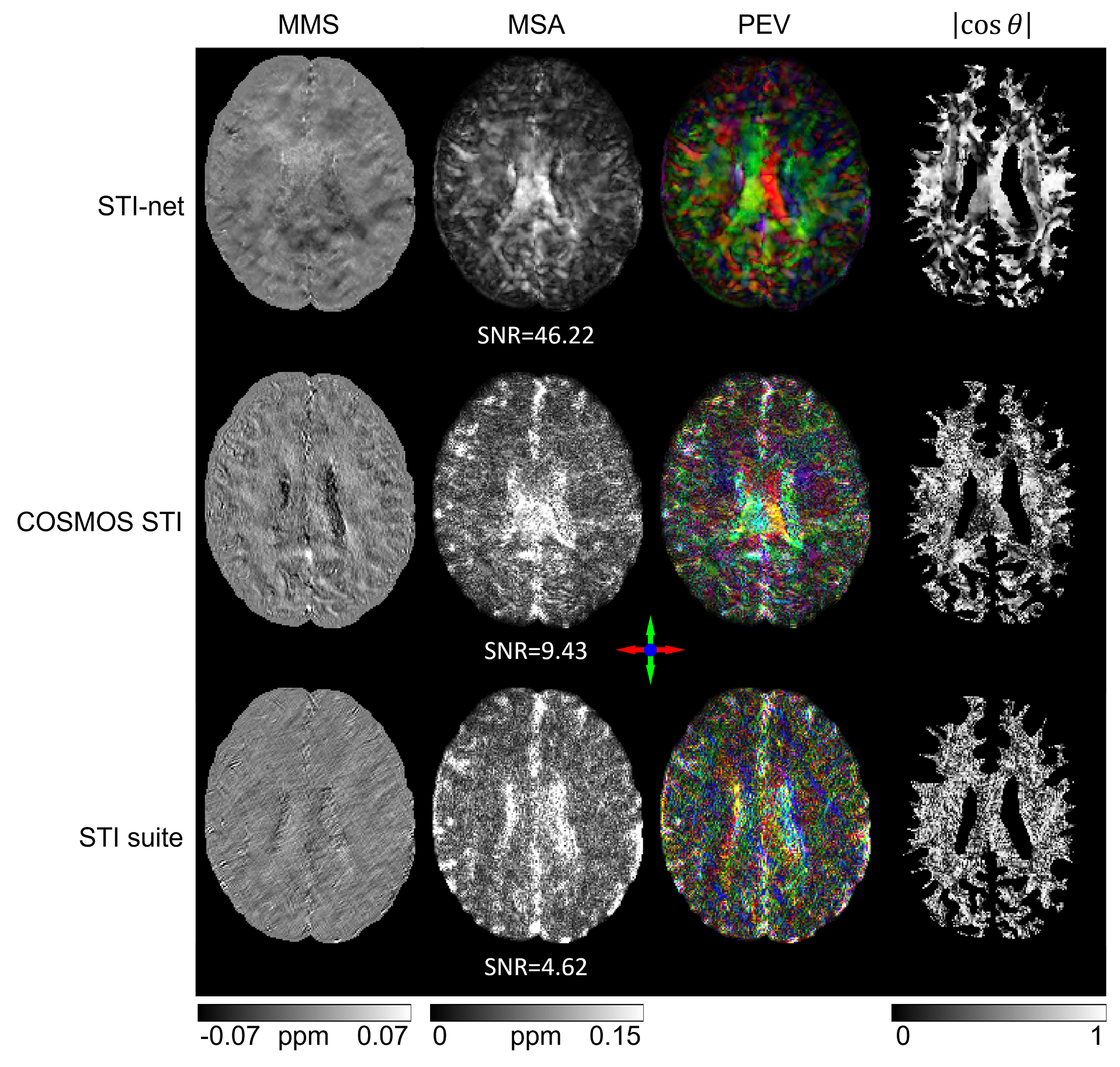
Figure 3. Susceptibility Tensor reconstructed from in-vivo data using the STI-net (first row), COSMOS STI (second row) and STI suite (third column), at the corpus callosum. The reconstructed MMS, MSA and PEV appears in the first, second and third column respectively. The fourth column shows the degree of alignment with the DTI PEV. Finally, the SNR presented was calculated in the MSA.