2595
Self-supervised learning with motion correction for fitting IVIM model parameters1School of Medical Information Engineering, Guangzhou University of Chinese Medicine, Guangzhou, China, 2Department of Medical Imaging Center, Nanfang Hospital, Southern Medical University, Guangzhou, China
Synopsis
Keywords: IVIM, Motion Correction
Motivation: The existing fitting methods of lntravoxel incoherent motion (IVI M) parameter maps can already achieve good performance, but they all ignore the impact of internal heart beat or breathing movements on multiple b-value images for the fitting performance.
Goal(s): We expect to incorporate motion correction in the fitting process to improve fitting performance.
Approach: In this study, we propose an end-to-end deep network structure that combines self-supervised learning and motion correction for fitting IVIM parameters.
Results: The quantitative and qualitative comparative experimental results indicate that using self-supervised motion correction can improve the fitting performance.
Impact: For the first time, we consider incorporating motion correction into IVIM parameter fitting, and the self-supervised and end-to-end network design does not require training data, which can be extended to clinical applications.
Introduction
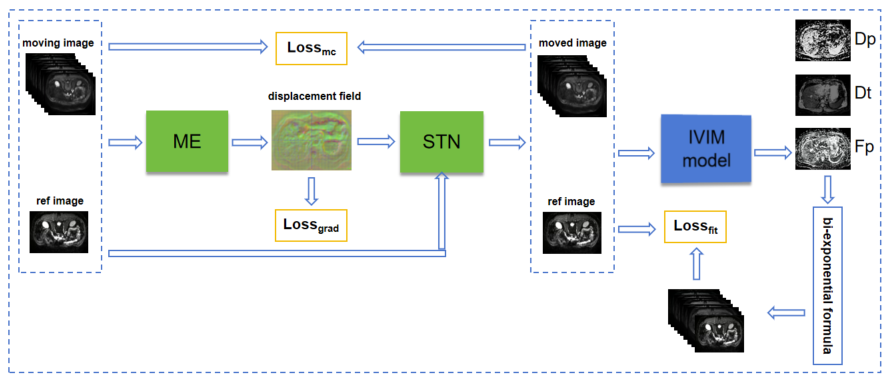
lntravoxel incoherent motion (IVIM) is a type of diffusion weighted imaging (DWI), and the parameters of the IVIM model (water molecule diffusion rate Dt, pseudo diffusion coefficient Dp, and tissue perfusion fraction Fp) have been widely used for the diagnosis and characterization of malignant lesions. However, during the process of scanning clinical b-value maps, there is movement deviation between different b-value images due to the patient's breathing or internal heartbeat. The current fitting method based on artificial neural networks1, or fully supervised and self-supervised fitting methods based on deep learning2-4, have not taken into account the motion impact between DWI images with different b values. In this study, we propose a self-supervised fitting deep network that integrates motion correction processes. By self-supervised registration of b-value images to eliminate motion artifact and self-supervised generation of IVIM parameter maps, our method achieves better performance compared to existing methods.Materials and Methods
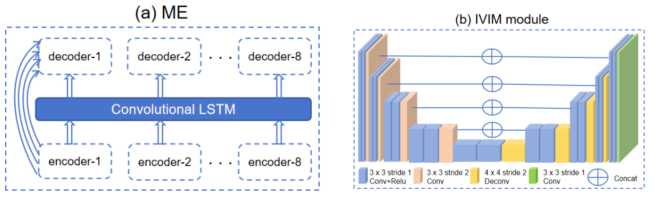
117 consecutive patients diagnosed with hepatocellular carcinoma (HCC) between January 2017 and September 2020 were included in the study, and routine IVIM–DWI serial examinations were performed using a 3.0 T magnetic resonance imaging system (Achieva, Philips Healthcare, the Netherlands) in preoperative MR imaging. An IVIM–DWI sequence was performed in the axial plane (TR/TE = 1973/57, 132 × 114 matrix, 5 mm slice thickness, FOV = 375 mm × 302 mm × 176 mm, slice gap = 0.5 mm, slices = 32, NSA = 2). IVIM–DWI employs respirator triggered single-shot echo planar imaging (EPI, EPI factor = 53). Axial DWI was performed with nine b-values (b = 0, 10, 20, 40, 80, 200, 400, 600, and 1000 s/mm2). Figure 1 shows the proposed network, which uses a concatenation structure to combine motion correction and IVIM fitting. To process multi-frame spatio-temporal data, the motion estimation module is a multi-frame 3-D U-net with shared weights and a convolutional long short-term memory layer integrated on the bottleneck6(Figure2(a)). The IVIM fitting model is a structure similar to 2-D U-net7(Figure2(b)).The motion compensation frame output by the motion correction module is processed into a two-dimensional image with 9 channels, and one channel for each b value is used as the input of the IVIM fitting module. The losses from motion correction and IVIM fitting are added with different weights and summed for optimization. Since there is no gold standard for parametric maps for real patient, structural similarity (SSIM) and normalized root mean square error (nRMSE) and the number of outliers in the region of interest(ROI) of HCC were calculated the performance of the proposed method, as well as other compared methods.Result
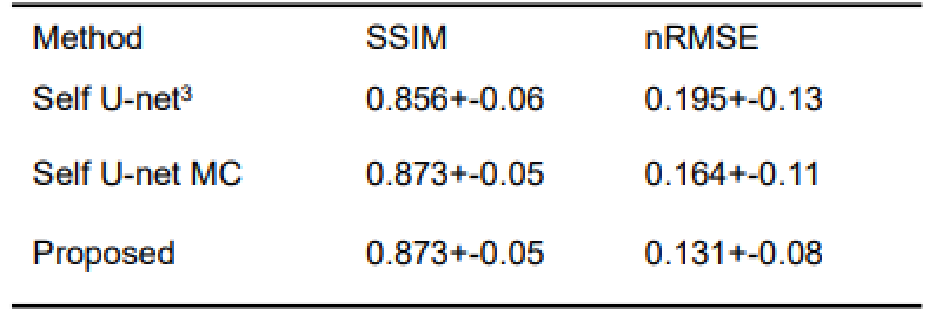
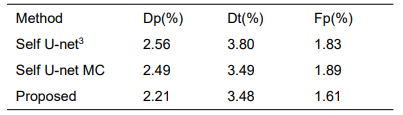
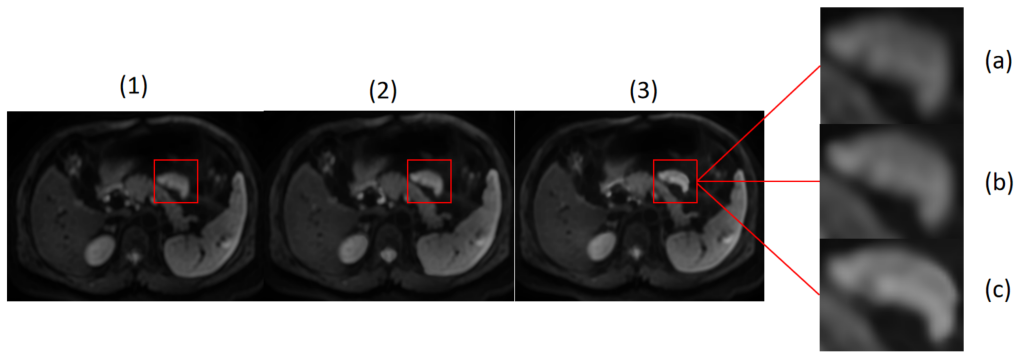
Table 1 shows the comparison of IVIM fitting performance of different methods. The performance of the pure self-supervised3 method is the worst, and the performance of the method of motion correction followed by self-supervised fitting is improved. When the motion correction and fitting of the series structure are performed, the performance of fitting reaches the best. Table 2 indicates that the parametric maps generated by the proposed method achieve the lowest number of outliers in ROI of HCC, Which further indicates that motion correction leads to a better fit. Figure 3 shows the superposition of sample dynamic frames, the corrected dynamic frames are more aligned than the original dynamic frame superposition, and the dynamic frame superposition effect is optimal after the correction module of the proposed method.Discussion
Our study reveals that motion correction between IVIM b-value maps can greatly improve the fitting performance, indicating that the two tasks of motion correction and fitting of the series can be promoted by each other. This is not considered in the previous studies1-4, but the influence of motion correction on the performance of different parameters fitting has been considered in other clinical occasions such as MCP-NET5. Furthermore, the proposed network implements both the fitting function and the motion correction function, both in an unsupervised or self-supervised manner. Training samples are not required, which greatly facilitates the application of this model in clinical practice. It is worthwhile to note that the our motion correction module can also be extended to other fully-supervised learning fitting methods1-2 and traditional least squares fitting methods8, thereby improving the performance of other fitting methods. Our future work will consider fusing models of tumor characterization in the current network while enabling motion correction, parameter fitting, and tumor diagnosis.Conclusion
In this work, we proposed a self-supervised learning with motion correction for fitting IVIM parameters. Experimental results demonstrate that Motion correction of b-value maps prior to IVIM fitting can significantly improve the fitting performance.Acknowledgements
The authors thanks the Department of Medical Imaging Center, Nanfang Hospital, Southern Medical University for providing clinical support for this study.References
1. Bertleff M, Domsch S, Weingärtner S, et al. Diffusion parameter mapping with the combined intravoxel incoherent motion and kurtosis model using artificial neural networks at 3 T. NMR Biomed. 2017;30:e3833.
2. Kaandorp M P T, Barbieri S, Klaassen R, et al. Improved unsupervised physics‐informed deep learning for intravoxel incoherent motion modeling and evaluation in pancreatic cancer patients[J]. Magnetic resonance in medicine, 2021, 86(4): 2250-2265.
3. Vasylechko S D, Warfield S K, Afacan O, et al. Self‐supervised IVIM DWI parameter estimation with a physics based forward model[J]. Magnetic resonance in medicine, 2022, 87(2): 904-914.
4. Huang H, Liu B, Xu Y, et al. Synthetic‐to‐real domain adaptation with deep learning for fitting the intravoxel incoherent motion model of diffusion‐weighted imaging[J]. Medical Physics, 2023, 50(3): 1614-1622.
5. Guo X, Zhou B, Chen X, et al. Mcp-net: Inter-frame motion correction with patlak regularization for whole-body dynamic pet[C]//International Conference on Medical Image Computing and Computer-Assisted Intervention. Cham: Springer Nature Switzerland, 2022: 163-172.
6. Guo X, Zhou B, Pigg D, et al. Unsupervised inter-frame motion correction for whole-body dynamic PET using convolutional long short-term memory in a convolutional neural network[J]. Medical Image Analysis, 2022, 80: 102524.
7. Ronneberger O, Fischer P, Brox T. U-net: Convolutional networks for biomedical image segmentation[C]//Medical Image Computing and Computer-Assisted Intervention–MICCAI 2015: 18th International Conference, Munich, Germany, October 5-9, 2015, Proceedings, Part III 18. Springer International Publishing, 2015: 234-241.
8.Wang He, Zhang Su, Lin N, et al. Intravoxel incoherent motion diffusion-weighted MR imaging of breast cancer at 3.0 tesla: comparison of different curve-fitting methods. J Magn Reson Imaging: JMRI. 2015;42:362-370.
Figures