2518
Piloting individualised probabilistic tractography to measure motor system integrity and rehabilitation potential in cerebral palsy1Wellcome Centre for Integrative Neuroimaging, Nuffield Department of Clinical Neurosciences, University Of Oxford, Oxford, United Kingdom, 2Movement Science Group, Oxford Brookes University, Oxford, United Kingdom, 3Oxford University Hospitals NHS Foundation Trust, Oxford, United Kingdom, 4Department of Health Sciences, Brunel University London, London, United Kingdom, 5Nuffield Department of Orthopaedics, Rheumatology and Musculoskeletal Science, University Of Oxford, Oxford, United Kingdom, 6Department of Rehabilitation, Jönköping University, Jönköping, Sweden, 7School of Sport, Exercise and Rehabilitation Sciences, University of Birmingham, Birmingham, United Kingdom, 8Department of Epidemiology and Public Health Medicine, Royal College of Surgeons in Ireland, Dublin, Ireland, 9National Institute for Health Research Exeter Biomedical Research Centre, University of Exeter, Exeter, United Kingdom
Synopsis
Keywords: Neuro, Diffusion Tensor Imaging, Cerebral palsy
Motivation: A biomarker of motor system function is needed to assist with treatment selection for children with cerebral palsy (CP).
Goal(s): We aimed to pilot an automated tractography tool in a clinical trial cohort of adolescents with CP, and determine if corticospinal tract (CST) integrity could be used as a biomarker for baseline function and treatment response.
Approach: A customised probabilistic tractography pipeline was used to quantify CST integrity. Hand function was assessed at baseline and after a motor training intervention.
Results: We demonstrated feasibility, and found that CST integrity was positively correlated with baseline hand function, and negatively correlated with improvement after training.
Impact: Automated individualised native-space tractography is feasible in a clinical population of adolescents with cerebral palsy. Tractography-derived corticospinal tract integrity predicts baseline hand function impairment and may be useful as a predictive biomarker for rehabilitation response.
Introduction
Cerebral Palsy (CP) is a heterogenous condition, defined not by underlying pathology, but through shared clinical features: motor impairment due to an insult to the developing brain1,2.An unmet need in CP research and clinical practice is a robust, reproducible, and generalisable biomarker of underlying brain motor system integrity across disease subtypes. An effective biomarker would predict functional impairment at baseline, as well as response to therapeutic interventions. One promising candidate is diffusion tensor imaging, which is shown to usefully predict impairment and treatment response in adult stroke3,4. Applying tractography in this population has been historically challenging due to protocol and analytic variability, and the challenge of reproducibly generating reliable tracts in brains with structural lesions.
In this study, we piloted the use of an automated native-space tractography tool in a clinical trial cohort of adolescents with CP. We then correlated individualised metrics from a key motor system tract to baseline motor function and treatment response.
Methods
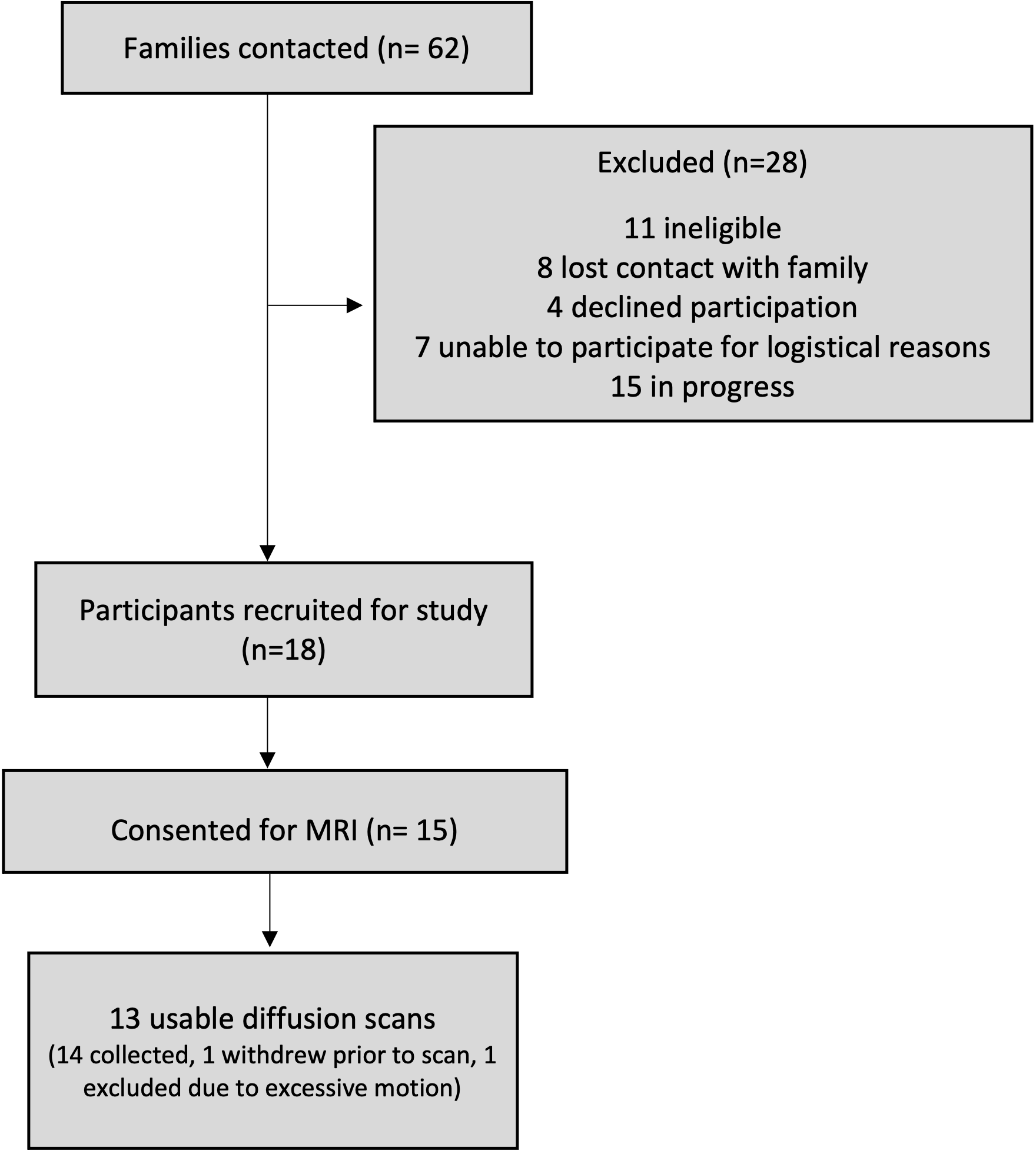
As part of an ongoing clinical trial (ISRCTN74235136), participants with a clinical diagnosis of CP, aged 10-16 years were recruited. Hand function, measured by the Jebsen-Taylor Test (JTT ), and a baseline MRI, were collected. Participants received 10 sessions of upper- and lower-limb motor training, combined with brain stimulation or sham.MRI data were acquired in a single scanning session, using a 32-channel head coil in 3.0-T Prisma Magnetom scanners (Siemens Medical Systems, Germany).
Diffusion-weighted echo-planar imaging scans (TR=2483ms/TE=78.20ms/FOV=214mm3/voxel size= 1.8mm isotropic/multiband factor of 4) were collected for two b-values (1250 and 2500s/mm2), over 120 directions and an additional 15 volumes were acquired at b=0 (11 A-P, 4 P-A).
Image pre-processing and analyses were performed using the FMRIB software library5(FSL version 6.0). Structural T1 images were processed as part of the fsl_anat pipeline and diffusion data were pre-processed using FMRIB’s Diffusion Toolbox.
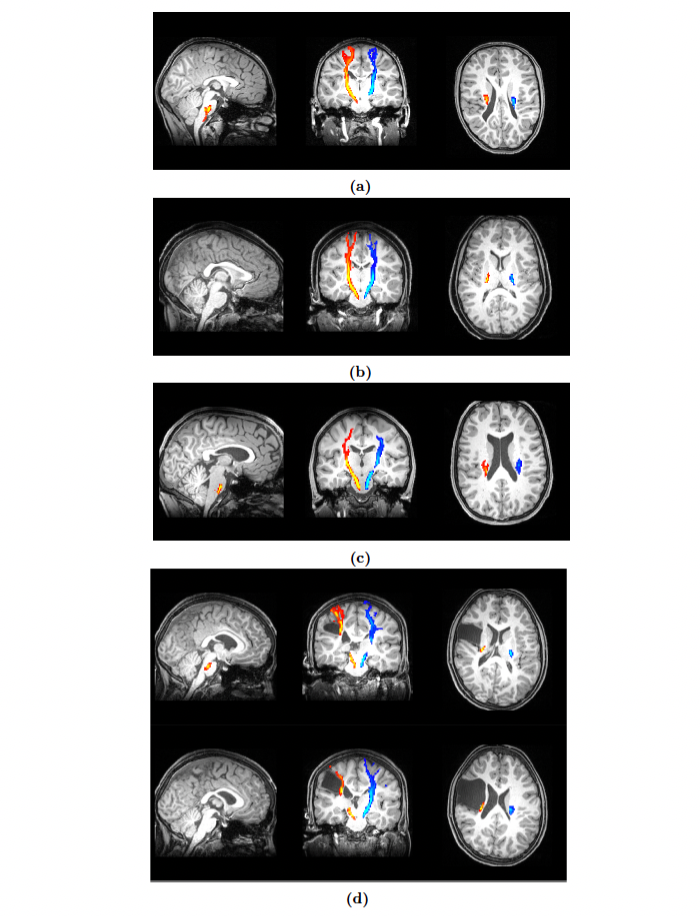
To assess white matter integrity, we selected the corticospinal tract (CST), a key motor system structure that is particularly affected in CP, and performed probabilistic tractography. Analysis was performed in native diffusion space using XTRACT's standard CST protocol which has demonstrated robustness to between-subject structural variation, including lesions in large reference datasets6. Summary statistics (mean FA, tract volume) were generated for the CSTs in each participant, with a threshold of 0.01 applied to the tract probability map.
These metrics of CST integrity were correlated with baseline hand function (JTT) and the percentage change in JTT time at 1-, 6- and 12-weeks post-intervention.
Results
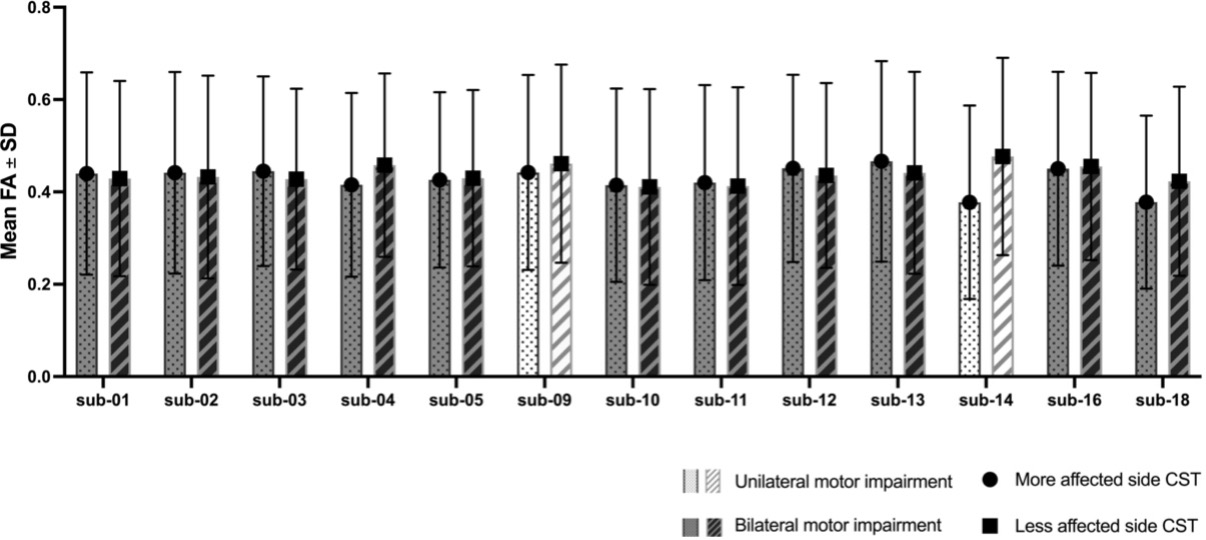
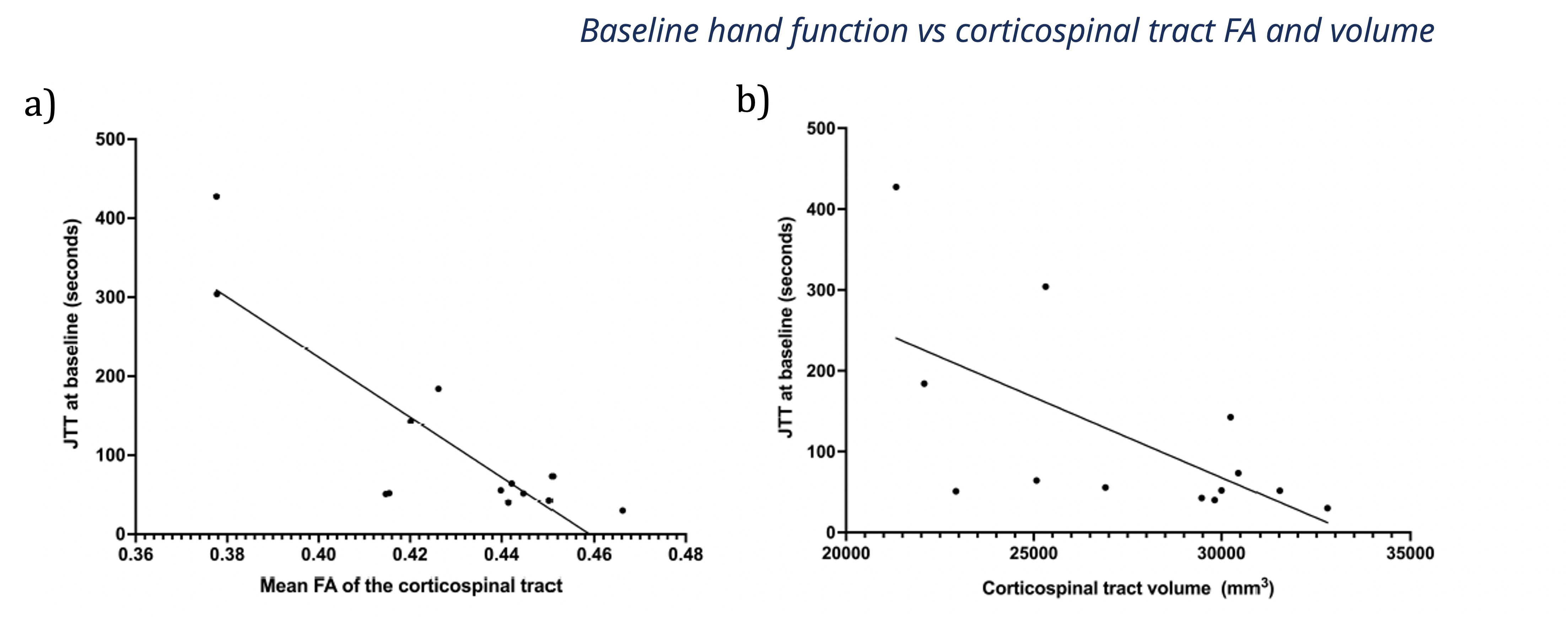
Anatomically plausible tracts were generated in all participant scans that passed initial quality control (n=13, Figure 1), and respected the underlying anatomical variation (Figure 2). Our patient cohort demonstrated less CST asymmetry and variability than expected, despite the range of functional ability and brain pathology within the cohort (Figure 3).Baseline hand function (JTT) was strongly, and statistically significantly, negatively correlated with CST fractional anisotropy (FA) (r(11) = -0.845, p=0.0003) and CST volume (r(11) = -0.6268, p=0.0219), whereby higher CST FA and volume of the contralateral tract was associated with faster performance time (Figure 4).
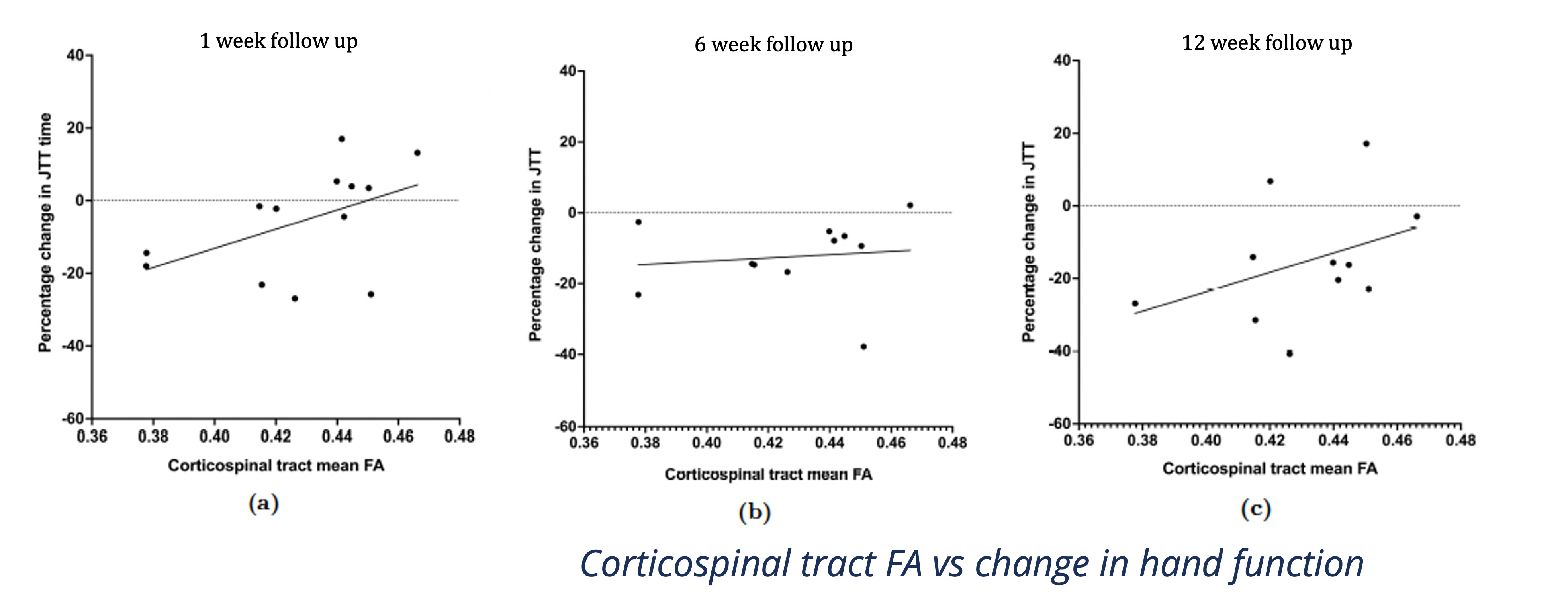
There was a trend towards lower baseline CST FA (Figure 5) in participants with greater improvement in hand function at 1- and 12-weeks post-intervention (not statistically significant).
Discussion
We present a pilot analysis from one of only a few studies evaluating potential biomarkers of motor system integrity in a clinically relevant cohort of CP patients. This work demonstrates the feasibility of automated individualised native-space tractography, generating tracts in a robust and standardised manner, in cerebral palsy patients.We found that lower FA and CST volume correlated with worse contralateral hand function at baseline. Furthermore, patients with lower FA and tract volume tended to show more improvement in their hand function after the trial intervention.
None of our participants had absent CSTs, suggesting greater potential for improvement in patients with some deficit in CST integrity, and possibly a ceiling of improvement in those with near-normal CSTs. This suggests a role for white matter imaging and individualised tractography in assessing motor system integrity in future clinical studies.
Conclusion
We have demonstrated the feasibility of characterising corticospinal tracts in an adolescent CP patient population with heterogeneous pathology, using an automated tractography tool in native space.In our study, CST integrity correlates with baseline motor function, and lower baseline FA may be a predictor of better response to rehabilitation.
As a pilot study, this work is limited by its small sample size. With validation in larger datasets across age and spectrum of disease, this may translate clinically to a useful biomarker for characterising baseline motor system integrity and treatment selection.
Acknowledgements
This research would not have been possible without funding from Action Medical Research and the Chartered Society for Physiotherapy. BG is funded by a Rhodes Scholarship.
Thank you to our patients and their families, to whom we are very grateful.
References
1. Rosenbaum P, Paneth N, Leviton A, Goldstein M, Bax M, Damiano D, Dan B, Jacobsson B. A report: the definition and classification of cerebral palsy April 2006. Dev Med Child Neurol Suppl. 2007 Feb;109:8-14. Erratum in: Dev Med Child Neurol. 2007 Jun;49(6):480. PMID: 17370477.
2. Bax M, Goldstein M, Rosenbaum P, Leviton A, Paneth N, Dan B, Jacobsson B, Damiano D; Executive Committee for the Definition of Cerebral Palsy. Proposed definition and classification of cerebral palsy, April 2005. Dev Med Child Neurol. 2005 Aug;47(8):571-6. doi: 10.1017/s001216220500112x. PMID: 16108461.
3. Cathy M. Stinear, P. Alan Barber, Peter R. Smale, James P. Coxon, Melanie K. Fleming, Winston D. Byblow, Functional potential in chronic stroke patients depends on corticospinal tract integrity, Brain, Volume 130, Issue 1, January 2007, Pages 170–180, https://doi.org/10.1093/brain/awl333
4. Zheng X, Schlaug G. Structural white matter changes in descending motor tracts correlate with improvements in motor impairment after undergoing a treatment course of tDCS and physical therapy. Front Hum Neurosci. 2015 Apr 30;9:229. doi: 10.3389/fnhum.2015.00229. PMID: 25983684; PMCID: PMC4415397.
5. Jenkinson M, Beckmann CF, Behrens TE, Woolrich MW, Smith SM. FSL. Neuroimage. 2012 Aug 15;62(2):782-90. doi: 10.1016/j.neuroimage.2011.09.015. Epub 2011 Sep 16. PMID: 21979382.
6. Warrington S*, Thompson E*, Bastiani M, Dubois J, Baxter L, Slater R, Jbabdi S, Mars RB, Sotiropoulos SN (2022) Concurrent mapping of brain ontogeny and phylogeny within a common space: Standardized tractography and applications. Science Advances, 8(42). DOI: 10.1126/sciadv.abq2022
Figures