2449
A Least Difference Block Sharing (LDBS) Method for Optimizing the View-sharing iblocks-DTI1Department of Biomedical Engineering, The Chinese University of Hong Kong, Shatin, Hong Kong, 2Multi-Scale Medical Robotics Center, Shatin, Hong Kong, 3Graduate Institute of Biomedical Electronics and Bioinformatics, National Taiwan University, Taipei, Taiwan, 4Department of Biomedical Engineering, University of Arizona, Tucson, AZ, United States, 5Brain Imaging and Analysis Center, Duke University Medical Center, Durham, NC, United States, 6Department of Diagnostic Radiology, The University of Hong Kong, Hong Kong, Hong Kong
Synopsis
Keywords: Diffusion Acquisition, Diffusion Tensor Imaging, multi-shot DTI; data sharing; high-resolution DTI
Motivation: View-sharing iblocks-DTI (VSiblocks-DTI) can substantially reduce the long scan time of iblocks-DTI while providing accurate DTI tensor calculations. However, its neighbor sharing method may limit its performance when using a randomized ordering of diffusion directions or small imaging matrix.
Goal(s): This work aims to optimize the sharing method for VSiblocks-DTI.
Approach: The least difference block sharing (LDBS) method was proposed and evaluated under different conditions.
Results: The proposed LDBS method provided more accurate DTI tensor calculations than the previous neighbor sharing method under six different conditions, demonstrating its robustness to provide accurate DTI tensor calculation for VSiblocks-DTI.
Impact: This study proposes a least difference block sharing (LDBS) method for optimizing view-sharing iblocks-DTI. It alleviates the limitation of previous sharing method on the ordering of diffusion directions and shows robust and accurate DTI tensor calculation with different matrix sizes.
Introduction
Interleaved block-segmented DTI (iblocks-DTI)1 has been recently proposed to achieve high-resolution DTI, with 1) further reduced distortion artifacts and 2) more robust phase variation correction at high magnetic fields or with high b-values than the conventional interleaved DTI. However, iblocks-DTI needs to acquire five patch patterns for covering a complete k-space with increased scan time, making it less practical for clinical use. Hence, view-sharing iblocks-DTI (VSiblocks-DTI)2 was proposed to achieve reasonable scan time by sharing peripheral blocks among neighboring diffusion directions and decreasing the number of required patch patterns. However, VSiblocks-DTI requires a smooth ordering of diffusion directions to maintain the similarity of diffusion contrast among the shared k-space blocks. In previous study, VSiblocks-DTI has only been assessed with a smooth ordering of diffusion directions and a matrix size equal to 128×128. The effects of matrix sizes and orderings of diffusion directions on VSiblocks-DTI performance have not been investigated. In this study, we assess the performance of previously proposed VSiblocks-DTI with different orderings of diffusion-weighted directions and three matrix sizes. Moreover, we propose a novel least difference block sharing (LDBS) method for VSiblocks-DTI, to enable robust VSiblocks-DTI under different conditions.Materials and methods
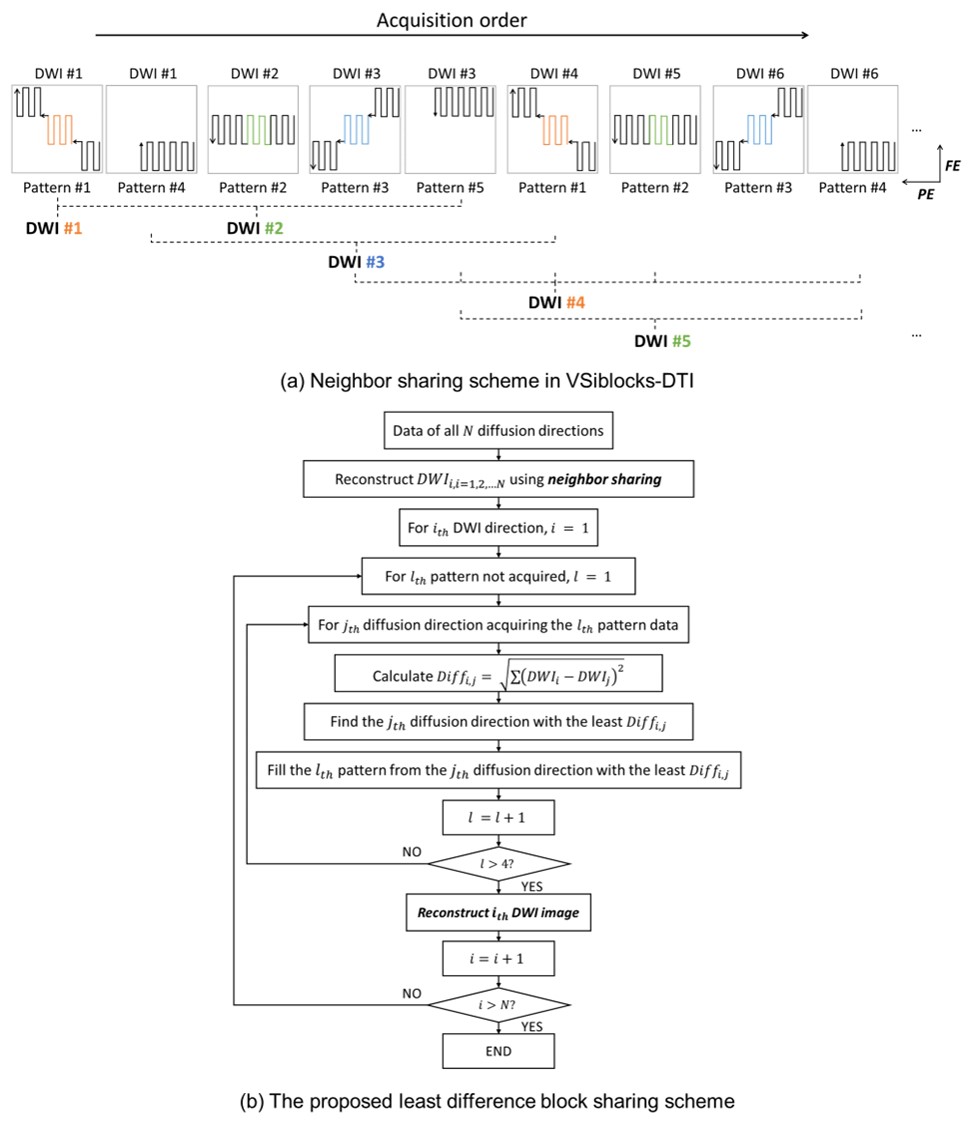
The least difference block sharing (LDBS) scheme for VSiblocks-DTIFigure 1a demonstrates the data acquisition and sharing scheme in the previously proposed VSiblocks-DTI. For the data acquisition, only one target pattern including the central block (pattern #1, #2, or #3) was acquired for each diffusion direction and pattern #4 or #5 was acquired once every three diffusion directions to provide necessary peripheral high-frequency data. Afterward, for each diffusion direction, the unacquired peripheral blocks were filled with patterns from neighboring diffusion directions. This previous sharing method is referred to as neighbor sharing in the following content. In the proposed least difference block sharing (LDBS) scheme (Figure 1b), DWI images were first reconstructed with neighbor sharing for calculating the image difference values in the next step. Then, for each diffusion direction, unacquired peripheral blocks were filled with patterns shared from a diffusion direction providing the least image difference value from the current direction, thereby minimizing the differences between the shared blocks and the desired correct data.
Experiments
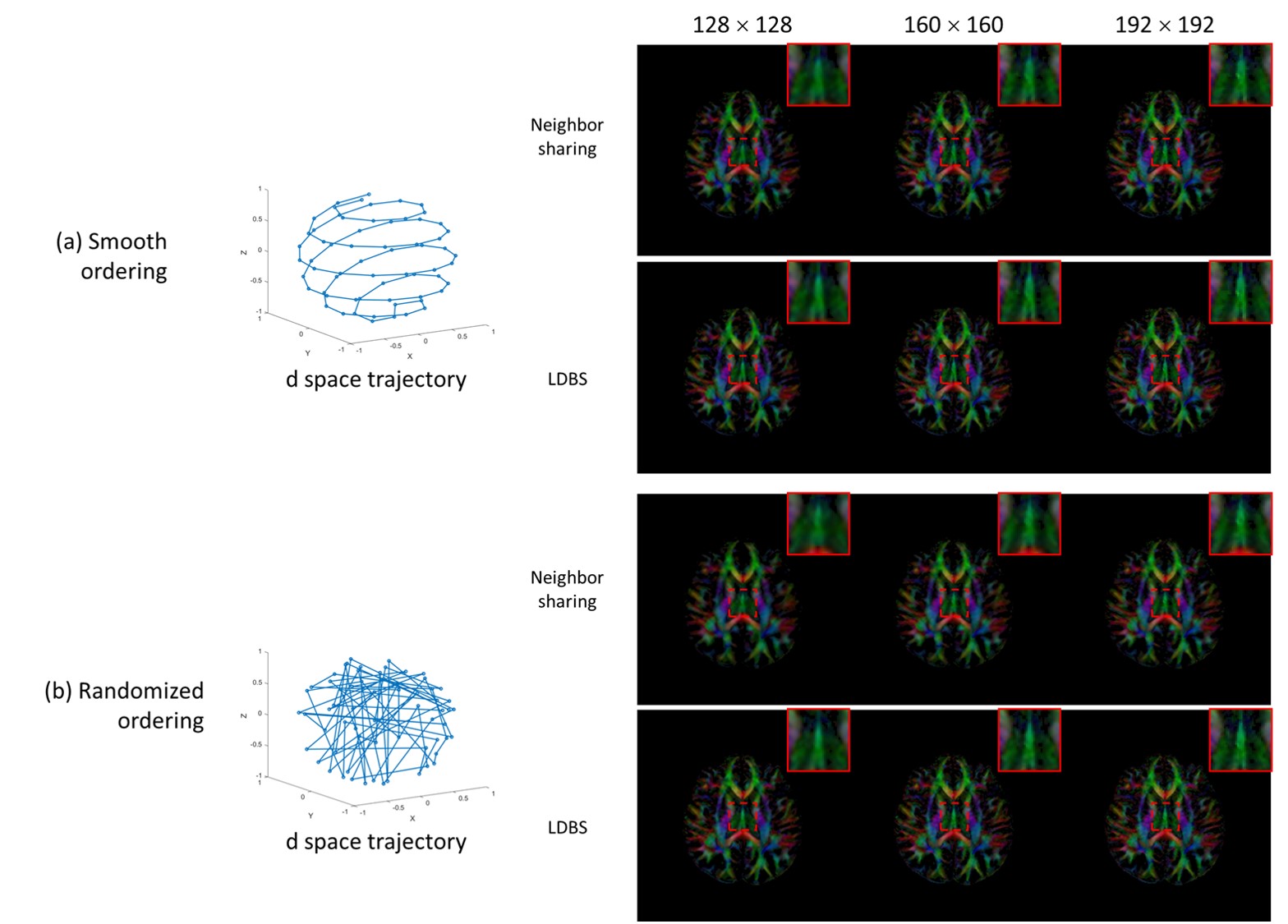
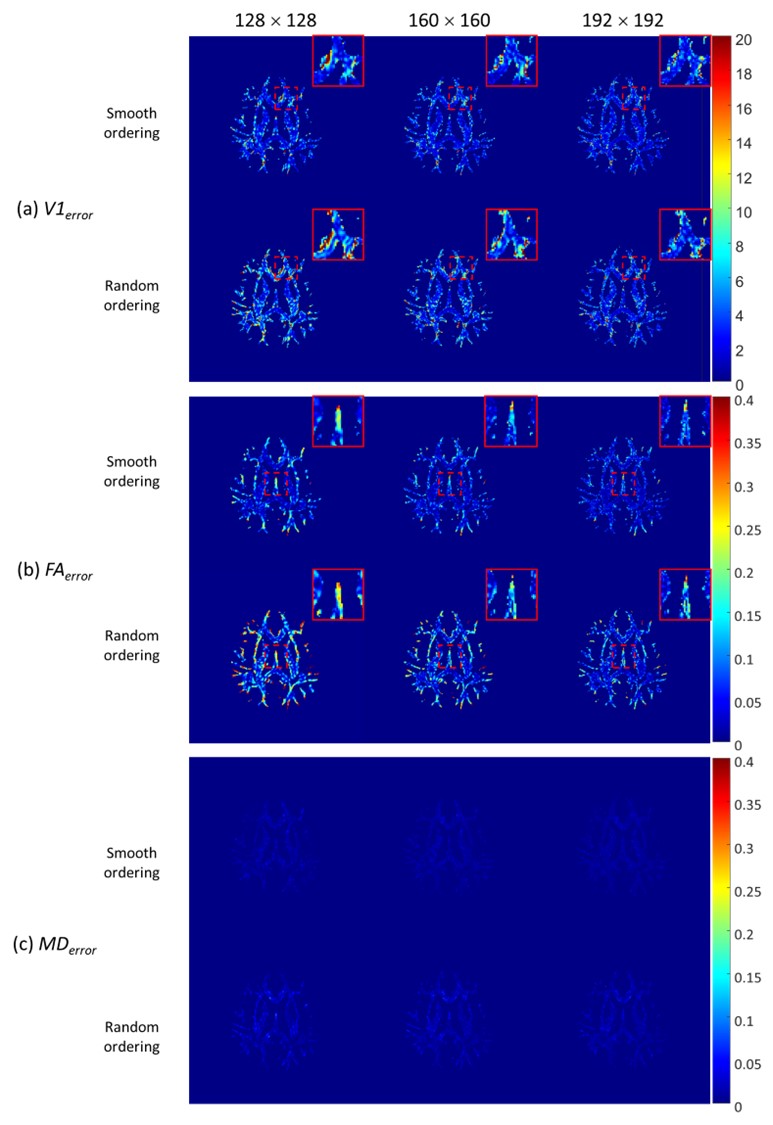
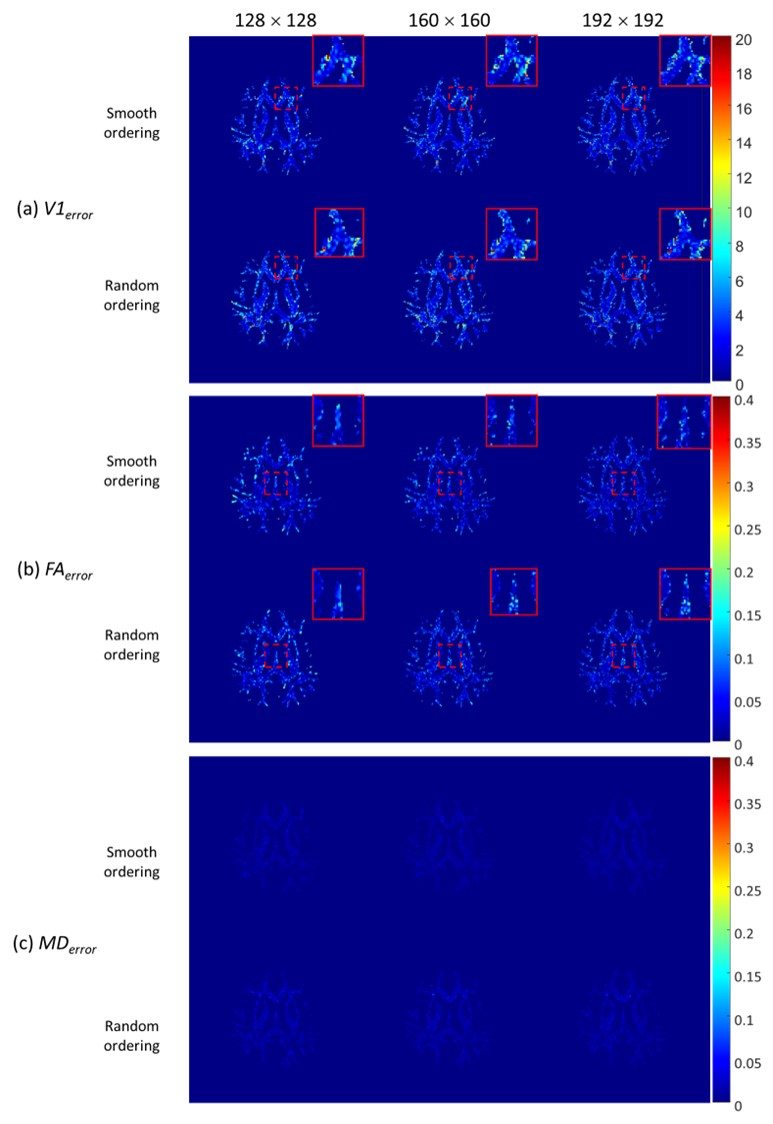
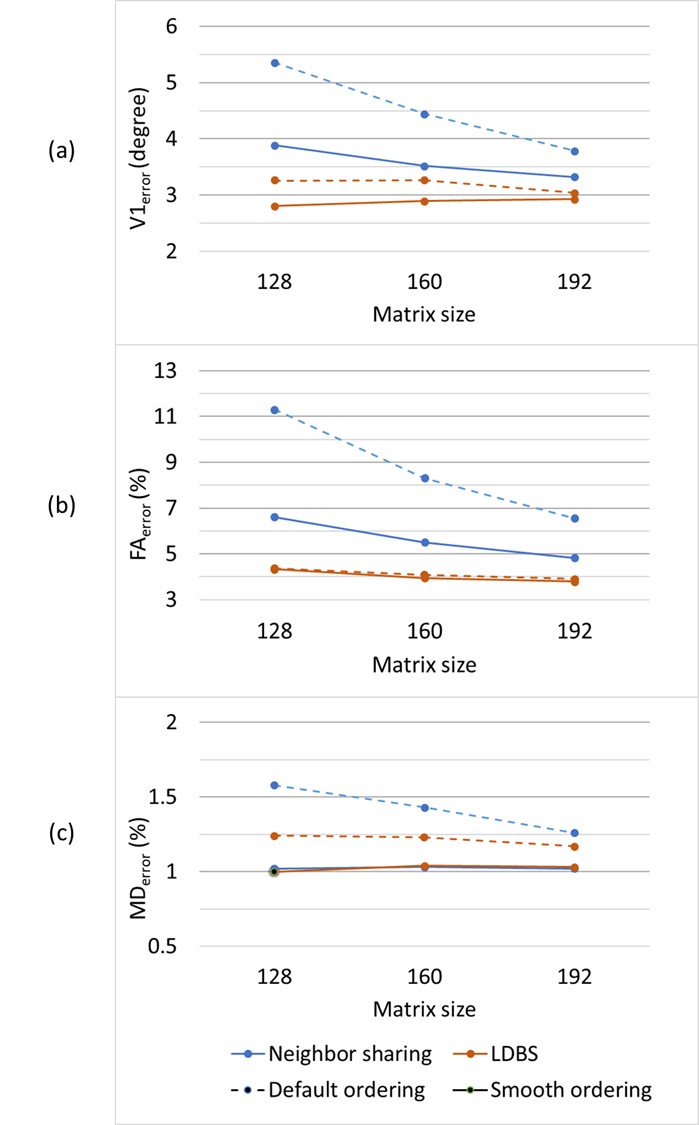
Hybrid simulations were performed to investigate the performance of VS iblocks-DTI with either neighbor sharing or LDBS under different conditions. Firstly, two sets of four-shot interleaved DTI data with 64 diffusion directions were acquired on a 1.5 T MRI scanner using a 19-channel coil with the following scan parameters: TE/TR = 90.5(full-echo)/4000 ms, FOV = 24x24 cm2, matrix size = 192×192, and b-value = 750 s/mm2. One set was acquired with a smooth ordering of diffusion directions3 (Figure 2a) while the other one with a randomized ordering (Figure 2b). Second, central k-space data with 3 different sizes: 1) 128×128, 2) 160×160, and 3) 192×192 were obtained from these data to simulate the data acquired with different matrix sizes. MUSE4 reconstruction results of respective four-shot interleaved data served as the gold standard for calculating DTI tensor. Afterward, 6 sets of VS iblocks-DTI data (three different matrix sizes and two different orderings of diffusion directions) were generated and reconstructed by POCSMUSE5. DTI tensor calculations from neighbor sharing and LDBS were quantitatively evaluated with three error indexes: 1) angular deviation of the principal eigenvector V1error, 2) percentage fractional anisotropy deviation FAerror, and 3) percentage mean diffusivity deviation MDerror.
Results and Discussion
First, colored FA maps, quantitative tensor error maps and values in Figures 2, 3, 4, and 5 showed that LDBS provided better DTI fiber visualization and smaller quantitative tensor errors than neighbor sharing under all six different conditions. Second, results in Figures 2, 3, and 5 demonstrated that the DTI tensors produced by neighbor sharing possessed larger errors with smaller matrix sizes, suggesting that the reduced size of central blocks could affect reconstruction performances. Furthermore, for neighbor sharing results, tensor calculations with a randomized ordering of diffusion directions showed larger errors than those with a smooth ordering. Therefore, both matrix sizes and the ordering of diffusion directions could reduce the performance of VSiblocks-DWI with neighbor sharing. In comparison, with LDBS, tensor calculation errors under all six different conditions were very subtle (V1error < 3.27 degrees; FAerror < 4.37%; MDerror < 1.24%), and no obvious differences in tensor errors among the six different conditions were observed (maximum difference in V1error: 0.46 degrees; FAerror: 0.58%; MDerror: 0.24%). Thus, we conclude that the proposed LDBS is a robust sharing method for VSiblocks-DTI to provide accurate DTI tensor calculation, therefore benefiting further applications of VSiblocks-DTI and the development of high-resolution DTI techniques.Acknowledgements
The work was in part supported by grants from Hong Kong Research Grant Council (GRF17106820, GRF17125321, GRF14206723, and ECS24213522).References
1. Chang H-C, Chu M-L, Sundman M, Chen N-K. High-Quality and Self-Navigated Diffusion-Weighted Imaging Enabled by a Novel Interleaved Block-Segmented (iblocks) EPI. In: International Society for Magnetic Resonance in Medicine, 23rd Annual Meeting, Toronto, Ontario, Canada
2. Liang L, Chu M-L, Chen N-K, Chang H-C. A Time-Saving View-Sharing Interleaved Block-Segmented Diffusion-Tensor Imaging (VSiblocks-DTI). In: International Society for Magnetic Resonance in Medicine, 2023 Annual Meeting, Toronto, Ontario, Canada
3. Chao, T., Chiou, J. G., Maier, S. E. & Madore, B. Fast diffusion imaging with high angular resolution. Magn. Reson. Med. 77, 696–706 (2017).
4. Chen, N. kuei, Guidon, A., Chang, H. C. & Song, A. W. A robust multi-shot scan strategy for high-resolution diffusion weighted MRI enabled by multiplexed sensitivity-encoding (MUSE). Neuroimage 72, 41–47 (2013).
5. Chu, M. L. et al. POCS-based reconstruction of multiplexed sensitivity encoded MRI (POCSMUSE): A general algorithm for reducing motion-related artifacts. Magn. Reson. Med. 74, 1336–1348 (2015).
Figures