2447
Low-rank Constrained Reacquired-navigator reconstruction of multi-shot diffusion weighted image1Medical Imaging Center, Department of Electronic Engineering and Information Science, University of Science and Technology of China, Hefei, China
Synopsis
Keywords: Diffusion Reconstruction, Diffusion/other diffusion imaging techniques, Low-rank, Phase correction,Reacquired-navigator
Motivation: Multi-Shot Diffusion-Weighted Imaging (MS-DWI) requires additional phase correction data and parallel imaging prescans to respectively suppress artifacts caused by positive-negative readout gradient and motion-induced phase variation.
Goal(s): Our objective is to mitigate two common artifacts without the need for additional linear-phase corrections and parallel imaging prescans.
Approach: We propose subtle modifications to the dual spin-echo DW sequence 1, where positive and negative gradients are employed to separately acquire complete navigator-echo data for low-rank constrained reconstruction.
Results: Simulation studies and in vivo brain imaging experiments demonstrate that the proposed method effectively mitigates image artifacts caused by phase variations, resulting in better image quality.
Impact: This paper presents a novel artifact correction method applied to spin-echo DW sequence, offering an effective prescan-free acquisition and reconstruction strategy that mitigates the impact of prescan data mismatch and additional prescan time consumption.
Introduction
MSDWI uses multi-shot acquisitions to fill the k-space batch and reduce the echo train length, which is essential for high-resolution imaging and mitigating image blurring. However, there are two significant challenges. Firstly, it leads to more severe artifacts due to a mismatch between positive and negative echoes 2. Secondly, even minimal non-rigid motions can introduce phase differences between different shots, resulting in prominent image artifacts 3-4. The low-rank constrained technique has demonstrated considerable success in suppressing these artifacts in magnetic resonance reconstruction tasks 5-9. By transforming the causes of artifacts into the problem of annihilating low-rank matrices, a convex optimization problem is then formulated and solved using the iterative optimization algorithm. In this work, we unify the mismatch between positive-negative echoes, as well as motion-induced phase variation, into a cohesive optimization problem. By incorporating low-rank constraints, we apply this unified framework to MSDWI reconstruction.Theory
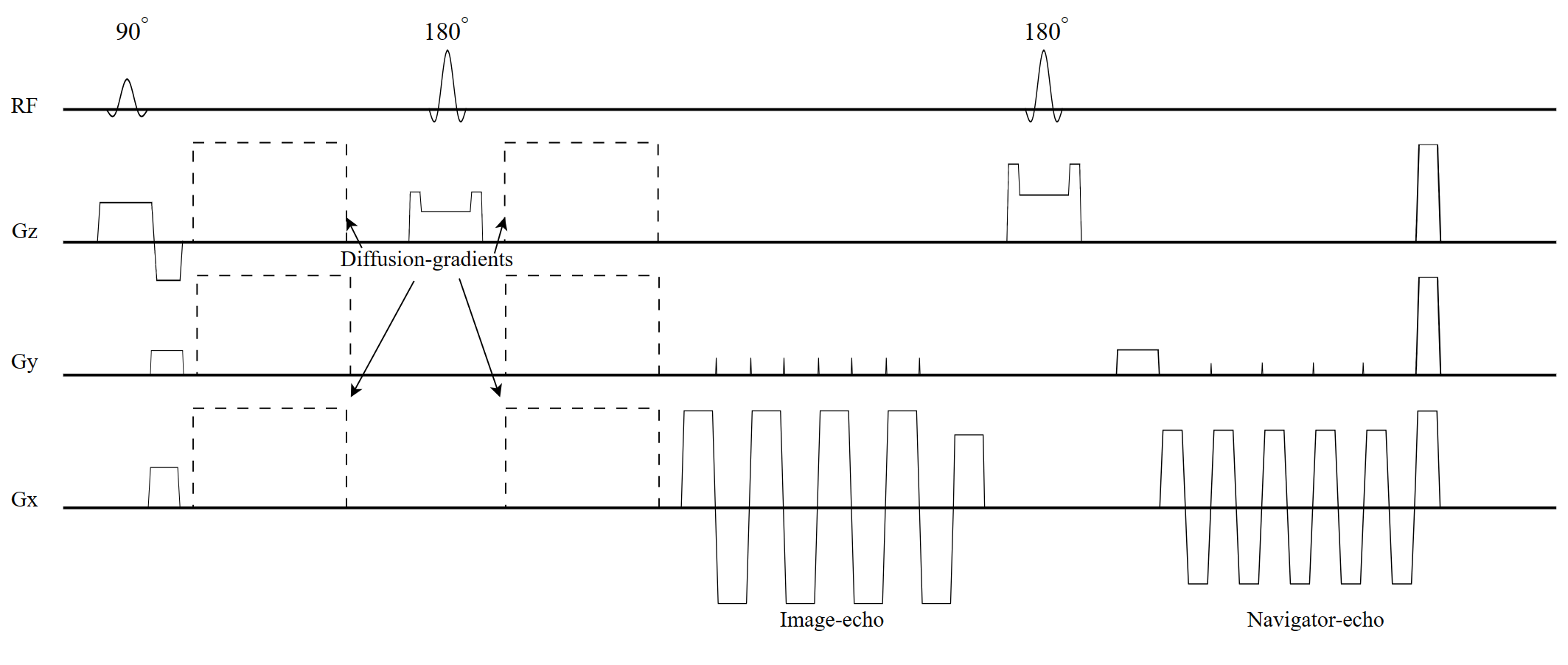
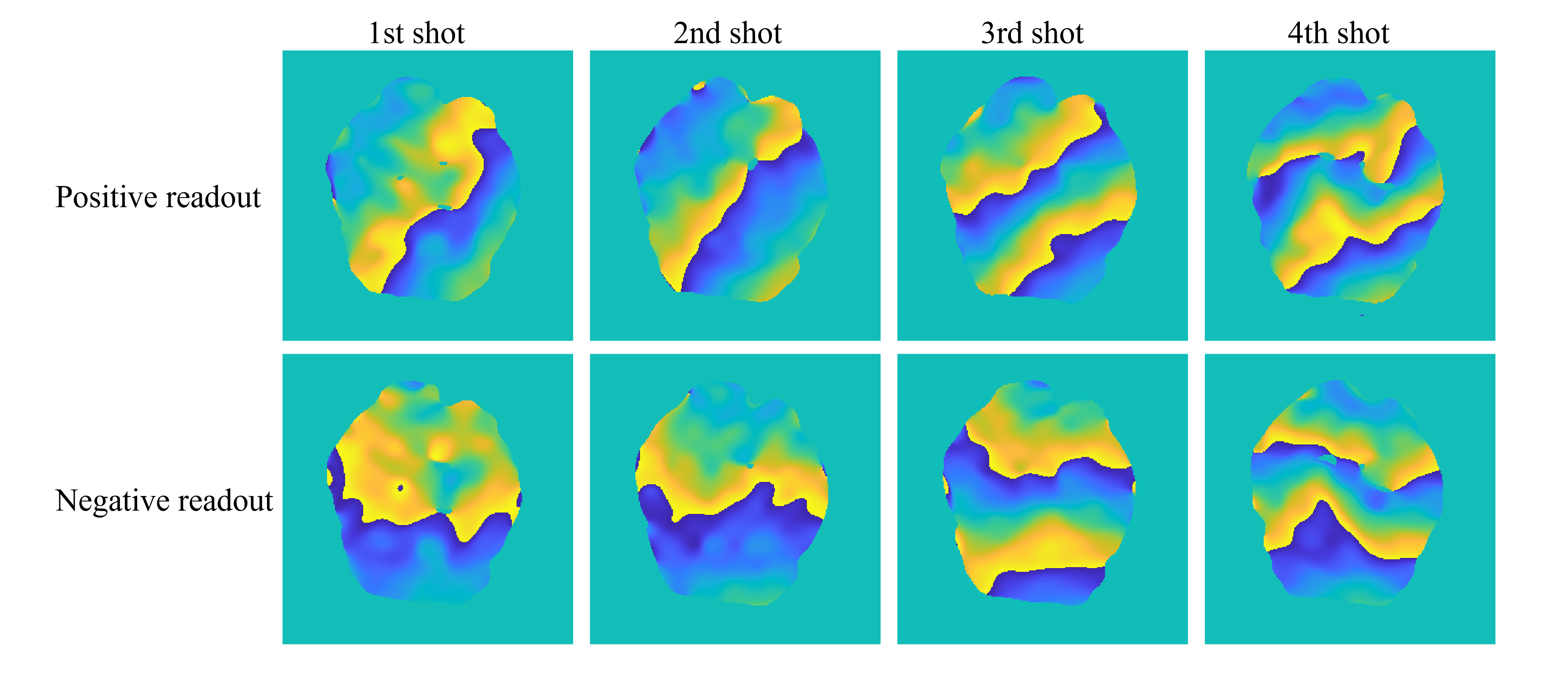
Pulse designSingle-shot DWI (SS-DWI) has an exceptionally rapid acquisition speed. Following the acquisition of imaging echo, navigator-echo is collected using SSDWI, which has similar motion-induced phase variations as imaging echo 10. Several reconstruction methods based on navigator-echo have already been applied in MSDWI research to rectify phase discrepancies 11-14. Fig. 1 illustrates subtle modifications in the dual spin-echo DWI sequence, where two complete navigator-echo data (k+ and k-) are acquired during each phase-encoding step using positive and negative gradients, respectively. Fig. 2 demonstrates that, within each acquisition shot, k+ and k- encompass phase errors induced by gradients, while in different shots the same polarity navigator-echo exhibits varying motion-induced phase errors. This navigator-echo can be concurrently employed to rectify the two primary sources of phase errors in MSDWI.
Low-rank Constraints for MSDWI Reconstruction
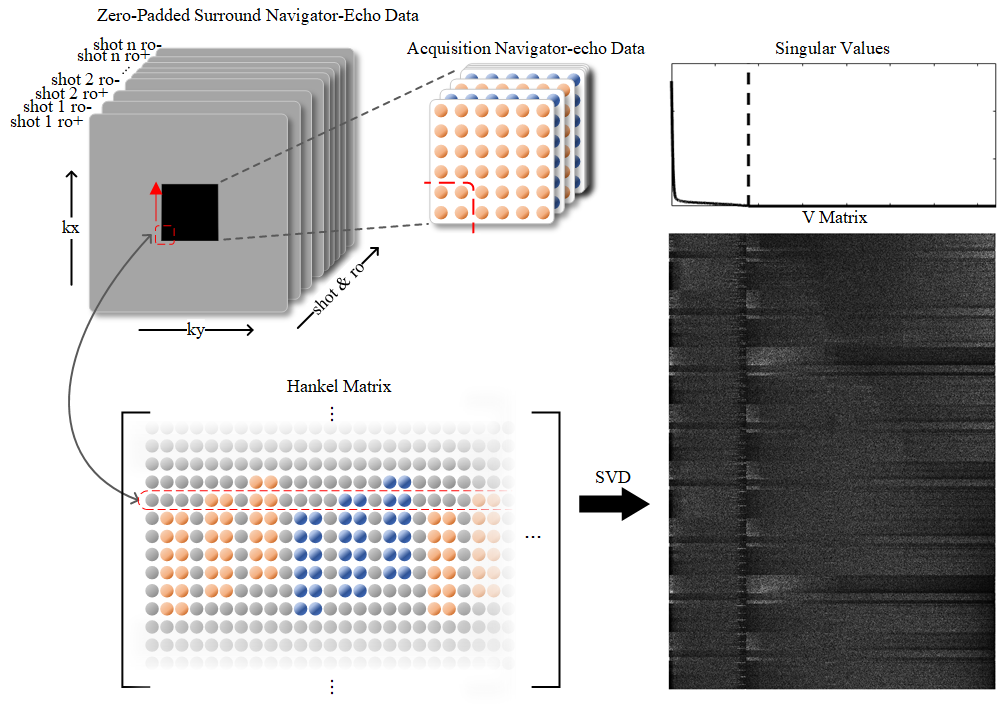
The problem of artifact removal can be reformulated as a uniform under-sampling reconstruction. Some methods have incorporated parallel imaging techniques into MSDWI reconstruction 12-13,15-16 or combined with low-rank constraints 6-7,9,17 to achieve improved image quality. In this study, we partition each echo into shots ro+ and ro-. Subsequently, we treat these separated undersampled data as a new virtual channel dimension. Considering the added complexity of ro+ and ro- echo separation exacerbating the undersampling challenge, we stack the navigator-echo into the virtual channel for the estimation of null space, as depicted in Fig 3. Finally, we formulate the following optimization problem.
$$\hat{s}=\mathop{argmin}\limits_{s}\frac{1}{2}\mid\mid\mathcal{P}s-d\mid\mid_{2}^2+\lambda\mid\mid\mathcal{H}sV_{null}\mid\mid_{F}^2,$$
Where $$$\mathcal{H}$$$ is an operator that converts $$$s$$$ into the Hankel matrix, $$$\mathcal{P}$$$ is the sampling operator, $$$V_{null}$$$ is the basis for the null space of the Hankel matrix, and $$$\lambda$$$ is the regularization parameter for the low-rank constraint.
Methods
Data acquisitionWe generated 4-shot images by applying smooth phase variations to a $$$192\times192$$$ digital brain phantom 18. Subsequently, we transformed them into hybrid (x-ky) space, and introducing phase offsets in the frequency-encoding direction, and then added Gaussian noise (expectation $$$\mu=0$$$, standard deviation $$$\sigma=0.01$$$) in k-space. Additionally, navigator-echo data were acquired from the central k-space data with same expectation but higher standard deviation Gaussian noise.
To evaluate the effect in in-vivo imaging, two volunteers‘ brains were scanned on 1.5 Tesla Climber148 system (supported by Anhui Fuqing Medical Technology Company) using 16-channel head receive-only coil with 4 shots. Acquired matrix=$$$168\times168$$$, FOV (field-of-view)=$$$230\times230mm^2$$$, in-plane resolution=$$$1.5mm$$$, slice thickness=$$$6mm$$$,b-value= $$$1000 s/mm^2$$$ and NEX (number of repetitions) = 1.
Data preprocessing and reconstruction
All acquired data were reconstructed by compact kernel grappa 13 and the proposed method using Augmented Lagrangian algorithm with 300 iterations, a regularization parameter of 0.1 and $$$5\times 5$$$ patches for the Hankel matrix. Additionally, a comparison was made with the linear phase correction (LPC) method 19, which involves the acquisition of additional prescan data.
Results and discussion
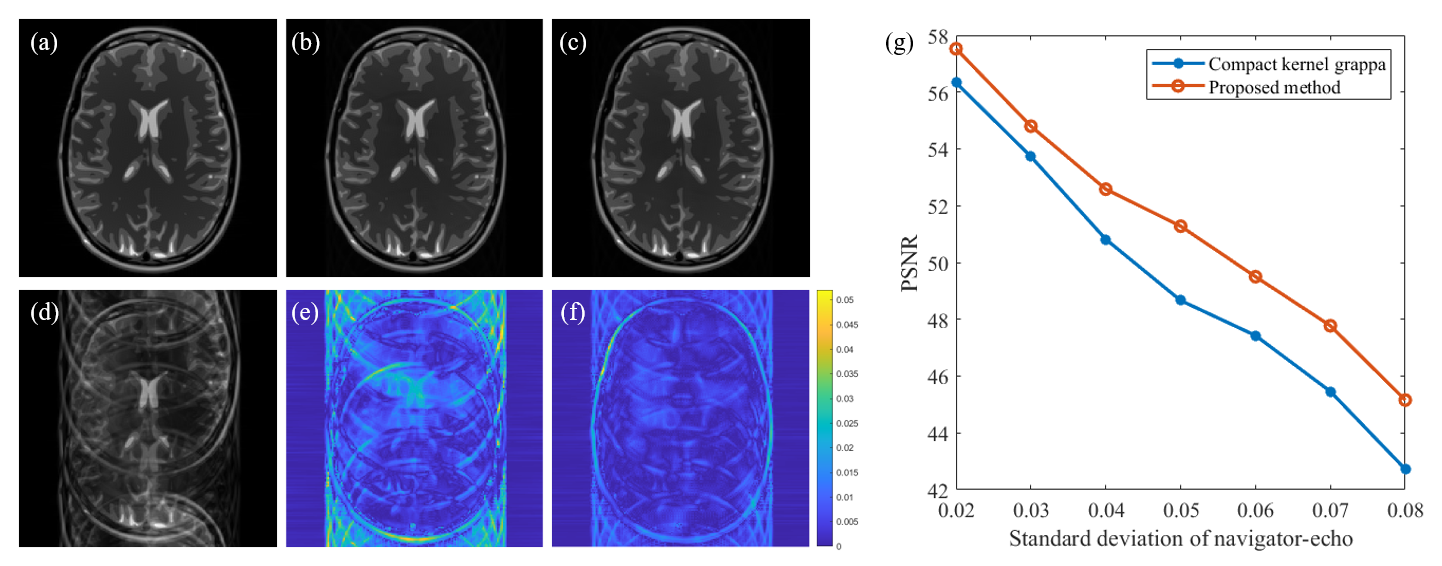
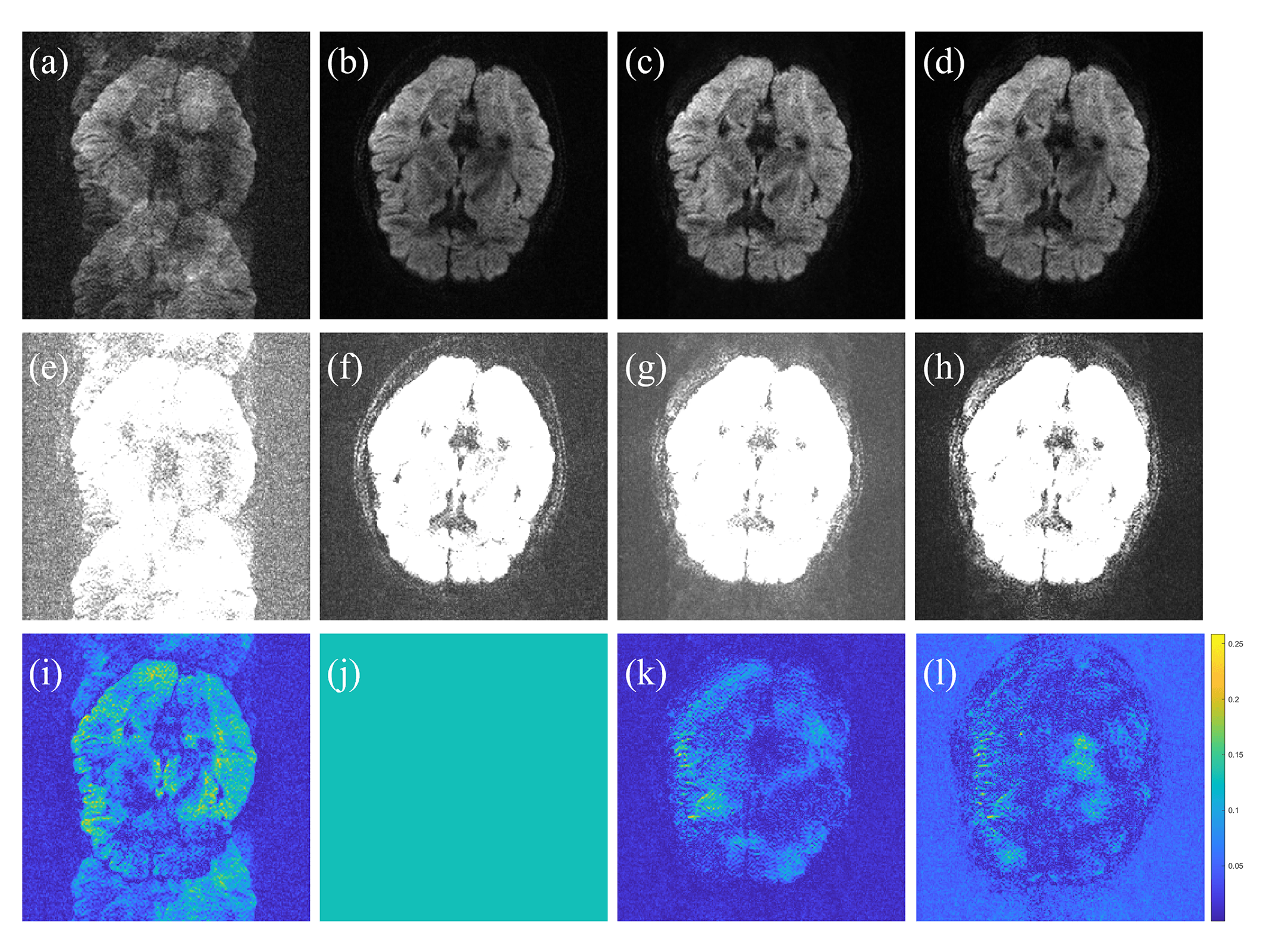
In numerical simulation (Fig. 4), as the standard deviation in navigator-echo increases, compact kernel grappa has peak signal-to-noise ratio (PSNR) decreases and increases the residual artifacts compared with the proposed method shown in (Fig. 4h).For in vivo data, there is no golden standard for reference. Thus, we combine LPC with the proposed method to reconstruct an image as reference. Fig. 5 shows a 4-shot head DWI image, where the proposed method exhibits fewer noise and residual artifacts.
The proposed method can also be applied to sense-based reconstructions, such as MUSSELS 6 and MUSE 15, to achieve higher PSNR. However, further efforts are required to address potential residual artifacts caused by distortion in navigator-echo.
Conclusion
By utilizing navigator-echo data acquired with different polarity readout gradients, it is possible to simultaneously correct two common phase variations in MSDWI without the need for additional prescan. The proposed method, incorporating low-rank constraints, proves to be robust in artifact removal and noise suppression.Acknowledgements
We acknowledge the equipment support provided by "Anhui Fuqing Medical Equipment Company." The authors express their gratitude to the Information Science Laboratory Center at the University of Science and Technology of China for their measurement services.References
1. Jeong HK, Gore JC, Anderson AW. High-resolution human diffusion tensor imaging using
2-D navigated multishot SENSE EPI at 7 T. Magn Reson Med. 2013;69(3):793-802.
2. BERNSTEIN, M. A., KING, K. F., & ZHOU, X. J. Handbook of MRI pulse sequences. Elsevier,
2004. 702–801.
3. Anderson, Adam W., and John C. Gore. "Analysis and correction of motion artifacts in
diffusion weighted imaging." Magnetic resonance in medicine 32.3 (1994): 379-387.
4. Butts, Kim, et al. "Diffusion‐weighted interleaved echo‐planar imaging with a pair of
orthogonal navigator echoes." Magnetic resonance in medicine 35.5 (1996): 763-770.
5. Lee, Juyoung, Kyong Hwan Jin, and Jong Chul Ye. "Reference‐free single‐pass EPI N yquist
ghost correction using annihilating filter‐based low rank H ankel matrix
(ALOHA)." Magnetic resonance in medicine 76.6 (2016): 1775-1789.
6. Mani, Merry, et al. "Multi‐shot sensitivity‐encoded diffusion data recovery using
structured low‐rank matrix completion (MUSSELS)." Magnetic resonance in medicine 78.2
(2017): 494-507.
7. J. P. Haldar, "Autocalibrated loraks for fast constrained MRI reconstruction," 2015 IEEE
12th International Symposium on Biomedical Imaging (ISBI), Brooklyn, NY, USA, 2015, pp.
910-913, doi: 10.1109/ISBI.2015.7164018.
8. Lobos, Rodrigo A., et al. "Navigator-free EPI ghost correction with structured low-rank
matrix models: New theory and methods." IEEE transactions on medical imaging 37.11
(2018): 2390-2402.
9. Hu, Yuxin, et al. "Motion‐robust reconstruction of multishot diffusion‐weighted images
without phase estimation through locally low‐rank regularization." Magnetic resonance in
medicine 81.2 (2019): 1181-1190.
10. Ordidge, Roger J., et al. "Correction of motional artifacts in diffusion-weighted MR images
using navigator echoes." Magnetic resonance imaging 12.3 (1994): 455-460.
11. Porter, David A., and Robin M. Heidemann. "High resolution diffusion‐weighted imaging
using readout‐segmented echo‐planar imaging, parallel imaging and a two‐dimensional
navigator‐based reacquisition." Magnetic Resonance in Medicine: An Official Journal of the
International Society for Magnetic Resonance in Medicine 62.2 (2009): 468-475.
12. Liu, Wentao, et al. "DWI using navigated interleaved multishot EPI with realigned GRAPPA
reconstruction." Magnetic resonance in medicine 75.1 (2016): 280-286.
13. Ma, Xiaodong, et al. "Improved multi-shot diffusion imaging using GRAPPA with a
compact kernel." Neuroimage 138 (2016): 88-99.
14. Riedel, Malte, et al. "Segmented simultaneous multi‐slice diffusion‐weighted imaging
with navigated 3D rigid motion correction." Magnetic Resonance in Medicine 86.3 (2021):
1701-1717.
15. Chen, Nan-kuei, et al. "A robust multi-shot scan strategy for high-resolution diffusion
weighted MRI enabled by multiplexed sensitivity-encoding (MUSE)." Neuroimage 72
(2013): 41-47.
16. Herbst, Michael. "Autocalibrating segmented diffusion‐weighted acquisitions." Magnetic
Resonance in Medicine 86.4 (2021): 1997-2010.
17. Lobos, Rodrigo A., et al. "Robust autocalibrated structured low‐rank EPI ghost
correction." Magnetic resonance in Medicine 85.6 (2021): 3403-3419.
18. Guerquin-Kern, Matthieu, et al. "Realistic analytical phantoms for parallel magnetic
resonance imaging." IEEE Transactions on Medical Imaging 31.3 (2011): 626-636.
19. Feiweier, T. (2013). U.S. Patent No. 8,497,681. Washington, DC: U.S. Patent and Trademark
Office.
Figures