2424
Short echo-time high-resolution diffusion imaging using multi-interleave spiral acquisition with simultaneous multi-slice (SMS) technique1Krembil Research Institute, University Health Network, Toronto, ON, Canada, 2Department of Physics, University of British Columbia, Vancouver, BC, Canada, 3Department of Psychology, University of Toronto, Toronto, ON, Canada
Synopsis
Keywords: Diffusion Acquisition, Diffusion Tensor Imaging, Spiral Acquisition, Multi-Interleave, SMS, Field Inhomogeneity Correction
Motivation: Diffusion-weighted imaging (DWI) using spiral readout has higher signal-to-noise efficiency comparing to EPI approaches. Spiral DWI with a high spatial-resolution with improved image qualities is desirable for studies in fine-scale brain structures.
Goal(s): The goal is to develop a short echo-time distortion-free diffusion imaging method with about 1 mm in-plane resolution with spiral readouts and simultaneous multi-slice (SMS) to accelerate acquisition.
Approach: We developed a SMS multi-interleave spiral acquisition of DWI with gradient and B0 inhomogeneity corrections. The between-interleave phase error was corrected using a CG-SENSE method.
Results: We demonsrated that a distortion-free short-TE high-resolution DWI using SMS multi-interleave spiral readout is feasible.
Impact: A short echo-time multi-interleave spiral diffusion-weighted imaging (DWI) method with gradient and B0 inhomogeneity corrections without additional hardware is developed, leading to a high spatial-resolution DWI with an improved image quality for studies in fine-scale brain structures.
Introduction
Recent studies have shown that diffusion imaging using spiral readout enables a much shorter echo time (TE) than EPI. Additionally, it demonstrates higher SNR efficiency and reduced T2 blurring due to the shorter readout train relative to traditional EPI-based diffusion MRI [1, 2]. In this study, we propose a multi-interleave spiral readout diffusion MRI to achieve higher spatial resolution while utilizing simultaneous multi-slice (SMS) acceleration to reduce the acquisition time. We show that a two-step SENSE-based reconstruction approach [3,4,5] for between-interleave phase error correction works successfully in the SMS regime for spiral DWI, relying solely on a standard MRI system without additional hardware.Methods
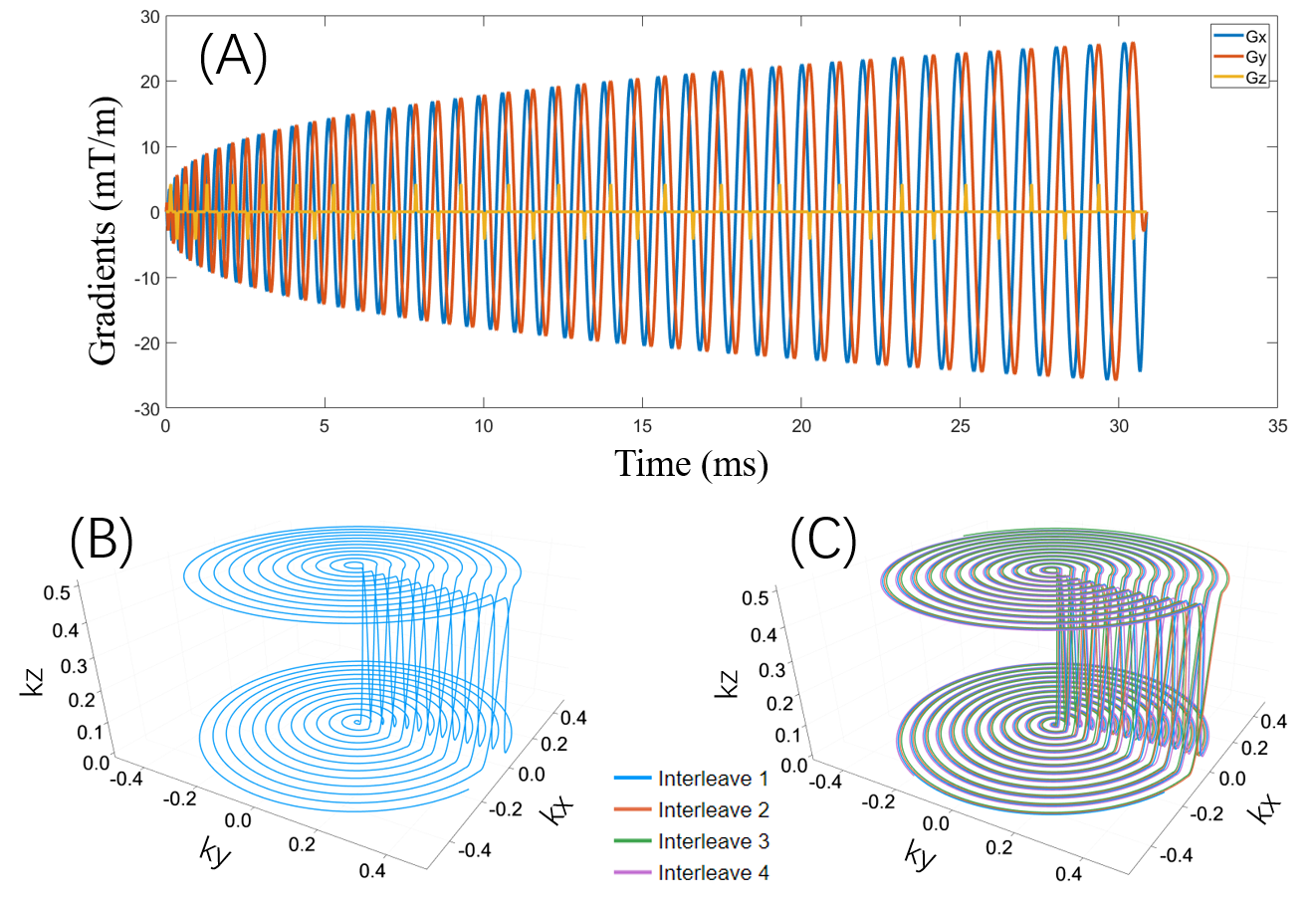
The spiral diffusion sequence was developed on Siemens IDEA platform. A four-interleave spiral readout trajectory (each with 15655 samples) was designed for an in-plane FOV of 220 mm and a resolution of 1.1 mm (Figure 1). The CAIPI blips [6] along the slice direction (Z) were designed according to the SMS factor and the FOV along the z-axis.Two diffusion-weighted imaging (DWI) datasets were acquired with the above spiral readout on a 3T Prisma scanner (Siemens, Erlangen, Germany) using a 20-channel head-neck coil. Two spiral DWI datasets (”SMS 2” and “non-SMS”) were obtained with and without SMS=2 excitation and CAIPI blips during the readout. Acquisition parameters were: TR/TE 8000/40 ms, slice thickness 2 mm, b-values of 0 and 1000 s/mm2, 6 diffusion directions, 60 slices in total (30 slice groups with 2 slices each for SMS 2). A separate dual-echo (TE 4.9/7.4 ms) GRE dataset was acquired for coil sensitivity and B0 field maps.
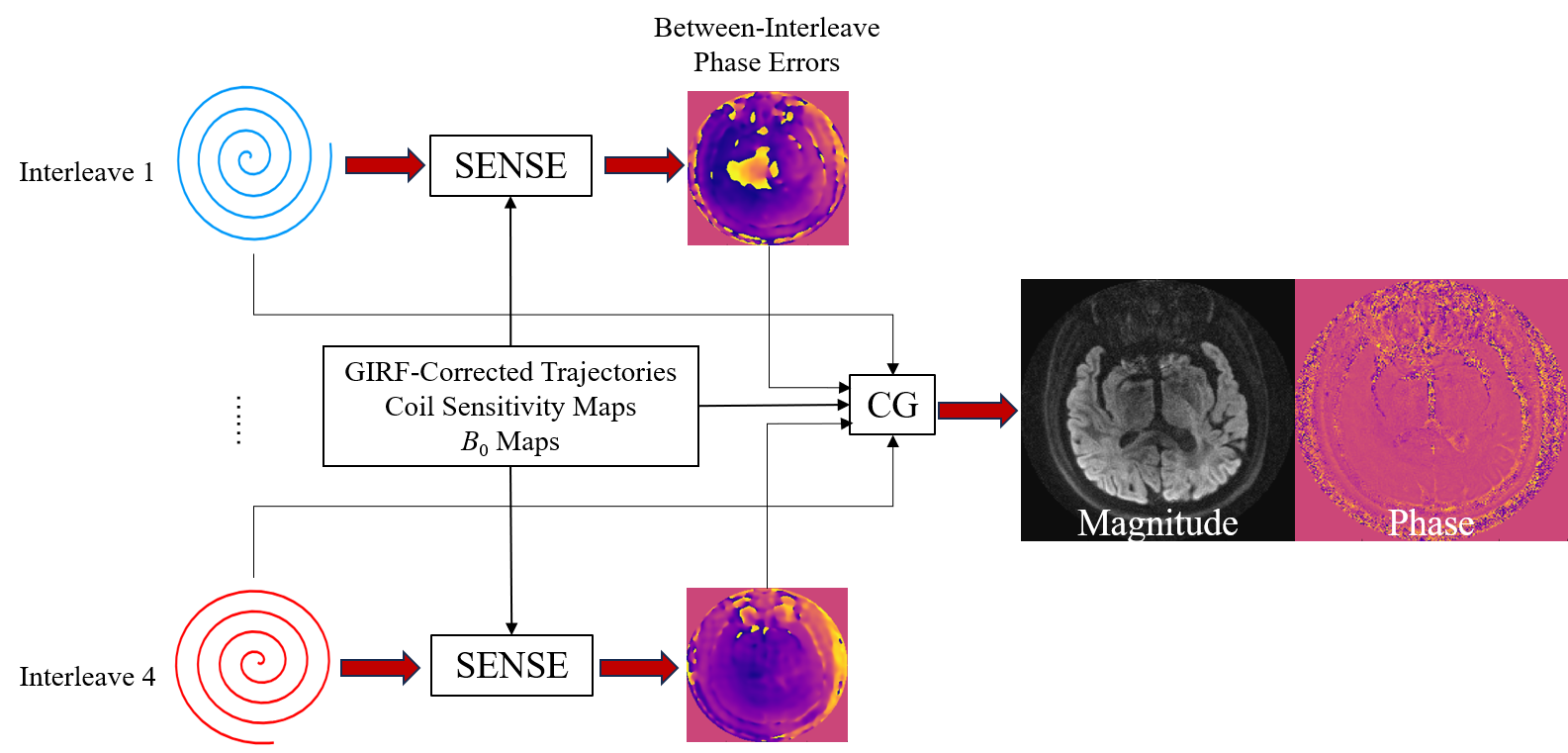
The spiral images were reconstructed using Julia language (v1.9.3) as part of the reconstruction pipeline GIRFReco.jl [7] using the MRIReco.jl toolbox [8]. Before image reconstruction, the spiral k-space trajectory was first corrected using the previously measured gradient impulse response function (GIRF) [9,10]. We used an extended signal model that includes the B0 term [11] to correct field inhomogeneity using a time segmentation approach [12]. The encoding matrix for the SMS spiral dataset utilized a 3D Fourier encoding framework [13], while the non-SMS dataset was reconstructed in 2D. To correct the signal cancellation in multi-interleave DWIs caused by phase errors due to physiological motion, the first 1000 samples of each spiral interleave were used to estimate low-resolution between-interleave phase maps. This phase information was included in image reconstruction via an iterative conjugate-gradient (CG) algorithm [3,4,5]. The reconstruction pipeline for SMS multi-interleave spiral dataset is demonstrated in Figure 2. The DWIs were post-processed in FSL to fit a diffusion tensor model for calculating the maps of fractional anisotropy and corresponding eigenvectors.
Results
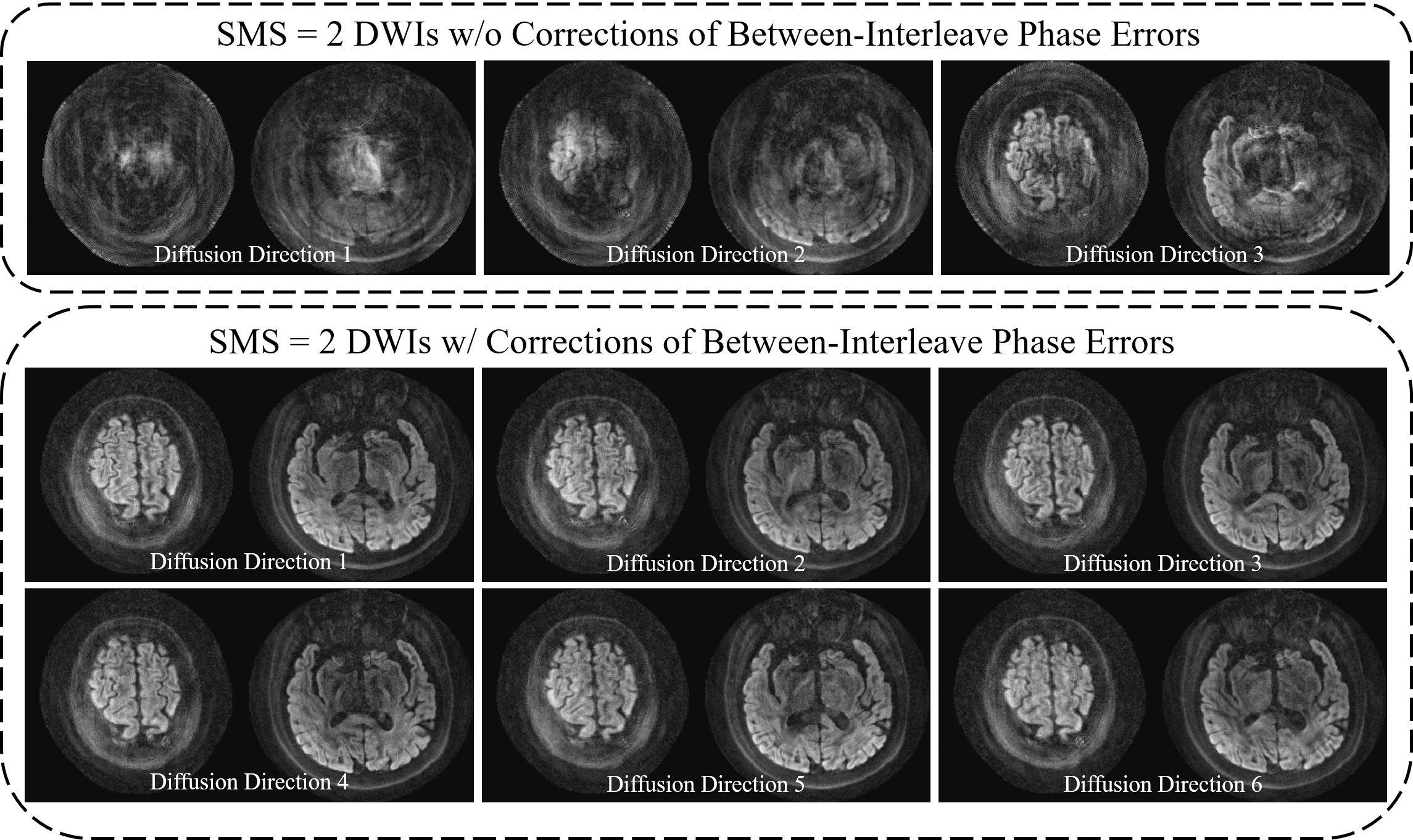
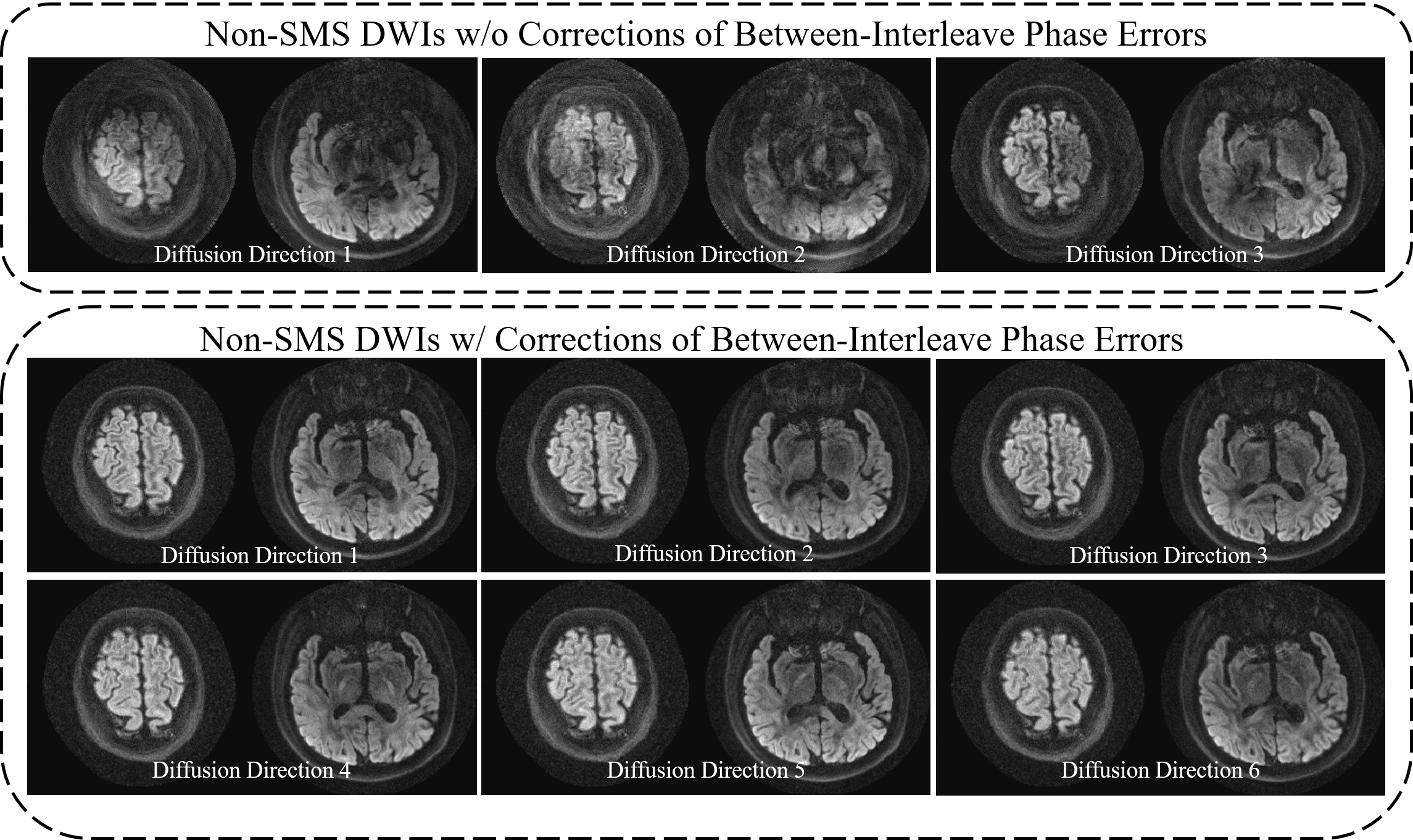
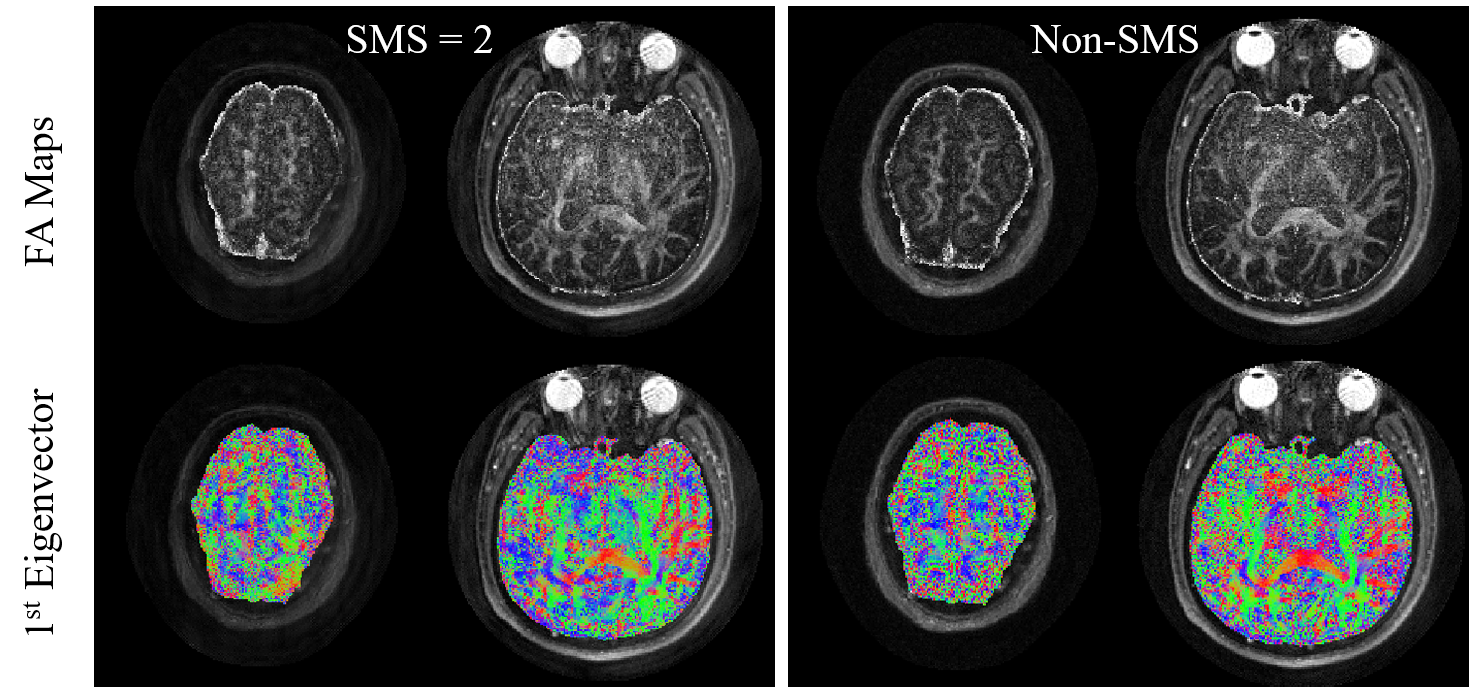
Figure 3 shows the four-interleave spiral DWIs with SMS 2 of one out of 30 slice groups before and after the phase error correction. The correction of between-interleave phase errors dramatically improves the image quality of all DWIs, while no visible image blurring remains after B0 field inhomogeneity correction during reconstruction. Figure 4 demonstrates non-SMS four-interleave spiral DWIs on the same slice positions for comparison. Figure 5 demonstrates the maps of fractional anisotropy and the first eigenvector on the same slice locations for both the SMS 2 and non-SMS cases, demonstrating the feasibility of extracting diffusion parameters from spiral imaging with and without SMS.Discussion and Conclusion
This study demonstrated the feasibility of multi-interleave spiral acquisition of high-resolution DWI with SMS. The TR for the SMS protocol is identical to the non-SMS acquisition TR for 60 slices (8000 ms) to match contrast. The actual minimum TR for SMS 2 acquisition was 4000 ms for 60 slices, indicating a potential 2-fold acceleration of the total acquisition time. Meanwhile, the multi-interleave spiral readout reduced TE dramatically while achieving a high spatial resolution comparing to EPI: an EPI DWI protocol that reaches the same b-value and with echo train length reduced through GRAPPA and partial Fourier still needs a TE > 70ms, and in-plane resolution remains at 1.7 mm. As a comparison, the proposed method only needs a TE of 40 ms to achieve 1.1 mm in-plane resolution.There are still limitations in this study. Currently there are relatively wide gaps in each k-space plane with all interleaves (Figure 2C), which leads to residual under-sampling artifacts in DWIs (comparing Figure 3 to 4), indicating an optimized spiral trajectory is needed. Furthermore, a higher SMS factor for a further reduction of scanning time is desirable, which would benefit a spiral trajectory in more interleaves with a shorter readout duration.
In summary, we present the feasibility of a distortion-free short-TE high-resolution DWI through multi-interleave spiral acquisition with SMS.
Acknowledgements
No acknowledgement found.References
[1] Yoojin Lee, Bertram J. Wilm, David O. Brunner, Simon Gross, Thomas Schmid, Zoltan Nagy, Klaas P. Pruessmann. On the signal-to-noise ratio benefit of spiral acquisition in diffusion MRI. Magnetic Resonance in Medicine 2021;85: 1924 – 1937. https://doi.org/10.1002/mrm.28554
[2] Bertram Jakob Wilm, Franciszek Hennel, Manuela Barbara Roesler, Markus Weiger, Klaas Paul Pruessmann. Minimizing the echo time in diffusion imaging using spiral readouts and a head gradient system. Magnetic Resonance in Medicine 2020;84: 3117–3127. https://doi.org/10.1002/mrm.28346
[3] Chunlei Liu, Michael E. Moseley, Roland Bammer. Simultaneous Phase Correction and SENSE Reconstruction for Navigated Multi-Shot DWI with Non-Cartesian k-Space Sampling. Magnetic Resonance in Medicine 2005, 54:1412–1422. https://doi.org/10.1002/mrm.20706
[4] Trong-Kha Truong, Arnaud Guidon. High-resolution multishot spiral diffusion tensor imaging with inherent correction of motion-induced phase errors. Magnetic Resonance in Medicine 2014; 71: 790 – 796. https://doi.org/10.1002/mrm.24709
[5] Nan-kuei Chen, Arnaud Guidon, Hing-Chiu Chang, Allen W. Song. A robust multi-shot scan strategy for high-resolution diffusion weighted MRI enabled by multiplexed sensitivity-encoding (MUSE). NeuroImage 2013; 72: 41 – 47. https://doi.org/10.1016/j.neuroimage.2013.01.038
[6] Kawin Setsompop, Borjan A. Gagoski, Jonathan R. Polimeni, Thomas Witzel, Van J. Wedeen, Lawrence L. Wald. Blipped-controlled aliasing in parallel imaging for simultaneous multislice echo planar imaging with reduced g-factor. Magnetic Resonance in Medicine 2012; 67: 1210–24. https://doi.org/10.1002/mrm.23097
[7] Alexander Jaffray, Zhe Wu, S. Johanna Vannesjo, Kâmil Uludağ, and Lars Kasper. GIRFReco.jl: An open-source pipeline for spiral MRI reconstruction in Julia. The Journal of Open Source Software 2023 (under review).
[8] Tobias Knopp, Mirco Grosser. MRIReco.jl: An MRI reconstruction framework written in Julia. Magnetic Resonance in Medicine 2021;86:1633–1646. https://doi.org/10.1002/mrm.28792
[9] Zhe Wu, Alexander Jaffray, Johanna Vannesjo, Kamil Uludag, and Lars Kasper. MR Gradient System Long-Term Stability Investigation and Protocol Optimization for Quality Control using Gradient Impulse Response Function (GIRF). Proceeding of ISMRMR 2022, pp 0641.
[10] Vannesjo, S. J., Haeberlin, M., Kasper, L., Pavan, M., Wilm, B. J., Barmet, C., & Pruessmann, K. P. (2013). Gradient system characterization by impulse response measurements with a dynamic field camera. Magnetic Resonance in Medicine 2013, 69, 583–593. https://doi.org/10.1002/mrm.24263
[11] Bertram J. Wilm, Christoph Barmet, Simon Gross, Lars Kasper, S. Johanna Vannesjo, Max Haeberlin, Benjamin E. Dietrich, David O. Brunner, Thomas Schmid, Klaas P. Pruessmann. Single-Shot Spiral Imaging Enabled by an Expanded Encoding Model: Demonstration in Diffusion MRI. Magnetic Resonance in Medicine 2017, 77, 83 – 91. https://doi.org/10.1002/mrm.26493
[12] Bradley P. Sutton; Douglas C. Noll; Jeff A. Fessler. Fast, iterative image reconstruction for MRI in the presence of field inhomogeneities. IEEE Transactions on Medical Imaging 2023, 22, 178 – 188. https://doi.org/10.1109/TMI.2002.808360
[13] Benjamin Zahneisen, Benedikt A. Poser, Thomas Ernst, and V. Andrew Stenger. Three-Dimensional Fourier Encoding of Simultaneously Excited Slices: Generalized Acquisition and Reconstruction Framework. Magnetic Resonance in Medicine 2014;71:2071–2081. https://doi.org/10.1002/mrm.24875
Figures