2220
Cloud-Magnetic Resonance Imaging Systems: Prospects and Challenges1Department of Electronic Science, Biomedical Intelligent Cloud R&D Center, Fujian Provincial Key Laboratory of Plasma and Magnetic Resonance, National Institute for Data Science in Health and Medicine, Institute of Artificial Intelligence, Xiamen University, Xiamen, China, 2Department of Electronic Science, Key Laboratory of Digital Fujian on IoT Communication, Xiamen University, Xiamen, China, 3Shanghai Electric Group CO., LTD, Shanghai, China, 4China Telecom Group, Quanzhou, China, 5China Mobile Group, Xiamen, China, 6School of Computer and Information Engineering, Xiamen University of Technology, Xiamen, China
Synopsis
Keywords: AI/ML Software, Software Tools
Motivation: Magnetic Resonance Imaging (MRI) plays an important role in medical diagnosis, generating petabytes of image data annually in large hospitals. Local data processing demands substantial manpower and hardware investments. Data isolation across different healthcare institutions hinders cross-institutional collaboration.
Goal(s): Solve a series of problems existing in current hospitals.
Approach: Integrating cloud computing, 6G, edge computing, federated learning, and blockchain.
Results: Cloud-MRI transforms raw data to the Imaging Society for Magnetic Resonance in Medicine Raw Data (ISMRMRD) format and enables fast reconstruction, AI training, and analysis. Results are relayed to cloud radiologists.
Impact: This system safeguards data, promotes collaboration, and enhances diagnostic precision and efficiency.
Introduction
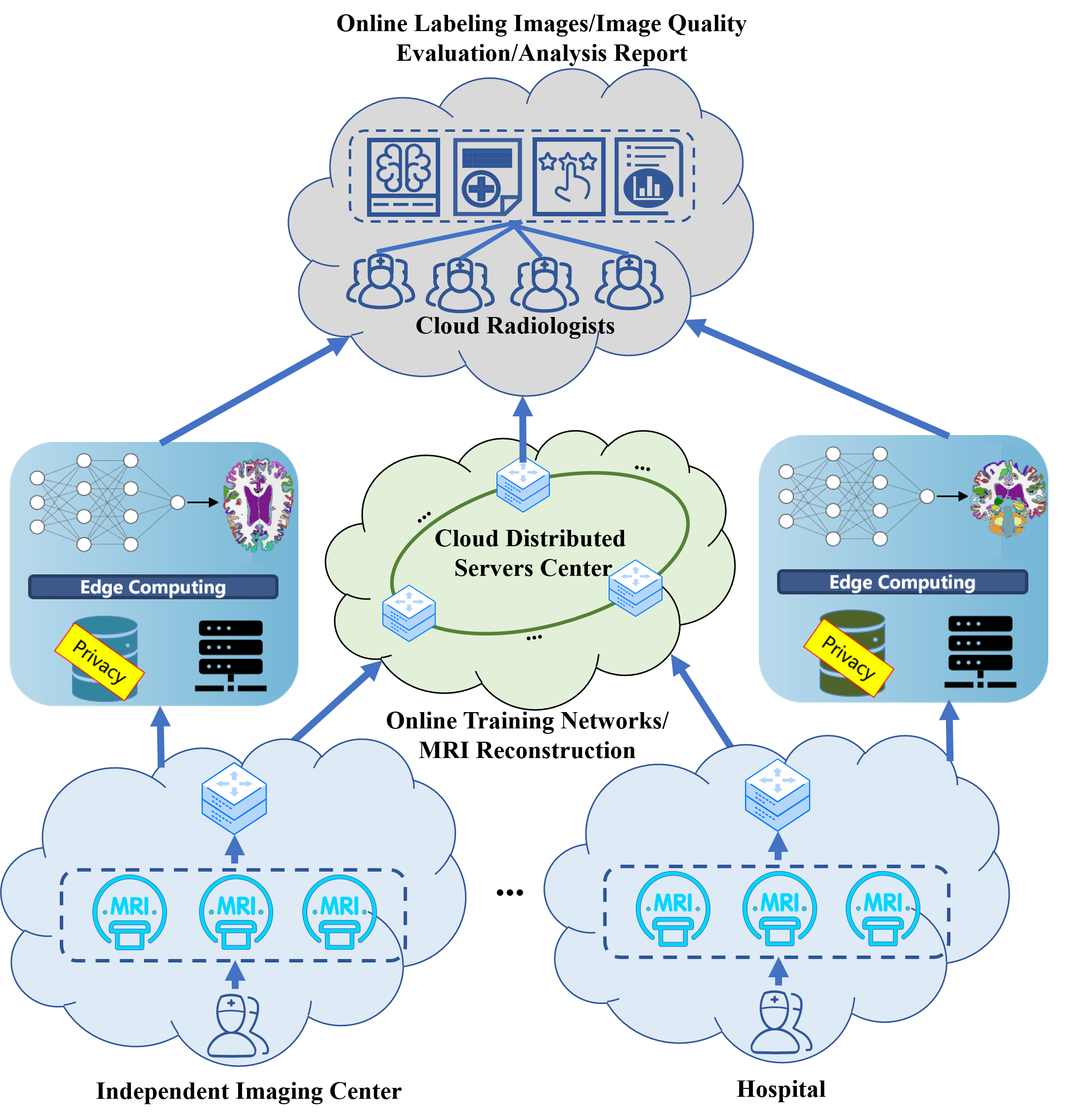
Magnetic Resonance Imaging (MRI) holds a pivotal role in medical diagnosis, generating petabytes of image data annually within large hospital facilities [1]. To accommodate such voluminous data, substantial network bandwidth and extensive storage devices are prerequisites [2]. The necessity for data retention extends up to three decades [3, 4], and in the context of personal digital archives, permanence is the expectation. Local data management and processing not only necessitates substantial investments in both human resources and hardware but also poses challenges regarding inter-institutional data sharing within the healthcare sector [5].To solve these challenges, we proposed a Cloud-MRI system, as depicted in Figure 1, which encompasses four distinct generations. These innovative technologies include distributed cloud computing [6], 6G bandwidth [7], edge computing [8], federated learning [9], and blockchain technology [10]. The workflow commences with the transformation of k-space raw data into the ISMRM format [11]. Subsequently, the data are uploaded to the cloud or edge nodes, facilitating fast image reconstruction, neural network training, and automatic analysis. The outcomes are seamlessly transmitted to clinics or research institutes for diagnosis purposes and an array of additional services.
Method
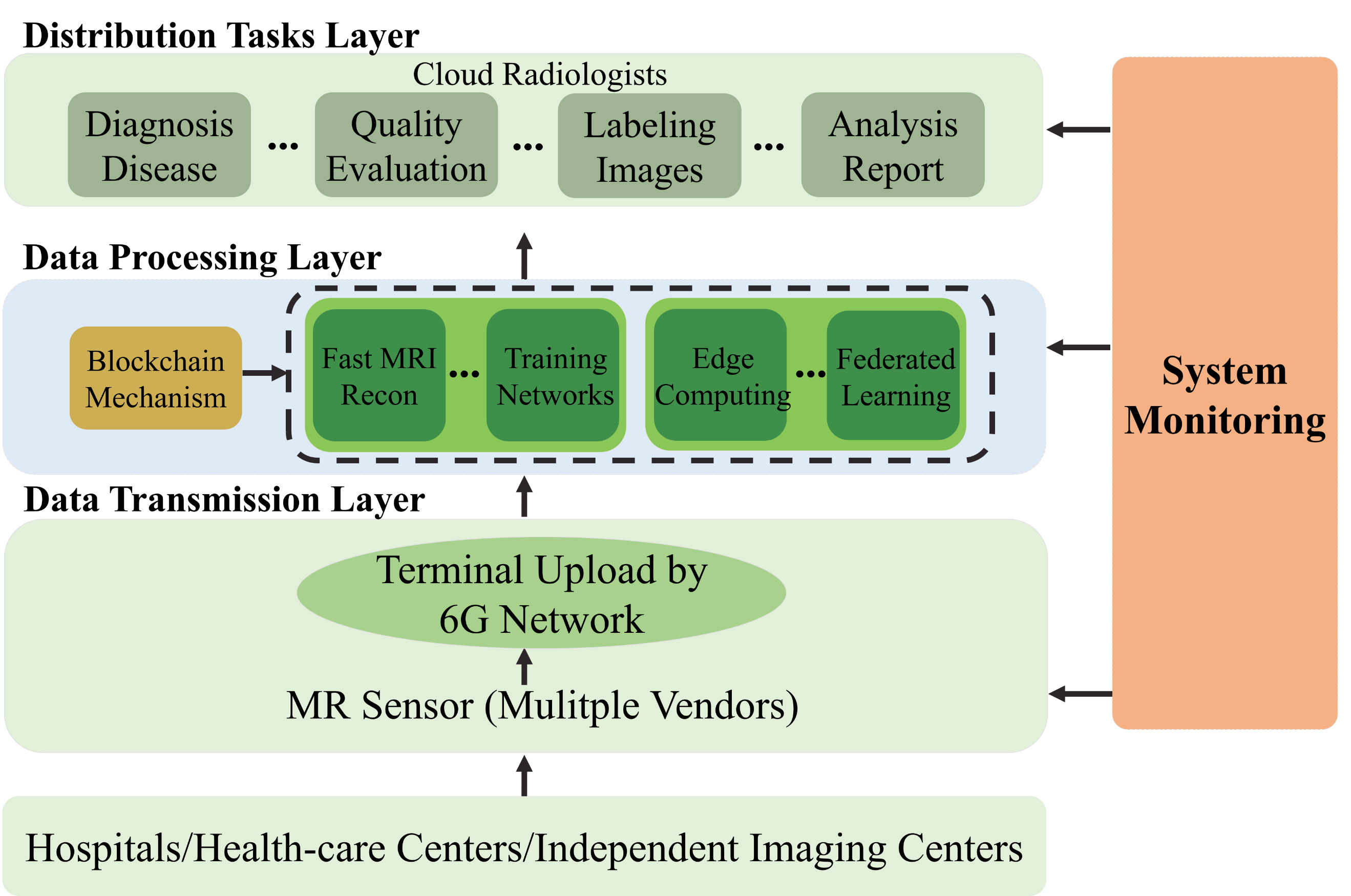
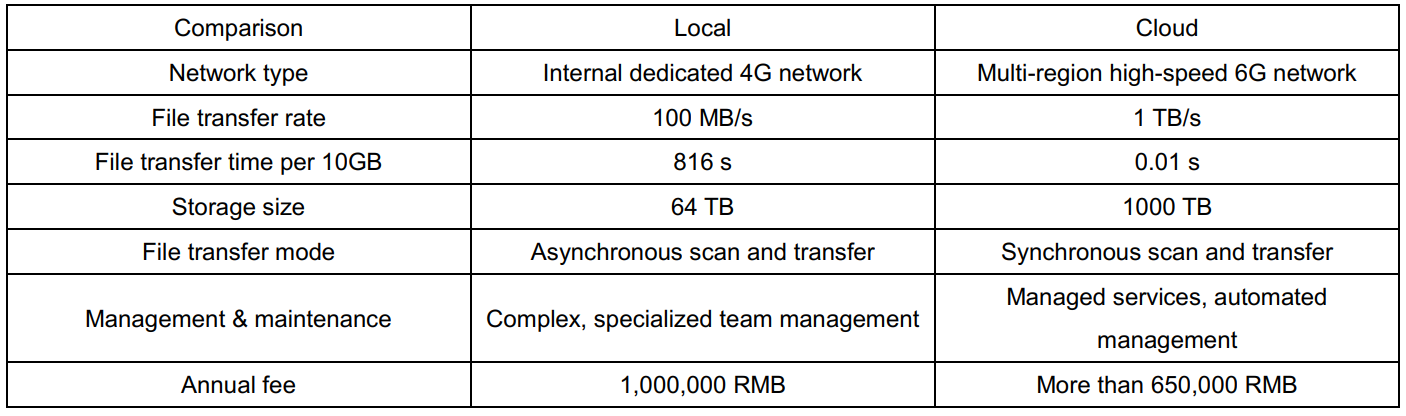
Cloud-MRI starts from the raw data acquisition on an MRI scanner to form diagnostic reports written by radiologists. The architecture comprises four main parts (Figure 2).The data transmission layer utilizes the ISMRMRD format for seamless cross-platform MRI data exchange. Authorized operators securely upload data via encrypted channels like SSH, and AES [7] encryption. Leveraging 6G technology significantly enhances transmission speed and potentially reduces annual fees by 35%, as shown in Table I.
The data processing layer incorporates cloud-distributed cluster servers, local edge computing, federated learning, and blockchain mechanisms to process and protect MRI data efficiently. Tools like Kubernetes and Docker enable advanced image reconstruction methods and demonstrate significantly faster cloud-based reconstructions with high-quality images compared to local computations. Local edge servers reduce the burden on the cloud, lessening network latency for hospitals. Federated learning tools like PySyft enable collaborative AI training without raw data sharing, enhancing neural network performance globally. Blockchain records data hash values and employs smart contracts and cryptography for data access control, ensuring MRI data privacy and security from unauthorized access.
The distribution tasks layer lets cloud radiologists use encrypted channels to conduct image reviews, report writing, quality evaluation, and online labeling tasks for comprehensive patient MRI analysis.
The system monitoring module uses SIEM tools and other AI detection technology in real time to identify and alert anomalies like unauthorized data access or cyber-attacks.
Results
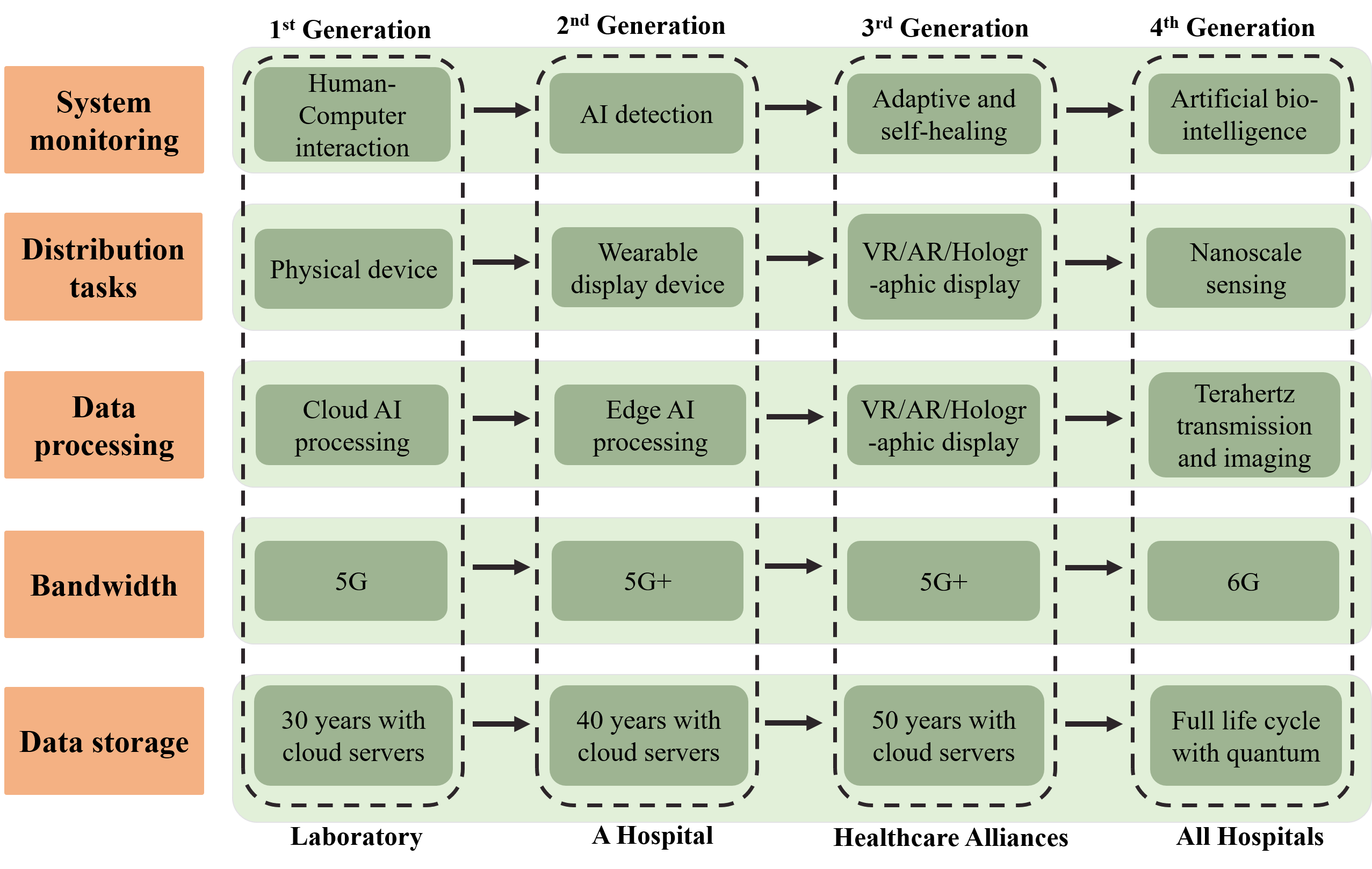
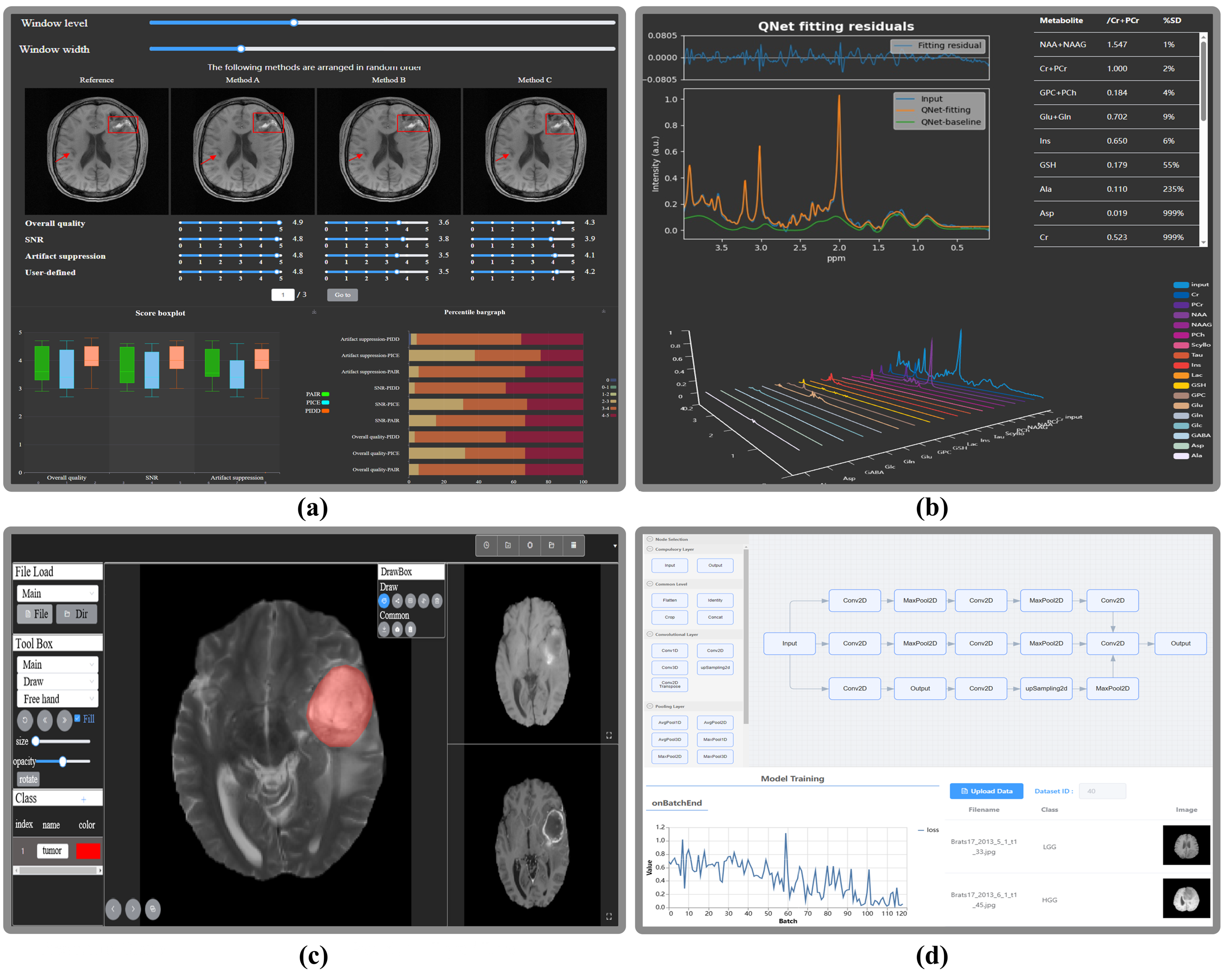
The practical implementation of the Cloud-MRI system involves distinct evolutionary phases (Figure 3). This progression unfolds across four generations.The 1st generation architecture of the Cloud-MRI system primarily centered on lab-level infrastructure, where MRI data in ISMRMRD format was encrypted and sent to cloud servers for a long duration. It featured a basic web interface for radiologists to utilize cloud-based AI tools for image processing, monitored via tools like Nagios for data security. An example Cloud-MRI system (Figure 4) demonstrated on https://csrc.xmu.edu.cn/CloudBrain.html employs distributed cloud computing servers [12-16].
The 2nd generation architecture, expected within 3 years, focuses on improving hospital system performance through MRI parametric imaging, extended data storage to 40 years, edge AI computing, task assignments via wearable devices like smartwatches, AI-based automated monitoring, and achieving reduced latency to 0.5 milliseconds using 5G+ technology.
The 3rd generation architecture, slated for completion in 6 years, advances healthcare alliances by enabling MRI for high-resolution multi-nuclear metabolic data, extending data storage to 50 years. It incorporates VR, AR, and holographic projection to relay diagnostic results for surgical planning, survival rates, and recovery, alongside an automatic self-healing monitoring system, utilizing 5G+ bandwidth.
The 4th generation architecture unifies healthcare institutions with potent computing and advanced MRI sensors capable of detecting nanoscale changes, and permanently storing data using quantum storage. AI computing on atomic spins offers unprecedented health insights grounded in quantum mechanics. Integrated sensing through terahertz communication enables both MRI and terahertz imaging. Lifelong monitoring utilizing artificial bio-intelligence and 6G technology cuts network transmission delays to approximately 0.1 milliseconds, fostering comprehensive human health surveillance.
Conclusion
In this work, we anticipate an innovative Cloud-MRI system, the technologies including distributed cloud computing, 6G bandwidth, edge computing, federated learning, and blockchain. The primary objective is to address the challenges of MRI data encompassing data acquisition, storage, processing, transmission, and sharing. Additionally, the Cloud-MRI system aims to streamline the maintenance of AI algorithms, foster collaborative data initiatives across healthcare institutions, facilitate cross-institutional clinical cooperation and biomedical research, and finally improve the level and efficiency of medicine.Acknowledgements
See more details in the full-length preprint: https://arxiv.org/abs/2310.11641. This work was supported by the National Natural Science Foundation of China (62122064, 61971361, 62331021, 62371410), the Natural Science Foundation of Fujian Province of China (2023J02005 and 2021J011184), the President Fund of Xiamen University (20720220063), and the Nanqiang Outstanding Talents Program of Xiamen University.The correspondence should be sent to Prof. Xiaobo Qu (Email: quxiaobo@xmu.edu.cn)
References
[1] S. Dash et al., "Big data in healthcare: Management, analysis, and future prospects," Journal of Big Data, vol. 6, no. 1, pp. 1-25, 2019.
[2] A. Jaleel et al., "Towards medical data interoperability through the collaboration of healthcare devices," IEEE Access, vol. 8, pp. 132302-132319, 2020.
[3] http://www.nhc.gov.cn/fzs/s3576/201808/7a922e4803fa452f99d43a25ec0a3d77.shtml
[4] https://www.healthit.gov/sites/default/files/appa7-1.pdf
[5] M. J. Willemink et al., "Preparing medical imaging data for machine learning," Radiology, vol. 295, no. 1, pp. 4-15, 2020.
[6] J. Yang, "Cloud computing for storing and analyzing petabytes of genomic data," Journal of Industrial Information Integration, vol. 15, pp. 50-57, 2019.
[7] K. B. Letaief et al., "The roadmap to 6G: AI empowered wireless networks," IEEE Communications Magazine, vol. 57, no. 8, pp. 84-90, 2019.
[8] P. Dong et al., "Edge computing based healthcare systems: Enabling decentralized health monitoring in Internet of medical Things," IEEE Network, vol. 34, no. 5, pp. 254-261, 2020.
[9] G. A. Kaissis et al., "Secure, privacy-preserving and federated machine learning in medical imaging," Nature Machine Intelligence, vol. 2, no. 6, pp. 305-311, 2020.
[10] A. A. Abdellatif et al., "Medge-chain: Leveraging edge computing and blockchain for efficient medical data exchange," IEEE Internet of Things Journal, vol. 8, no. 21, pp. 15762-15775, 2021.
[11] S. J. Inati et al., "ISMRM Raw data format: A proposed standard for MRI raw datasets," Magnetic Resonance in Medicine, vol. 77, no. 1, pp. 411-421, 2017.
[12] Y. Zhou et al., "CloudBrain-ReconAI: An online platform for MRI reconstruction and image quality evaluation," arXiv preprint, arXiv:2212.01878, 2022.
[13] Y. Zhou et al., "Cloud-magnetic resonance imaging system: In the era of 6G and artificial intelligence," arXiv preprint, arXiv:2310.11641, 2023.
[14] X. Chen et al., "CloudBrain-MRS: An intelligent cloud computing platform for in vivo magnetic resonance spectroscopy preprocessing, quantification, and analysis," arXiv preprint, arXiv:2306.11021, 2023.
[15] C. Qian et al., "A paired phase and magnitude reconstruction for advanced diffusion-weighted imaging," IEEE Transactions on Biomedical Engineering, DOI: 10.1109/TBME.2023.3288031, 2023.
[16] Z. Wang et al., "One for multiple: Physics-informed synthetic data boosts generalizable deep learning for fast MRI reconstruction," arXiv preprint, arXiv:2307.13220, 2023.
Figures