2168
Filtering of spurious streamlines via streamline orientation and pathway density1ICTEAM, UCLouvain, Louvain-la-Neuve, Belgium, 2IoNS, UCLouvain, Brussels, Belgium
Synopsis
Keywords: Tractography, Tractography & Fibre Modelling, diffusion, filtering, streamline, tractometry, tractography, brain
Motivation: Tract extraction from whole-brain tractograms requires either an extensive knowledge of inclusion and exclusion zones or manual efforts to obtain clean tracts.
Goal(s): Automated filtering of spurious streamlines can accelerate the tract extraction process. The algorithm should be versatile, while preserving tract shape and minimizing parameter adjustments.
Approach: We developed a filtering algorithm based on streamline direction and density along an average trajectory. Our method was compared to four other filtering implementations.
Results: Our algorithm is applicable to a wide variety of tracts with a high and low streamline count. It offers efficient filtering and provides a conservative filtering preserving tract morphology.
Impact: We introduced an efficient filtering algorithm, removing spurious streamlines while preserving tract morphology across tracts of low and high density with default parameters. Additionally, the computed average trajectory enables the analysis of metrics in multi-fixel models along the tract pathway.
Introduction
Probabilistic tractography has uncovered more neural pathways compared to deterministic algorithms by allowing orientations with a lower diffusivity to contribute to the propagation of streamlines. While this has enabled a more complete overview of the existing pathways, it has also brought with it a higher number of false positive streamlines1,2. In bundles extracted by targeting specific regions of interest, these false positives often appear as spurious streamlines, requiring the use of exclusion zones to filter them out.We believe that the majority of spurious streamlines can be removed using algorithmic criteria, simplifying the process of exclusion zone selection and reducing the need for exhaustive trial-and-error testing for each tract. We have developed tools to efficiently compute the mean tract trajectory, which can be used to clean up tracts and study the microstructure of linear fascicles along their pathways.
Methods
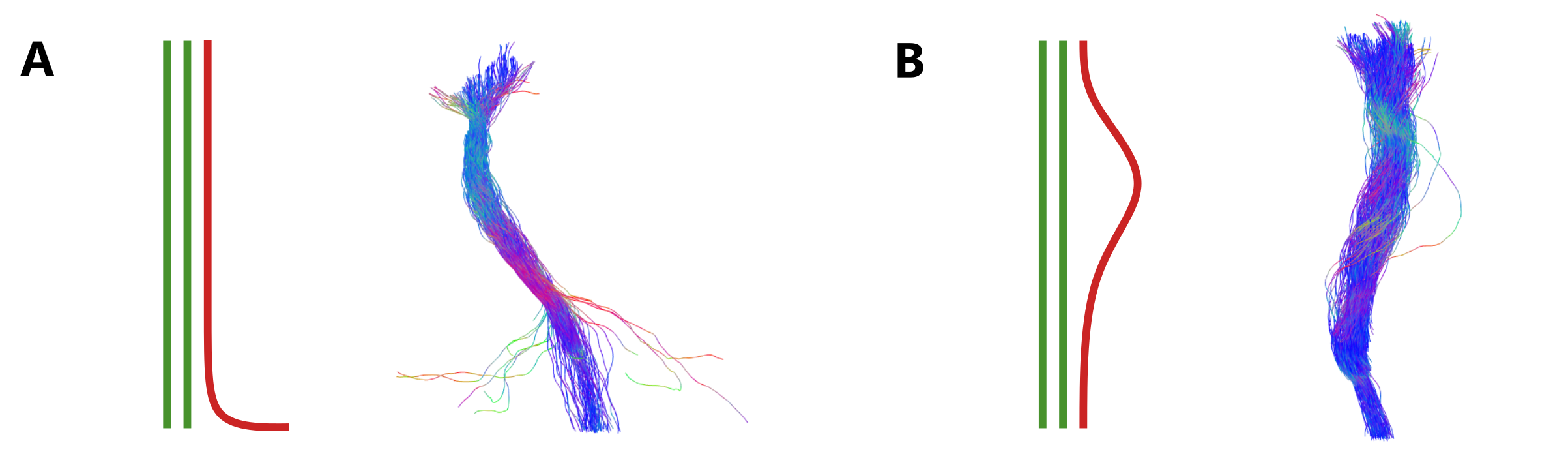
FilteringWe considered two types of spurious streamlines in a tract$$$~\mathcal{T}$$$: oversteps and missteps (Fig.1).
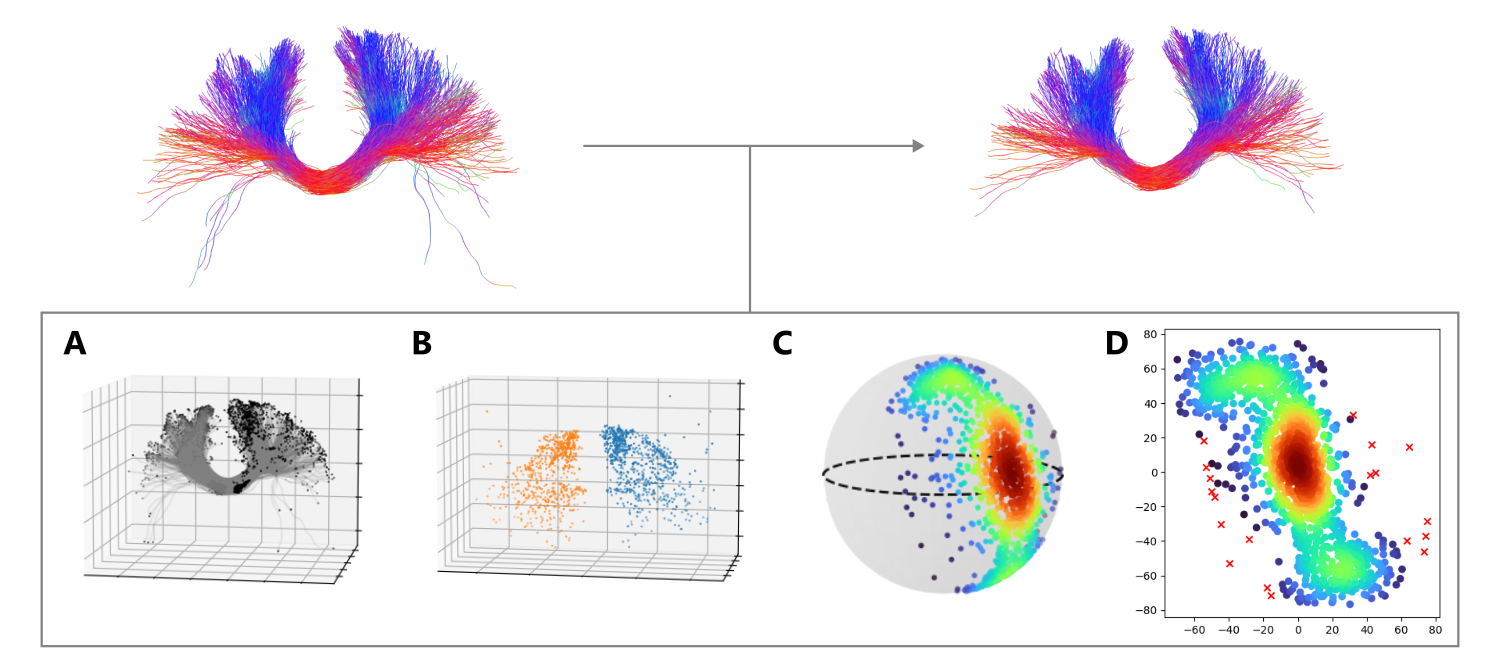
Oversteps depicted in Fig.1A, refer to inaccuracies in streamline endpoints. These inaccuracies can be detected based on the overall streamline orientation. To achieve this, streamlines endpoints are extracted and categorized as start and end points (Fig.1A-B). The orientations of the streamlines, denoted as$$$~\textbf{u}_i$$$, are then transformed into polar coordinates$$$~\textbf{u}_i=(x,y,z)\rightarrow\textbf{u}_i=(\theta,\phi)~$$$centered on the average orientation of the tract (Fig.1C-D). Subsequently, the kernel density$$$~\hat{d}_h(\textbf{u})~$$$is estimated for all streamline orientations.
$$\hat{d}_h(\textbf{u})=\frac{1}{lh}\sum_{i=1}^lK(\frac{\textbf{u}-\textbf{u}_i}{h}),$$
where$$$~l~$$$is the number of streamlines in the tract and$$$~K~$$$is a symmetric bi-variate Gaussian kernel with a bandwidth$$$~h$$$. Streamlines$$$~\mathcal{L}~$$$with an insufficient number of neighbors are then removed from the set$$$~\mathcal{T}~$$$(Fig.2D).
$$\textbf{Criterion: }\mathcal{L}_i\notin\mathcal{T}~\text{if}~\hat{d}_h(\textbf{u}_i)\leq\frac{n}{2\pi\cdot h^2},$$
where$$$~n~$$$is the approximate number of neighboring streamlines necessary to be classified as non-isolated.
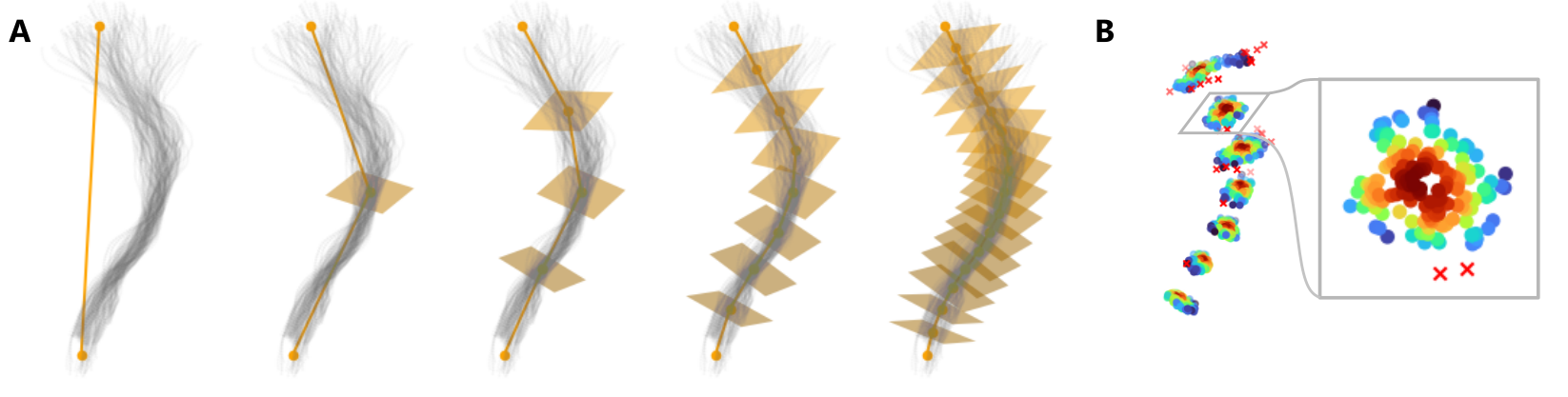
Missteps illustrated in Fig.1B, represent imperfections within the streamline pathway. To address these, an average bundle trajectory is calculated. The computation of the average trajectory proceeds iteratively: planes are positioned at the midpoint between two nodes, with their normal aligned to the direction of these points. A new node is then added to the average trajectory at the centroid of the points where the streamlines and plane intersect (Fig.3A). The outlier streamlines are then identified based on their positional density$$$~\hat{d}_h(\textbf{x}_{p,i})~$$$at each plane$$$~p~$$$(Fig.3B).
$$\hat{d}_h(\textbf{x}_p)=\frac{1}{lh}\sum_{i=1}^lK(\frac{\textbf{x}_p-\textbf{x}_{p,i}}{h}),$$
with$$$~\textbf{x}_{p,i}~$$$the coordinate vector of streamline$$$~i~$$$at plane$$$~p~$$$. Similarly to the previous criterion, isolated streamlines are then removed from the set$$$~\mathcal{T}$$$.
$$\textbf{Criterion: }\mathcal{L}_i\notin\mathcal{T}~\text{if}~\hat{d}_h(\textbf{x}_{p,i})\leq\frac{n}{2\pi\cdot h^2}.$$
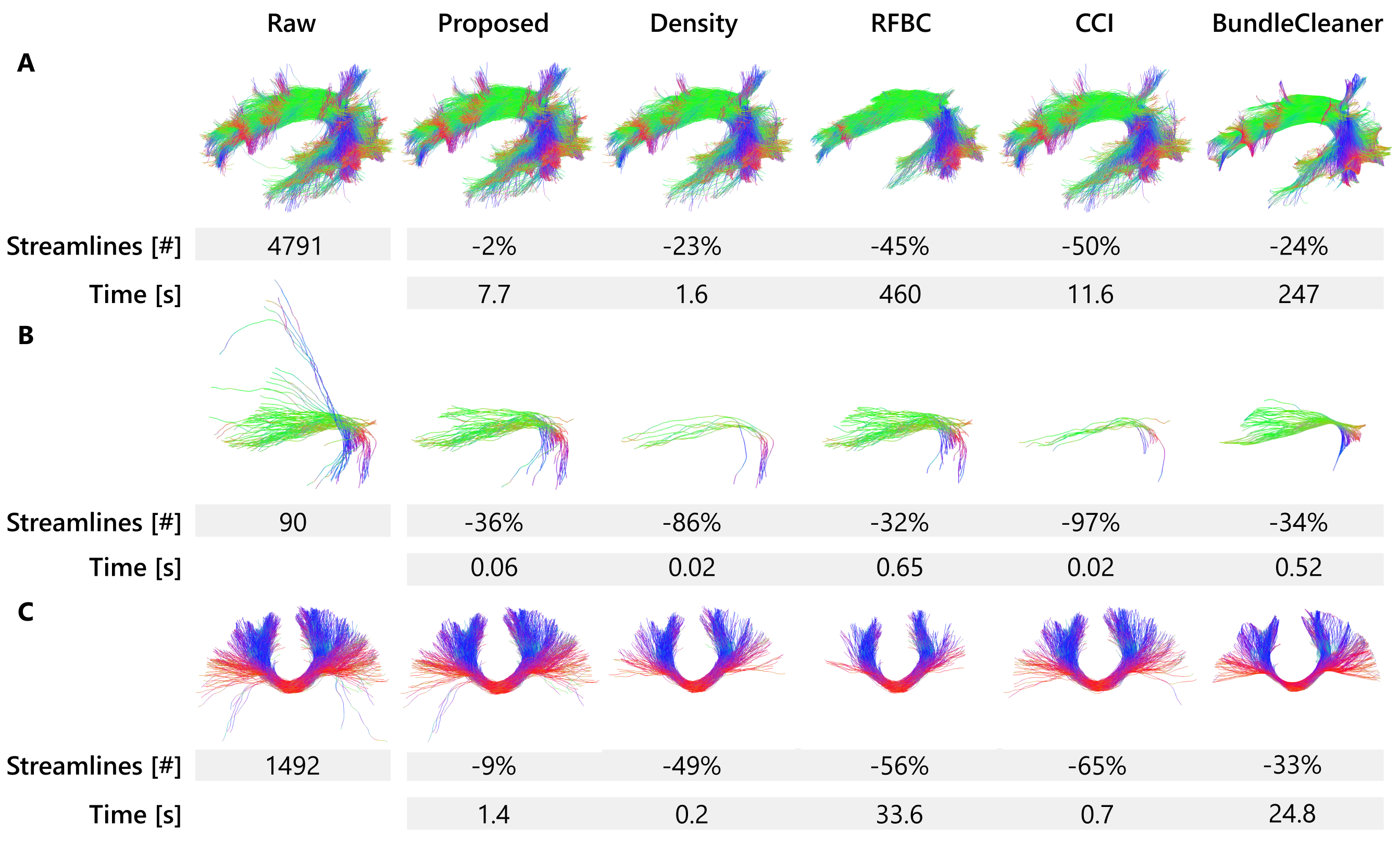
The implemented code is open-source and available3. The streamline filter generated with our method was compared with filtering techniques employing density thresholding, RFBC4, CCI5 and BundleCleaner6. The local modeling was estimated with msmt-CSD7 and the probabilistic tractography was performed with iFOD28.
Along-tract analysis
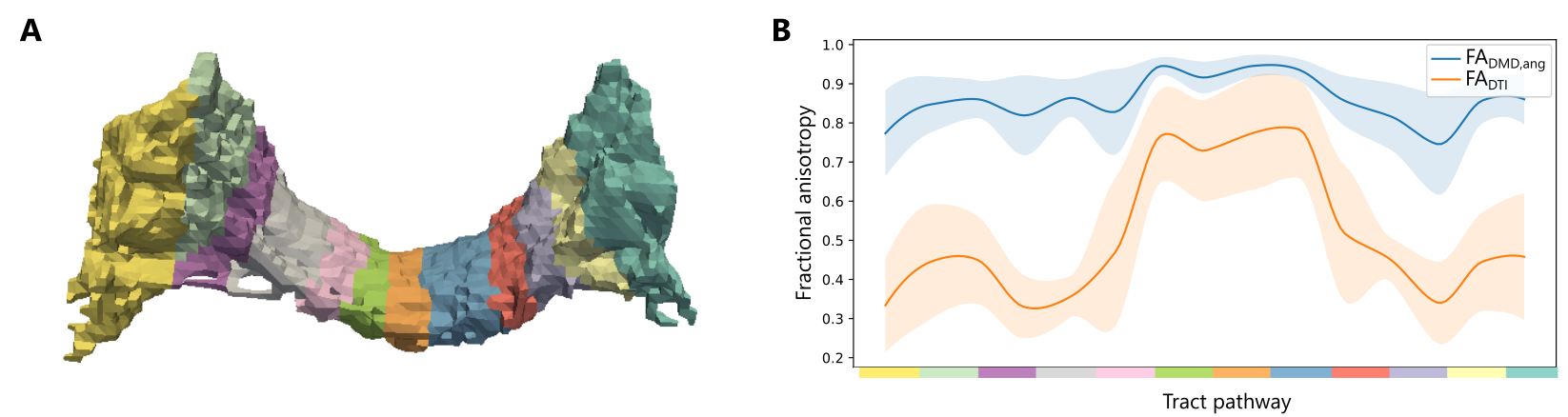
The mean trajectory and perpendicular planes previously computed for the streamline filtering can be leveraged to segment the tract ROI into subsections (Fig.4A) to provide along-tract analyses of microstructural metrics (Fig.4B). To illustrate, the fractional anisotropy (FA) of a bundle of the corpus callosum was estimated with a single-fixel (DTI9)$$$~FA_{\textit{DTI}}~$$$and multi-fixel model (DIAMOND10)$$$~FA_{\textit{DMD}}~$$$with UNRAVEL11 to visualize the impact of crossing fibers on metric estimation.
Results & Discussion
The arcuate fasciculus (AF) shown in Fig.5A had a high number of streamlines and presented a complex shape with multiple end regions. The computation time of RFBC and BundleCleaner greatly increased with the number of streamlines. Furthermore, RFBC resulted in the loss of most of the AF's shape. Our proposed method removed spurious streamlines while preserving more of the shape of the AF compared to other techniques. The uncinate fasciculus displayed in Fig.5B had a low number of streamlines and presented spurious streamlines at the top, which all methods successfully eliminated. However, density thresholding and CCI removed many coherent streamlines due to the low density of the tract. Regarding the corpus callosum bundle shown in Fig.5C, all methods yielded similar outcomes, with varying degrees of streamline removal.The along-tract analysis on Fig.4 highlighted the benefit of multi-fixel analysis in comparison to single-fixel models, such as DTI. With$$$~FA_{\textit{DTI}}$$$, a decrease in values was observed at the beginning and end of the tract, due to the presence of crossing fibers in the left and right hemispheres. Conversely, in the middle of the tract where a single fiber population exists, the results aligned more closely with the values obtained through$$$~FA_{\textit{DMD,ang}}$$$.
Conclusion
The proposed method demonstrated a conservative filtering with a low computation time, making it well-suited for tracts with a high number of streamlines and tracts of low density. Certain areas require further improvement, such as refining the removal of spurious streamlines within non-linear fascicles. Nonetheless, the algorithm should prove to be valuable for individuals seeking to filter spurious streamlines while preserving the tract morphology and to perform along-tract analyses with multi-fixel models.Acknowledgements
No acknowledgement found.References
1. Klaus H. et al. The challenge of mapping the human connectome based on diffusion tractography. Nature Communications, 8(1):1349, 6 November 2017.
2. Kurt G. Schilling, Chantal M. W. Tax, Francois Rheault, Bennett A. Land-man, Adam W. Anderson, Maxime Descoteaux, and Laurent Petit. Prevalence of white matter pathways coming into a single white matter voxel orientation: The bottleneck issue in tractography. Human Brain Mapping, 43(4):1196–1213, March 2022.
3. Nicolas Delinte. DelinteNicolas/UNRAVEL: v1.4.9, September 2023.10.5281/ZENODO.7753501.
4. Stephan Meesters, G Sanguinetti, Eleftherios Garyfallidis, J Portegies, P Ossenblok, and R Duits. Cleaning output of tractography via fiber to bundle coherence, a new open source implementation. Human Brain Mapping Conference 2016, 2016.
5. Kesshi M. Jordan, Bagrat Amirbekian, Anisha Keshavan, and Roland G.Henry. Cluster Confidence Index: A Streamline-Wise Pathway Reproducibility Metric for Diffusion-Weighted MRI Tractography. Journal of Neuroimaging, 28(1):64–69, January 2018.
6. Yixue Feng, Bramsh Q. Chandio, Julio E. Villalon-Reina, Sophia I. Thomopoulos, Himanshu Joshi, Gauthami Nair, Anand A. Joshi, Ganesan Venkatasubramanian, John P. John, and Paul M. Thompson. BundleCleaner : Unsupervised Denoising and Subsampling of Diffusion MRI-Derived Tractography Data. preprint, Neuroscience, August 2023.
7. Ben Jeurissen, Jacques-Donald Tournier, Thijs Dhollander, Alan Connelly,and Jan Sijbers. Multi-tissue constrained spherical deconvolution for improved analysis of multi-shell diffusion MRI data. NeuroImage, 103:411–426, December 2014.
8. Jacques-Donald Tournier, F. Calamante, and Alan Connelly. Improved probabilistic streamlines tractography by 2nd order integration over fibre orientation distributions. Proc. Intl. Soc. Mag. Reson. Med. (ISMRM), 18, January 2010.
9. P.J. Basser, J. Mattiello, and D. Lebihan. Estimation of the Effective Self-Diffusion Tensor from the NMR Spin Echo. Journal of Magnetic Resonance,Series B, 103(3):247–254, March 1994.
10. Benoit Scherrer, Armin Schwartzman, Maxime Taquet, Mustafa Sahin, Sanjay P. Prabhu, and Simon K. Warfield. Characterizing brain tissue by assessment of the distribution of anisotropic microstructural environments in diffusion-compartment imaging (DIAMOND): Characterizing Brain Tissue with DIAMOND. Magnetic Resonance in Medicine, 76(3):963–977, September 2016.
11. Nicolas Delinte, Laurence Dricot, Benoit Macq, Claire Gosse, Marie Van Reybroeck, and Gaetan Rensonnet. Unraveling multi-fixel microstructure with tractography and angular weighting. Frontiers in Neuroscience,17:1199568, June 2023.
Figures