2136
Impact of Fiber Segmentation Methods on Fiber Quantification Reliability1Polytechnic Institute, Zhejiang University, Hangzhou, China, 2Center for Brain Imaging Science and Technology, Zhejiang University, Hangzhou, China, 3Research Center for Healthcare Data Science, Zhejiang Lab, Hangzhou, China, 4Wellcome Centre for Integrative Neuroimaging, FMRIB Centre, Nuffield Department of Clinical Neurosciences, University of Oxford, London, United Kingdom, 5College of Biomedical Engineering and Instrument Science, Zhejiang University, Hangzhou, China, 6School of Physics, Zhejiang University, Hangzhou, China, 7State Key Laboratory of Brain-Machine Intelligence, Zhejiang University, Hangzhou, China
Synopsis
Keywords: Data Processing, Data Analysis, fiber quantification, tract segmentation, reliability
Motivation: The reliability of fiber quantification depends on the quality of the fiber tract reconstruction, which is influenced by the method used for fiber segmentation.
Goal(s): Our objective was to assess the reliability of different fiber segmentation methods and determine the most suitable strategy for the specific bundle.
Approach: We compared the distributions of intra-class coefficient (ICC) for different measurements and tracts across three widely used fiber segmentation methods. This analysis was conducted using the traveling subject dataset. The results are presented along with examples, followed by a discussion of the underlying reasons.
Results: We summarized the advantageous strategies for main tracts.
Impact: This strategy aims to enhance the stability of study results by facilitating the selection of more efficient segmentation methods for conducting fiber-specific quantification in the future.
INTRODUCTION
In recent years, fiber quantification has gained popularity as a method for accurately characterizing microstructural information along fiber tracts in the individual brain1,2. The fiber quantification pipeline typically involves three steps: fiber segmentation, metric estimation, and quantification3–6. The quality of fiber tract reconstruction, which affects fiber quantification, depends on the segmentation method employed. However, there is currently a lack of reliability comparisons for fiber quantification among different segmentation methods.In this study, we compared the reliability of quantification for microstructural metrics derived from DTI and NODDI using three established methods: AFQ7, TractSeg8, and RecoBundle9. Based on our findings, we propose a strategy for selecting fiber bundle segmentation methods based on the reliability of their quantification results. This strategy aims to enhance the stability of fiber quantification by facilitating the selection of more efficient segmentation methods for conducting fiber-specific quantification in the future.
METHODS
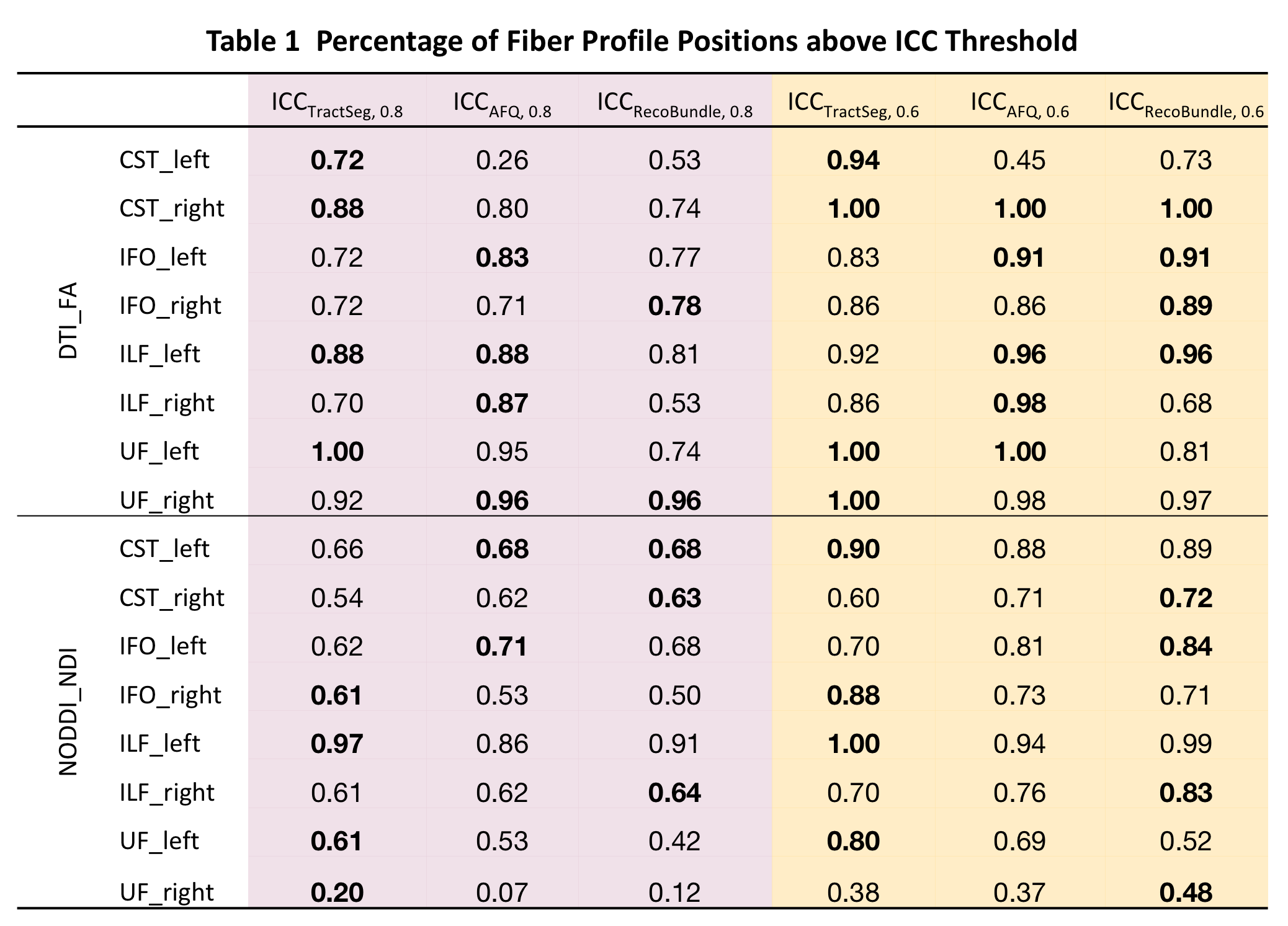
We used multicenter datasets10 with eight centers and three traveler subjects. T1-weighted MRI and multi-shell (b = 1000, 2000, 3000 s/mm²) diffusion MRI data were acquired. The Multi-shell multi-tissue constrained spherical deconvolution (MSMT-CSD) model was utilized to reconstruct fiber orientation distributions (FODs) using MRtrix3 software. Fiber segmentation was performed using three strategies: TractSeg, AFQ, and RecoBundle. Both AFQ and RecoBundle were based on the same whole brain tractography. Eight tracts in common were finally reconstructed, including the left and right corticospinal tracts (CST), the left and right inferior fronto-occipital fasciculus (IFO), the left and right inferior longitudinal fasciculus (ILF), and the left and right uncinate fasciculus (UF). Both DTI- and NODDI-derived parameters were estimated using DIPY 1.7.0 and dmri-amico packages. Profiles with 100 nodes were generated between pairs of waypoints for each metric and tract by applying the AFQ algorithm using pyAFQ2.A "two-way random effects, absolute agreement, multiple raters" intraclass correlation coefficient (ICC)11 was selected to assess the reliability of each position of profiles. We finally compared the distributions of ICC for different measurements and tracts across three fiber segmentation methods. This was followed by examples and a discussion of the reasons. In each case, the percentage of nodes with ICC>0.6 and ICC>0.8 was calculated separately, marked as ICCmethod,0.8.and ICCmethod,0.6.
RESULTS
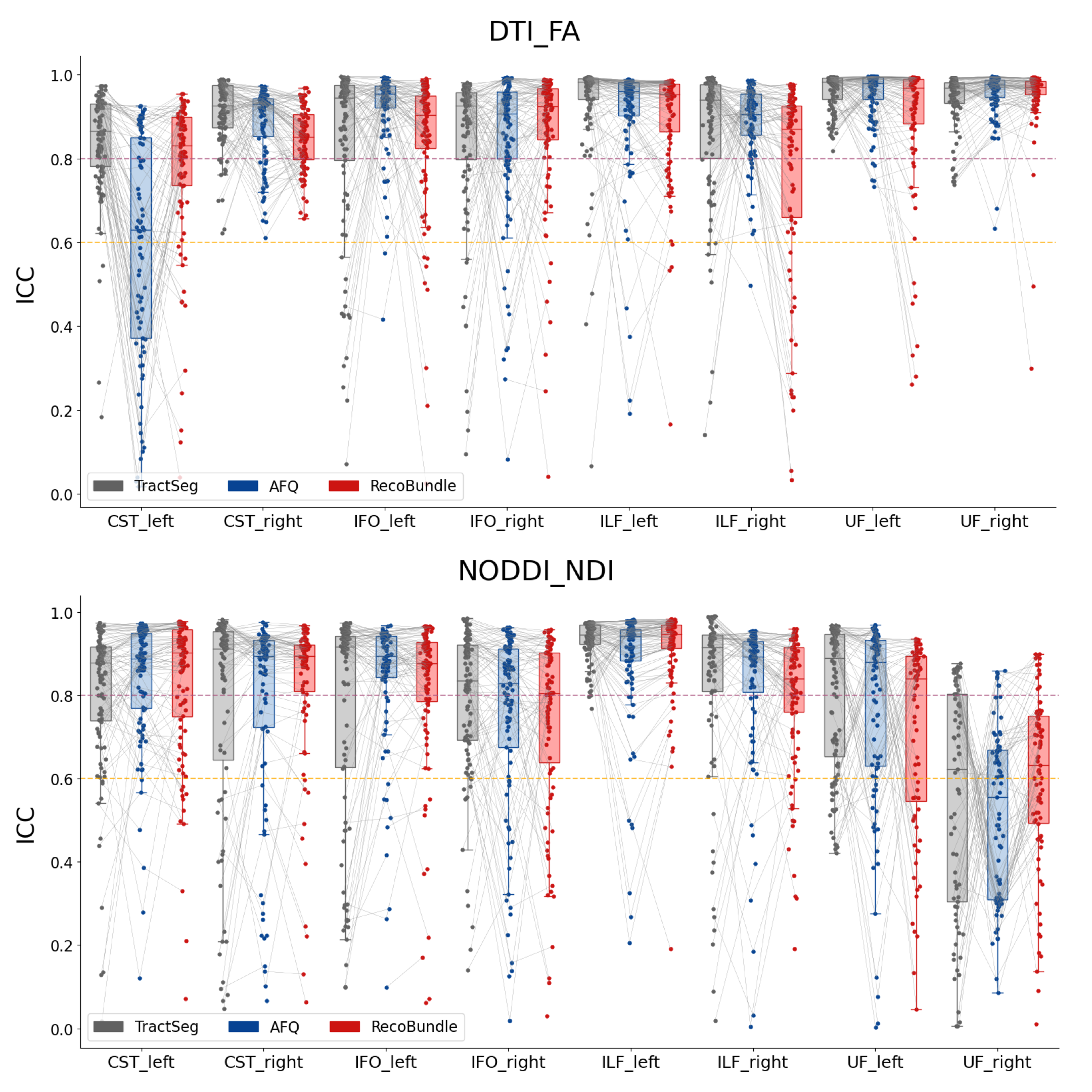
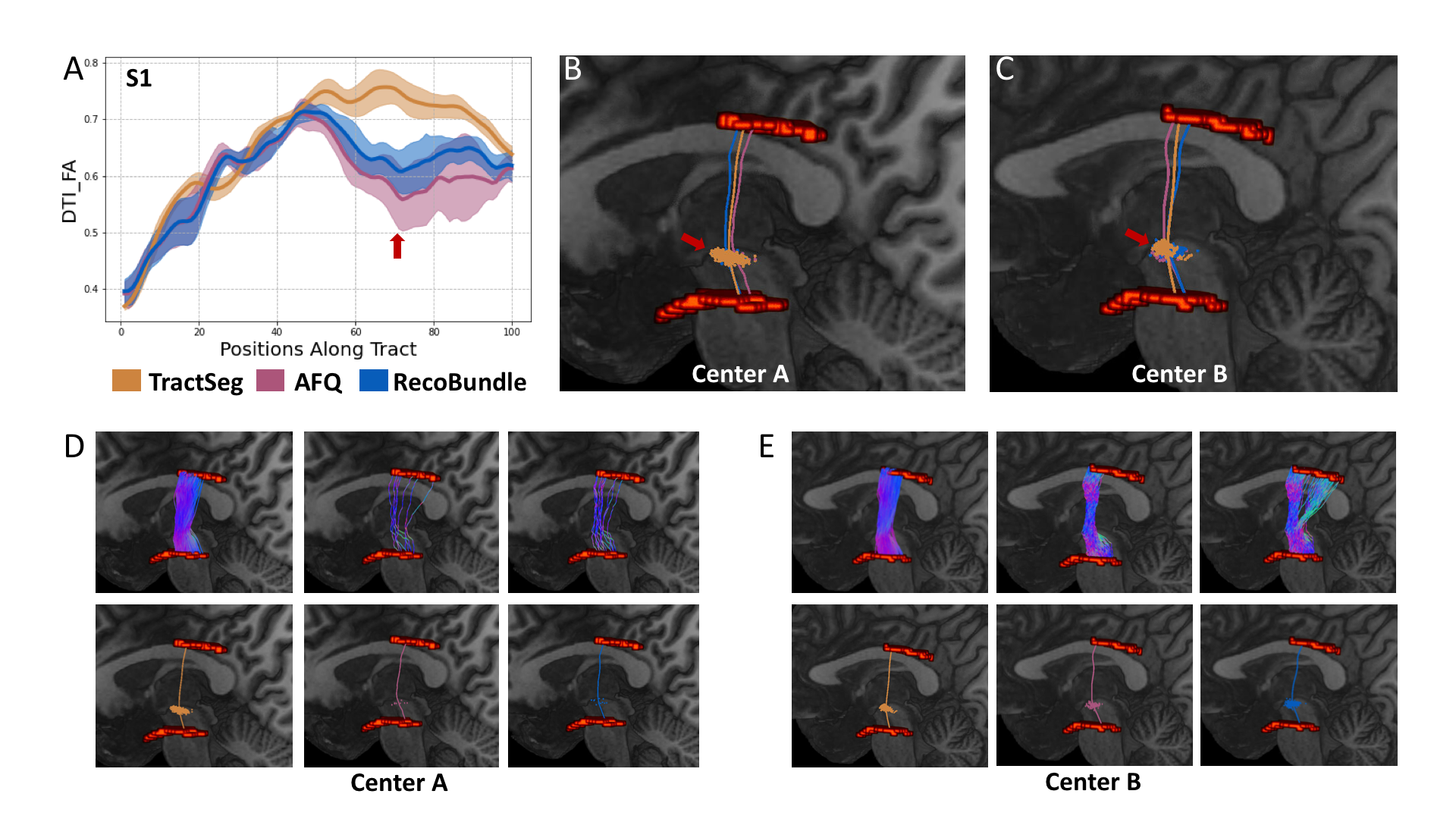
Reliability of different methods in relation to the specificity of tracts and measurements. Figure 1 shows the distribution of ICCs across the methods with 100 nodes on each tract. For the quantification of fractional anisotropy (FA), TractSeg showed better reliability than the other two methods for left CST, right CST, and left UF. When examining the left IFO and right ILF, the AFQ method yielded a relatively higher percentage of reliable positions. On the other hand, the RecoBundle method demonstrated a higher percentage of reliable positions for the right IFO. The other fiber tracts and metrics, and the relevant predominant methods have been highlighted in bold in Table 1.The reliability of fiber quantification is affected by the consistency of fiber bundle morphology among centers. For the left CST, the fiber quantification of TractSeg is more reliable (ICCTractSeg,0.8=0.72) than the other two (ICCAFQ,0.8=0.26, ICCRecoBundle0.8=0.53). This is linked to the fact that TractSeg obtains full left IFO morphology in all the centers (Figure 2D and Figure 2E), while AFQ and RecoBundle have sparse fiber bundles in some centers causing under-sampling of nodes (Figure 2D) and resulting in between-center variations.
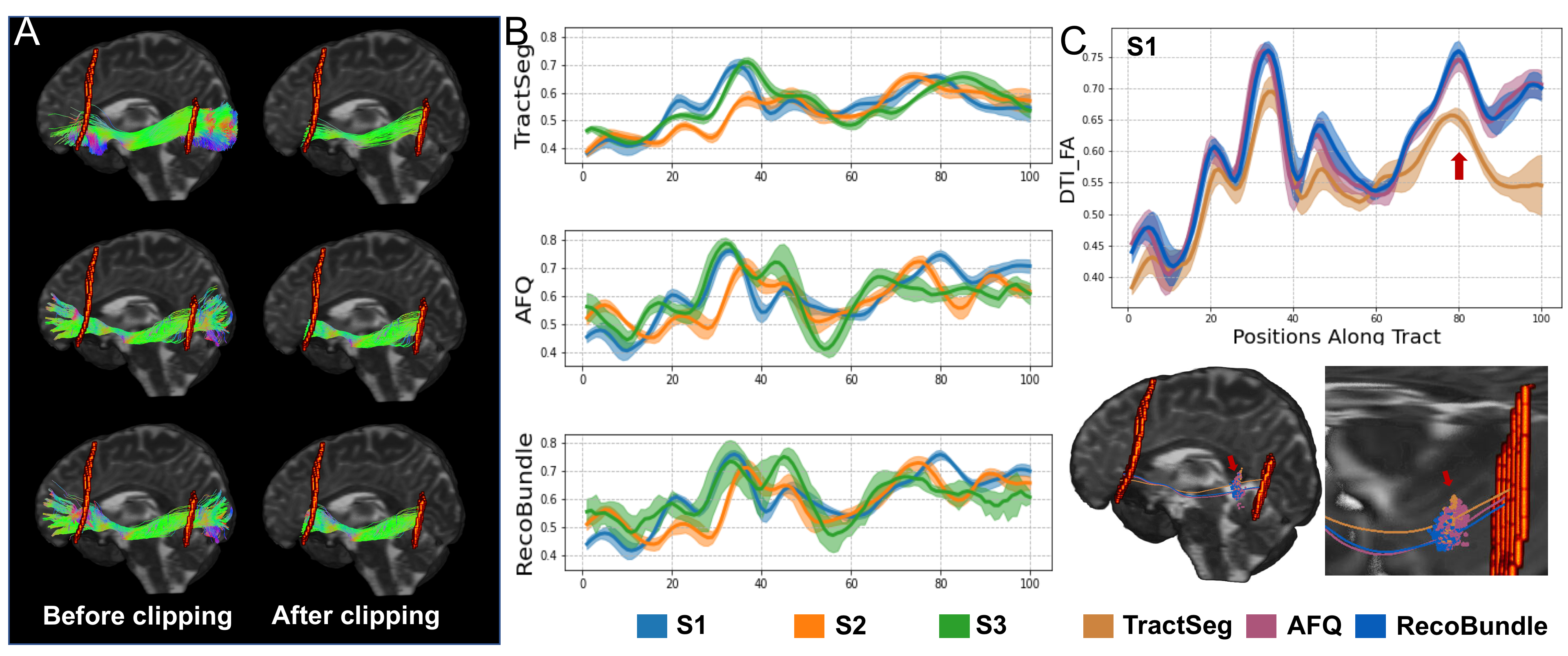
Our study found that the three methods have similar reliability for quantifying some fiber bundles, but they produce substantially different results. For instance, TractSeg segmentation leads to different morphology for the left IFOF (Figure 3), affecting core fiber, cross sections, and quantification results. These morphology differences result from using different tract atlases, emphasizing the significance of considering fiber bundle template accuracy when selecting segmentation methods.
CONCLUSIONS
This work provides a comprehensive analysis of various fiber segmentation methods and their impact on the reliability of fiber quantification within different tracts. Our results highlight advantageous strategies that ultimately aid in selecting the most effective approach for fiber segmentation. It is important to note that certain confounding variables, such as the quality of whole-brain tractography and the accuracy of microstructural parameter estimation, were not considered in our analysis and may affect reliability. Additionally, lower intra-class correlation coefficients observed at specific locations may be attributed to smaller sample sizes and similarities between subjects.Acknowledgements
This study was funded by the National Natural Science Foundation of China (82372036) and the Fundamental Research Funds for the Central Universities (226-2023-00095).References
1. Wang D, Fan Q, Xiao X, He H, Yang Y, Li Y. Structural Fingerprinting of the Frontal Aslant Tract: Predicting Cognitive Control Capacity and Obsessive-Compulsive Symptoms. J Neurosci. 2023;43(42):7016-7027.
2. Zhang F, Daducci A, He Y, et al. Quantitative mapping of the brain’s structural connectivity using diffusion MRI tractography: a review. NeuroImage. Published online January 2022:118870.
3. Yeatman JD, Dougherty RF, Myall NJ, Wandell BA, Feldman HM. Tract Profiles of White Matter Properties: Automating Fiber-Tract Quantification. PLoS One. 2012;7(11):e49790.
4. Kruper J, Yeatman JD, Richie-Halford A, et al. Evaluating the Reliability of Human Brain White Matter Tractometry. Apert Neuro. 2021;1(1):25.
5. Chandio BQ, Risacher SL, Pestilli F, et al. Bundle analytics, a computational framework for investigating the shapes and profiles of brain pathways across populations. Sci Rep. 2020;10(1):17149.
6. Colby JB, Soderberg L, Lebel C, Dinov ID, Thompson PM, Sowell ER. Along-tract statistics allow for enhanced tractography analysis. NeuroImage. 2012;59(4):3227-3242.
7. Yeatman J, Rokem A. pyAFQ: Automated Fiber Quantification in Python. Published online July 2021.
8. Wasserthal J, Neher P, Maier-Hein KH. TractSeg - Fast and accurate white matter tract segmentation. NeuroImage. 2018;183:239-253.
9. Garyfallidis E, Côté MA, Rheault F, et al. Recognition of white matter bundles using local and global streamline-based registration and clustering. NeuroImage. 2018;170:283-295.
10. Tong Q, He H, Gong T, et al. Multicenter dataset of multi-shell diffusion MRI in healthy traveling adults with identical settings. Sci Data. 2020;7(1):157.
11. Bartko JJ. The Intraclass Correlation Coefficient as a Measure of Reliability. Psychol Rep. 1966;19(1):3-11.
Figures