2114
Accelerating KalmanNet using POD: Real-time 3D MR-thermometry for monitoring microwave ablation procedures1Department for Diagnostic and Interventional Radiology, Hanover Medical School, Hannover, Germany, 2STIMULATE Research Campus, Magdeburg, Germany
Synopsis
Keywords: Analysis/Processing, Thermometry
Motivation: Noise is a challenge for real-time MR-thermometry. The Extended Kalman Filter (EKF) has been shown to reduce noise successfully in temperature maps.
Goal(s): We modified KalmanNet, a recurrent neural network emulating an EKF, using a proper orthogonal decomposition (POD) to reduce computational cost.
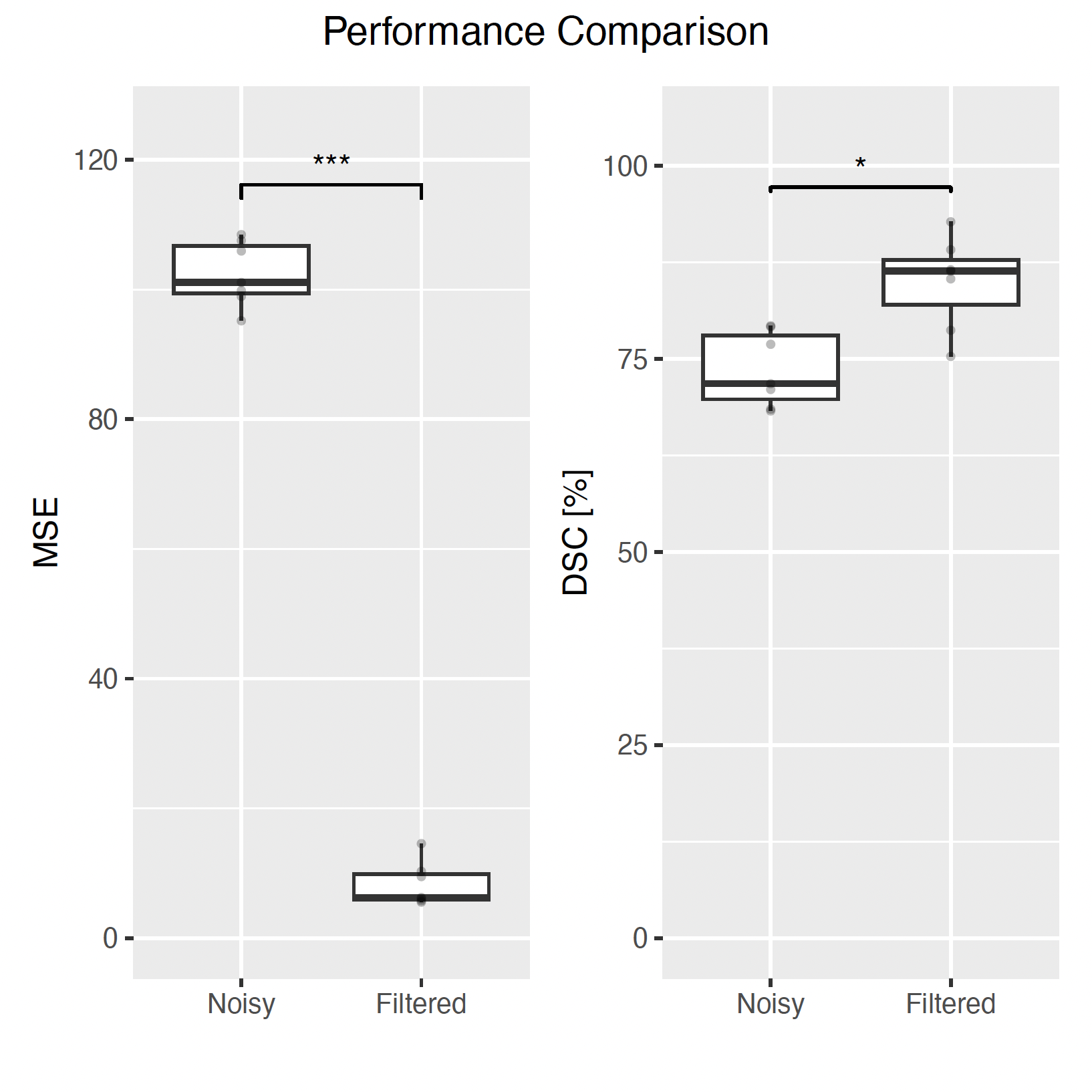
Approach: POD-KalmanNet was applied to microwave ablations of 14 bioprotein phantoms. Mean squared errors (MSE) and Sørensen-Dice-Coefficient (DSC) were compared between noisy and filtered data.
Results: Results show a highly significant reduction of MSE (p < 0.001) and a significant increase of DSC (p < 0.05) for filtered images compared to noisy images. POD-KalmanNet could enable real-time filtering of MR-Thermometry.
Impact: KalmanNet was modified using proper orthogonal decomposition. This modification allows lower memory usage and inference times. It makes the application of KalmanNet to 3D temperature maps practically feasible. Reducing noise in 3D temperature maps can improve outcomes of thermoablation procedures.
Purpose
MR-thermometry using the proton resonance frequency shift (PRFS) can be used to intraoperatively monitor thermoablation procedures such as microwave ablation (MWA) [1]. Thermal dose models such as the CEM43 model are used to estimate the ablation zone [2]. One of the challenges for real-time monitoring is noise due to electromagnetic interference or undersampled data resulting in a tradeoff between computation time and accuracy of the ablation zone estimation. Filters such as the Extended Kalman Filter (EKF) have been shown to reduce noise successfully in temperature maps [3]. However, the high computational effort makes it unsuitable for real-time monitoring. Revach et al. [4] have proposed a variation of the EKF aided by a recurrent neural network called KalmanNet. It was shown to be more robust to model mismatch while achieving an accuracy similar to the EKF.While KalmanNet applied to MR-Thermometry offers faster computations than the EKF, it cannot filter entire 3D temperature maps due to high memory requirements and long inference times [5]. We modified KalmanNet using a proper orthogonal decomposition (POD) [6] to reduce state space and the underlying simulated process in hopes of achieving accurate real-time filtering of 3D temperature maps.Material and Methods
While maintaining the structure of the original KalmanNet, we adapted the input and output vectors to fit the task of correcting 3D temperature maps. Penne’s bioheat transfer equation (BHTE) [7] was employed as the predictive model of heat distribution within the tissue. It was solved numerically using a Runge-Kutta-Integration whereas previous iterations of the KalmanNet used an analytical solution using the Fourier-Transform [5]. The power input for the BHTE was computed using a simulation of the electromagnetic field of a microwave ablation needle using Comsol Multiphysics (Comsol AB, Sweden).Microwave ablation was performed on 14 polyacrilamide phantoms and monitored with PRFS-based MR thermometry using a kz-accelerated multi-echo 3D Stack-of-Stars sequence (echo times (TE): 1.2 ms - 10.5 ms, repetition time (TR): 14.5 ms, slice thickness: 2.5 mm, bandwidth: 1090 Hz / pixel, flip angle (FA): 15°, field of view (FOV): 320 x 320 mm², and matrix size: 128 x 128) [8]. The resulting scan was used as ground truth for the evaluation of the KalmanNet. Gaussian noise with a standard deviation that was uniformly sampled between 19.5°C – 20.5°C to account for inaccurate observation noise estimation was added to the data to emulate measurement noise. 24 slices of a 32x32 pixel region around the ablation zone were used from each phantom for training and testing. 7 phantoms were used as training data and 7 as test data. POD basis vectors for the reduced state space were computed on the time series of noisy data. The 5% of basis vectors containing most information were selected to represent the reduced state space. Mean squared errors (MSE) were computed using the difference between temperature maps averaged over all voxels and time points. Dice-Sørensen-Coefficients (DSC) were computed using necrosis maps computed with the CEM43 model with a thermal dose threshold of 240. A paired t-test (a = 0.05) was used to compare MSEs and DSCs of noisy data to filtered data. Inference time was measured for the test data on a system with a 12x 2.1 GHz CPU with 128 GB RAM and a NVIDIA Quadro RTX A6000 GPU with 48 GB VRAM.Results
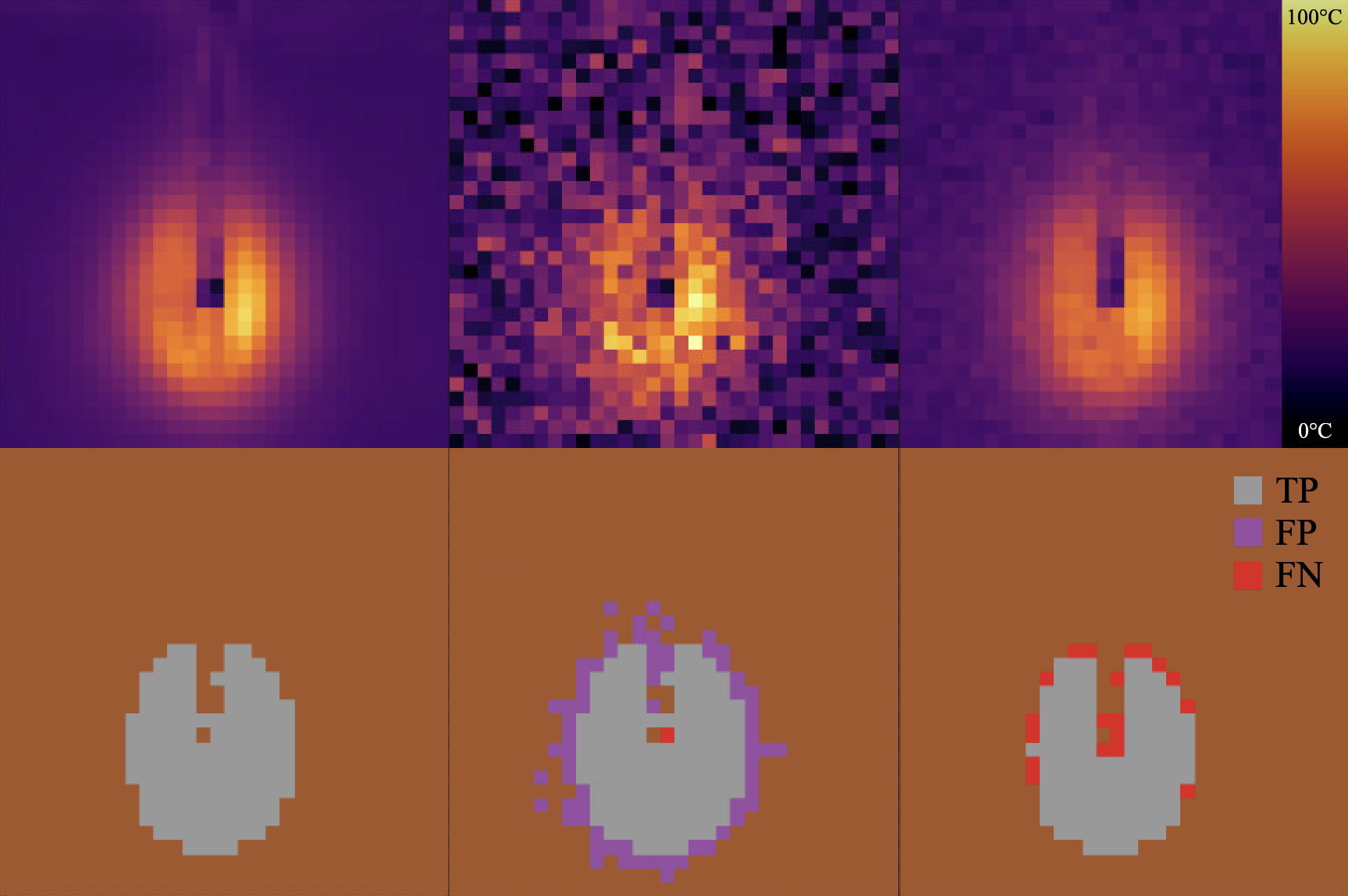
MSEs were significantly different with 102.43±4.6 for the noisy and 8.27±3.11 for the filtered data (p < 0.001). DSCs were significantly different with 73.57%±4.45% for the noisy and 84.9%±5.54% for the filtered data (p < 0.05). Example images are shown in Fig. 1 and scores in Fig. 2. Average inference time of the KalmanNet was 2.64s per time series or 0.048s per 32x32x24 temperature map.Discussion/Conclusion
An additional POD allows KalmanNet to process bigger amounts of data in real-time. It significantly reduces noise and significantly increases the accuracy of necrosis zone predictions. A previous evaluation using EKF and KalmanNet without POD [5] showed inference times of 0.39s and 0.07s for a single 22x24 pixel image. Comparing computation times per pixel the POD results in a 378x and 68x speedup relative to the EKF and KalmanNet, respectively. POD-KalmanNet could potentially enable true real-time monitoring and filtering of MR-thermometry improving ablation zone estimation. An application of the KalmanNet to patient data would allow for more significant conclusions regarding the feasibility of this method in clinical practice.Acknowledgements
This work was funded by the Federal Ministry of Education and Research within the Research Campus STIMULATE under the number ‘13GW0473A’ and ‘13GW0473B’.References
[1] Rieke and Butts Pauly.: MR thermometry. J. Magn. Resonance Imag. 2008; 27:376-90.
[2] Sapareto and Dewey: Thermal dose determination in cancer therapy. Int. J. Radiat. Oncol. Biol. Phys. 1984; 10:787-800.
[3] de Senneville et al.: Extended Kalman Filtering for Continuous Volumetric MR-Temperature Imaging. IEEE Transaction Med. Imag. 2013; 32:711-718.
[4] Revach et al.: KalmanNet: Neural Network Aided Kalman Filtering for Partially Known Dynamics. IEEE Transactions Signal Proc. 2022; 70:1532-1547.
[5] Schröer et al.: KalmanNet in MR-Thermometry: A step towards accurate real-time 3D monitoring of thermoablation procedures. RSNA 2022.
[6] VilasBoas-Ribeiro et al.: POD–Kalman filtering for improving noninvasive 3D temperature monitoring in MR-guided hyperthermia. Med. Physics 2022; 49;4955-4970.
[7] Pennes.: Analysis of Tissue and Arterial Blood Temperatures in the Resting Human Forearm. J. Applied Physiol. 1948; 1:93-122.
[8] Svedin et al.: Multiecho pseudo-golden angle stack of stars thermometry with high spatial and temporal resolution using k-space weighted image contrast. Magn. Resonance Med. 2018; 79:1407–1419.
Figures