2101
Semi-supervised segmentation method based on a small number of labeled left atria1Center for Biomedical Imaging Research, Department of Biomedical Engineering, Tsinghua University, BeiJing, China, 2Department of Biomedical Engineering, Tsinghua University, BeiJing, China, 3Beijing Tsinghua Changgung Hospital, BeiJing, China
Synopsis
Keywords: Analysis/Processing, Segmentation, left atria; semi-supervised
Motivation: The study aims to propose segmentation models and explore the impact of the proposed model on small models and the impact of the proportion and amount of different labeled data on the results.
Goal(s): The goal of this study is to achieve better results with less labeled data.
Approach: The study builds a model and evaluates the performance of the model on different sizes of left atria labeled data.
Results: The method proposed in this study can improve the effect of small models, and reducing the labeled data proportion has a greater impact on the model performance than reducing the training data.
Impact: This study provides help for how to improve the medical image segmentation performance of small models, improve the efficiency of manual labeling, and achieve better segmentation results with fewer manual annotations.
Introduction
Semi-supervised medical image segmentation is an important research field that aims to help doctors diagnose and treat diseases more accurately. In medical image segmentation, especially for LA segmentation, traditional supervised learning methods usually require a large amount of labeled data, but these data are usually difficult to obtain and the labeling cost is high in the medical field. Semi-supervised learning provides a way to compensate for the lack of labeled data by using both labeled and unlabeled data to train a deep learning model, thereby improving segmentation accuracy. This paper designs a network framework based on Mean Teacher1 architecture, explores the impact of this framework on small parameter models, and evaluates the impact of different proportions of labeled data on segmentation performance.Methods
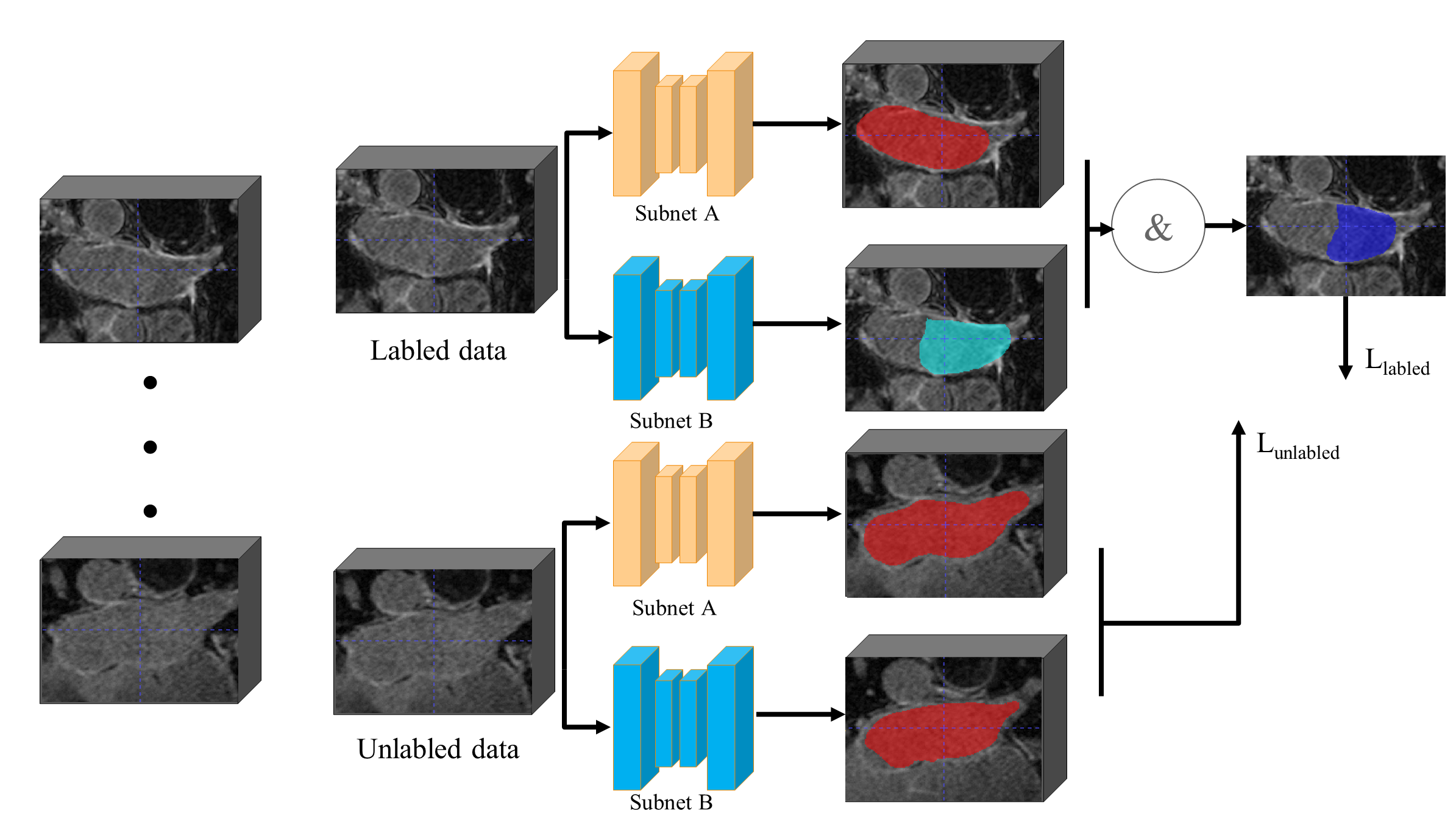
Wang et al. introduced a novel mutual correction framework (MCF) to explore network bias correction and improve the performance of semi-supervised medical image segmentation2. In Wang’s approach, a contrastive difference review (CDR) module is proposed to find out inconsistent prediction regions and perform a review training. In our work, we used a dataset of 80 manually labeled LA3, and the dataset was divided into test and training data in a ratio of one to four. To evaluate the accuracy of different proportions of labeled data for the prediction of our method based on the Mean Teacher framework, we used different proportions and different amounts of labeled data as training data and evaluated its effect. In Wang's work, the networks they use are 3D-ResVNet and Vnet and the ratio of labeled and unlabeled data is one to four. In our work, to improve the performance of the small parameter subnetwork, we take the intersection of the output of the two subnetworks at the input labeled data side to calculate the correction, to improve the segmentation performance of the small parameter subnetwork. To evaluate the effect of this part, we use Unet and Vnet, which have a large difference in the number of used parameters, as subnetworks. Our framework for LA segmentation can be illustrated in Figure 1. This framework is implemented by PyTorch with an NVIDIA V100 GPU. Specifically, the SGD optimizer is used to update the network parameters with weight decay 0.0001, and momentum 0.9. The initial learning rate is 0.01 and is divided by 10 after every 2500 iterations for a total of 6000 iterations. The batch size is 4, which includes 2 labeled data volumes and 2 unlabeled volumes. We use four metrics to evaluate model performance, including regional sensitive metrics: Dice similarity coefficient (Dice), Jaccard similarity coefficient (Jaccard), and edge sensitive metrics: 95% Hausdorff Distance (95HD) and Average Surface Distance (ASD).Results
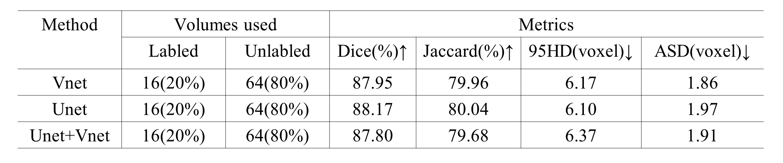
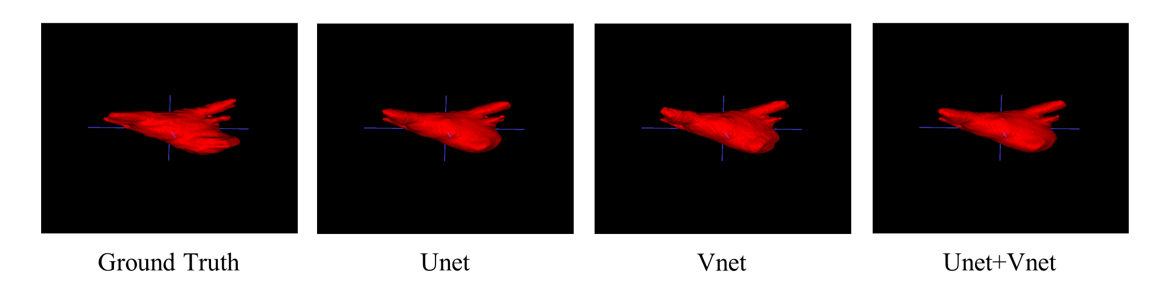
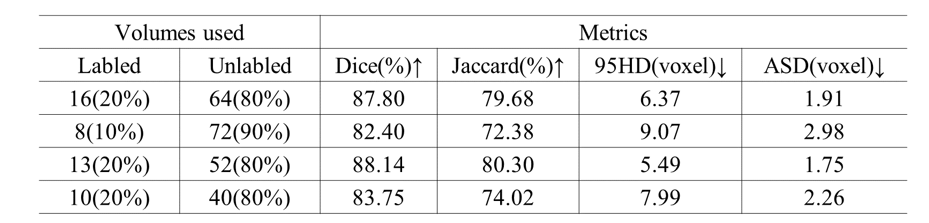
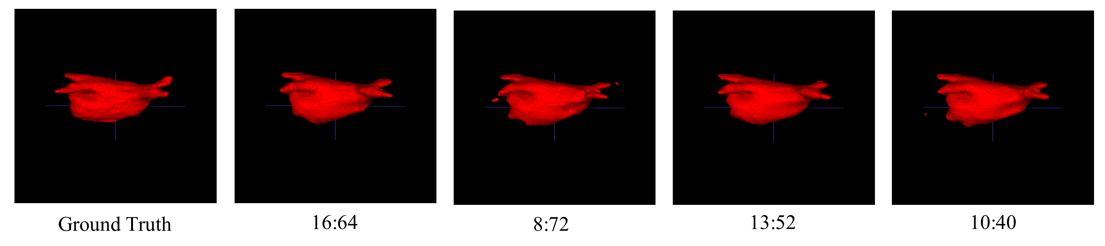
The LA dataset includes 100 3D gadolinium-enhanced MR imaging volumes with an isotropic resolution of 0.625 × 0.625 × 0.625mm3 and the corresponding ground truth labels. In the LA dataset, we use 20 data as test data, and the training data are 20% labeled data and different proportions and amounts of labeled data, respectively. Figure 2 shows the quantitative results in the case of 80 training data, and 20% labeled data. In Figure 2 we can see that the segmentation ability of the smaller Unet is higher than that of the Vnet and the hybrid network of both. Figure 3 shows the 3D segmentation effect under 20% labeled on the LA dataset. Figure 4 shows the effect of different proportions and amounts of labeled data on the performance of the model. As can be seen in Figure 4, reducing the labeled data proportion has a greater impact on the model performance than reducing the training data. Figure 5 shows the 3D segmentation effect of the results with different proportions and amounts of labeled data.Conclusions
In this study, we designed the model based on the Mean Teacher structure to improve the performance of the small parameter model. Moreover, the influence of different proportions and numbers of labeled data on the performance of the model is evaluated.Acknowledgements
No acknowledgement found.References
[1] Tarvainen, A., & Valpola, H. (2017). Mean teachers are better role models: Weight-averaged consistency targets improve semi-supervised deep learning results. Advances in neural information processing systems, 30.
[2] Wang, Y., Xiao, B., Bi, X., Li, W., & Gao, X. (2023). MCF: Mutual Correction Framework for Semi-Supervised Medical Image Segmentation. In Proceedings of the IEEE/CVF Conference on Computer Vision and Pattern Recognition (pp. 15651-15660).
[3] Xiong, Z., Xia, Q., Hu, Z., Huang, N., Bian, C., Zheng, Y., ... & Zhao, J. (2021). A global benchmark of algorithms for segmenting the left atrium from late gadolinium-enhanced cardiac magnetic resonance imaging. Medical image analysis, 67, 101832.
Figures