2060
The changes of brain metabolism after spinal manipulation in patients with chronic nonspecific low back pain: a MRS study1Department of Radiology, Shuguang Hospital Affiliated to Shanghai University of Traditional Chinese Medicine, Shanghai, China, 2MR research Collaboration, Siemens Healthineers Ltd, Shanghai, China
Synopsis
Keywords: Functional/Dynamic, Spectroscopy
Motivation: Bridge the knowledge gap in understanding the central mechanisms of chronic low back pain (CLBP) and the effects of spinal manipulation (SM).
Goal(s): To use 1H-MRS to investigate metabolic differences in the posterior cingulate cortex (PCC) during spinal manipulation for chronic low back pain (CLBP).
Approach: The approach involved recruiting CLBP patients and healthy controls, performing 1H-MRS in the posterior cingulate cortex (PCC) before and after spinal manipulation (SM), and correlating metabolite changes with clinical outcomes.
Results: CLBP patients exhibited altered brain metabolism in the posterior cingulate cortex (PCC), with changes in specific metabolites, and these abnormalities improved after spinal manipulation (SM).
Impact: The research provides insights into the central mechanisms of chronic low back pain (CLBP) and the potential therapeutic benefits of spinal manipulation, which could inform better pain management strategies.
Introduction
Chronic low back pain (CLBP) is a common and debilitating condition with complex underlying mechanisms. Spinal manipulation (SM) is among the widely used non-pharmacological approaches for managing CLBP, providing relief through multiple physiological and psychological mechanisms. However, the central mechanisms of how SM exerts its pain-relieving effects remain poorly understood. Considering this knowledge deficit, we aimed to investigate the metabolic differences in the posterior cingulate cortex (PCC) between the chronic low back pain (CLBP) group and the healthy control (HC) group using 1H-magnetic resonance spectroscopy (1H-MRS). Additionally, we sought to dynamically monitor PCC metabolite changes in CLBP patients at different time points during SM and explore the central mechanisms behind SM's pain relief effects.Methods
Thirty CLBP patients (CLBP group) and 30 healthy volunteers (HC group) with matched sex and age were recruited. All patients are from the Department of Orthopedics and manipulation at our hospital between January and December 2021. The CLBP group received six times SM (25min each, twice a week, in three weeks) within a 20-days period. Clinical evaluation, including visual analogue scale (VAS), Chinese Short Form Oswestry Disability Index (C-SFODI) and 1H MRS in PCC were conducted at various time points: before SM (baseline, T1), after the first (day 1, T2), the third (day 10, T3), and the sixth (day 20, T4) SM. HC group didn’t receive any intervention and only was performed four times 1H-MRS examinations at the same time point as the CLBP group. LCmodel software was used to process the data of 1H MRS with water suspension and without water suspension. Two sample t-test was used to find the difference between CLBP and HC group at baseline. One Way Anova was used to differentiate the different metabolism among different time points in CLBP and HC group. Pearson method was used to analyze the correlation between metabolite concentration with statistical difference and clinical scale score or change rate.Results
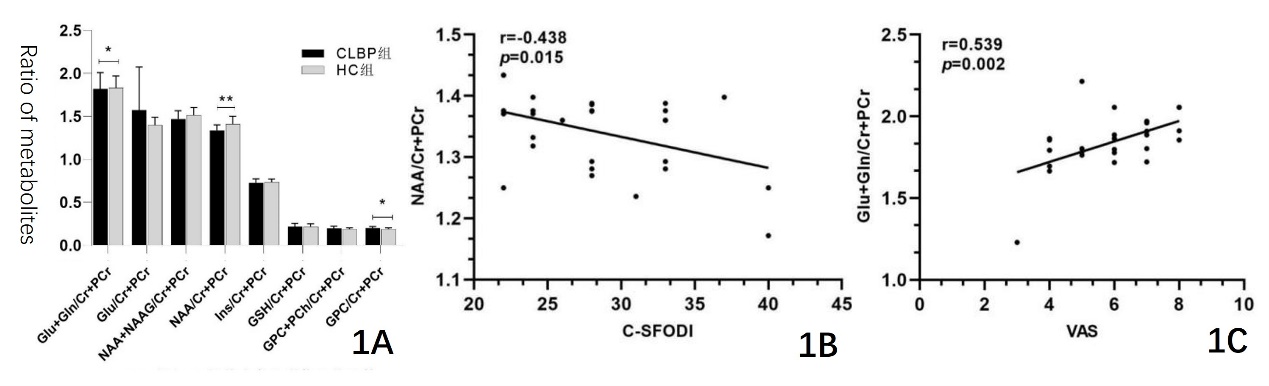
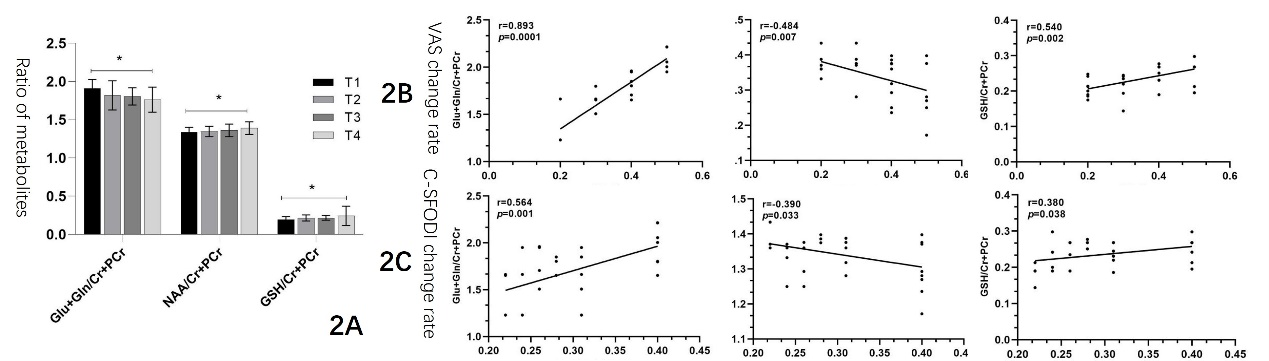
At baseline, Glu+Gln/Cr+PCr and GPC/Cr+PCr values in CLBP group were higher than those in HC group (P<0.05), NAA/Cr+PCr values in CLBP group were lower than those in HC group (P<0.05). Glu+Gln/Cr+PCr value (r=0.539, P=0.002) was positively correlated with VAS in CLBP group, while NAA/Cr+PCr value (r=-0.438, P=0.015) was negatively correlated with C-SFODI in CLBP group. The value of Glu+Gln/Cr+PC in CLBP group at baseline was higher than that after sixth SM (P<0.05), and GSH/Cr+PCr and NAA/Cr+PCr values at baseline in CLBP group were lower than those after the sixth SM (P<0.05). NAA/Cr+PCr value of CLBP group at baseline was negatively correlated with the change rates of VAS and C-SFODI after the sixth SM (r=-0.484, P=0.007, r=-0.390, P=0.033). Glu+Gln/Cr+PCr values in CLBP group at baseline were positively correlated with the change rates of VAS and C-SFODI after the sixth SM (r=0.893, P=0.0001, r=0.564, P=0.001). Glu + Gln/Cr + PC value in HC group at baseline was less than those at the fourth 1H-MRS examination. After the first SM, Glu+Gln/Cr+PCr and NAA/Cr+PCr values in CLBP group were lower than those in HC group (P<0.05), GPC/Cr+PCr values after the third treatment were higher than those in HC group (P<0.05). After the sixth SM, there was no significant difference in metabolites between CLBP group and HC group (P>0.05). There was a positive correlation between Glu+Gln/Cr+PCr value (R =0.362, P=0.049) and VAS change rate immediately after the first massage treatment in CLBP group. There was a negative correlation between NAA/Cr+PCr and C-SFODI change rate (r =-0.424, P=0.020) after sixth SM in CLBP group.Discussion
(1) Significant differences in Glx, GPC, and NAA values were observed between the CLBP and HC groups at baseline. These three metabolites to some extent reflect the pain levels and functional impairments of CLBP patients. (2) After 20 days of SM, patients in the CLBP group showed significant improvements in pain and functional impairments, suggesting that massage therapy may alleviate pain by regulating Glx, NAA, and GSH levels, restoring neuronal function, reducing neuronal excitability, and regulating oxidative-reduction metabolic reactions in the central nervous system. (3) Glx and NAA metabolites may serve as the biochemical basis for immediate and long-term pain relief through massage therapy, providing objective imaging evidence for early prevention, diagnosis, and treatment of CLBP.Conclusion
Patients with CLBP showed abnormal brain metabolism in PCC, which focused on decreased NAA and increased Glx and GPC. The abnormal brain metabolism was recovered after six SMs. So SM might play an analgesic role by restoring neuronal function, reducing neuronal excitability, and regulating redox reaction.Acknowledgements
NoneReferences
NoneFigures