2025
Reduced B0/B1+ sensitivity in velocity-selective inversion ASL using adiabatic refocusing pulses1Center for fMRI, University of California San Diego, La Jolla, CA, United States, 2Siemens Healthineers, Erlangen, Germany
Synopsis
Keywords: Arterial Spin Labelling, Arterial spin labelling, velocity-selective ASL, CBF
Motivation: Fourier transform velocity selective inversion (FT-VSI) ASL is sensitive to B0/B1+ inhomogeneities, which can lead to pronounced artifacts in CBF imaging.
Goal(s): Reduce B0/B1+ sensitivity and improve performance of FT-VSI by utilizing adiabatic refocusing pulses in lieu of composite refocusing pulses.
Approach: Adiabatic hyperbolic secant (sech) pulses with MLEV-8 phase modulation were integrated into the FT-VSI train, replacing the composite pulses. Simulations and phantom acquisitions were performed to evaluate B0/B1+sensitivity and subtraction fidelity. Human CBF data were acquired to compare image quality, tSNR, and artifacts.
Results: Adiabatic refocusing markedly improved FT-VSI robustness to B0/B1+ inhomogeneities. CBF maps showed improved tSNR, image quality, and artifact reduction.
Impact: A novel VSASL labeling train that uses adiabatic refocusing pulses for velocity selective inversion is introduced and found to dramatically enhance performance by improving accuracy, increasing tSNR, and reducing artifacts in human CBF imaging.
Introduction
Fourier transform velocity-selective inversion (FT-VSI) ASL1 utilizes refocusing pulses sensitive to B0/B1+field inhomogeneity, which can result in substantial artifacts and decreased SNR due to spatially-dependent labeling of static spins2,3. Dynamic phase-cycling across TRs largely mitigates these artifacts2, but requires averaging over four control-label pairs to create a single perfusion image. As such, the approach is i) more susceptible to physiologic noise and motion, ii) suboptimal for fMRI and microvascular pulsatility methods4 that require high temporal resolution and iii) less amenable to data-censoring since four control-label pairs must be removed even if only one is corrupted (e.g., by motion).To improve the FT-VSI train’s robustness to B0/B1+ inhomogeneity for a single control-label pair, we replace the conventional composite refocusing pulses1,2 with adiabatic refocusing pulses. We compare performance between the original and modified trains by first examining subtraction fidelity in simulations and phantoms, and then assessing image quality, tSNR, and artifact presence in human CBF data.
Methods
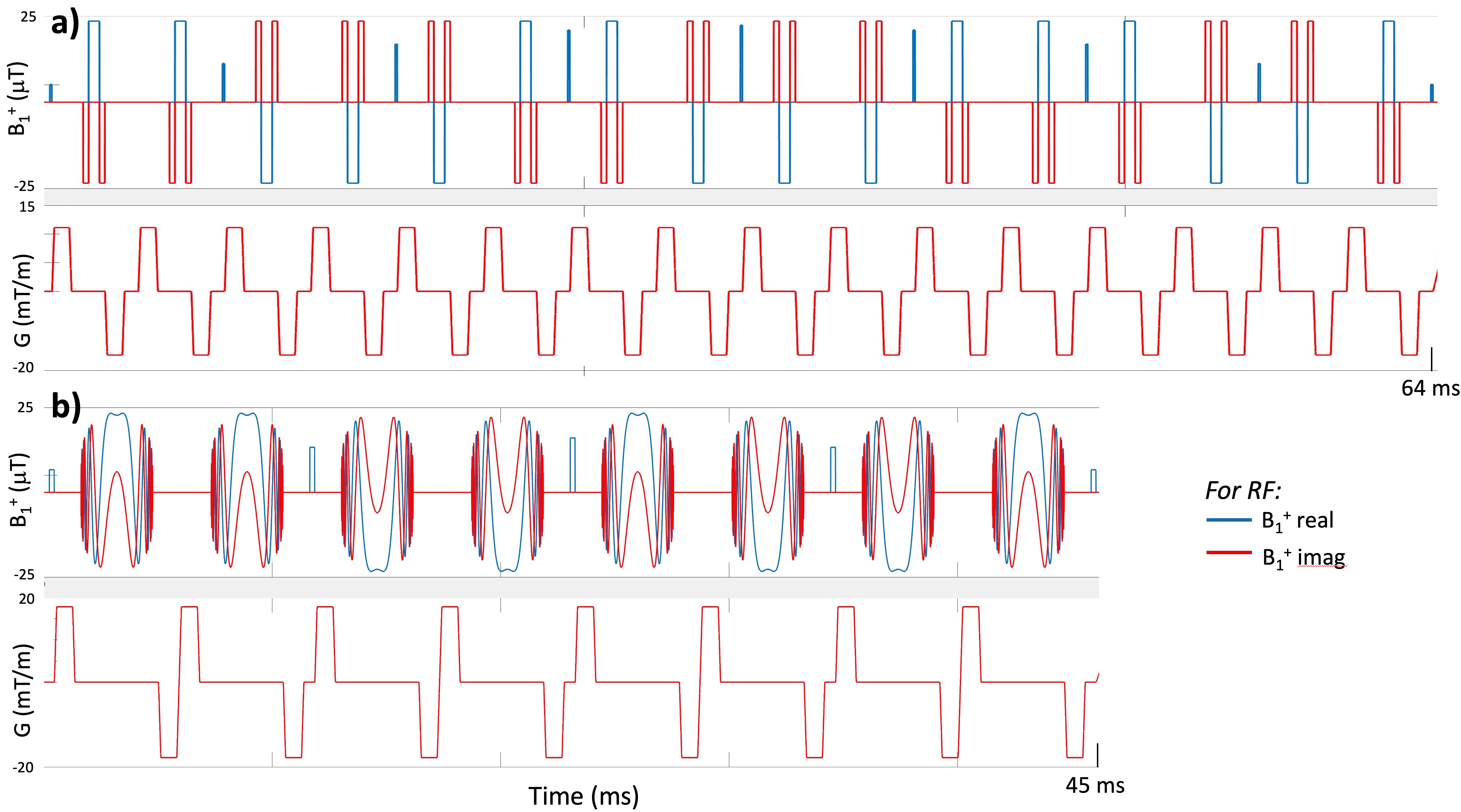
A conventional 64ms FT-VSI train with nine sinc-modulated hard excitation pulses and eight composite refocusing pairs modulated by MLEV-16 phase cycling was used as the reference train1,2,5 (Figure 1a). A new 45 ms VSI train was designed using five sinc-modulated hard excitation pulses and four adiabatic hyperbolic secant (µ=5, β=800) refocusing pairs modulated by MLEV-8 phase cycling (sech train, Figure 1b). Four pairs kept us well under SAR limitations. Bloch simulations incorporating T1/T2 relaxation evaluated the velocity response of both trains across a wide B0/B1+ range.Both reference and sech trains were implemented into a VSASL preparation module (Vcut = 2cm/s, Tsat=1500ms, τ/TI/TBGS = 500/1000/735ms, TR = 3000ms, 64 meas, scan time ~3:20) with a 3D GRASE readout (voxel size=4x4x6 mm3, 40 slices, single-shot, TE=15.42ms, GRAPPA acceleration 2x2 in PExSlice) on a Siemens 3T Prisma. VSASL data using both trains were collected on 1) an agarose phantom and 2) three healthy human volunteers (males, 29-45). Control-label subtraction fidelity was compared using the phantom data. CBF image artifacts and temporal SNR were compared using the human data.
Results
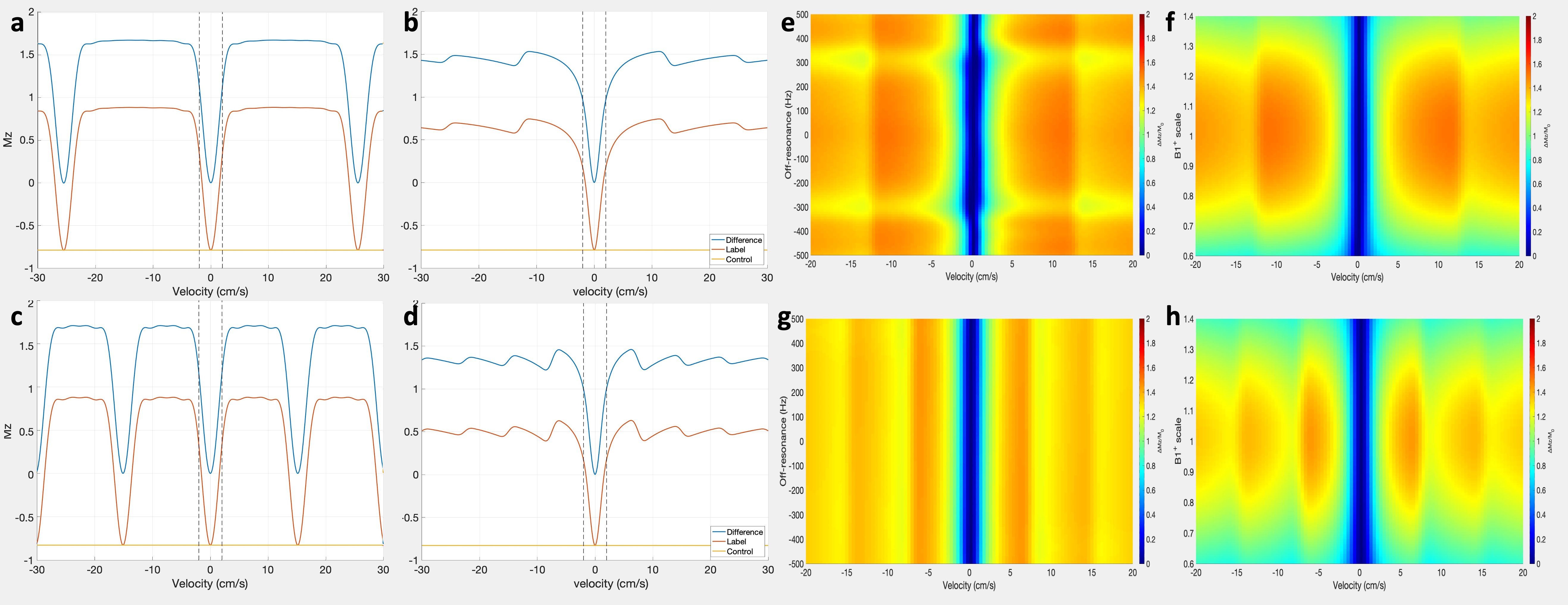
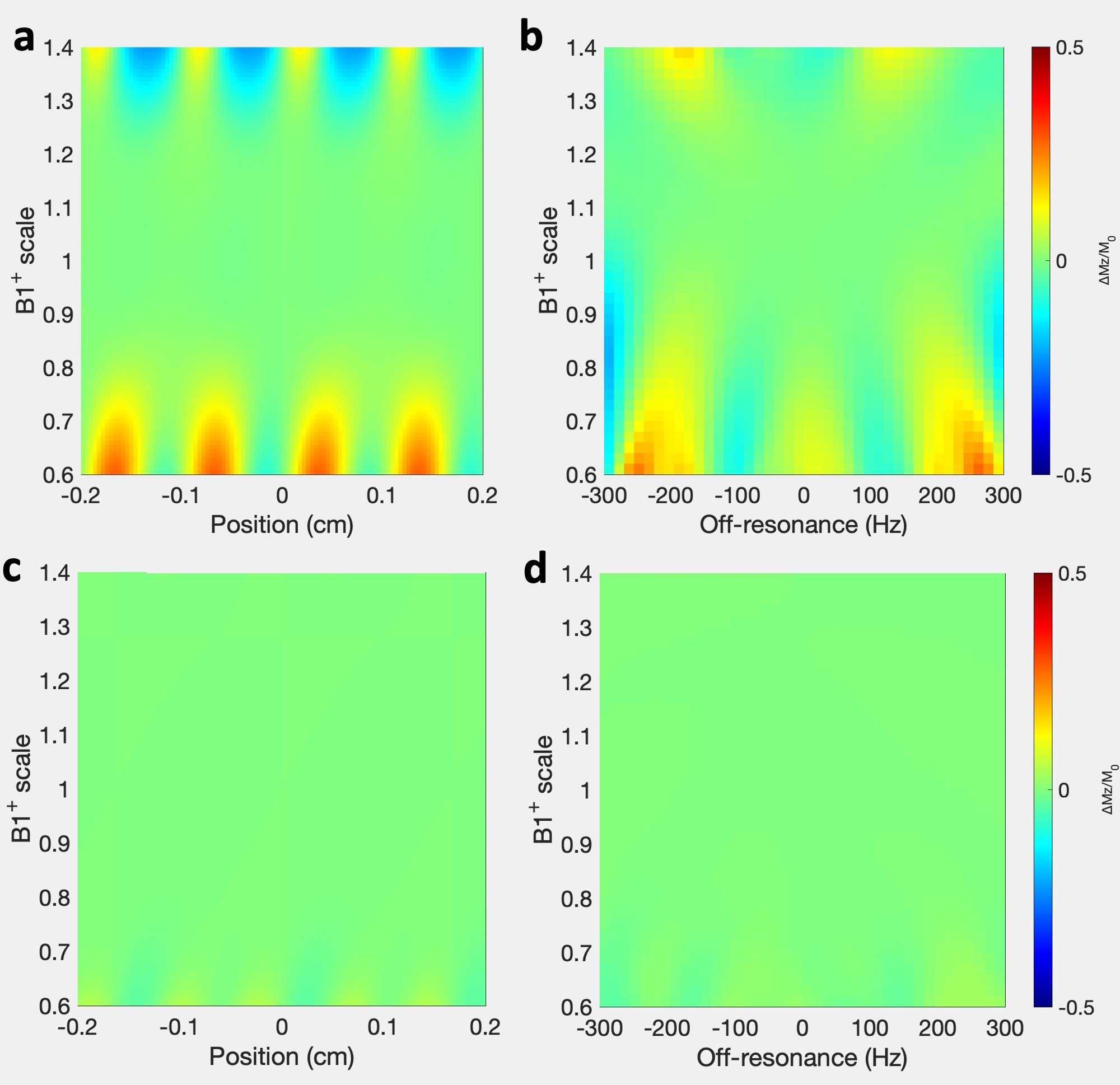
Figure 2. Shows the velocity responses for both reference and sech trains. The line plots depict velocity profiles under uniform and laminar (physiologic) flow conditions in the absence of field inhomogeneities. The interval between Nyquist replicas decreases with the sech train (relative to the reference) under uniform flow conditions, but the response under laminar flow conditions is quite similar. The colormaps depict the laminar flow velocity profiles in the presence of B0 and B1+ inhomogeneity, respectively. The velocity profile of the sech train is essentially immune to B0 variation, whereas there is some modulation with the reference train. The velocity response in the presence of B1+ inhomogeneity is similar to the line plots for a reasonably wide B1+ range for both trains.Figure 3 shows subtracted magnetization (ΔM/M0) following simulation of both reference and sech trains as a function of i) position and B1+ and ii) B0 off-resonance and B1+. The sech train essentially eliminates contributions from unwanted static spins that can be seen with reference trains.
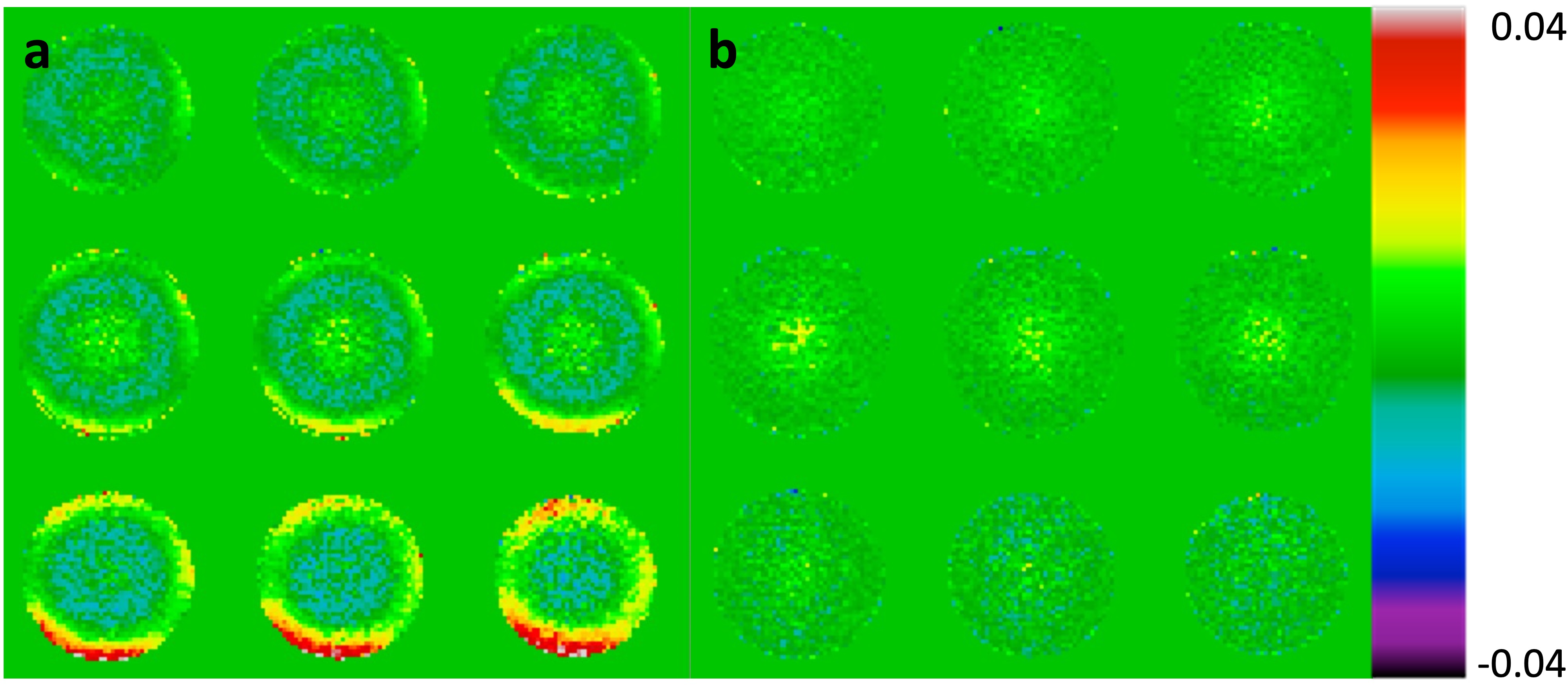
Figure 4 shows agarose phantom control-label difference images for reference and sech trains. Signal from static spins can be seen to contaminate the difference images acquired using the reference train, whereas the sech train difference images are close to zero.
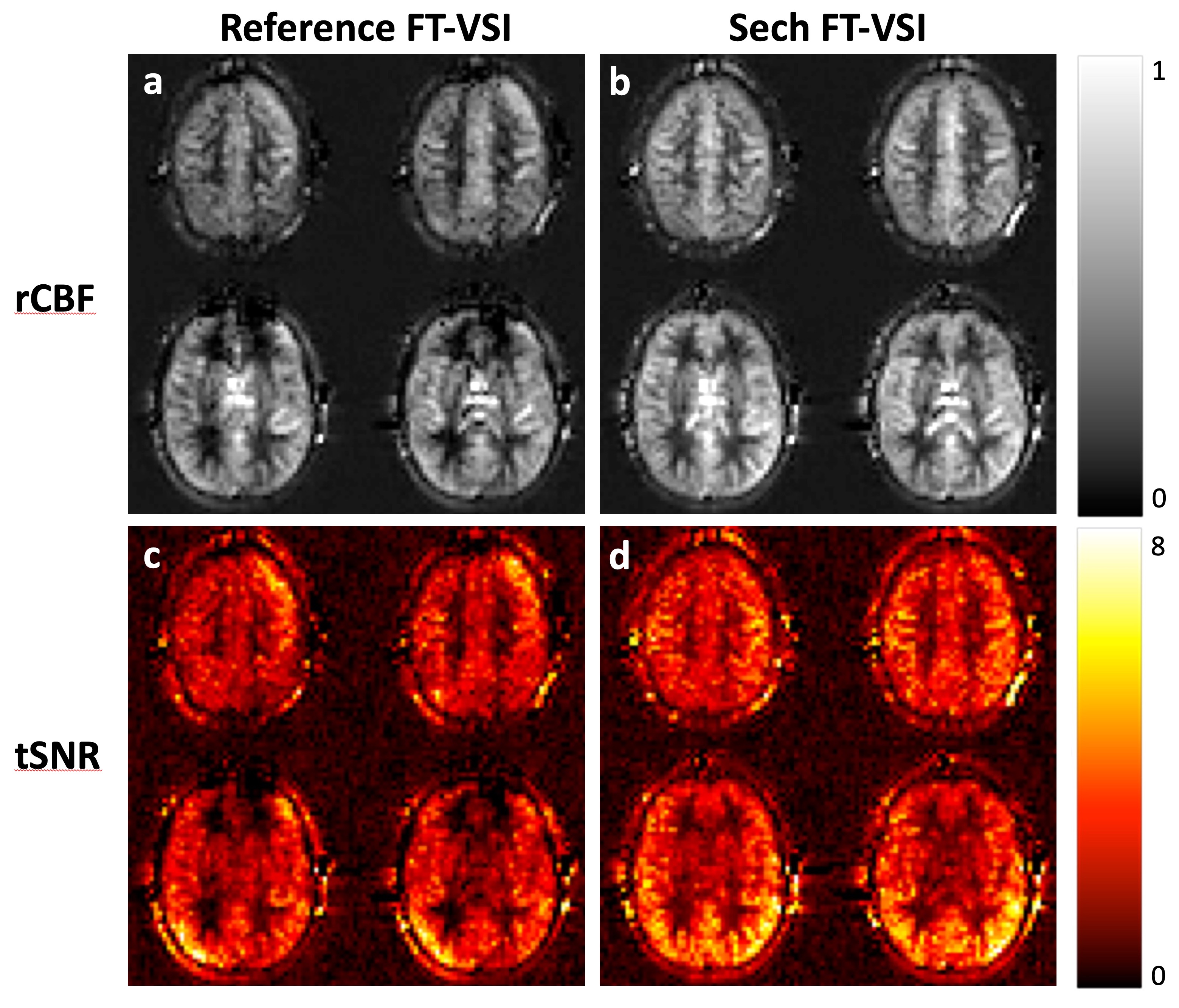
Figure 5 shows CBF and associated tSNR maps acquired using reference and sech trains for subject 1. The sech train significantly reduces artifacts, improves homogeneity, and boosts gray matter tSNR by 30.1%.
Similar observations of artifact reduction and gray matter tSNR improvement with the sech train were made for Subjects 2 and 3, with respective increases of 44.9% and 46.7%.
Discussion
Our findings suggest that a FT-VSI train utilizing sech refocusing pulses with MLEV-8 phase cycling is less sensitive to B0/B1+ inhomogeneity, which improves subtraction fidelity, reduces artifacts, and improves image quality and tSNR of CBF maps on per-subtraction basis. Despite adiabatic pulses being longer than composite pulses, we were able to shorten the sech train by 30% relative to the reference by reducing the replica interval in the uniform flow velocity response, while maintaining a similar laminar flow velocity response. Addition of dynamic phase cycling to this adiabatic approach will enable robustness to an even larger range of B0/B1+ variation, which may be useful at higher field (7T) implementation.Conclusion
A novel FT-VSI train that incorporates adiabatic refocusing with MLEV-8 phase cycling substantially reduces artifacts and increases tSNR in CBF imaging with VSASL.Acknowledgements
Simulations were generated using publicly available MATLAB code:
Woods JG, Liu D. (2002). Bloch Equation Simulation of VS Labeling (V1.0). Zenodo. https://doi.org/10.5281/zenodo.10000979
References
1. Qin Q, van Zijl PC. Velocity-selective-inversion prepared arterial spin labeling. Magn Reson Med. 2016 Oct;76(4):1136-48.
2. Qin Q, Shin T, Schär M, Guo H, Chen H, Qiao Y. Velocity-selective magnetization-prepared non-contrast-enhanced cerebral MR angiography at 3 Tesla: Improved immunity to B0/B1 inhomogeneity. Magn Reson Med. 2016 Mar;75(3):1232-41.
3. Liu D, Li W, Xu F, Zhu D, Shin T, Qin Q. Ensuring both velocity and spatial responses robust to B0/B1+ field inhomogeneities for velocity-selective arterial spin labeling through dynamic phase-cycling. Magn Reson Med. 2021 May;85(5):2723-2734.
4. Chen C, Barnes RA, Wong EC, Liu TT, Bolar DS. Measuring microvascular pulsatility with short bolus duration (τ) VSASL.
5. Guo J, Das S, Hernandez-Garcia L. Comparison of velocity-selective arterial spin labeling schemes. Magn Reson Med. 2021 Apr;85(4):2027-2039.
Figures