1958
Manifold-Aware Swin UNET Transformer for High-Fidelity Diffusion Tensor Imaging from Six Directions1Biomedical Engineering, Technion - Israel Institute of Technology, Haifa, Israel
Synopsis
Keywords: Analysis/Processing, Brain, AI/ML Image Reconstruction ,Diffusion Analysis & Visualization, DTI
Motivation: Diffusion Tensor Imaging (DTI) requires numerous diffusion weighted images, resulting in long scan sessions that motivate a need for more efficient DTI estimation techniques.
Goal(s): Our goal is to demonstrate that Deep Neural Networks (DNNs) trained with a manifold-respecting loss function can more accurately estimate diffusion tensors from fewer diffusion-weighted images, surpassing networks trained with Euclidean losses while honoring the tensors' manifold structure.
Approach: We employed the Swin UNET Transformer architecture and trained two models: one with Log-Euclidean loss and another with Euclidean loss.
Results: When evaluating the predicted tensors against conventional techniques, our approach consistently outshined the rest.
Impact: The study will enable an accurate estimate of brain microstructure from DTI data acquired with six gradient directions by developing manifold-aware DNN for DTI analysis. This breakthrough may reduce patient discomfort and scanning artifacts, and potentially increase imaging centers throughput.
Introduction
Diffusion Tensor Imaging (DTI) utilizes MRI technology to characterize the microstructure and pathways within brain tissue by applying a tensor model to diffusion-weighted (DW) images collected at various gradient orientations. Traditional methods of DTI parameter estimation, predominantly the least squares (LS) approach, require the acquisition of numerous DW images to achieve accurate parameter estimations, which consequently prolongs the MRI scan time. This increase in scan duration can lead to more motion-related artifacts and patient discomfort, notably in newborns. Therefore, there is a need for a refined method that can estimate DTI parameters with fewer DW images. Deep Neural Networks (DNNs) present a promising solution to this issue. DNNs have an advantage over traditional estimation techniques as they do not rely on predefined mathematical models for the diffusion signal and its associated noise, allowing for a more flexible and efficient estimation process.Current DNN methods use the Euclidean distance as the loss function for DNN training1-3 :
$$ \text{dist}(D_{ref}, D_{pred}) = ||D_{ref} - D_{pred}||_F\qquad (1)$$
where $$$ F $$$ denotes the Frobenius norm, and $$$D_{ref}$$$ and $$$D_{pred}$$$ are the reference and predicted tensors respectively. Since diffusion tensors are 3×3 symmetric positive-definite (SPD) matrices these tensors do not form a vector space but rather a Riemannian manifold4. Therefore using a Euclidean distance as the loss function may result in incorrect tensor estimates. This emerges the need for a manifold-respecting loss function for DTI parameter estimation with DNN that preserves the tensors manifold structure.
Previously, Arsigny4 et al. introduced the log-euclidean distance metric for manifold-aware tensor processing:
$$\text{dist}(D_{ref}, D_{pred}) =\Vert \log(D_{ref}) - \log(D_{pred}) \Vert_F\qquad (2)$$
Several works in the deep learning domain have utilized the log-Euclidean framework for tensor computations, such as in DTI super-resolution tasks5,6. However, this framework has not been utilized for DTI estimation from a limited number of directions. In this work, we developed and evaluated a manifold-aware DNN method for high-fidelity DTI from six Directions.
Methods
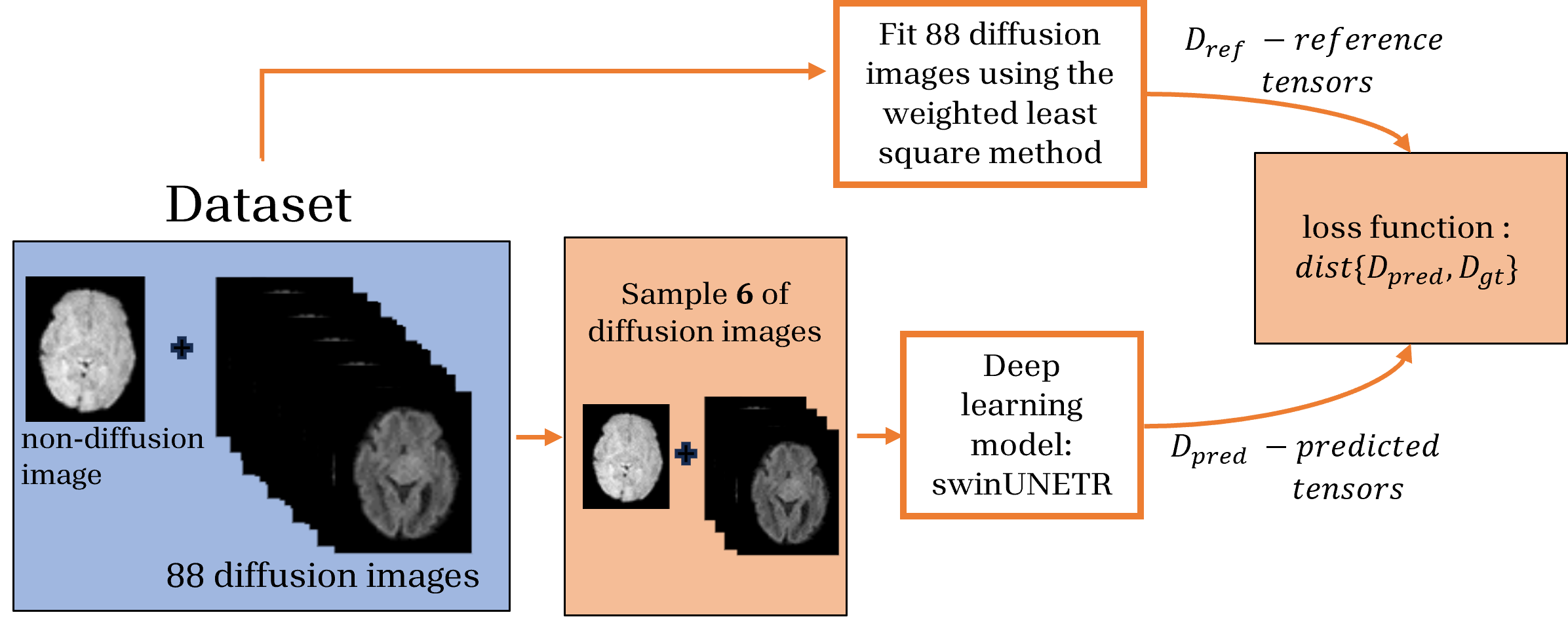
Dataset: We used the developing Human Connectome Project (dHCP) dataset7 for the DNN models development and evaluation. The dHCP dataset consists of 688 cases of DW-MRI images of neonates scanned at 29–45 gestational weeks. Each case contains 280 DW images with different b-values(400, 1000, 2600) and 20 non-diffusion images. We used the b-value = 1000 measurements (88 gradient directions) for DTI estimation. For each subject, we reconstructed a high-quality ``reference'' DTI using the entire 88 gradient directions. We simulated a short scanning duration by selecting 6 optimized directions out of the 88 as suggested by Skare8 et al. We divided the dataset into training (550 cases), validation (68 cases), and test subsets (70 cases).DNN model: We used the Swin-UNETR architecture9, originally developed for semantic segmentation of brain tumors in MRI, as our DNN architecture. The input to the network is a stack of 7 3D MRI images (6 DW images + one non-diffusion image) and the output is a stack of 6 3D images, each representing a different diffusion tensor coefficient.
Experiments: We trained our model on two occasions: non-manifold-aware (mean-squared error (MSE) loss) and once with manifold awareness (Log-Euclidean loss). We utilized identical hyperparameters in both training sessions. We used the two models to predict the DTs from the test data. Next, we calculated fractional anisotropy (FA) maps from the DTs generated with the different models and compared them to the reference FA maps computed from the reference high-quality DTs. We used the MSE to assess the FA accuracy. We further evaluated the tensor estimation accuracy by means of the Log-Euclidean distance between the reference and predicted tensors (Eq. (2)). We verified the statistical significance of the improvement using repeated-measures ANOVA with p$$$<0.05$$$ deemed indicative of significance.
Figure 1 illustrates the comprehensive workflow of this study.
Results and Discussion
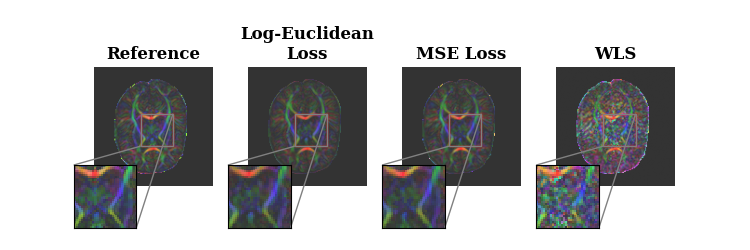
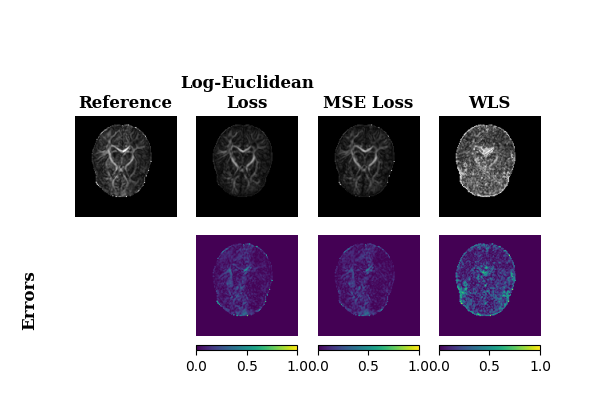
Table 1. summarizes our results. Our manifold-aware approach surpasses the commonly used approaches by means of reducing both FA and tensor errors. The difference was statistically significant. Figures 2 and 3 demonstrate that DNN-based estimations of FA maps and tensor coefficients are more precise and less noisy compared to those derived from WLS. This improvement is likely due to DNNs considering spatial voxel correlations, unlike WLS which estimates tensors voxel-by-voxel independently.Conclusions
We introduced the Log-Euclidean loss function to improve high-fidelity DTI training using a manifold-aware DNN from six gradient directions. Unlike the typical Euclidean distance loss, our approach preserves tensor properties, leading to more accurate diffusion tensor estimates. This can enhance the subject experience, reduce motion artifacts, and potentially increase imaging center throughput by speeding up DTI acquisition.Acknowledgements
This work was supported in part by research grants from the Israel-US Binational Science Foundation, the Israeli Ministry of Science and Technology, the Israel Innovation Authority, and the joint Microsoft Education and the Israel Inter-university Computation Center (IUCC) program.References
1. Karimi, Davood, and Ali Gholipour. "Diffusion tensor estimation with transformer neural networks." Artificial Intelligence in Medicine 130 (2022): 102330.
2. Li, Hongyu, et al. "SuperDTI: Ultrafast DTI and fiber tractography with deep learning." Magnetic resonance in medicine 86.6 (2021): 3334-3347.
3. Weine, Jonathan, et al. "Synthetically trained convolutional neural networks for improved tensor estimation from free-breathing cardiac DTI." Computerized Medical Imaging and Graphics 99 (2022): 102075.
4. Arsigny, Vincent, et al. "Log‐Euclidean metrics for fast and simple calculus on diffusion tensors." Magnetic Resonance in Medicine: An Official Journal of the International Society for Magnetic Resonance in Medicine 56.2 (2006): 411-421.
5. Spears, Tyler A., and P. Thomas Fletcher. "Super-Resolution of Manifold-Valued Diffusion MRI Refined by Multi-modal Imaging." International Workshop on Computational Diffusion MRI. Cham: Springer Nature Switzerland, 2022.
6. Anctil-Robitaille, Benoit, Christian Desrosiers, and Herve Lombaert. "Manifold-aware CycleGAN for high-resolution structural-to-DTI synthesis." Computational Diffusion MRI: International MICCAI Workshop, Lima, Peru, October 2020. Cham: Springer International Publishing, 2021.
7. Bastiani, Matteo, et al. "Automated processing pipeline for neonatal diffusion MRI in the developing Human Connectome Project." Neuroimage 185 (2019): 750-763.
8. Skare, Stefan, et al. "Condition number as a measure of noise performance of diffusion tensor data acquisition schemes with MRI." Journal of magnetic resonance 147.2 (2000): 340-352.
9. Hatamizadeh, Ali, et al. "Swin unetr: Swin transformers for semantic segmentation of brain tumors in mri images." International MICCAI Brainlesion Workshop. Cham: Springer International Publishing, 2021.
Figures