1930
The variation of GABA in the anterior cingulate and posterior cingulate cortex of migraineurs during a migraine attack and the interictal stage1Shandong University, Jinan, China, 2Shandong Provincial Hospital Affiliated to Shandong First Medical University, Jinan, China, 3Philips Healthcare, Shanghai, China
Synopsis
Keywords: Neurotransmission, Brain, Migraine,GABA
Motivation: To investigate the variation of GABA concentrations in the anterior cingulate cortex and posterior cingulate cortex of migraine patients without aura during a migraine attack and the interictal stage.
Goal(s): To elucidate the role of GABA in the migraine pathophysiology.
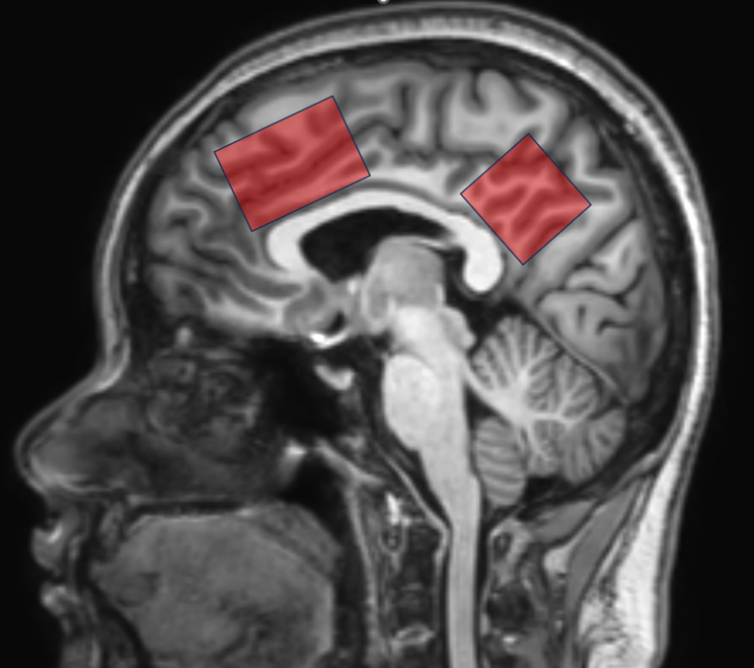
Approach: We prospectively enrolled 12 migraineurs and 16 healthy controls and acquired MEGA-PRESS on a 3T MR from voxels located in the ACC and the PCC.
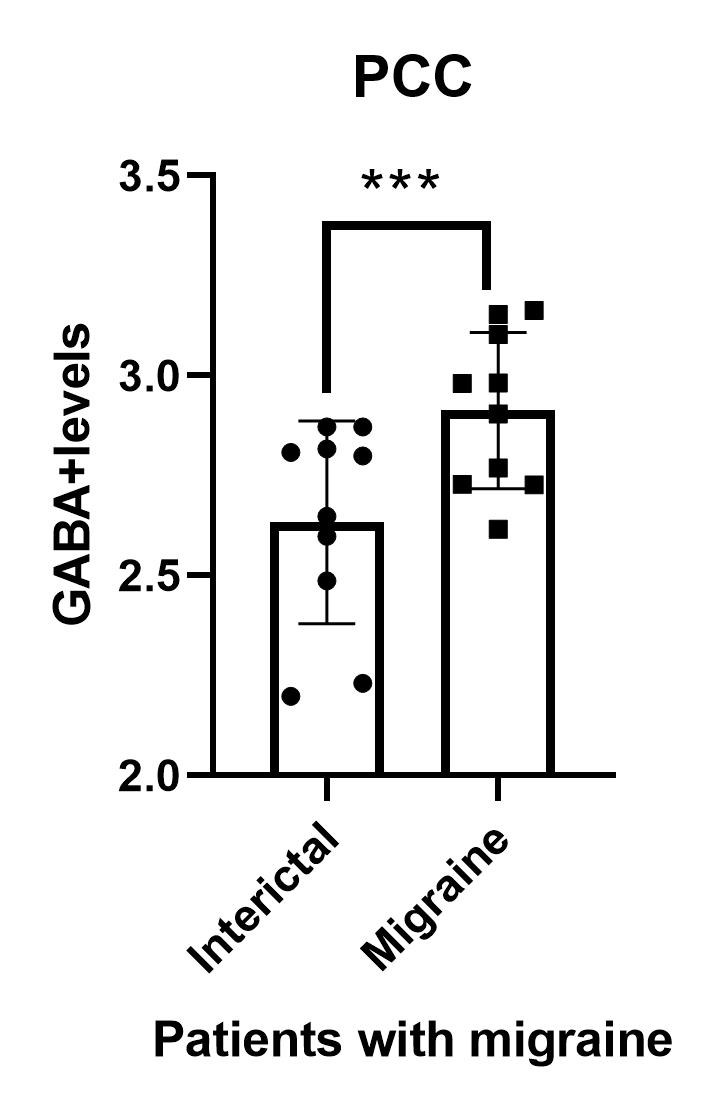
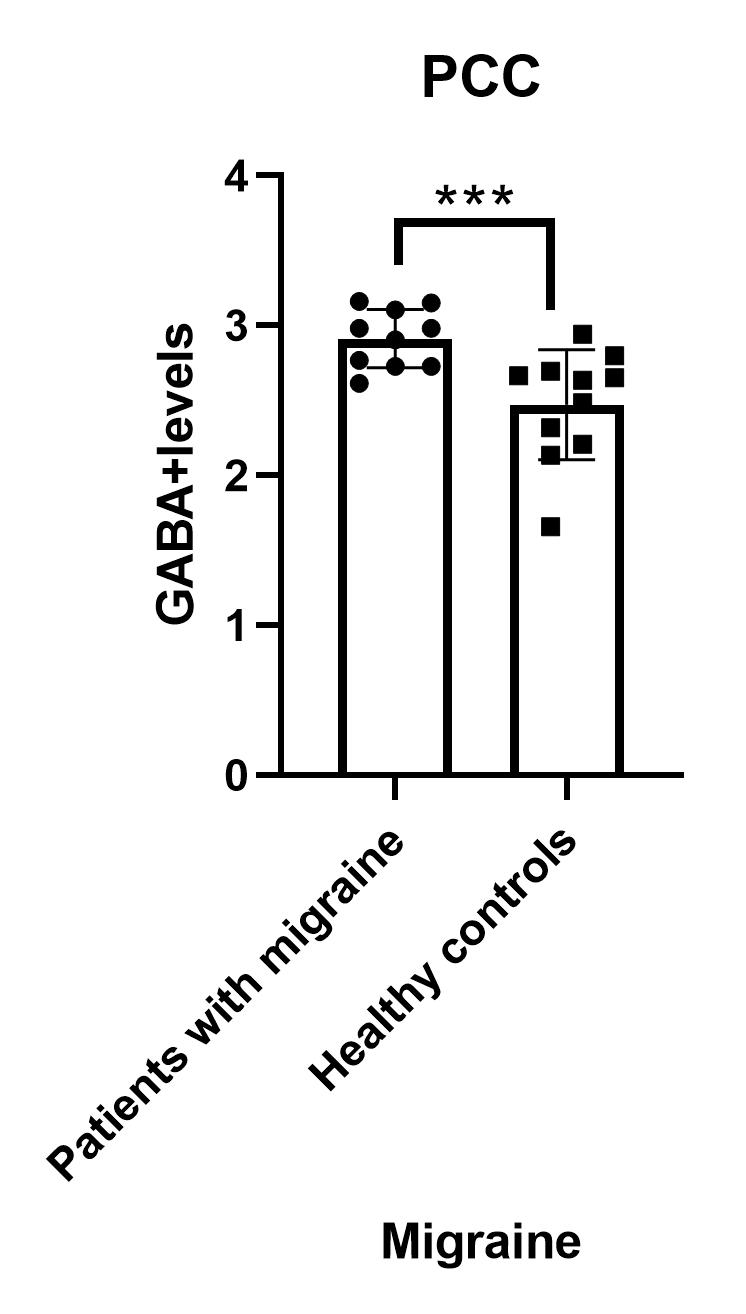
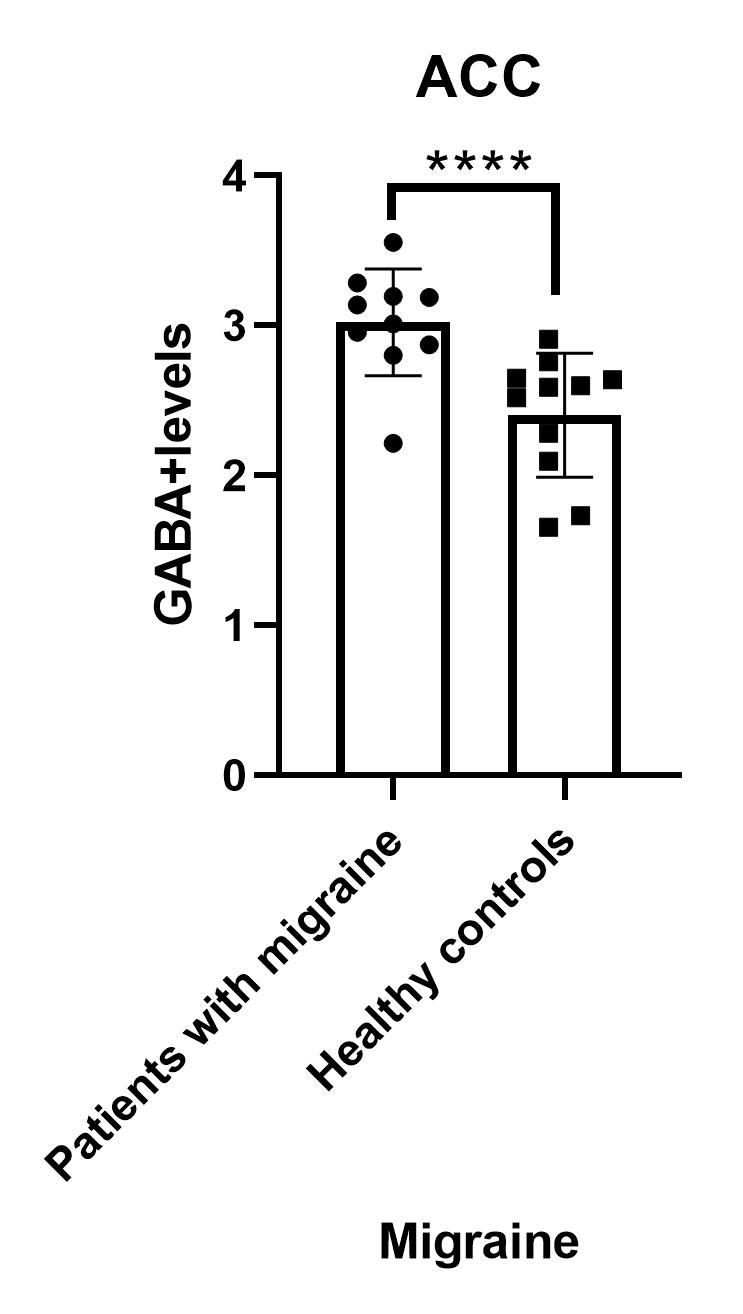
Results: Among migraineurs, a significant increase in GABA+ in the PCC during a migraine attack versus the interictal stage(P=0.0023). Measurements in ACC and PCC showed a statistically significant elevation of GABA+ in migraineurs than healthy controls(P=0.0017, P=0.0031).
Impact: We speculate that increased GABA levels may reflect a compensating mechanism to reduce a hyperexcitatory state and a protective role for GABA in suppressing headaches. We will probe into the mechanism of GABAergic Drugs for the treatment of migraine.
Introduction
Migraine is an intense, recurring headache with an unclear cause, which has major effects on patients and society. Migraine affects about 15% of the general population globally1. As the major inhibitory neurotransmitter, gamma-aminobutyric acid(GABA)2-3 is likely to play a role in cortical hyperexcitability of the migraine brain. To investigate the variation of GABA concentrations in the anterior cingulate cortex and posterior cingulate cortex of migraine patients without aura during a migraine attack and the interictal stage3, we used J-edited 1H-MR spectroscopy (Mescher-Garwood point-resolved spectroscopy) to quantify regional in vivo GABA concentrations, and we further compared it with healthy controls.Methods
We prospectively enrolled 12 migraine patients without aura who were diagnosed in Shandong Provincial Hospital’s neurology clinic and 16 age-matched healthy controls from the community and acquired Mescher-Garwood point-resolved spectroscopy spectra on a 3T MR imaging scanner from voxels located in the anterior cingulate cortex and the posterior cingulate cortex. Migraine attacks and patients are diagnosed using the International Classification of Headache Disorders (ICHD) diagnostic criteria. We finally got 10 migraine patients and 11 healthy controls MRS Data. These data were analyzed using Gannet 3.1. GABA+ concentrations were compared for regional variations. T-test was used for the data analysis.Results
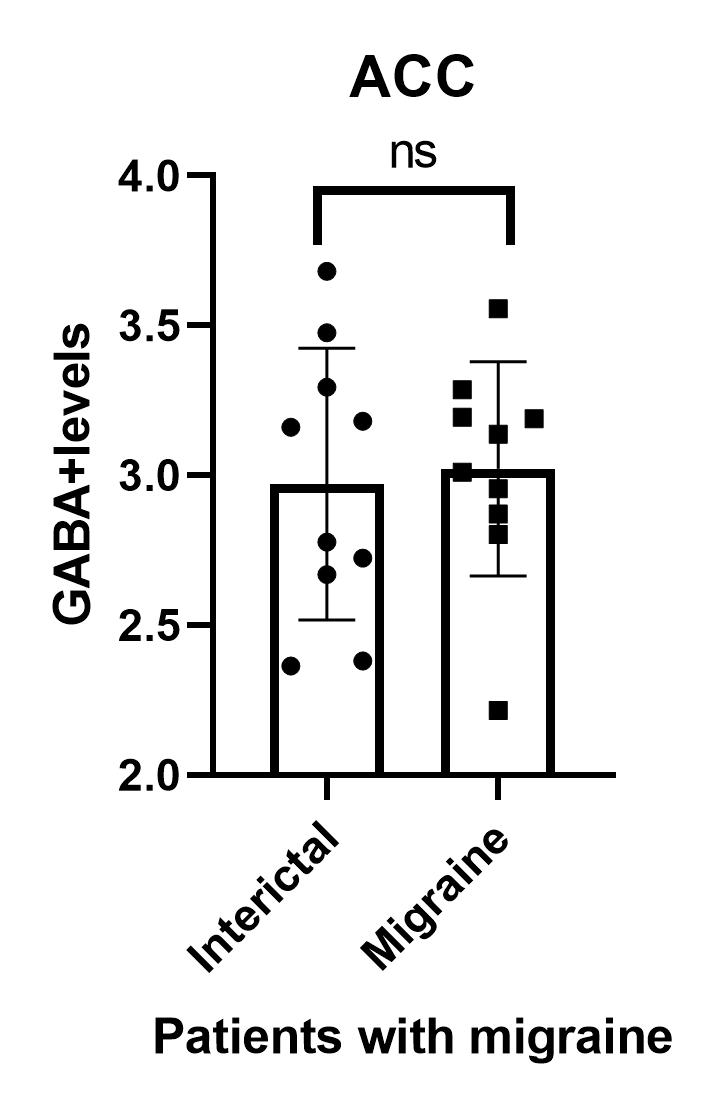
Among patients with migraine, there is a significant increase in GABA+ concentration in the posterior cingulate cortex(PCC) during the period of a migraine attack versus the interictal stage (P=0.0023). Also, migraine subjects have been shown to have higher GABA+ levels in the anterior cingulate cortex(ACC) during a migraine attack, but no statistical significance is attained (P= 0.7298 ). During a migraine attack, measurements in ACC and PCC have shown a statistically significant elevation of GABA+ in migraine subjects than healthy controls(P=0.0017, P=0.0031). Whereas between the migraine attacks, we don’t find a statistically significant difference in GABA+ concentration between migraine subjects and healthy controls in the ACC and PCC(P=0.146, P=0.2622).Discussion
We have chosen the ACC and PCC because of their putative role in multiple processing in migraine including involvement in salience, descending modulation, and altered resting-state connectivity4. As noted previously, the cingulate is involved in numerous processes in migraine behaviors such as interoception, executive function, salience, and pain modulation, amongst others. Maleki observed functional and morphometric changes in the cingulate in episodic in 20125. Studies have noted changes in many of these functions in migraineurs. Fortunately, we did observe increased GABA levels in ACC and PCC during a migraine attack in migraineurs compared with healthy controls. This observation suggests that the increase in GABA concentration is associated with the onset of a migraine attack. There is a general agreement now that migraine is not only a vascular phenomenon but also a genetically determined heterogenic ion-channelopathy resulting in cortical-spreading-depression-like events, the temporary impairment of antinociceptive structures of the brainstem, and the activation of the trigeminal-vascular system. It is clearly relevant for the modulation of pain disorders or specific painful situations such as birth, is the high affinity for neurosteroids, which mediate their effects at the GABAA receptor through both mechanisms, the increase of channel frequency and channel opening time6-7. Therefore, significant evidence suggests that GABAA receptor modulation may play an important role in the modulation of migraine attacks and headache phases and that GABAA receptors may potentially serve as a target for anti-headache drugs. Our findings therefore strongly suggest an evident role of GABA in the migraine pathophysiology. We speculate that increased preictal GABA levels, as observed in our study, may reflect a compensating mechanism to reduce a hyperexcitatory state and/or may reflect a protective role for GABA in suppressing headaches. We will probe into the mechanism of GABAergic Drugs for the treatment of migraine and the effectiveness of the different drugs8. To explore the variation of GABA concentrations in the ACC and PCC of migraine patients without aura after taking GABAergic Drugs, we will recruit more migraine patients9. Further research will have to sort this out more completely.Conclusion
Migraine subjects have been shown to have higher GABA concentrations in the posterior cingulate cortex(PCC) during a migraine attack than in the interictal stage, which reflects the involvement of the GABAergic system in the onset of attacks. Our findings therefore strongly suggest an evident role of GABA in the migraine pathophysiology. We conclude that 3T MRS can show changes in the glutamatergic system towards a triggered migraine attack, by revealing an increased GABA concentration associated with the onset of a migraine attack.Acknowledgements
No acknowledgement found.References
1.Ferrari MD, Goadsby PJ, Burstein R, et al. Migraine. Nat Rev Dis Primers. 2022;8(1):2.
2.Puppe A, Limmroth V. GABAergic drugs for the treatment of migraine. CNS Neurol Disord Drug Targets. 2007;6(4):247-250.
3.Onderwater GLJ, Wijnen JP, Najac C, et al. Cortical glutamate and gamma-aminobutyric acid over the course of a provoked migraine attack, a 7 Tesla magnetic resonance spectroscopy study. Neuroimage Clin. 2021;32:102889.
4.Becerra L, Veggeberg R, Prescot A, et al. A 'complex' of brain metabolites distinguish altered chemistry in the cingulate cortex of episodic migraine patients. Neuroimage Clin. 2016;11:588-594.
5.Maleki. Concurrent functional and structural cortical alterations in migraine. Cephalalgia 2012;32, 607–620.
6.Global Burden of Disease Study 2016 Collaborators, 2017. Global, regional, and national incidence, prevalence, and years lived with disability for 328 diseases and injuries for 195 countries, 1990–2016: a systematic analysis for the Global Burden of Disease Study Lancet. 2016;390, 1211–1259.
7.Watson, C.J. Insular balance of glutamatergic and GABAergic signaling modulates pain processing. Pain. 2016;157 (10), 2194–2207.
8.Sun- Edelstein, C., Rapoport, A. M., Rattanawong, W.& Srikiatkhachorn, A. The evolution of medication overuse headache: history, pathophysiology and clinical update. CNS Drugs. 2021;35, 545–565.
9.Eikermann Haerter, K. Neuronal plumes initiate spreading depolarization, the electrophysiologic event driving migraine and stroke. Neuron. 2021;109, 563–565.
Figures