1929
Motor hand area GABA could be a physiological switch between motor network and default mode network connectivity1Nuffield Department of Clinical Neurosciences, Wellcome Centre for Integrative Neuroimaging, University of Oxford, Oxford, United Kingdom, 2Brain Network Dynamics Unit, Oxford, United Kingdom, 3Department of Sport, Exercise and Rehabilitation, University of Northumbria, Newcastle, United Kingdom, 4USC Thompson Institute, University of the Sunshine Coast, Birtinya, Brisbane, Queensland, Australia, 5Department of Psychology and Brain Sciences, Dartmouth College, Hanover, NH, United States, 6School of Health Sciences, Purdue University, West Lafayette, IN, United States
Synopsis
Keywords: Neurotransmission, Neuroscience
Motivation: The functional role of Inhibitory tone in the motor cortex is not completely understood. Previous work has been limited by the coarse spatial resolution in single-voxel spectroscopy.
Goal(s): We applied a novel high spatial resolution MR spectroscopic imaging technique to test the relationship between inhibitory tone and motor network (MN) connectivity.
Approach: We performed voxel-wise analysis of neurochemical data to correlate measures of inhibitory and excitatory tone with age as a confounder, MN and default mode network (DMN).
Results: In the motor hand areas, we demonstrated a reciprocal correlation of inhibitory tone with MN and DMN connectivity. Inhibitory tone could “switch” node connectivity.
Impact: The connectivity of key motor network nodes could be influenced by their inhibitory tone and the excitation–inhibition difference. This finding advances the understanding of motor network function and could be a target for modulation in clinical settings.
Introduction
A ‘gating’ functional role of the inhibitory neurochemical GABA in the primary motor cortex has been suggested previously, with inhibitory activity fine-tuning or gating primary motor cortex activation and motor learning1. This has important clinical implications. Modulating inhibition could be harnessed in rehabilitation after motor network damage in stroke. Loss of physiological inhibitory mechanisms may drive neurodegeneration in amyotrophic lateral sclerosis2. Previous work has been limited by the coarsespatial resolution afforded by single-voxel spectroscopy.Methods
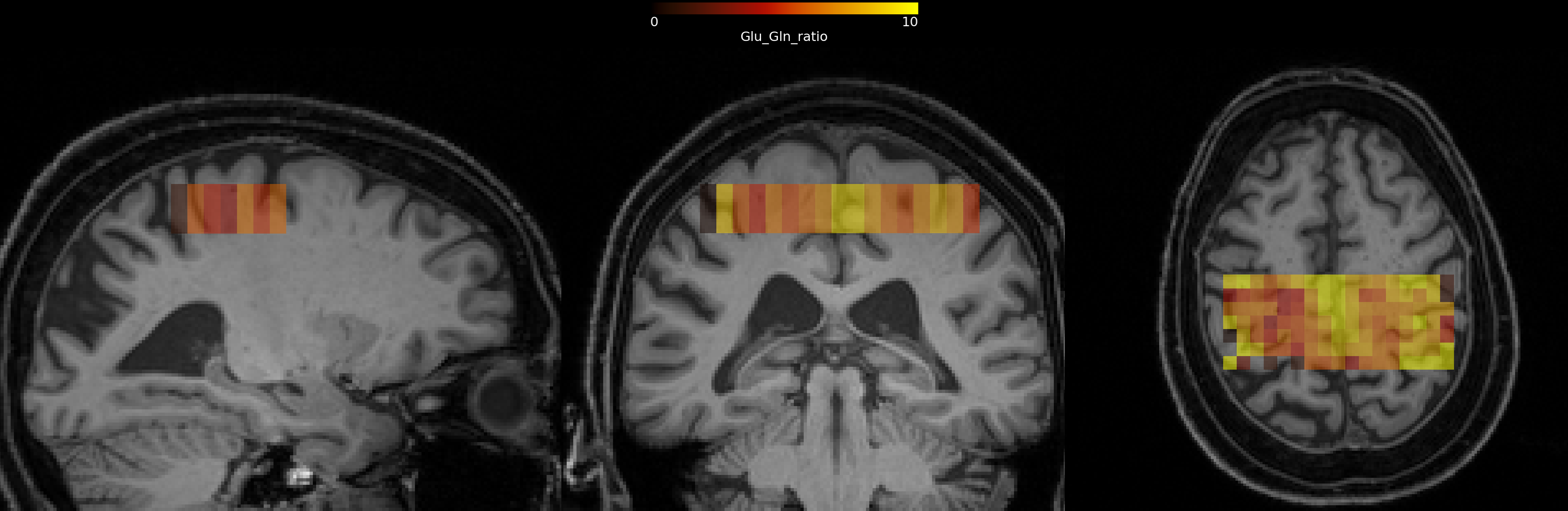
We applied a novel proton magnetic resonance spectroscopic imaging technique (metabolite-cycled density-weighted concentric rings k-space trajectory (DW-CRT) with semi-LASER excitation) using a Siemens Prisma 3T scanner3. We acquired data from 62 healthy individuals in an 85×35×15mm region of interest placed over motor areas (Figure 1) with a high in-plane spatial resolution (5×5mm). We developed and performed quality control of a novel analysis pipeline using the open-source FSL-MRS tool4.We collected multiband resting-state functional MRI data in the same scan session using the UK Biobank protocol (2.4mm isotropic resolution, 0.735s TR). We performed a voxelwise analysis of metabolites of interest [N-acetylaspartate (NAA), glutamate, and GABA] with age and resting state motor connectivity using a general linear model (randomise; non-parametric permutation inference) with false-discovery-rate (FDR) correction.
Results
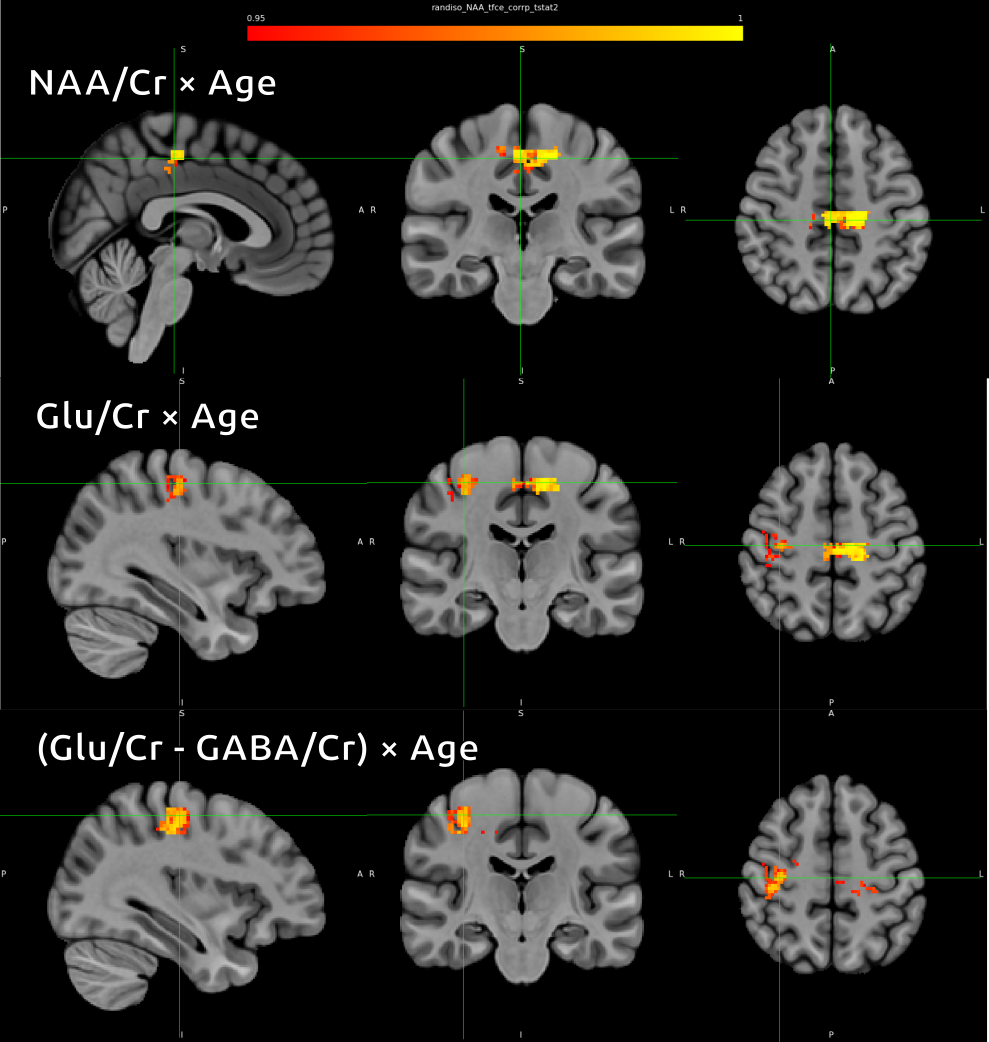
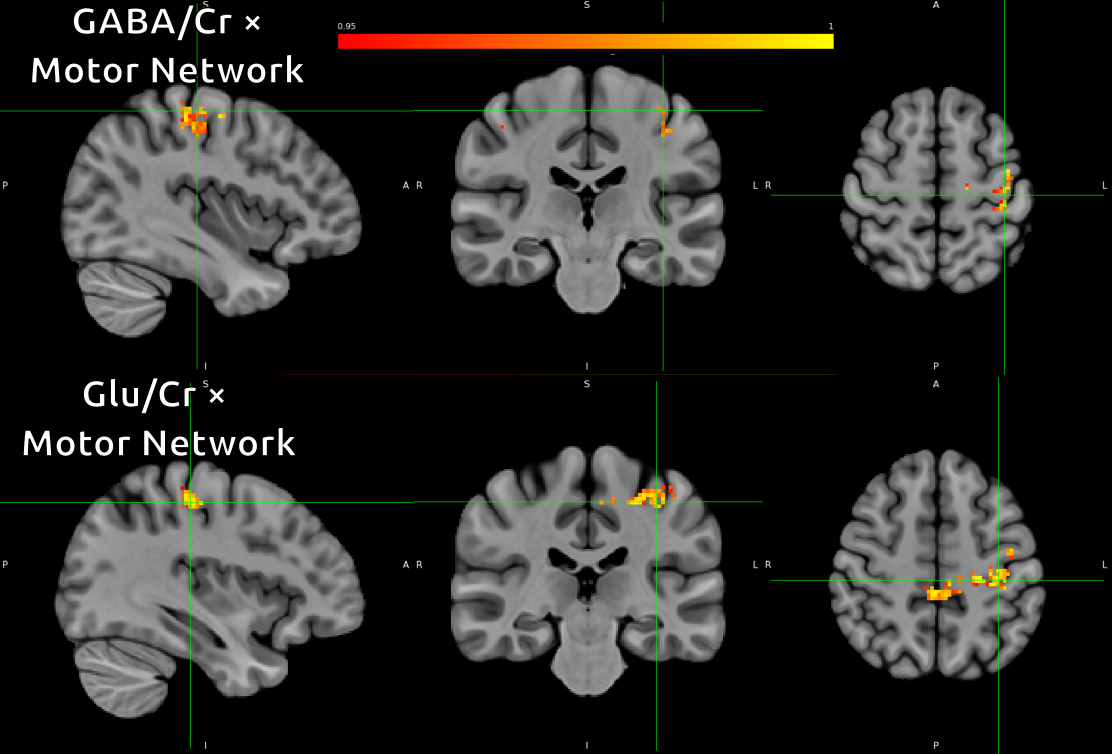
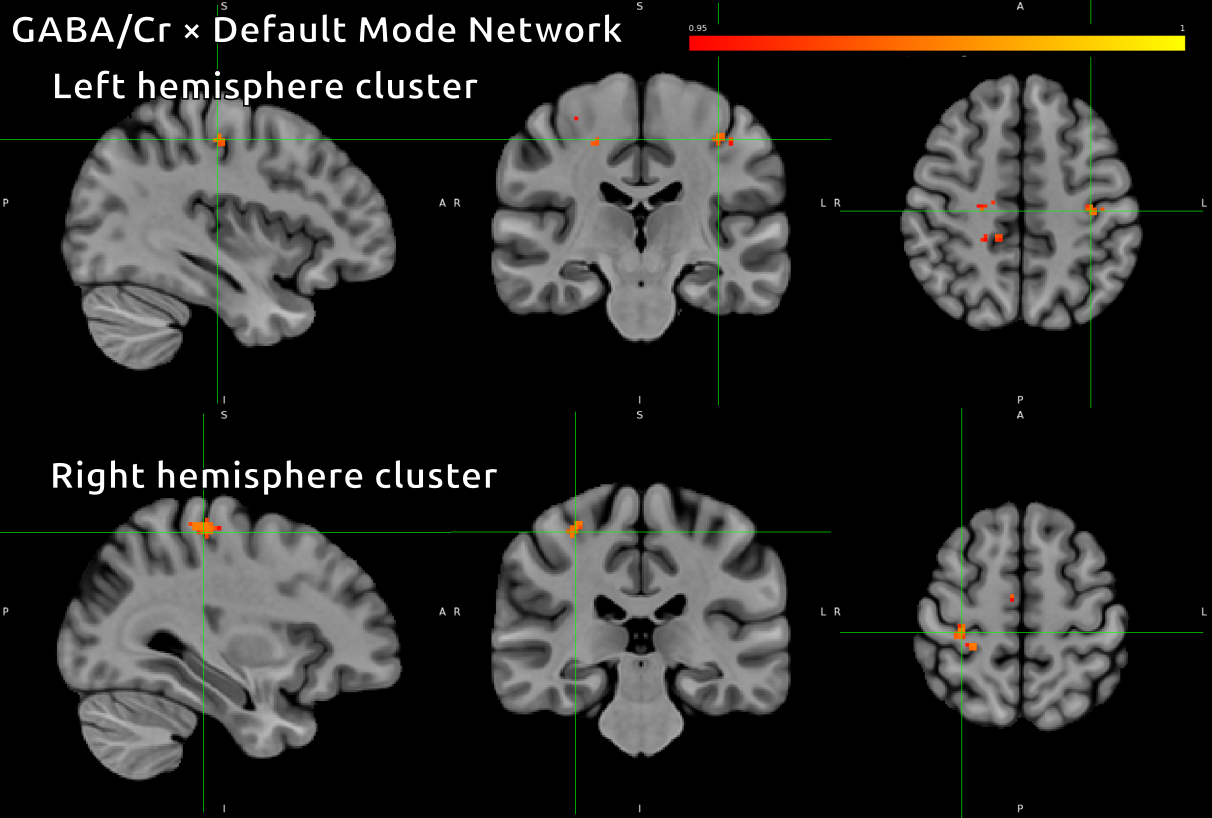
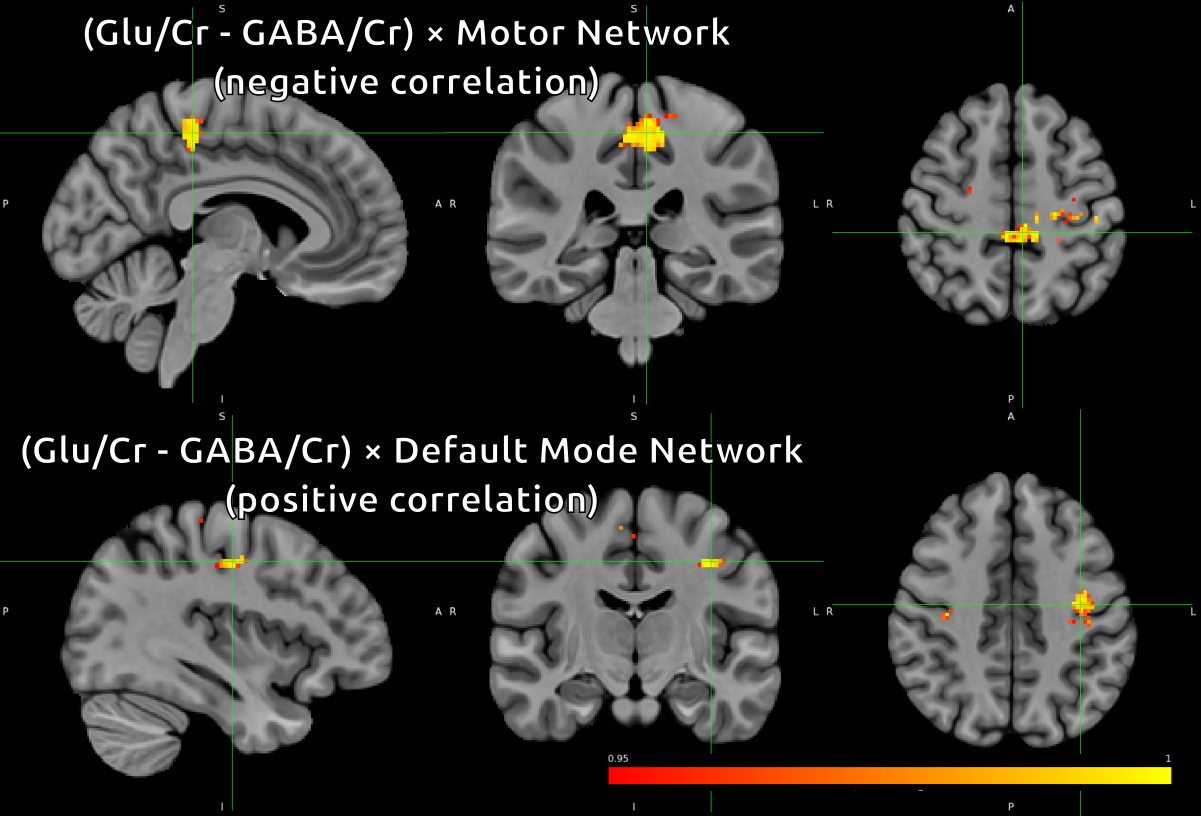
As the healthy individuals ranged from age 18 – 80, we demonstrated an age-related decline in the neuronal markers NAA and glutamate (Figure 2). A glutamate decline with age was seen preferentially in the left motor hand area. We showed that glutamate and GABA are both negatively correlated with motor network connectivity in the left motor hand area (Figure 3), while GABA is positively correlatedwith motor network connectivity in both left and right motor hand area regions (Figure 4). Glu/Cr – GABA/Cr (Excitation–inhibition difference) was negatively correlated with motor network connectivity in primary motor regions and positively correlated with default mode network connectivity in the left premotor region (Figure 5).Discussion
These results support an important functional role for inhibitory and excitatory neurochemicals in the motor network. The excitatory and inhibitory tone balance has network node-specific associations with functionally distinct networks. In particular, as measured by GABA concentration, the inhibitory tone was reciprocally associated with motor and default mode network connectivity in key network nodes, and may have a switching or gating role.We also demonstrated that age-related physiological changes are hemisphere-dependent, and may reflect preferential compensation in the dominant hemisphere. This supports the use of higher resolution MR spectroscopic imaging techniques in studying motor network physiology and pathology, and the need for standardisation by age in clinical translation.
Conclusion
We show that high-resolution imaging of GABA and glutamate concentration is feasible in a large healthy population including middle-aged and older adults, using a clinically translatable protocol at 3 Tesla. We show age-related changes in NAA and glutamate with higher spatial detail than in previous work and reinforce the need for considering age as a confounder in future research, and the need for large reference datasets in different age groups to support clinical translation. Finally, we show motor network node-specific associations of inhibitory tone and EI difference that suggest a physiological gating or switching function.Acknowledgements
No acknowledgement found.References
1. Kolasinski, J. et al. The dynamics of cortical GABA in human motor learning. J. Physiol. 597, 271–282 (2019).
2. Bae, J. S., Simon, N. G., Menon, P., Vucic, S. & Kiernan, M. C. The puzzling case of hyperexcitability in amyotrophic lateral sclerosis. J Clin Neurol 9, 65–74 (2013).
3. Chiew, M. et al. Density-weighted concentric rings k-space trajectory for 1H magnetic resonance spectroscopic imaging at 7 T. NMR Biomed. 31, e3838 (2018).
4. Clarke, W. T., Stagg, C. J. & Jbabdi, S. FSL-MRS: An end-to-end spectroscopy analysis package. http://biorxiv.org/lookup/doi/10.1101/2020.06.16.155291 (2020) doi:10.1101/2020.06.16.155291
Figures