1916
Reconstruction of Highly Underdamped 3D Spiral and Golden Angle Radial MRI Data Using Spherical Fourier-Legendre Transform1Department of Radiology, Division of Medical Physics, University Medical Center Freiburg, Faculty of Medicine, University of Freiburg, Freiburg im Breisgau, Germany, 2Department of Radiological Sciences, University of California Los Angeles, Los Angeles, CA, United States, 3Department of Biomedical Engineering, Amirkabir University of Technology, Tehran, Iran (Islamic Republic of)
Synopsis
Keywords: Image Reconstruction, Image Reconstruction
Motivation: Fast imaging is crucial in MRI for various applications. This study proposes a novel method to reconstruct highly undersampled MRI data for faster and higher-quality imaging.
Goal(s): Reconstruct the highly undersampled 3D golden-angle and spiral radial MRI data.
Approach: We proposed a novel image reconstruction method for 3D radial MRI data at high acceleration rates, based on the spherical Fourier-Legendre transform. This method reconstructs images directly in the spherical coordinates without using interpolation operator in k-space domain.
Results: The feasibility of the proposed method is proven by reconstructing highly undersampled 3D golden-angle and spiral radial data of digital Shepp-Logan and in-vitro ACR phantoms.
Impact: A nivel image reconstruction method for fast and high-quality radial MRI imaging. It focuses on highly undersampled 3D golden-angle and spiral radial MRI data, reconstructing images directly in spherical coordinates without any frequency interpolation.
Introduction
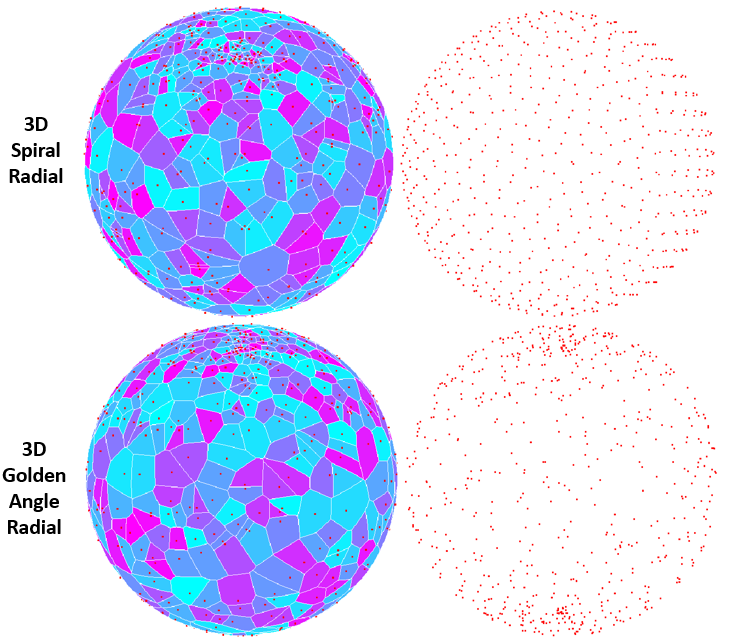
Fast imaging in MRI plays a crucial role across a wide range of applications, including real-time imaging, cardiac imaging, dynamic contrast-enhanced MRI, functional MRI and MR angiography. Radial acquisitions are commonly used for this purpose due to their shorter acquisition time, higher signal-to-noise ratio, and lower sensitivity to flow and movement. The re-gridding [1] algorithm is quite efficient for reconstruction of the highly-sampled radial data. Nevertheless, when a reduced number of spokes is necessary for accelerated data acquisition, re-gridding becomes susceptible to streaking artifacts that may stem from interpolation within the spatial frequency domain. In [2], Shafiekhani et al. proposed a novel image reconstruction method for highly sampled equiangular 3D radial MRI data, based on spherical Fourier-Legendre transform which reconstructs the images directly in the spherical coordinates without any interpolation operator in the spatial frequency domain. The feasibility of this method was proven based on the reconstructed images of highly sampled simulated 3D radial data of Shepp-Logan phantom. In this study, we developed the spherical Fourier-Legendre transform-based image reconstruction method for conventional 3D radial sampling patterns such as 3D golden-angle and 3D spiral radial. The 3D golden-angle radial data of the digital Shepp-Logan and 3D spiral radial data of in-vitro ACR phantoms are reconstructed by the proposed method.Methods
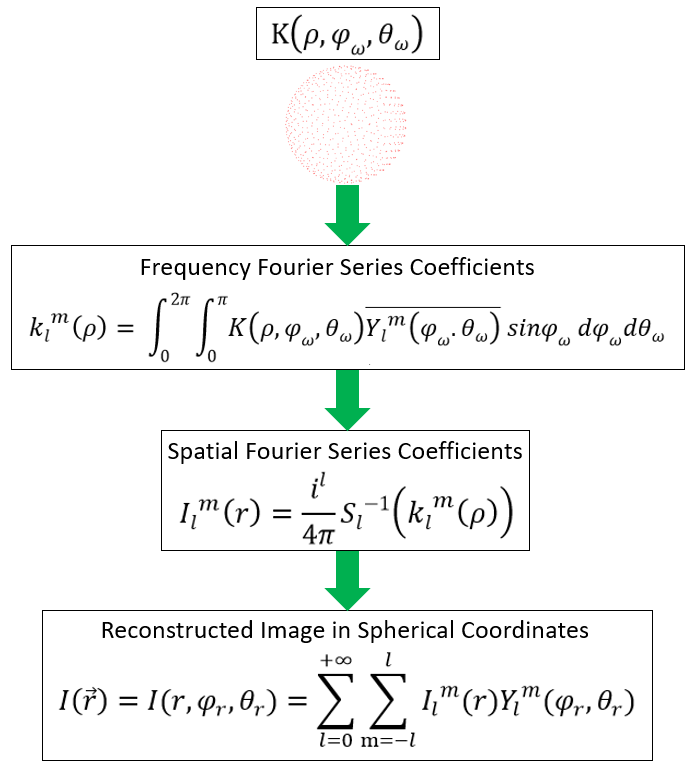
The big picture of the proposed algorithm is represented in Figure 1. The first step is to calculate the frequency Fourier series coefficients: $$$k_{l}m(ρ)$$$ [3]. Note that $$$Y_{l}m$$$ represents the spherical harmonic of degree $$$l$$$ and order $$$m$$$. Second step is computing spatial Fourier series coefficients: $$$I_{l}m(r)$$$ . Next step is to calculte the reconstructed image in the spherical coordinates: $$$I(r,φ_{r},θ_{r})$$$Note that L is the Maximum degree of the spherical harmonics which can be determined by user. At the final step, we used linear interpolation to visualize the images in the Cartesian coordinates system.
We artificially simulated a 3D golden angle radial trajectory on the 3D Shepp-Logan using the non-uniform fast Fourier transform. Additionally, the 3D spiral radial ACR in-vitro data was acquired on a 16 channel coil 3T Siemens scanner.
Results
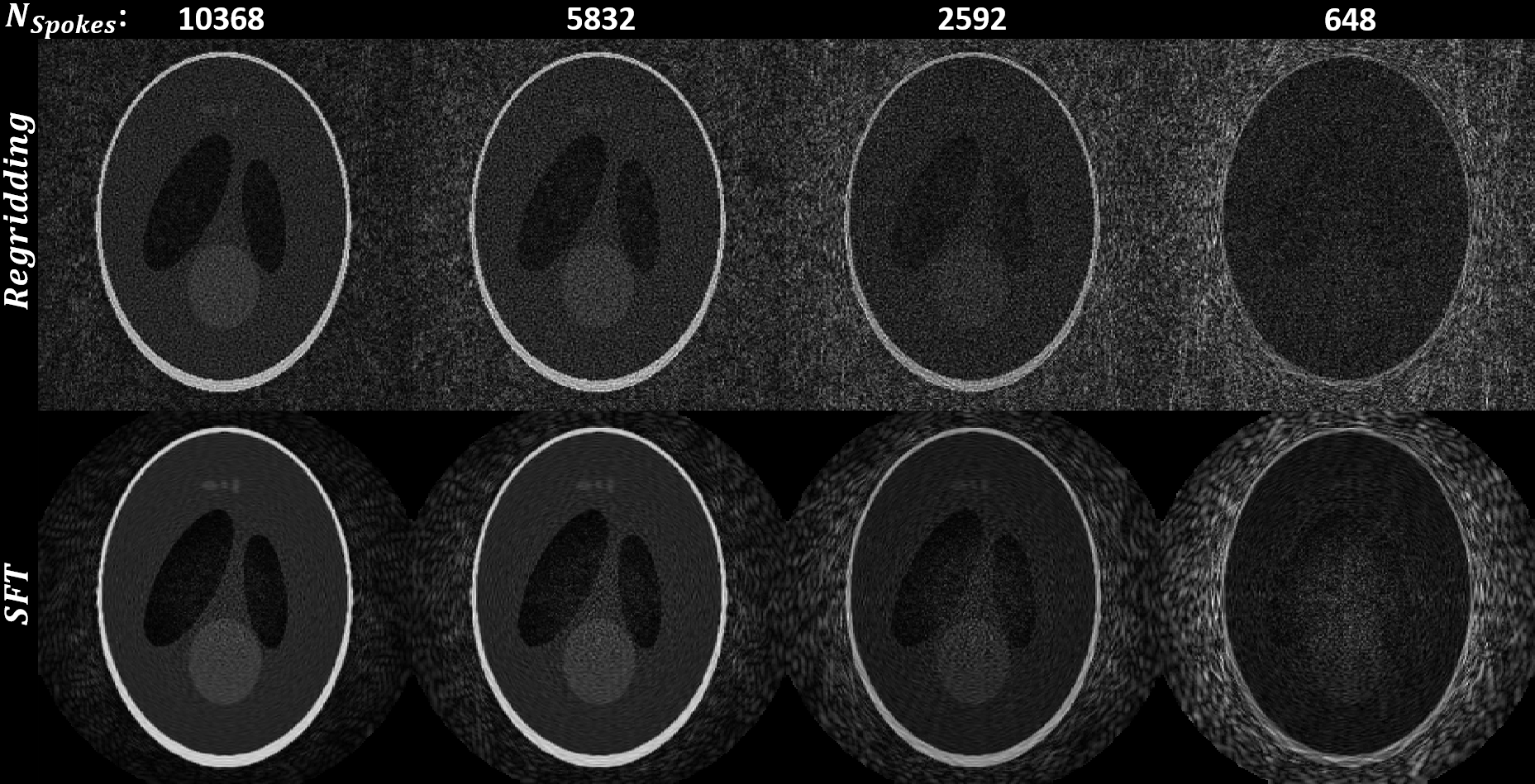
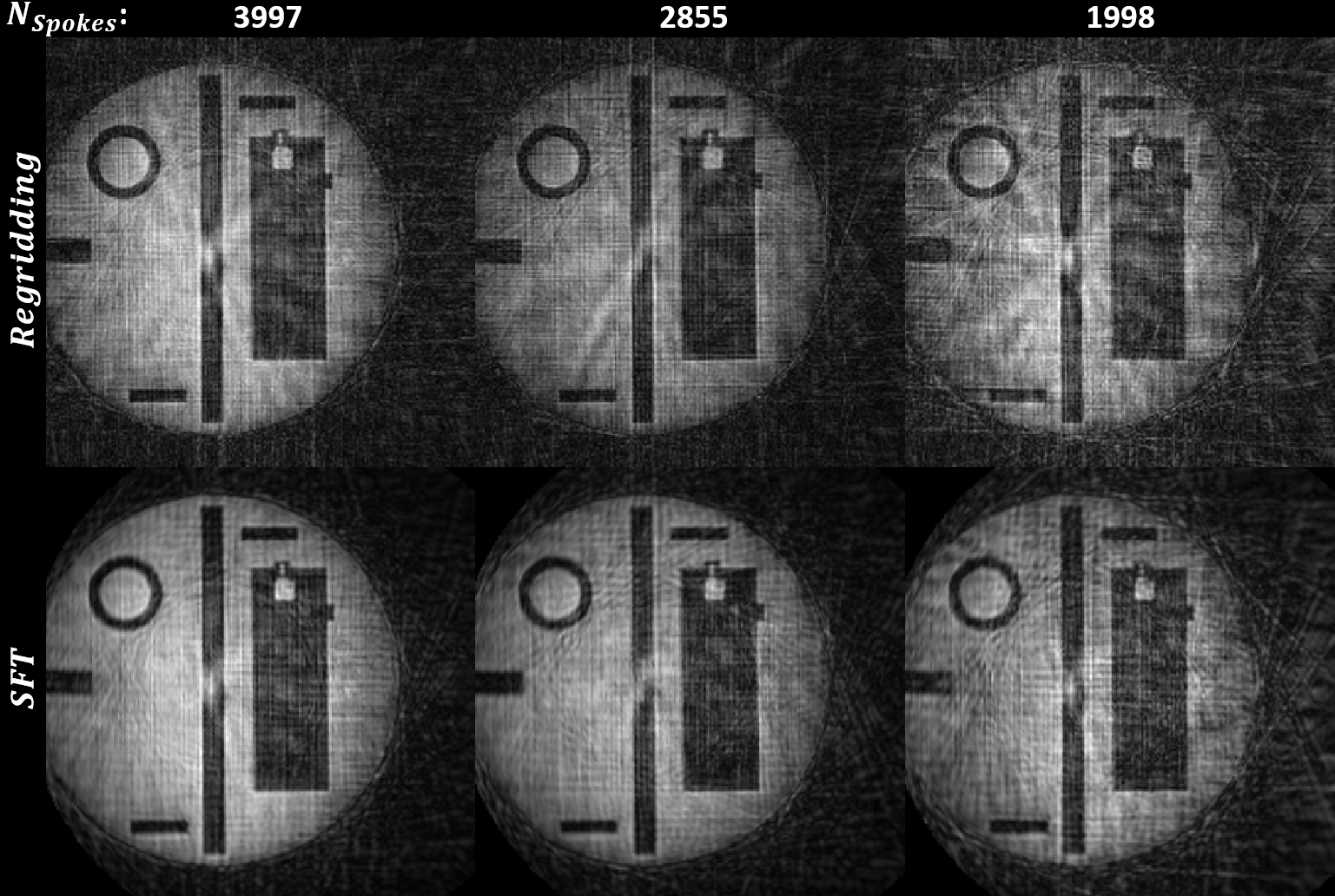
Simulated Phantom: The simulated 3D golden-angle radial data of the Shepp-Logan phantom were reconstructed by the spherical Fourier-Legendre transform with the different number of spokes including 10368, 5832, 2592 and 648. The degree of spherical harmonics is L=120. Figure 2 demonstrates the reconstructed images by the proposed method and the Gaussian kernel-based re-gridding for comparison. The SSIM quantitative metric of Shepp-Logan simulated phantom with 10368 spokes for Spherical Foureir-Legendre Transform is 0.4251 and for re-gridding mathod is 0.2805.In-vitro Phantom: The undersampled 3D spiral radial data of ACR phantom with 3997, 2855 and 1998 spokes were reconstructed by the proposed method and re-gridding and are represented in Figure 2.
Discussion and Conclusion
This study proposes a novel reconstruction method based on spherical Fourier-Legendre transform for any kind of 3D radial sampling pattern including 3D golden-angle and 3D spiral radial which reconstructs directly in the spherical coordinates without any frequency interpolation. The feasibility of the proposed method for reconstructing highly undersampled data is shown based on the higher SSIM compared to Gaussian kernel-based re-gridding algorithm. This method requires more evaluation and reconstructing the human real data and finding the optimal sampling pattern is our plan for future studies.Acknowledgements
No acknowledgement found.References
[1] L. Greengard and J.-Y. Lee, “Accelerating the nonuniform fast Fourier transform,” SIAM review, vol. 46, no. 3, pp. 443–454, 2004.
[2] Shafiekhani M, Ghodrati V, Nasiraei-Moghaddam A. A Novel Three-Dimensional k-Space Reconstruction Method by Spherical Fourier Transform.
[3] N. Baddour, “Operational and convolution properties of three-dimensional Fourier transforms in spherical polar coordinates,” JOSA A, vol. 27, no. 10, pp. 2144–2155, 2010.
Figures