1910
Explicit analytical solution for bSSFP with 3 general phase-cycled acquisitions1Physics, University of Washington, Seattle, WA, United States, 2Radiology, University of British Columbia, Vancouver, BC, Canada, 3Radiology and Biomedical Imaging, University of California, San Francisco, San Francisco, CA, United States
Synopsis
Keywords: Image Reconstruction, Image Reconstruction, Geometric demodulation, bSSFP, Phase-cycles, ellipse, elliptical signal model
Motivation: Unlocking the phase-cycled bSSFP system with high efficiency, accuracy, and flexibility.
Goal(s): To find and validate an explicit analytical solution to the bSSFP MRI framework using three general phase-cycled acquisitions.
Approach: Using the elliptical signal model and trigonometrical relationships, this study obtains explicit, general, and closed form expressions of an analytical solution to the bSSFP system with only 3 acquisitions. To reduce noise sensitivity, the solution was also linearized using regional optimal weighted averaging.
Results: Analytical results showed efficacy via validation by simulated data with noise covering all possible scan parameters.
Impact: Phase-cycled bSSFP imaging is becoming prominent, and has recently been analytically unlocked with only 3 acquisitions. This development will allow even more widespread use of the technique due to its associated multi-parametric capability.
Introduction
Balanced steady-state free precession (bSSFP) is an SNR-efficient imaging sequence that is regularly employed in various applications including cardiac, low field, and inner ear imaging. The development of the elliptical signal model (ESM) has enabled the potential realization of bSSFP quantitative parameter mapping, furthering its clinical value1. However, achieving effective banding artifact removal and parametric quantitation has thus far required the acquisition of at least four phase-cycled bSSFP images1, presenting a challenge for time-sensitive applications. Previously, a procedure to obtain an analytical solution that requires only three phase-cycled images has been described2, promising to further improve time efficiency. However, the final solution was not explicitly presented, and its effectiveness has only been demonstrated under noiseless scenarios using an equally-spaced phase-cycled angle setup $$$(0^\circ,120^\circ,240^\circ)$$$. Here we present an explicit closed-form solution to the bSSFP system with 3 general phase-cycled acquisitions. Our method is demonstrated for phase-cycled images acquired at angles of $$$(10^\circ,118^\circ,258^\circ)$$$, although potentially any three angles may be chosen due to the solution’s flexibility to the arbitrary selection of phase cycling increments.Methods
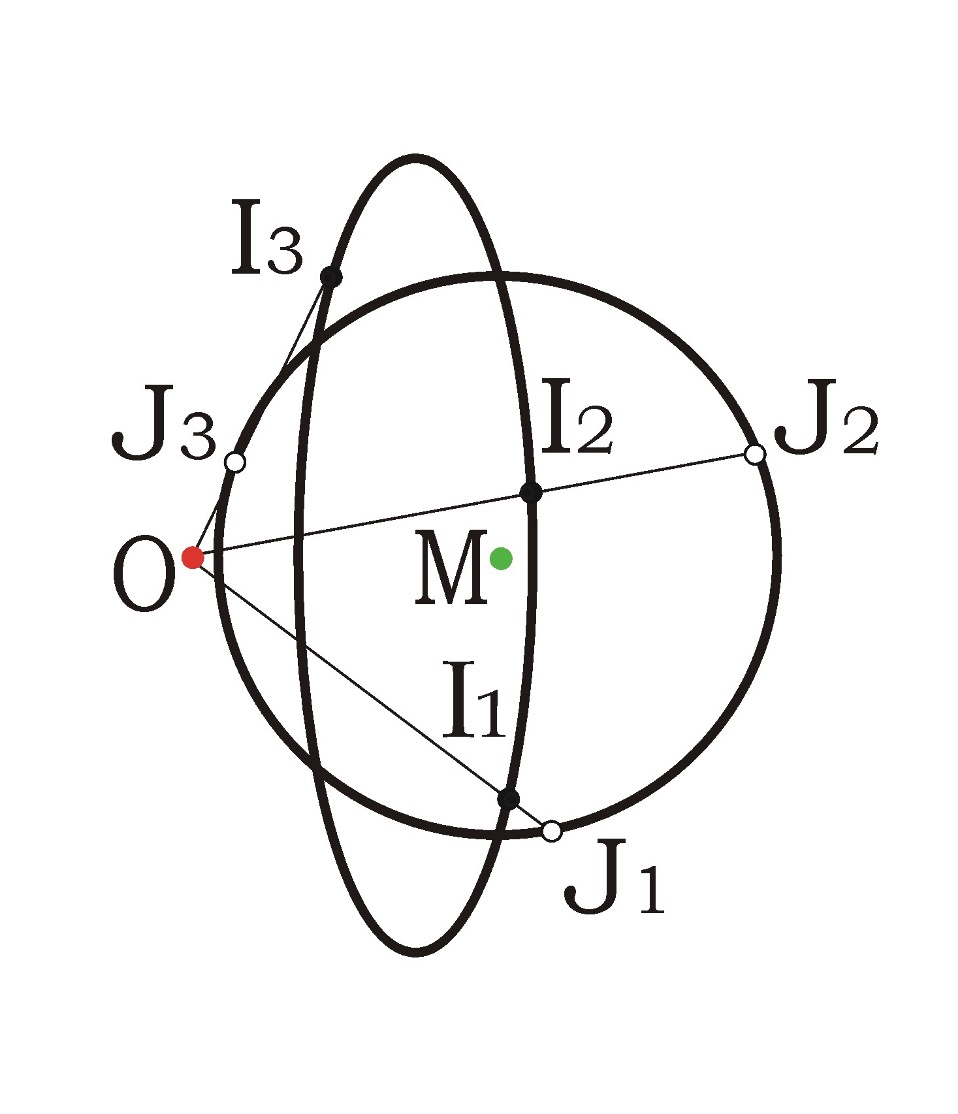
Theory:The ESM for bSSFP is described in Eq.(1) and depicted in Figure 1, with the tissue and imaging parameters $$$M_0,T_1,T_2,\alpha,$$$ and $$$TR$$$ grouped into the ESM parameters $$$M,a,b$$$:$$\begin{aligned}I_j&=M\frac{1-a\,e^{i(\theta+\psi_j)}}{1-b\cos(\theta+\psi_j)}e^{i\phi},\quad\,j=1,2,3\quad(1)\\E_1:&=\exp(-TR/T_1)\\E_2:&=\exp(-TR/T_2)\\a:&=E_2\\M:&=\frac{M_0(1-E_1)\sin\alpha}{1-E_1\cos\alpha-E_2^2(E_1-\cos\alpha)}\\b:&=\frac{E_2(1-E_1)(1+\cos\alpha)}{1-E_1\cos\alpha-E_2^2(E_1-\cos\alpha)}\end{aligned}$$
Here $$$\psi$$$ denotes arbitrary RF phase cycling increments, where $$$\psi_1,\psi_2,\psi_3$$$ represent three bSSFP acquisitions, and $$$\theta$$$ and $$$\phi$$$ respectively denote the off-resonant phase accumulation at TR and TE.
Previous work2 demonstrated that the demodulated magnetization $$$M$$$ may be determined by transformation of the signal ellipse to a J-circle formulation, which is defined by its center $$$M\,e^{i\phi}$$$, radius $$$Ma$$$ and is obtained through multiplication of $$$(1-b\cos(\theta+\psi_j))$$$ onto the elliptical bSSFP signal $$$I$$$:$$J_j=I_j(1-b\cos(\theta+\psi_j)),\quad\,j=1,2,3\quad(2)$$
Given that the relation between the three transformed points $$$J_1,J_2,J_3$$$ is guaranteed by the circular property:$$(J_3-J_2)E=(J_1-J_2)\quad(3)$$$$E=\frac{e^{i\psi_1}-e^{i\psi_2}}{e^{i\psi_3}-e^{i\psi_2}}\quad(4)$$
a linear system with 2 equations and 2 unknowns $$$(b\cos\theta,b\sin\theta)$$$ is deduced.
Solving the linear system then yields the following closed form solution for $$$(b\cos\theta,b\sin\theta)$$$:
$$\begin{aligned}b\cos\theta&=\frac{\mathrm{Im}\left[\cos\frac{\psi_1+\psi_2}{2}I_1^*I_2e^{i\frac{\psi_1-\psi_2}{2}}+\cos\frac{\psi_1+\psi_3}{2}I_3^*I_1e^{i\frac{\psi_3-\psi_1}{2}}+\cos\frac{\psi_2+\psi_3}{2}I_2^*I_3e^{i\frac{\psi_2-\psi_3}{2}}\right]}{\mathrm{Im}\left[\cos\frac{\psi_1-\psi_2}{2}I_1^*I_2e^{i\frac{\psi_1-\psi_2}{2}}+\cos\frac{\psi_3-\psi_1}{2}I_3^*I_1e^{i\frac{\psi_3-\psi_1}{2}}+\cos\frac{\psi_2-\psi_3}{2}I_2^*I_3e^{i\frac{\psi_2-\psi_3}{2}}\right]}\\b\sin\theta&=-\frac{\mathrm{Im}\left[\sin\frac{\psi_1+\psi_2}{2}I_1^*I_2e^{i\frac{\psi_1-\psi_2}{2}}+\sin\frac{\psi_1+\psi_3}{2}I_3^*I_1e^{i\frac{\psi_3-\psi_1}{2}}+\sin\frac{\psi_2+\psi_3}{2}I_2^*I_3e^{i\frac{\psi_2-\psi_3}{2}}\right]}{\mathrm{Im}\left[\cos\frac{\psi_1-\psi_2}{2}I_1^*I_2e^{i\frac{\psi_1-\psi_2}{2}}+\cos\frac{\psi_3-\psi_1}{2}I_3^*I_1e^{i\frac{\psi_3-\psi_1}{2}}+\cos\frac{\psi_2-\psi_3}{2}I_2^*I_3e^{i\frac{\psi_2-\psi_3}{2}}\right]}\quad(5)\end{aligned}$$
Once the transformed $$$J$$$-circle points $$$J_1,J_2,J_3$$$ are obtained, arithmetic manipulation allows solution for the point $$$M$$$ at the $$$J$$$-circle center. Notice that the point $$$M$$$ can also be interpreted as the circumcircle center of triangle $$$\triangle\,J_1J_2J_3$$$, suggesting that the coordinates of $$$M$$$ can be expressed through linear combination of $$$J_1,J_2,J_3$$$. The solution may then be found using barycentric coordinates of the triangle $$$\triangle\,J_1J_2J_3$$$ as follows:$$\begin{aligned}M\,e^{i\phi}&=\frac {W_{J1}J_1+W_{J2}J_2+W_{J3}J_3}{W_{J1}+W_{J2}+W_{J3}}\\W_{J1}&=\sin(\psi_3-\psi_2),\quad\,W_{J2}=\sin(\psi_1-\psi_3),\quad\,W_{J3}=\sin(\psi_2-\psi_1)\quad(6)\end{aligned}$$
This gives us the implicit solution for $$$M$$$ with arbitrary phase-cycled angles $$$\psi_1,\psi_2,\psi_3$$$. Using Eq.(2), (5) and (6), the closed-form solution for $$$M$$$ in terms of $$$I_1, I_2, I_3$$$ is expressed as follows:$$\begin{aligned}M\,e^{i\phi}&=\frac{W_{I1}I_1+W_{I2}I_2+W_{I3}I_3}{W_{I1}+W_{I2}+W_{I3}}\\W_{I1}&=\cos\left(\frac{\psi_2-\psi_3}{2}\right)\left(I_2^*I_3e^{i\frac{\psi_2-\psi_3}{2}}-I_2I_3^*e^{-i\frac{\psi_2-\psi_3}{2}}\right)\\W_{I2}&=\cos\left(\frac{\psi_3-\psi_1}{2}\right)\left(I_3^*I_1e^{i\frac{\psi_3-\psi_1}{2}}-I_3I_1^*e^{-i\frac{\psi_3-\psi_1}{2}}\right)\\W_{I3}&=\cos\left(\frac{\psi_1-\psi_2}{2}\right)\left(I_1^*I_2e^{i\frac{\psi_1-\psi_2}{2}}-I_1I_2^*e^{-i\frac{\psi_1-\psi_2}{2}}\right)\quad(7)\end{aligned}$$
Validation:
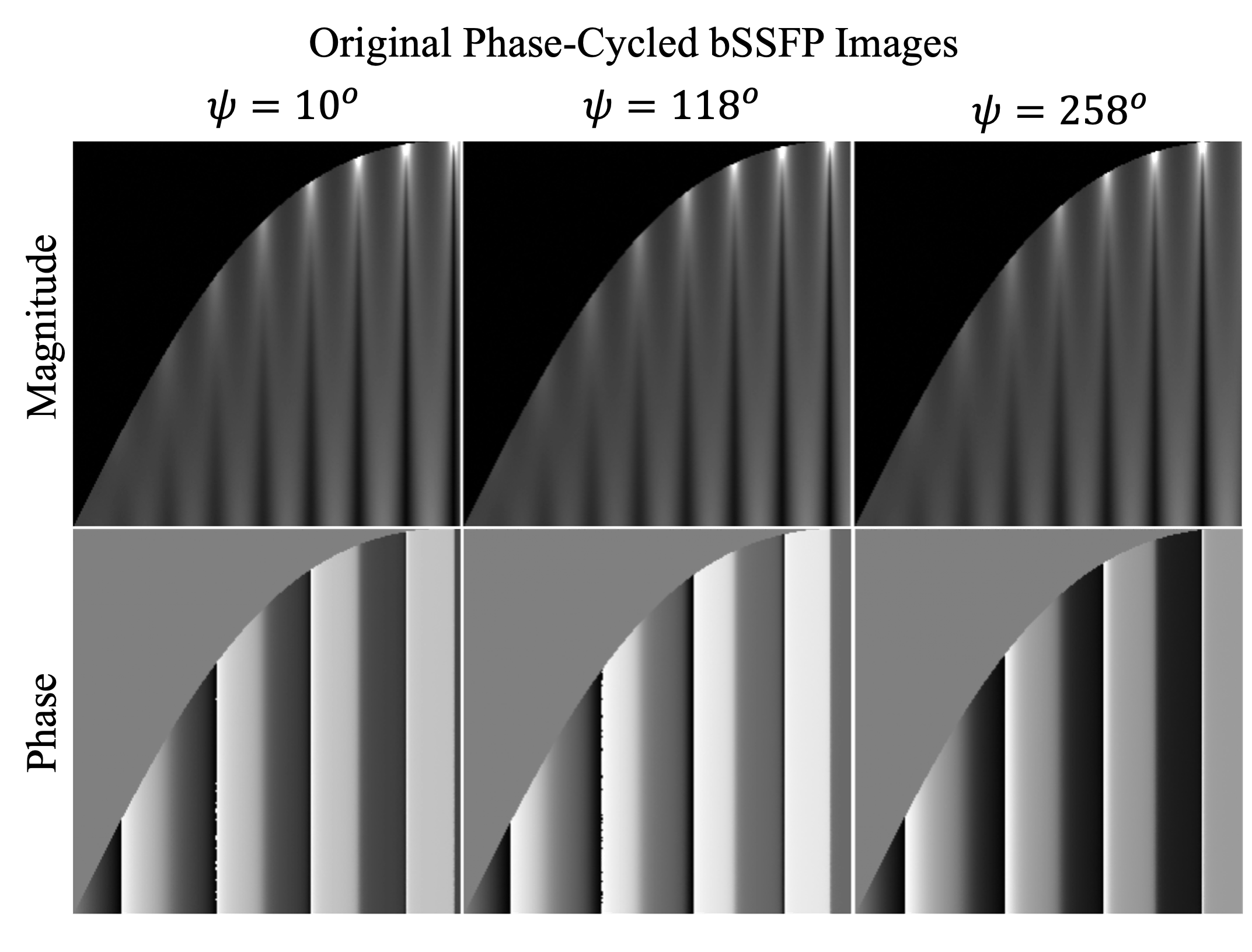
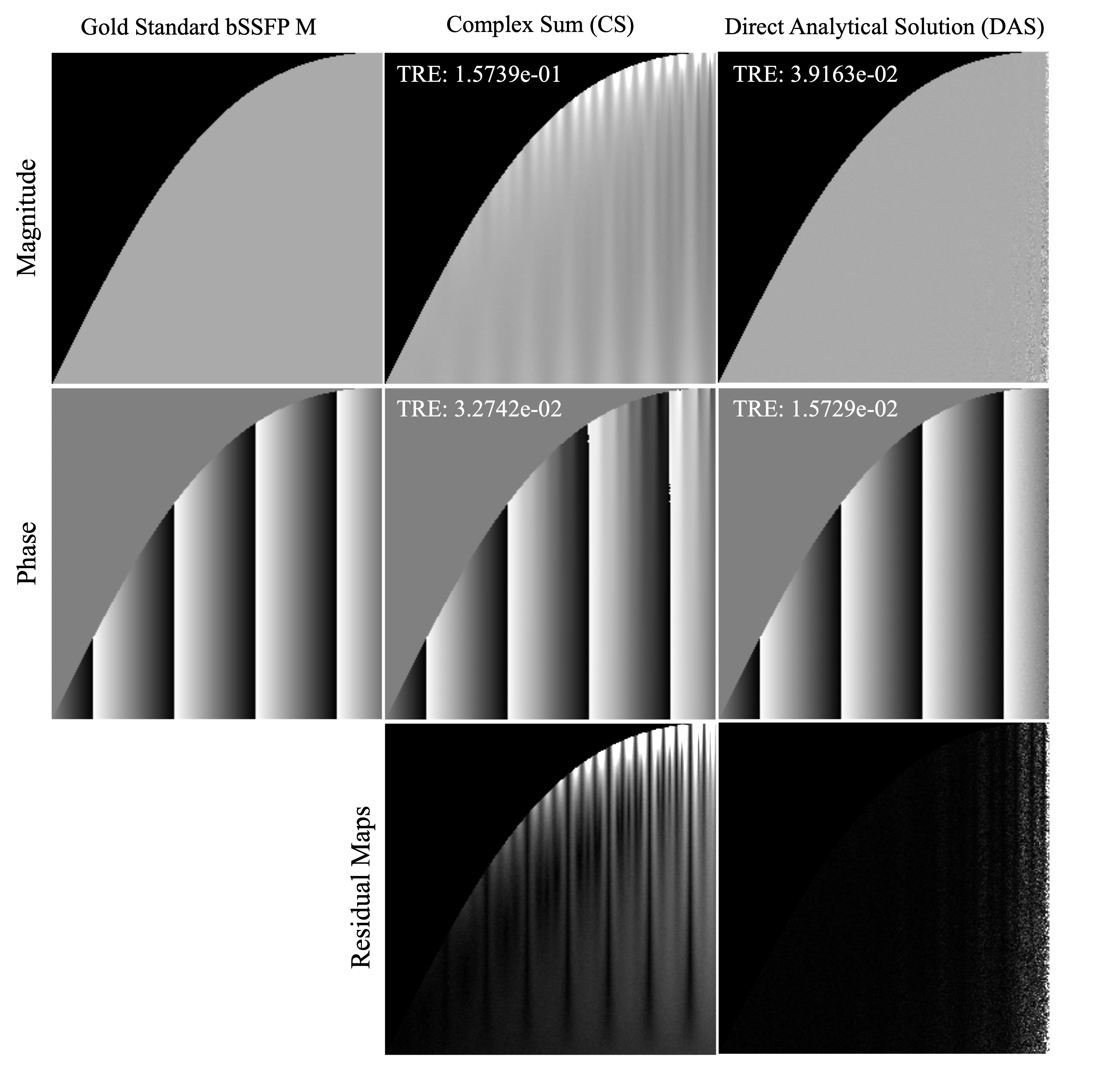
Three phase-cycled bSSFP images with arbitrary phase-cycling increment $$$\psi=10^\circ,118^\circ,$$$ and $$$258^\circ$$$ respectively were generated for simulations. All possible tissue properties and imaging conditions were covered by ESM parameters $$$a,b$$$ both within the realizable range of [0,1] and the real-world limitation defined by $$$b<\frac{2a}{1+a^2}$$$. Bivariate Gaussian noise at 2% of the mean signal intensity was added. The solution for the demodulated magnetization $$$M$$$ was then computed pixel-wise, compared with the complex sum (CS) solution and evaluated with total relative error (TRE) analysis3.
Results
Figure 2 depicts the three simulated bSSFP signal images. Figure 3 shows the simulated ground truth M, the complex sum (CS), and the proposed direct analytical solution (DAS) magnitude and phase images, followed by residual maps. Figure 3 shows that both DAS magnitude and phase TRE values are lower than those of the CS solution. The CS suffers from band sensitivity while the DAS exhibits higher accuracy and resilience near banding locations in the source images.Discussion
The closed-form DAS to the bSSFP system has been demonstrated with only three phase-cycled acquisitions at arbitrary-angles. The simulation shows that DAS is exact with noiseless data. With noise introduced, DAS manifests good accuracy over most possible tissue and imaging parameters. The DAS phase faithfully recovers the contrast of the ground truth, indicating potential for field mapping with only 3 bSSFP acquisitions. Future work will entail algorithmic improvements and refinements to extend the application to real data, including effective regularization and optimal selective design of phase cycle angles.Conclusion
An explicit closed form analytical solution to demodulate bSSFP images with arbitrary 3 phase-cycled angles is developed and regularized with a linearization approach using regional information, inspiring novel future qualitative and quantitative applications of rapid bSSFP imaging.Acknowledgements
No acknowledgement found.References
[1] Xiang QS, Hoff MN. Banding artifact removal for bSSFP imaging with an elliptical signal model. Magn Reson Med. 2014;71:927–933.
[2] Xiang QS, General Analytical Solution for Phase-Cycled bSSFP with Three Acquisitions, Joint Annual Meeting for ISMRM-ESMRMB, Program # 4066, 2022.
[3] Chang Z, Xiang Q-S. Highly accelerated MRI by skipped phase encoding and edge deghosting with array coil enhancement (SPEEDACE). Med Phys 2006;33:3758.
Figures