1905
Improved Region-Optimized Virtual Coils for Cartesian Acquisition Geometries1Signal and Image Processing Institute, Ming Hsieh Department of Electrical and Computer Engineering, University of Southern California, Los Angeles, CA, United States, 2Cardiovascular Innovation Research Center, Heart, Vascular, and Thoracic Institute, Cleveland Clinic, Cleveland, OH, United States
Synopsis
Keywords: Image Reconstruction, Image Reconstruction, accelerated acquisition, beamforming, reduced field-of-view imaging, signal suppression, region-optimized virtual coils, coil compression
Motivation: ROVir (Region-Optimized Virtual coils) is a technique that constructs MRI virtual coils in a way that seeks to simultaneously maximize the amount of information captured by the smallest number of virtual coils (coil compression/dimensionality reduction) while also suppressing signal from undesired spatial regions (avoiding aliasing/leakage artifacts). Although ROVir generally performs well, its performance can sometimes be limited by coil geometry.
Goal(s): To improve the performance of ROVir.
Approach: We exploit the structure of Cartesian imaging, calculating distinct ROVir weights for each position along the fully-sampled readout.
Results: The proposed approach enables substantially better dimensionality reduction and signal suppression performance.
Impact: The proposed approach provides substantially better signal suppression and coil compression for Cartesian acquisitions, alleviating burdens on data acquisition (reducing the need for sequence-based signal suppression and enabling reduced-FOV imaging) and reducing the computational complexity of image reconstruction.
Introduction
Modern MRI experiments frequently use large multichannel receiver arrays for better SNR and improved spatial encoding capabilities. However, storing and processing a large number of channels can be computationally burdensome. Several coil compression techniques have been proposed to mitigate this problem.1-3 These approaches construct a small number of virtual coils through linear combinations of the original channels, and the SVD can be used to calculate optimal coil-combination weights that maximize preserved signal energy.1-3Recently, the Region-Optimized Virtual (ROVir) coil approach4,5 has demonstrated that virtual coils can be formed that suppress user-specified spatial regions within the FOV while still achieving coil compression. ROVir can be useful for a wide range of applications,6-10 because it can suppress signals that would otherwise cause artifacts/aliasing. Moreover, ROVir can be applied in post-processing, without requiring modifications to the pulse sequence or acquisition protocol.
While ROVir generally performs well, its coil compression and signal suppression performance can be limited if the array geometry is non-ideal for capturing desired spatial regions of interest (ROIs) or suppressing undesired regions of non-interest (nROIs) from the FOV. This limitation is also present in standard coil compression and has been partially solved by a geometric approach. Geometric coil compression (GCC)3 takes advantage of the fact that, in Cartesian imaging, the readout dimension is fully-sampled. This enables decoupling of the different spatial positions along the readout dimension, allowing coil compression to be performed separately for each line of the image and enabling improved performance.
In this work, we propose and evaluate a line-by-line ROVir approach, which combines the signal suppression capabilities of ROVir with the Cartesian decoupling principles from GCC.
Methods
For simplicity, we will focus on the 2D case. Consider an array of $$$N_c$$$ receiver channels, with corresponding k-space data $$$d_\ell(k_x,k_y)$$$ for $$$\ell=1,\ldots,N_c$$$. Virtual coil methods convert such data into a smaller number $$$N_\nu$$$ of virtual coils $$$v_j(k_x,k_y)$$$ for $$$j=1,\ldots,N_\nu$$$ using linear combinations of the form $$v_j(k_x,k_y)=\displaystyle{\sum_{l=1}^{N_c}w_{\ell j}d_\ell(k_x,k_y)}.$$ In ROVir,4,5 the coil combination weights $$$w_{\ell j}$$$ are chosen to be orthonormal and maximize a signal-to-interference ratio (SIR), which balances the maximization of signal (the amount of energy captured by the virtual coils in ROIs) against the minimization of interference (the amount of energy from nROIs). The SIR objective is easily optimized using generalized eigendecompositions.4,5In Cartesian MRI, a Fourier transform along the readout dimension can be used to decouple the reconstruction of a 2D image into a series of 1D problems,11,12 and leads to hybrid data of the form $$$d_\ell(x,k_y)$$$ for $$$\ell=1,\ldots,N_c$$$. GCC makes the observation that this decoupling allows the use of coil combination weights $$$w_{\ell j}(x)$$$ that are a function of the spatial position $$$x$$$ along the readout,3 with $$v_j(x,k_y)=\displaystyle{\sum_{l=1}^{N_c}w_{\ell j}(x) d_\ell(x,k_y)}.$$ In line-by-line ROVir, we adopt this same approach, and choose spatially-varying weights $$$w_{\ell j}(x)$$$ that seek to optimize the SIR for the 1D spatial line at position $$$x$$$. Because it is much easier to compress ROI information and suppress undesired nROI energy for a single 1D line than for the entire 2D image, this approach offers substantially improved performance over conventional ROVir.
Results
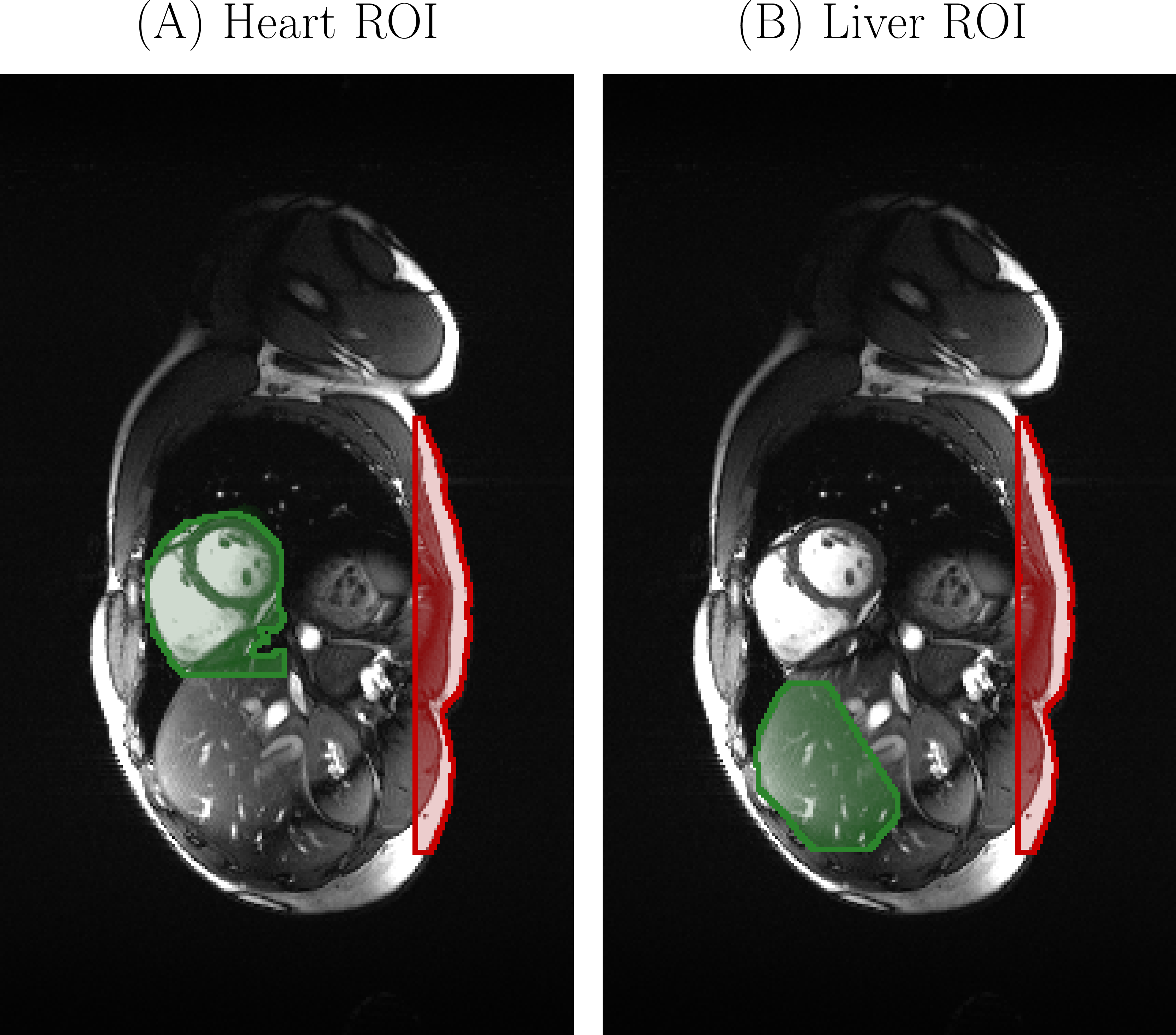
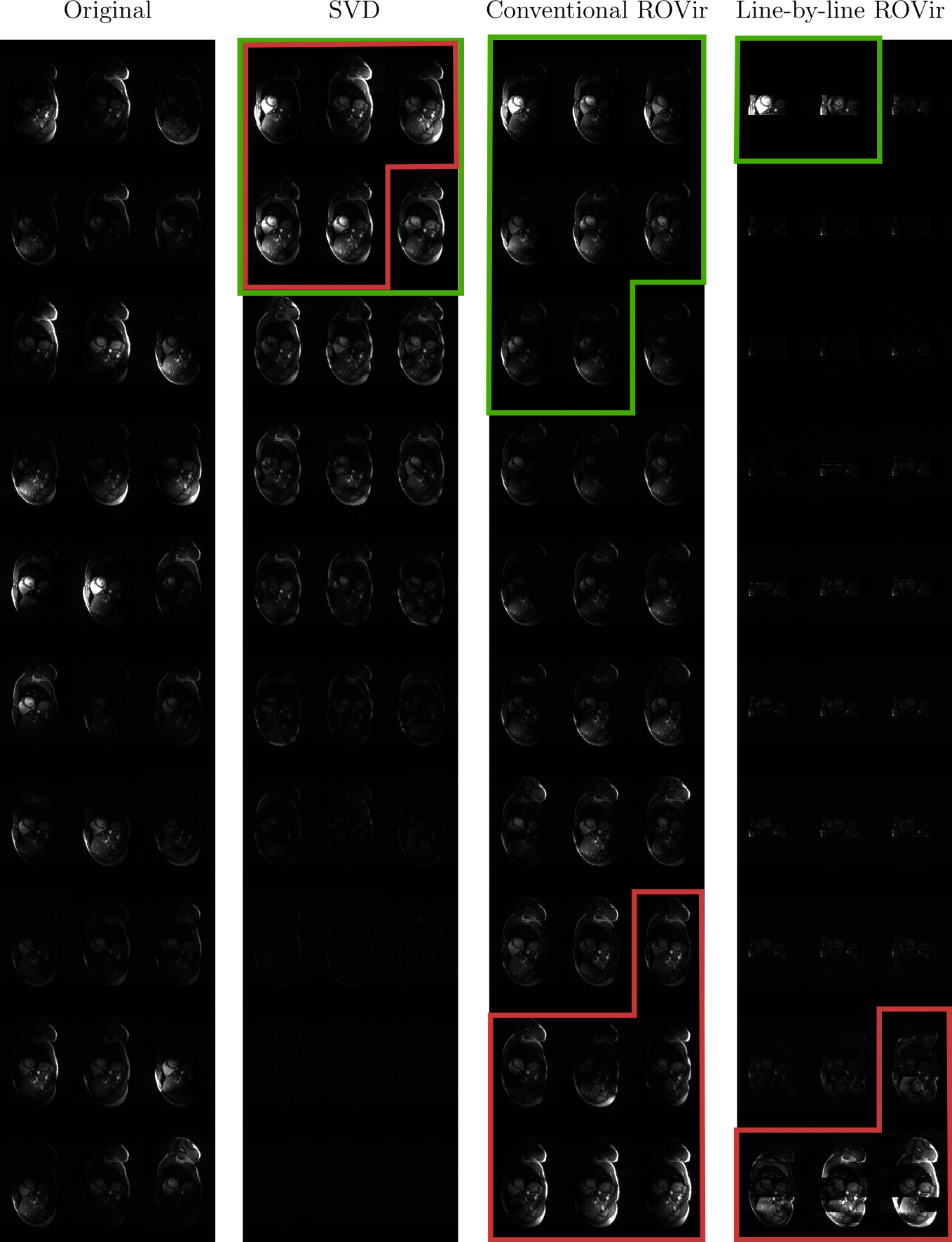
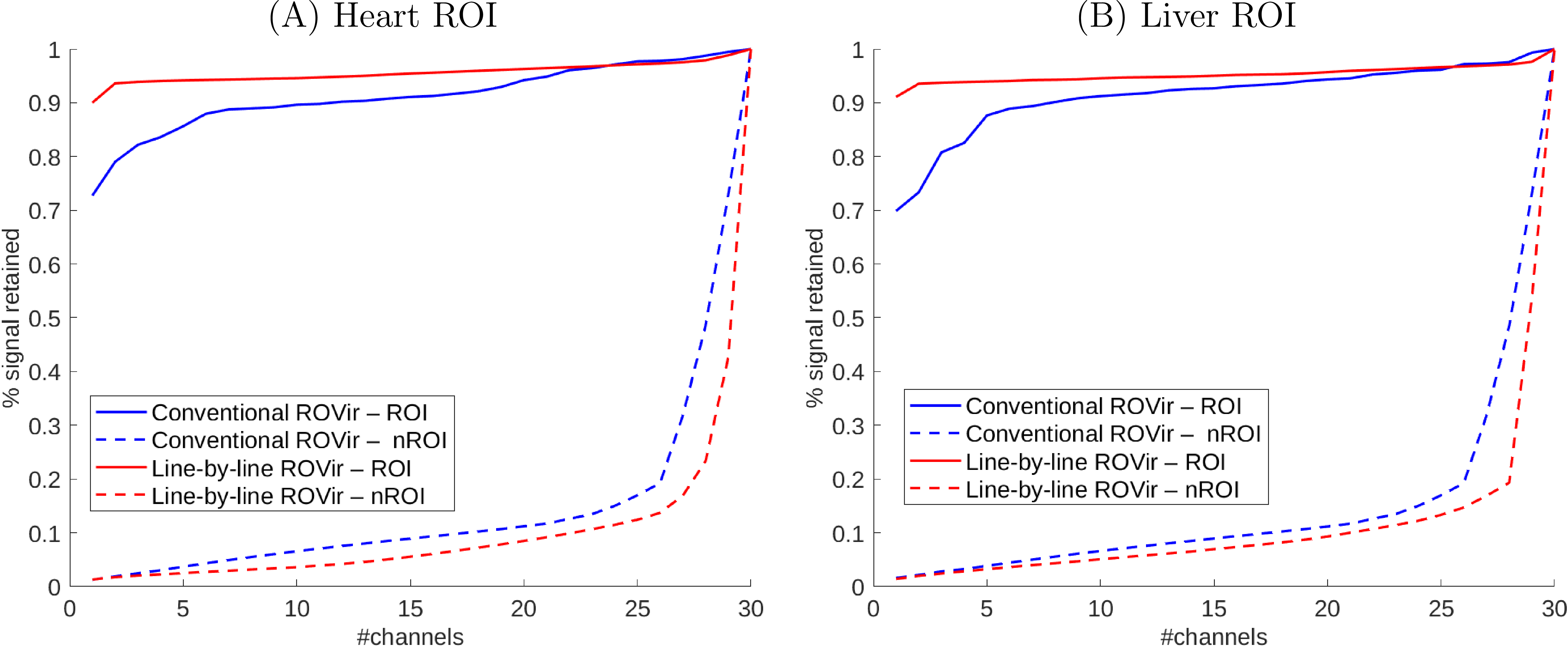
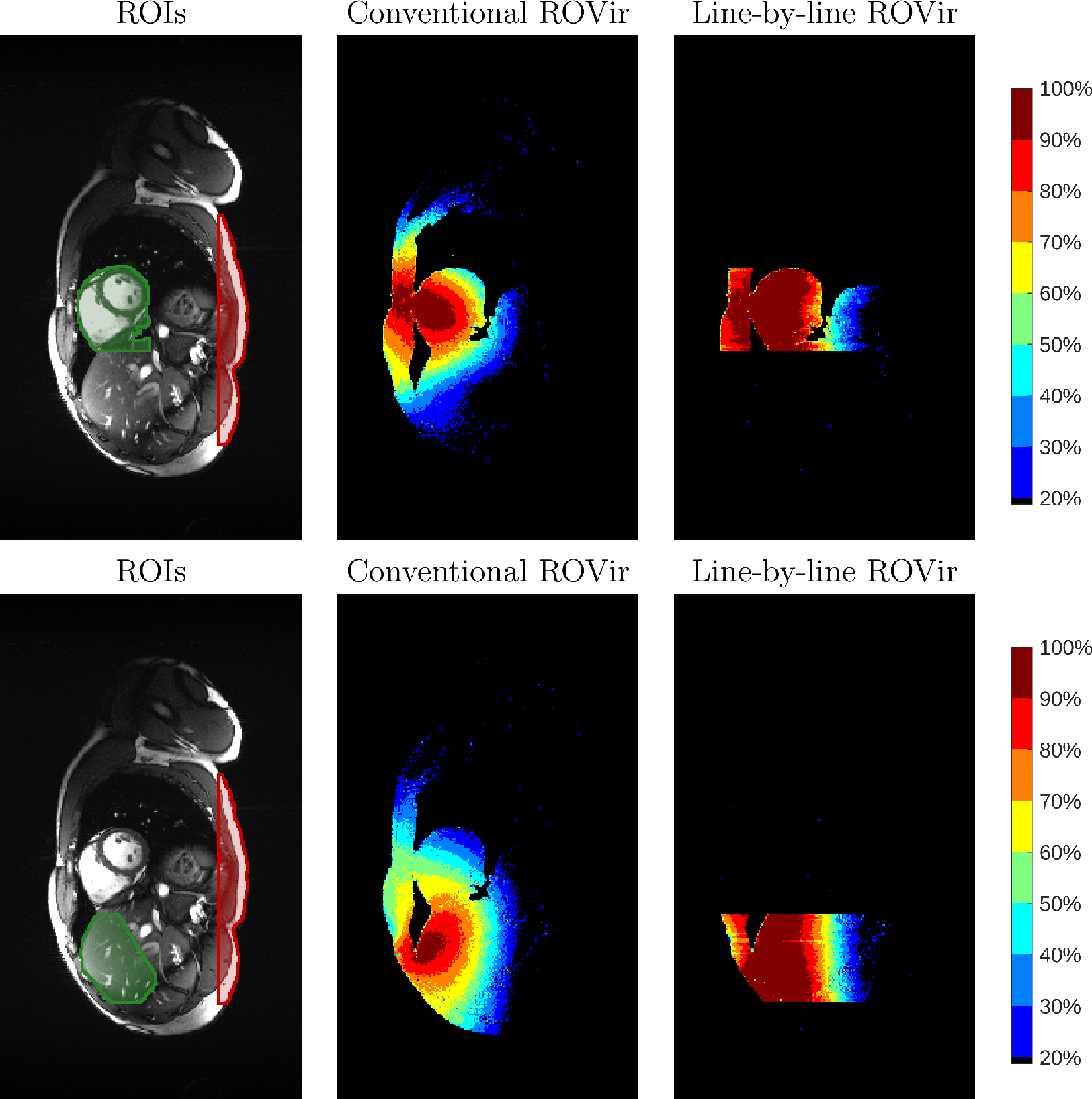
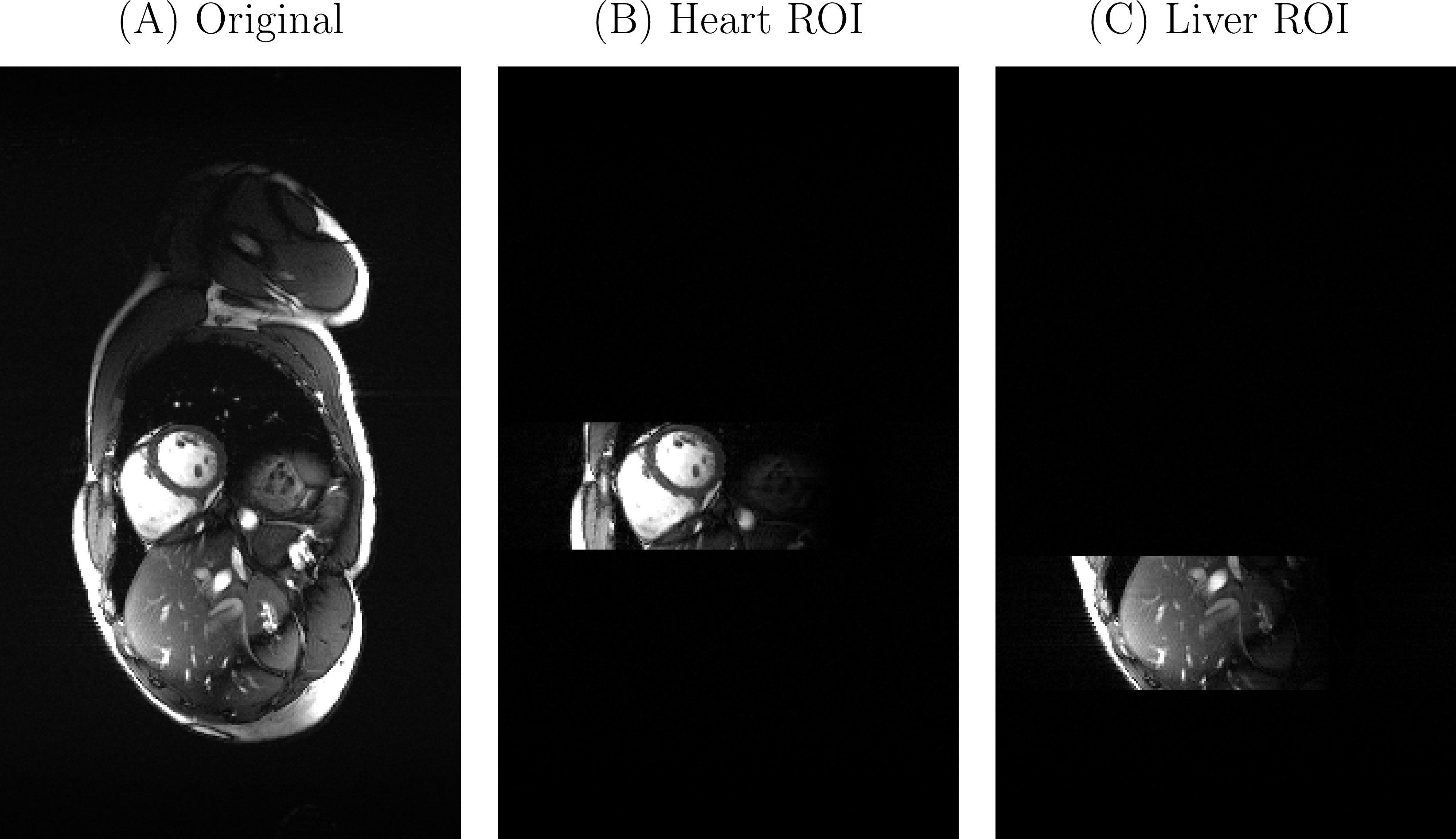
We evaluated line-by-line ROVir using 30-channel data and targeting two different organs, as shown in Figure 1. In one case, the ROI was focused on the heart and an nROI was drawn to suppress subcutaneous fat signal that would alias with a small-FOV acquisition.4,6 In the other case, the ROI was focused on the liver instead of the heart.Figure 2 shows the virtual coils obtained for the heart ROI. As can be seen, line-by-line ROVir is substantially better than ROVir at compacting energy from the heart ROI into a small number of virtual channels, and is also quite effective at separating the undesired subcutaneous fat. Figure 3 shows this quantitatively, where we observe that line-by-line ROVir is consistently better than ROVir at capturing more ROI signal in a smaller number of channels while also rejecting more nROI interference. Figure 4 shows the spatial distribution of retained signal energy, where we again see that compared to conventional ROVir, the new line-by-line approach captures a larger percentage of the desired ROI and a smaller percentage of the undesired nROI at most spatial positions. Figure 5 demonstrates that line-by-line ROVir could enable highly-reduced FOVs.
Conclusions
We proposed an improved line-by-line version of ROVir for Cartesian imaging that chooses different coil combinations for different positions along the fully-sampled readout dimension. The approach is easy to implement, and demonstrates improved performance relative to conventional ROVir. We expect that line-by-line ROVir will prove useful across a wide range of Cartesian imaging applications.Acknowledgements
This work was supported in part by NIH research grants U01-HL167613, and R01-MH116173, the USC Provost's Strategic Directions for Research Award, a USC Viterbi/Graduate School Fellowship, and computing resources from the USC Center for Advanced Research Computing.References
[1] Buehrer M, Pruessmann KP, Boesiger P, Kozerke S. Array compression for MRI with large coil arrays. Magn Reson Med 2007;57:1131-1139.
[2] Huang F, Vijayakumar S, Li Y, Hertel S, Duensing GR. A software channel compression technique for faster reconstruction with many channels. Magn Reson Imaging 2008;26:133-141.
[3] Zhang T, Pauly JM, Vasanawala SS, Lustig M. Coil compression for accelerated imaging with Cartesian sampling. Magn Reson Med 2013;69:571-582.
[4] Kim D, Cauley SF, Nayak KS, Leahy RM, Haldar JP. Region-Optimized Virtual (ROVir) Coils: Localization and/or Suppression of Spatial Regions using Sensor-Domain Beamforming. Magn Reson Med 2021;86:197-212.
[5] Haldar JP. On Optimality in ROVir. arXiv:2307.11258.
[6] Kim D, Coll-Font J, Lobos RA, Stab D, Pang J, Foster A, Garrett T, Bi X, Speier P, Haldar JP, Nguyen C. Single breath-hold CINE imaging with combined simultaneous multislice and region-optimized virtual coils. Magn Reson Med 2023;90:222-230.
[7] Jin R, Li Y, Shosted RK, Xing F, Gilbert I, Perry JL, Woo J, Liang Z-P, Sutton BP. Optimization of 3D dynamic speech MRI: Poisson-disc undersampling and locally higher-rank reconstruction through partial separability model with regional optimized temporal basis. Magn Reson Med 2023. Early View.
[8] Lam F, Li Y, Zhao Y, Haldar JP. Improving lipid suppression for 1H-MRSI using region-optimized virtual coils. ISMRM 2022, p. 2621.
[9] Piek M, Toger J, Hedstrom E, Aletras AH. Fetal 3D cine cardiovascular MRI: Improved image quality with region-optimized virtual coils. ISMRM 2023, p. 1246.
[10] Sorland KI, Trimble CG, Bathen TF, Elschot M, Cloos MA. Reducing femoral flow artefacts in radial MR fingerprinting: A comparison of two methods applied to prostate imaging. ISMRM 2023, p. 2356.
[11] Kyriakos WE, Panych LP, Kacher DF, Westin C-F, Bao SM, Mulkern RV, Jolesz FA. Sensitivity profiles from an array of coils for encoding and reconstruction in parallel (SPACE RIP). Magn Reson Med 2000;44:301-308.
[12] Brau ACS, Beatty PJ, Skare S, Bammer R. Comparison of reconstruction accuracy and efficiency among autocalibrating data-driven parallel imaging methods. Magn Reson Med 2008;59:382-395.
Figures